By Lachlan Carmichael - CAIRO
Across a vast swathe of land from North Africa
to the Gulf, signs abound that the Internet is taking root in
Arab cities.
From Casablanca to Dubai, via Cairo, Amman, and
Beirut, there are now thousands of Arab businesses with
websites, hundreds of ISPs and Internet cafes, as well as a
host of dot.coms, and Internet-enabling software firms.
A few firms have attracted millions of dollars
in foreign investment in addition to Arab start-up
capital.
Yet, unlike in the United States, Europe and
Asia, an Arab Internet economy remains in its infancy, with
government and businesses needing to do more to nurture it,
according to analysts, businessmen and government
officials.
Such an economy "will grow rapidly by itself
providing the fundamental infrastructure and legislation are
in place," Nicholas Smith, Vice President of US-based Gartner
consultants, said while visiting Cairo late last month.
Already, "the pace of development is
increasing," said the executive with the Connecticut-based
firm.
The United Arab Emirates (UAE), Egypt, Lebanon
and Jordan are leading the way by starting to lay the legal
and banking foundations and investing in telecommunications
and education, Smith said.
The laggards were Syria and the oil-rich Gulf
states of Saudi Arabia, Bahrain, Kuwait and Qatar, according
to the survey Gartner conducted for California-based Cisco
Systems, a leader in networking for the Internet.
Internet Service Providers (ISPs) and others in
the Gulf who were questioned by Gartner worried that their
"government was still more concerned about the dangers than it
was about the opportunities," Smith said.
Smith said Arabs were increasingly using the
Internet for e-mail, obtaining information, and even shopping
for books, music CDs, computers and travel.
The Arabic-English web portal Ajeeb.com said
last month that more than 3.5 million of the estimated 240
million people in the Arab world are logging on to the
Internet, led by computer-savvy Emiratis in Dubai and Abu
Dhabi.
But Arabs were using the Internet much less for
banking transactions and there were few examples of firms
businesses dealing with each other on-line such as a factory
with its suppliers, Gartner said.
Jordan, by its own and independent accounts, is
heading in the right direction.
Fawaz Zu'bi, Jordan's minister of post and
communications, said during a visit to Cairo last month that
his government has adopted "a very aggressive approach to
prepare the environment so business can say 'let's go to
Jordan."
For starters, a 40-percent stake of state-run
Jordan Telecom was sold a year ago to strategic investor
France Telecom in a move which helps improve the Internet
infrastructure.
Egyptian businessmen complained privatization of
the state monopoly Telecom Egypt keeps getting postponed.
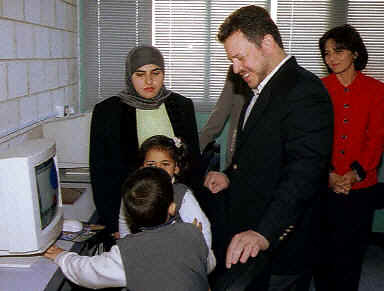
Both Jordan and Egypt have invested large sums
in computer education.
Since per capita income is low in Jordan and
throughout the region, Amman was trying to make access to
computers and the Internet affordable, and was studying a plan
to provide financing through state-run banks, Zu'bi said.
"What's going to make the real jump is
affordability," said Zu'bi while attending a recent conference
on information technology in Cairo. "Without this happening,
the Internet is not going to take off."
Gartner did not survey the North African
countries of Morocco, Algeria, Tunisia and Libya.
However, analysts say the Moroccan government is
a leading promoter of the Internet by selling a 35-percent
stake in state telephone monopoly Maroc Telecom to global
player Vivendi and by allowing competition among ISPs.
Casablanca, Morocco's business hub, is where
most of the action is, though Internet firms tend to prefer to
provide content or develop software in French rather than
Arabic, Upline Securities Managing Director Aisha Tadimi
said.
Meanwhile, millions of dollars in investment --
a trickle by western standards -- is coming into the
region.
The Internet and e-mail provider Africa Online
bought the Egyptian ISP MenaNet Communications SAE for 8.7
million dollars, it was announced here in February.
In September last year, Al-Bawaba, a
Jordan-based new Arabic Internet portal, was launched with a
promise to be the Middle East's "largest souk" for business,
news, e-mail, chats and shopping.
Start-up capital was 8.15 million dollars,
including three million from New York-based Tower Hill Capital
and 3.15 million dollars from Frankfurt-based TFG Venture
Capital, according to Al-Bawaba founder Hani Jabsheh.
Jabsheh admitted that raising the capital was
easier last year because it was before the dot.com meltdown on
the US and world markets and warned that only those Arab
entrepreneurs with a "sound business model will survive"
now.
Mustafa Abdel Wadood, managing director of Sigma
Capital which advised MenaNet in its deal with Africa Online,
said his is among a handful of venture capital firms in Egypt
targeting a small but budding Internet business.
He estimates his company would take a whole year
to spend its 15 million dollars in funds on six or seven
proposals.