 |
Mrs Leila Ben Ali
chairs opening of second Arab forum on "Women and
politics"
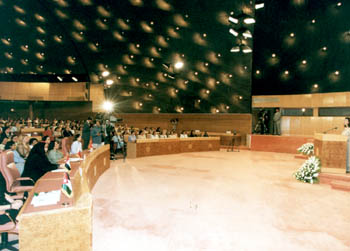
Tunis, May 31-- Mrs Leïla Ben Ali, Tunisia's first lady,
chaired today the opening
session of the second Arab forum on ''women
and politics'' held in Tunis under the topic, '' the political
contribution of Arab women to democracy and development.''
The
two-day forum which was decided by the first Arab women's summit held in
Cairo last November is expected to prepare the ground for the next Arab
women's summit scheduled for November 2001.
In her address, Mrs
Leïla Ben Ali said, political action is one of the fundamental attributes
of citizenship and of moral commitment to serve the national community. It
is also a contributionto the management of public affairs and to the
building of democracy.
Mrs Ben Ali said, "the attention that
has, for some time, been paid by political leaders and intellectual elite
to the issue of women as well as the degree of awareness and
clear-sightedness evidenced in the presentation of this issue, and in the
way it has been addressed, she said, are testimony of the intellectual
resurgence under way within our Arab societies, in the early days of the
third millennium.''
Mrs Leila Ben Ali stressed the need to
eliminate all forms of discrimination against women, whether within the
family, in the workplace, in social, economic, and political activities,
or in the media, adding "it is only fair that men and women enjoy the same
rights and have the same duties".
She pointed up that this forum is
called upon to develop an approach as
well as practical programmes
aimed at consolidating the presence of Arab women
in political life, in
institutions, elected bodies, and in the various components of civil
society.
Mrs Leila Ben Ali underscored the importance of developing
a common Arab
plan of action aimed at establishing the rights of women
both in legislation and in practice, based on clear programs aimed at
changing mindsets.
Mrs Ben Ali underlined the progress made by
Tunisian women in terms of
political particiapation especially since
the change of November 7,
1987. She stressed the widening presence of
women in national and local
elected bodies, including the Chamber of
deputies (Parliament) where
women hold 11.5 % of the seats (up from 7%
in 1994) and the municipal
councils where the hold 20.5 % of the seats
up from 16.4 % in 1995.
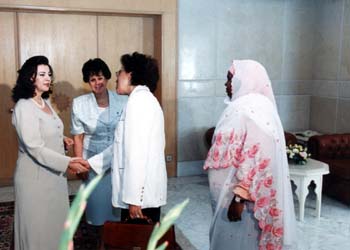
Mrs Leila Ben Ali affirmed
that Tunisia is as proud of its reformist heritage which it is determined
to keep, preserve and promote it. She added: ''our country has initiated a
comprehensive set of measures and legislations on childhood, family,
education, and human rights, thus establishing the principle of equality
between men and women, introducing within the couple the concept of
partnership in all vital
matters to the extent that nothing can be
developed today outside this
partnership".
She also noted the
deteriorating situation in the occupied Palestinian territoriesstressing
her keen admiration for the sacrifices made by Palestinian
women.
After a welcome address by Tunisian minister for women and
family
affairs, Mrs Neziha Zarrouk, the secretary general of Egyptian
national
women's council, Mrs Farkhanda Hassan stressed the importance
of the
issue of women's participation in political life in the Arab
world and
its implications in terms of decision-making in all
fields.
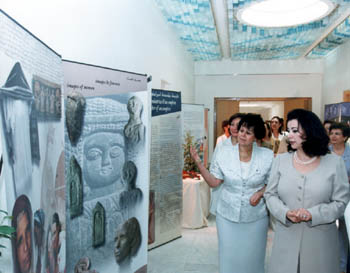
Earlier, Mrs Leila Ben Ali had
visited an exhibit on "Tunisian women
throughout the ages", organized
by the Tunisian ministry for women and
family affairs .
This
exhibit illustrates, through photos and paintings by Tunisian artists,
samples of traditional costumes and activities and crafts practiced by
women across the centuries, the stages of the development of Tunisian
women until today.
|



  |
|



