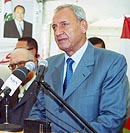
 Berri warns Israel to back
off Berri warns Israel to back
off
Michel Abdullah
Daily Star correspondent
Nabih Berri made the first visit by a speaker of Parliament
to Akkar since 1946 on Sunday, using the event as a platform
to warn of a return to hostilities with Israel if the
internationally recognized border between the two countries
was not respected.
Addressing more than 30,000 tobacco
farmers in a ceremony in Tal Abbas al-Gharbi, the speaker said
that the so-called “Blue Line,” the United Nations-set line
behind which Israeli forces must deploy, could become a “red
line” of hostilities.
“I speak for myself and on behalf of
President (Emile) Lahoud and everyone else,” Berri said.
“The ‘new’ Blue Line, just like the ‘old’ Blue Line is
rejected.”
The speaker said he was against “all the talk
of a new line which would differ from the 1923 internationally
recognized border.”
“There are internationally recognized
borders which are those of 1923,” he said. “We must return to
these borders or else this line will turn into a red line.”
Berri warned that the resistance, “which was capable of
liberating 1,230 square kilometers,” was capable of liberating
the areas still under dispute. “This is our land,” he said,
“and we won’t give it up for a blue or yellow line.”
He
also said that the border-demarcation dispute would not lead
to a conflict between Lebanon the United Nations “no matter
how much Israel and the United States try to cause us to have
a confrontation with them.”
He noted that while Israel had
been forced to implement Security Council Resolution 425, it
continued to ignore the implementation of Resolutions 242 and
338.
The speaker added that Lebanon maintained the right
to be compensated for Israeli aggression during its occupation
of the South.
Turning to domestic issues, Berri called on
the government to help tobacco farmers in the region and said
that the country’s history of internal conflict resulted from
the central government’s failure to address development needs.
“It’s time for the government to assume its
responsibilities. This is the main step that needs to be taken
to prevent Israel from disrupting public order,” Berri said.
“All the conflicts our country has experienced have been
because of the laziness of former governments, their social
oppression, deprivation and disregard for the poorer regions
of the country.”
However, he argued that Lebanon had
entered a new era of “national reconciliation” under Lahoud.
“We confirm that the government won’t neglect its duties and
will assume all its needed roles, especially in terms of the
economy and development,” he said.
Turning to specific
demands for the sector he has long championed, Berri demanded
that the government refrain from raising taxes on tobacco
farmers. He also recommended that it adopt several of
Parliament’s
recommendations, issued on May 31, which
would increase the annual tobacco crop purchased by the state
by some 2 million kilograms.
“Ten percent of the Lebanese
population work in this sector,” he claimed. “They must not be
treated like this. If the government wants to privatize this
sector, it must first strengthen the Tobacco and Tambac
Regie.”
Berri praised the regie for rendering the process
of acquiring a farming license simple and easy, but warned
that “certain attempts to liquidate this honorable sector
without offering an alternative” were misguided.
“These
policies are useless and they come at a time when we’re
occupied with other problems like striving to find
alternatives for drug cultivation in the Bekaa and the North,”
he said.
He complained that the government was not
allocating enough money to the agriculture sector, which he
claimed provides employment for 40 percent of the populace. He
also urged the government to develop the infrastructure of
rural areas.
After the ceremony, Berri inaugurated a
new 30-kilometer road connecting Dahr Nassar to Beino, a
project funded by the Issam Fares Foundation and the Green
Project. The road is expected to help farmers market produce
more effectively.
In the evening, the speaker left for
Cairo for the second session of parliamentarians in the
Islamic Conference Organization. The two-day session starts on
Monday, and Berri is expected to present the conference with
Lebanon’s plans for the post-liberation future.
He is also
scheduled to hold talks with several senior Egyptian
officials.
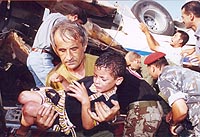 Speaker Nabih Berri’s inaugural trip to Akkar was
marred by a fatal road accident that saw three people killed
and more than 40 injured after a bus overturned on the
Nabatieh-Sidon highway. Early on Sunday morning, the bus
carrying 60 people, mostly farmers and their families from
Yohmor and Arnoun, to the ceremony hit an electricity
pole on the median of the highway and flipped twice, witnesses
said. Speaker Nabih Berri’s inaugural trip to Akkar was
marred by a fatal road accident that saw three people killed
and more than 40 injured after a bus overturned on the
Nabatieh-Sidon highway. Early on Sunday morning, the bus
carrying 60 people, mostly farmers and their families from
Yohmor and Arnoun, to the ceremony hit an electricity
pole on the median of the highway and flipped twice, witnesses
said.
The driver, Najib Jaafar, apparently lost control of
the vehicle, owned by the Tyre-based Mehdi Travel Agency, when
the brakes failed. Bahija Jaraf, the 70-year old wife of
Yohmor Mayor Hussein Jaraf; nine-year old Ali Abu Dalleh; and
Qassem Mohammed Jaber, 25, were killed. Forty-six passengers
were hurt, many of them sustaining concussions and fractures,
and were rushed to hospitals in Nabatieh and Sidon. Civil
Defense workers, policemen and security officers at Berri’s
nearby mansion also rushed to the scene, using a crane and two
forklifts to extricate the injured.
“I saw blood oozing
from my daughter Zeinab … and all I could remember is seeing
one of her limbs severed,” said Abu Dalleh’s mother.
Mahmoud Assaf, one of the injured, recalled that the
driver instructed the passengers to brace themselves before
the crash. “I remember hearing the shrieks and cries of
children … but I couldn’t move to help them,” he Assaf.
“The bus suddenly picked up speed and the driver got
confused after he wrestled to keep control of the bus,” said
Hassan Qattabi, who was also hurt in the crash.
|