St. Georges and Solidere do battle over soul of BCD
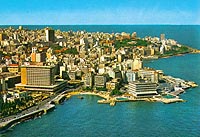
Warren Singh-Bartlett reports
on famous hotel’s struggle with giant developer
At the tip of the hotel district lies the partially
restored ruin of what was once considered one of the most
glamorous hotels in the world.
Back in the days when
Beirut was the “Pearl of the Mediterranean,” the city where
the party (apparently) never stopped, the St. Georges Hotel
was Ground Zero of Lebanon’s Golden Age.
Built in the
1930s and run by French proprietors until 1958, it was the
stylish backdrop against which film stars, singers,
businessmen, millionaires, dissidents, spies, writers, royalty
(deposed or otherwise) and practically the entire foreign
press corps of the Middle East created the image of Beirut as
the swinging hostess with the mostest.
Traitorous British
intelligence official Kim Philby came her to escape after
being found out as a KGB spy. Liz (Taylor) and Richard
(Burton) had a permanent suite. Farid al-Atrash and Omar
Sharif frequently visited. Less exalted but equally well-known
visitors also passed through its doors. Timothy Leary, leading
light of the 1960’s hallucino-generation, turned up dazed and
confused in 1970, accompanied by a contingent of pigmentally
challenged Black Panther-wannabes, on a “study tour” of Middle
Eastern revolutionary movements.
The hotel occupied a
special place in the hearts of those who knew it, finding its
way into songs, films and even the odd book or two.
Palestinian writer Souheil Natour, who arrived here in 1948,
remembers the St. Georges as the place people first went to
see women in bikinis. Bill Plante, longtime CBS newsman, still
remembers Mansour Braidi, the legendary concierge who
introduced him to Chateau Musar on the hotel terrace.
Across the road, the Phoenicia Hotel, another Golden Age
icon, once again hosts glittering events, regularly attracting
visitors almost as heavily decorated as its interior.
Under Solidere’s ministrations, the city center has
returned to a semblance of life, both by day and by night. The
enormous garbage dump that was once Normandy Bay is beginning
to shape up into what might one day become the eastern
Mediterranean’s most expensive slice of real estate.
But
seven years after work was begun to rehabilitate the St.
Georges, the hotel is still shrouded in scaffolding and green
netting, a dismal shadow of the days when it was known as the
“center of the Middle East.”
The St. Georges story is a
Byzantine epic of claim and counter-claim, decrees, decisions
and dotted lines all underscored by a clash of wills and egos
that is part David and Goliath (with both sides claiming
victim status) and part Um Kulthoum versus Asmahan.
Like
many regional conflicts, this one boils down to water rights.
But this duel is over a triangular patch of seawater in front
of the hotel, a mere 6000 square meters that is referred to in
official documents as “Sector Five.”
According to the
Societe des Grands Hotels du Levant (SGHL), the company that
owns the St. Georges, Sector Five is theirs to use as a marina
both by historical and legal precedent.
According to
Solidere, which has been given the land on either side of the
St. Georges, Sector Five is public property, or more properly
“maritime public domain,” and as such neither party enjoys
“rights” of any kind over the sea.
Predictably, the truth
is a mixture of both arguments. Sector Five, like all public
maritime domain, is public property, held in trust by the
Ministry of Transportation on behalf of the people of Lebanon.
Its use is regulated by laws that date back to 1925.
The
domain cannot be used for private purposes unless the
government authorizes such use through a decree of law, a
document that must be signed by the president and the prime
minister for it to be legally binding. Unlike regular
government property, maritime public domain cannot be bought
or sold.
Under Act 17 of Law 144S passed in 1925, people
who own property adjoining the domain are entitled to apply
for a license to use the beach and sea for private purposes.
The license, which is renewable on a yearly basis, can be
revoked at any time by the president. It cannot be transferred
to a third party
As the owner of the land adjoining Sector
Five, the St. Georges appears to have a solid claim to this
patch of sea. But Solidere insists that the St. Georges no
longer has any claim over Sector Five, saying that all
previous “understandings” were canceled by the Cabinet in
1995.
Additionally, it says the SGHL forfeited its rights
when it agreed to accept 11,000 square meters of reclaimed
land in what used to be Minet al-Hosn. Solidere maintains that
the 1997 contract the SGHL signed with the CDR, specifically
paragraph 18, states as much.
Jean Alghawi, the lawyer
representing SGHL, doesn’t agree.
“When we signed the
contract, in no way and nowhere did it mention we would
relinquish our rights over the water,” he says. “What we
agreed to relinquish at the time were rights to present or
future court actions against the CDR.”
Neither does Fadi
Khoury, chairman of SGHL, whose family has owned the St.
Georges since 1958. “The St. Georges is the hotel plus the
beach,” he says. “We never agreed to give up Sector Five and
we challenge Solidere to produce one document that says this.”
Trying to secure that document, or even official Solidere
or CDR comment on the case, is frustrating. The sole
representative of Solidere who agreed to discuss the issue
with The Daily Star, who referred to himself as a company
lawyer, refused to identify himself or to allow his comments
to be quoted.
The CDR is similarly unforthcoming on the
issue. Repeated attempts to get its perspective on the affair
were countered with a polite but firm “we have no comment at
this time.”
In the end, it was Khoury who gave The Daily
Star a copy of the contract. Paragraph 18 makes no mention of
Sector Five.
This has not stopped Solidere from attacking
the St. Georges in their reports. The introduction to an
article in the July-September 2000 issue refers to “important
issues that remain outstanding with the state, thus hindering
the reconstruction and development of Beirut city center.”
It goes on to talk of “two companies” which have
“trespassed” on the marina since 1999 and whose
“authorizations to occupy areas of the maritime public domain”
were “rescinded” in 1995 by the Cabinet when it allocated to
them 11,000 square meters of reclaimed land. The picture on
the following page shows a photo of the western marina,
showing the boats in the St. Georges marina under a caption
which reads “Beirut marina: still hampered.”
Alghawi says
this is deliberately misleading. “The (St. Georges) marina is
not even part of Solidere,” he says. “Decision 83 taken in
November 1995 does talk about merging Sector Five with the
western marina but they cannot do this legally. We own the
land adjacent to the sea.”
He points out that legally, a
Cabinet decision is not a binding document until it becomes a
decree a document that must carry the signature of the
president, as well as the prime minister. There is much
argument over this particular point of law. A provision in the
Taif Accord lends legal legitimacy to decisions taken by the
Cabinet but this provision is fiercely contested and has
repeatedly been attacked for being unconstitutional.
The
month following decision 83, the government appeared to
overturn the decision when it approved decree 7760. “Decree
7660 of Dec 15, 1995 clearly states that Sector Five is public
maritime domain,” Alghawi continues.
“Therefore under the
laws governing the public maritime domain and under the plan
proposed by Decree 7660, the marina is outside of the
(Solidere) limits.”
Those limits are Khoury’s crown of
thorns. The original plan drawn up in 1995 and the one
according to which the Solidere project was approved by the
government, shows quite clearly that the St. Georges marina,
as it was at the time, falls outside the scope of Solidere.
Later maps tell a different story, changing radically once the
land reclamation projects of Minet al-Hosn and Normandy Bay
had taken shape.
By 1999, some Solidere maps show the St.
Georges owning more waterfront property but indicate that
Sector Five now belongs to the western marina.
Nevertheless, a report prepared by the Ministry of
Transportation, published in February of last year, clear
states that this is not the case. The report, signed by
Minister Najib Mikati, draws a distinction between the western
marina under Solidere control and Sector Five, which it
confirms does not fall within Solidere’s boundaries. The
report further states that due to the complicated nature of
the case, the simplest and fairest resolution would be to use
the laws governing the maritime public domain.
“Solidere
wants to expand beyond its boundaries, beyond what the law has
given it,” says Khoury, “and not only to expand on the land,
but now on the sea too.”
His complaints don’t stop at
Sector Five.
As well as the delays he says the SGHL has
faced in getting permits and other official documentation over
the years including an 18-month delay in securing
official CDR approval of the works completed on time under
contractual obligation he points to the 8-meter-high
breakwater that looms over the marina, blocking the hotel’s
view of the sea and what he calls the “illegal” alterations to
Sector Three, the roughly triangular parcel of reclaimed land
that lies between the St. Georges and the Phoenicia.
Under
the terms of the contract signed between the SGHL and the CDR,
Sector Three was designated as a parking lot operated by the
SGHL to serve both the St. Georges and the Phoenicia. The plot
originally extended to the underpass that takes traffic from
the hotel district to the downtown proper.
Now, an access
road permitting passage to the Phoenicia runs across the plot,
cutting it in two. For it’s part, Solidere maintains that the
sea wall is necessary to protect the marina from freak waves
of up to 15 meters which apparently strike the city once every
100-150 years and that the original 1995 masterplan, the basis
on which the Solidere project was approved, was intended to be
a working document and never cast in stone.
Khoury
categorizes the entire affair as an “extremely bad experience”
both for himself and for other investors and says it is this
kind of behavior that keeps Lebanese investment locked up in
foreign banks.
Last week, the showdown entered its final
stage.
On orders from the Ministry of Transport,
originally drafted six months ago but only just released,
police descended on the St. Georges marina and slapped notices
of eviction on all the boats. Owners were informed that they
had a week in which to find other mooring spaces, or their
boats would be impounded.
As the boats began to move
elsewhere, Fadi Khoury, the chairman of SGHL and the man who
has fought to save his hotel’s connection to the sea,
announced that he had finally lost the battle.
What
remains to be seen is who will finally win the war.
If
Solidere is correct, the delays to the reconstruction of the
St. Georges are easy to understand. In its eyes, the St.
Georges is breaking the law and is standing in the way of its
own projects, costing the company valuable time and money.
But if the SGHL is correct, Solidere’s actions are far
less easy to understand. Why would the country’s largest real
estate developer be prepared to go to war just to get its
hands on a small patch of sea?
Khoury points to what is
happening in Normandy Bay as his answer. The sea between the
defensive sea-wall caissons and the reclaimed land, sea that
is marked on the BCD Masterplan as a “lagoon,” is being
reclaimed. Khoury believes this is the fate ultimately
awaiting St. Georges Bay.
The Hoss government stopped the
reclamation work in 1997, saying it exceeded Solidere’s remit.
But following last year’s elections, backfilling resumed,
although Solidere has now said that the land will become
public property.
If Khoury is mistaken, the easiest way to
silence his complaints would be to provide evidence that they
are unfounded. Unlike Khoury, who is more than happy to
provide stacks of documentation to bolster SGHL’s case, the
absence of similar proof from the CDR or Solidere and their
unwillingness to go on the record, doesn’t look good.
A
charitable reading of this silence is that neither the CDR nor
Solidere wish to further fan the flames of this acrimonious
affair, secure in the knowledge that they are in the right. A
less charitable reading is that Solidere and the CDR have
overstepped their bounds, as the Hoss government suggested. In
this case, by limiting their responses, they may be hoping
that the issue will simply wither and die.
But as last
week’s event and the flurry of press coverage it garnered
suggest, this is not likely to happen in the conceivable
future. Even before the St. Georges marina was closed down,
Khoury was threatening to turn the hotel over to a board of
trustees so that it remains a permanent, untouchable war-torn
thorn in the glamorous flanks of the hotel district.
With
a few tactically placed trees and some landscaping, the visual
impact this might have on what is once again fast becoming the
stomping ground of the “Cocktail Class” can be limited but the
demise of another Beirut landmark doesn’t bode well for a city
already stripped of much of what once made it glitter.
|