Content
Introduction 2
Chapter
1
Oil industry in Sudan 4
1.1 Brief
history 4
1.2 Oil
reserves and production 5
1.2.1 Reserves
5
1.2.2 Production
5
1.3 Overview
of interests of foreign oil companies currently operating in Sudan 6
Chapter 2
Oil and south and north Civil war 7
Chapter 3
Oil and the Sudanese-US relations 9
3.1
Background
9
3.2
1972-1985
9
3.3
1985-1989 10
3.4
1989-2000
11
3.5
2000-2006 14
Chapter 4
Oil and the Sudanese-Chinese relations 17
Conclusions and Perspectives 20
Maps
22
References 24
Introduction
Since its independence of Britain
and separation from Egypt in 1956, Sudan has enjoyed only 11 years of relative
stability and peace.
The oil discoveries
in Sudan, in the late 1970’s have additionally aggravated the political and
economic situation in Sudan. The oil
discoveries played a pivotal role in igniting the second civil war in
1983 and complicated the possibilities for peace between the south and north as
it became the central objective for the fighting parties.
This paper
investigates the impact of oil on the internal situation in Sudan as well as
its impact on Sudan’s international relations. The paper will focus on the role
of the main two foreign actors whose policies were and still are very
influential within Sudan; China and the United States.
The paper argues that oil has had a
catastrophic impact on Sudan. It played a key role in igniting the second civil
war in 1983 and complicated the possibilities for peace between the south and
north as control over it became the central issue for a settlement of the
conflict. The civil war made Sudan vulnerable. Internally it depleted the
economy and any prospect for development. In addition it rendered Sudan
vulnerable to external imperialist aggressive policies. The civil war and TheUnited
States imperialist aggressive policies aimed at controlling Sudan’s natural
resource (mainly oil), in fact has put the country on the verge of collapse as
a state.
Although the focus of this paper is
on the impact of oil, it should be mentioned here that Sudan has many more
valuable natural resources apart from oil. Its mineral wealth includes
significant reserves of uranium, copper, diamonds,
gold, iron ore, mica, silver, talc, tungsten, uranium, and zinc. Sudan’s total land surface amounts
to 2.51 million square km. of which about half is cultivable. However, only 170.000
square km. is actually being used for cultivation. Sudan has a strategic
position on the Red Sea, with borders with nine countries; Egypt, Libya, Chad,
Central Republic of Africa, Democratic republic of Congo, Uganda, Kenya, Ethiopia, and Eritrea. The Sudanese
potential for development is therefore vast if a situation would arise in which
its resources could be fully used for the benefit of the Sudanese people and
the development of the country in general. This fact is perceived as a threat
to the interests of the United States and its regional allies as it implies the
possibility for the emergence of a strong and independent Sudan.
The outline of this paper is as
follows. In the first chapter some background information will be provided on
Sudan’s oil wealth as well as some details on foreign involvement in the oil
exploration and exploitation over the years.
Subsequently, in chapter two, a
brief overview will be given on the internal Sudanese developments sine oil
exploration was initiated in Sudan.
In chapter three the role of the
United States and its policies towards Sudan will be discussed followed by a
similar discussion on the Chinese role and policies towards the country in
chapter four.
In the conclusion I aim to provide a
brief overview and interpretation of the described developments as well as a
personal perspective on the possible future of Sudan.
Chapter 1
Oil industry in Sudan
1.1 Brief history
Oil exploration in Sudan was first
initiated in 1959 by Italy’s Agip oil company in the Red Sea area. Several oil
companies followed Agip in the Red Sea Area but none were successful in their
exploration efforts. After the end of the first civil war in 1972 it became
possible to extend the oil exploration to southern Sudan. In 1975 the American
oil company Chevron was granted a concession in the south and south-west of the
country. The first oil discovery in Sudan was made by Chevron in the south of
Sudan in 1979, west of the Muglad. Chevron continued its successful exploration
and made more significant discoveries in the so called Unity and Heglig fields.
In 1983 Chevron, Royal Dutch Shell, the Sudanese government, and the Arab
Petroleum Investments Corporation (Apicorp) formed the White Nile Petroleum
Company in order to build an oil pipeline from the Sudanese oil fields to Port
Sudan on the Red Sea. The projected costs for this project amounted to US$ 1
billion. The plans of Chevron could not be implemented as the second civil war
erupted in 1983. Chevron suspended its operations in 1984 and entirely ended
its 17 year long involvement in Sudan by selling its interests to the Sudanese
company Concorp in 1992. Concorp sold these concessions on to the Canadian oil
corporation ‘State Petroleum Corporation’ a few months. In 1994 Arakis Energy
Corporation purchased State Petroleum Corporation and started operating in Sudan.
Arakis faced difficulties in securing the needed financing to fulfil its
exploration and production agreement with the Sudanese Government. In 1996 it
sold 75% of its shares to the China National Petroleum Company (CNPC), Petronas
(Malaysia) , and Sudanpet (Sudan)
with which it jointly formed the Greater Nile Petroleum Operating Company
(GNPOC). Arakis subsequently sold its 25% share in the GNPOC to the Canadian
company Talisman in 1998. The GNPOC made considerable discoveries, increasing
the amount of proven reserves in Sudan. It also succeeded in the construction
of the pipeline from the Heglig and Unity fields to Port Sudan on the Red Sea.
In 1999 the pipeline became operational and carried the first Sudanese oil
exports to Port Sudan.
In this period and as a result of
international public pressure over accusations of being complicit in human rights violations through its
operations in Sudan, Talisman sold its shares in the GNPOC to the Indian company Oil and Natural Gas
Corporation Limited (ONGC).
A consortium made of the French
company Total, the American company Marathon ,Kuwait Foreign Petroleum Company
and the Sudanese company Sudapet was granted a concession in south eastern
Sudan ( block B) in 1980. The consortium suspended its operations in 1985 as a
result of the civil war. Unlike Chevron, Total and its partners did not
relinquish their concessions as a result of the civil war and they signed an
agreement in December 2004 with the Sudanese government to update the contract.
As a result of this there is now a dispute between Total and a UK company,
White Nile Ltd, who claims that it signed an agreement with the future
government of south Sudan for oil exploration in part of the land believed to
be within block B and part of the concession of Total and its partners.
In 1997, the Sudanese Government
granted another concession in the so called block 5A to the Swedish company
Lundin with partners Petronas, OMV (Austrian oil and gas company) and Sudanpet.
In 2001 the same consortium was granted a concession over block 5B. In 2003
Lundin sold its interest in block 5A to Petronas and OMV sold its interests in
Blocks 5A and 5B to the Indian company Oil and Natural Gas Corporation Limited
(ONGC).
1.2 Oil reserves and production
1.2.1 Reserves: according to BP statistical review of world energy 2006, Sudan has a
proved oil reserve of 6.4 thousand million barrels. The oil exploration has
been limited to the central and south central regions. It is estimated that the
country holds vast potential reserves in the east, north-west and south of the
country.
1.2.2 Production:
|
Year |
1995 |
1996 |
1997 |
1998 |
1999 |
2000 |
2001 |
2002 |
2003 |
2004 |
2005 |
|
Thousand b/d |
2 |
5 |
9 |
12 |
63 |
174 |
211 |
233 |
255 |
325 |
379 |
Source; BP statistical review of
world energy 2006
In 1999 the construction of an export pipeline,
that connected the Heglig oil fields in central Sudan to Port Sudan on the Red
Sea, was completed. This led to a considerable increase in oil production, and
the first oil export in the history of Sudan. Since then production has
increased steadily.
In April 2006
another 1400 km pipeline, from Upper Nile in Sudan’s south-east to the eastern
Port Sudan became operational. This pipeline will raise production to 500,000
b/d in 2006 and it is estimated
that it will double the production in 2007.[1]
1.3 Overview of interests
of foreign oil companies currently operating in Sudan:
China National
Petroleum Corporation (CNPC).CNPC is involved in several projects in Sudan. It
has a 40% share in the Greater Nile Petroleum Operating Company (GNPOC),
which owns the rights in blocks
1,2 and 4 (Heglig and Unity fields), a 92% interest in block 6. In addition CNPC has a 41% share in the
Petrodar Consortium which owns concessions in blocks 3 and 7 and 35% in block
15.
Petroliam Nasional
Berhad (Petronas), a state owned Malaysian company has a 30% interest in GNPOC,
a 40% interest in the Petrodar Consortium (blocks 3,7), a 68.875% in block 5A,
39% in block 5B, 77% in block 8, and 35% in block 15.
Oil and Natural Gas
Corporation Limited (ONGC), a state owned Indian company has a 25% interest in
GNPOC, 26.125% in block 5A and 23.5% in block 5B.
Lundin Petroleum ,
a Swedish company has a 24.5% interest in block 5B
The French company
Total has a 32.5% interest in Block B.
The American
company Marathon Oil Corporation has 32.5% interest in block B.
Kuwait Foreign
Petroleum Company has a 25% interest in block B.
Cliveden, a Swiss
company has a 37% interest in block C.
Express Petroleum
of Nigeria has a 10% interest in block 15.
Chapter 2
Oil and south-north civil war
Sudan suffered its
first civil war between the 1956 and 1972. It was ended by the signing of the
Addis Ababa peace agreement on the basis of which the south became an
autonomous region. The second civil war broken out in 1983 as a consequence of
the collapse of the Addis Ababa agreement. The second civil war only ended
officially in 2005.
The oil discoveries
made by Chevron in Sudan complicated the relations between south and north
and played a major role in
re-igniting Sudanese civil war in 1983.
The oil related disputes started in 1980 when the Sudanese president Numeiri announced a plan to change the borders between the southern and northern provinces and which divided the southern region into three states creating the Unity state around Bentiu where the oil rich areas are located. On the basis of this division plan the Unity State became part of the north. This development was rejected by the leaders of the south who refused to accept it. The leaders of the south perceived the division plan as an attempt by the central government to control the oil areas and deprive the south of the oil revenues. It should be mentioned that under the Addis Ababa agreement the southern regional government had the right to all profits on exports from the region.
Another issue was a
dispute over the pipeline
connecting the southern fields to Port Sudan. The south preferred a route that
would not pass through the north and proposed a route that passed through Kenya
to the Indian Ocean. In addition there was a dispute over building a refinery
which the south demanded to be in
its region. This demand was rejected by the government in the north and the
refinery instead was build in the north. These disputes, all related to control
over the countries oil wealth, resulted in a deep crisis and an increasing lack
of confidence between the two parties. The central government’s clear
intentions to seize full control of the oil violated the Addis Ababa agreement
and increased anger and fear in the south which eventually resulted in the
eruption of the second civil war in March 1983. At that time the rebel Sudan
People’s Liberation Army (SPLA) was founded by the southern army commanders led
by John Garang.
The eruption of the
civil war made it impossible for the foreign companies to continue operating in
Sudan as the security situation was deteriorating. The SPLA targeted the oil fields in order to
prevent the Sudanese government from exploiting the oil resources. In 1984 the
SPLA attacked the oil fields in the south abducting and killing three Chevron
workers. This incident forced the consortium led by Chevron to suspend its
operations in Sudan. The consortium led by Total suspended its operations in
1985.
After the overthrow
of the Mengistu regime in Ethiopia in 1991, which was a main ally of the SPLA,
the SPLA lost considerable ground to the government forces over the following
three years. As a result of this
the majority of the oil fields once again came under the control of the
Sudanese Government and relative security prevailed. This new situation
attracted new foreign investments and led to the resumption of the oil
exploration and development operations. The oil revenues, especially after
1999, altered the balance of power within Sudan as the Sudanese government
gained the financial resources to modernise the army and make it more efficient in fighting the SPLA. This shift
in the military balance of power did however not bring the civil war to an end. The SPLA continued to receive support
of the United States and its regional allies and continued to attack the
Sudanese army and some oil fields.
The civil war only
ended officially in January 2005 by the signing of a peace agreement in
Nairobi, on the basis of which the south was granted the right to self determination
in 2011 after a six year long transitional period. An important element in the
agreement was the sharing of oil wealth, which would be divided equally between
the two parties.
Chapter 3
Oil and Sudanese-US Relations
3.1 Background
The Sudanese-US relations oscillated between two extremes. In 1972 Sudan, under the Numeiri’s regime, shifted its cold war alliance from the Soviet Union and became a strategic cold war ally of the United States. Sudan became more important for the United States to counterbalance the Soviet Union influence in the region, in particular after the overthrow of the United States historical ally in Ethiopia in 1977. The Sudanese-US alliance continued until the overthrow of Numeiri’s regime in 1985. Since then the Sudanese-US relations deteriorated and eventually collapsed completely in 1989 after the National Islamic Front military coup. The US policy towards Sudan became hostile and aggressive as the new Sudanese regime adopted independent policies that were against the American hegemony in the region. The new Sudanese government to be a client of the United States.
As a result of
this, up to 2000, US policies towards Sudan were aimed at isolating and
destabilising the Sudanese regime in order to pressure it to comply with US
(regional) interests. During this period the United States supported the rebel
movement in the south financially. After 2000, the Bush administration adopted
a different approach which was based on attempting to bring the Sudanese civil
war to an end. This new approach was related to the changing political and
economic realities in Sudan.
3.2 1972-1985
During this period
Sudan was a key ally of the United States in the region. Besides Sudan’s
strategic position on the Red Sea and the United States need for allies in the
region, Sudan’s vast natural resources
rendered it important ally for the United States.
The oil discoveries
made by Chevron in late 1970’s and early 1980’s bolstered the Sudanese-American
relations further. Subsequently, the United States substantially increased its
military and economic assistance to Sudan. By the early 1980’s Sudan was the
sixth largest recipient of U.S. military aid in the world. [2]
The US support for
Numeiri’s regime provided it with the confidence that it could provoke the south by changing the
internal boundaries between the north and south regions and violation of the
Addis Ababa agreement. The position of the US oil company Chevron was in favour
of the central government with regard to the south-north oil disputes. Chevron
signed an unpublicised contract
with the Numeiri government to explore areas in the south, with a
production-sharing formula with the central government alone.[3] As a consequence of its policies
Chevron’s relations with the southern Sudanese government worsened over time.
The first director of Chevron maintained good relations with the southern
regional government but as Abel Alier, a southern judge who was Numeiri’s vice
president, said “ a second Chevron group cut relations with us [ the southern
Sudanese] and treated us with less respect”.[4] Alier also indicated that Chevron was
quite comfortable with Numeiri’s plans to change the south- north boundaries.[5] It would seem logical that Chevron, in
order to protect its interests in the best manner possible, should have
maintained good relations with both parties. Chevron’s behaviour can however be
understood by taking into consideration the economic and political crisis
within Sudan, the general US role and interest in it and the related interest
of Chevron. At the time that it became evident that Sudan had significant oil
reserves, Sudan was suffering a deep economic crisis and Numeiri’s regime faced
increasing popular anger among the general population. Control over oil was
perceived by the regime as well as the United States as a tool to consolidate
its position while the political and economic situation in Sudan was
deteriorating. The United States interest obviously was keeping its ally, the
Numeiri government, in power.
Neither the
Americans nor Numeiri regime seemed to expect that their policies would lead to
the eruption of the civil war. The civil war forced Chevron to suspend its
operation after it had invested more that one billion US Dollars.[6] The civil war further weakened
Numeiri’s regime which was eventually overthrown in 1985 and obviously had a
catastrophic impact on the development and future of the country.
3.3 1985-1989
In April 1985
Numeiri’s regime was overthrown by the army after a popular uprising. One year
later parliamentary elections were held and Sadiq Al-Mahdi became Prime
minister. The new government’s foreign policy was neutral, a policy that was not welcomed by the United
States. As a result the United States started reducing its economic and military
support to Sudan, and in January 1989 it was totally suspended.[7]
In spite of the
deterioration of the United States relations with the Sudanese government,
Chevron was willing to resume its operations in the country. It agreed with the
Sudanese government to resume its operations in two years or to sell its
concessions to other companies.[8]
This decision by Chevron was based on the progress of negotiations aimed at bringing the civil war to an end. At
the end Chevron could not resume its operations as the hopes for a peaceful
solution dashed with the overthrow of the Sadiq Al-Mahdi government in June
1989 by Al-Bashir, the current Sudanese president, and the National Islamic
Front led by Hassan Al-Turabi.
3.4 1989- 2000
The new Sudanese
regime adopted policies that opposed
the American hegemony in the region. Sudan stood with Iraq against the
international American led aggression against Iraq in 1991 and started to develop
its relations with Libya , Iran and China . Considering these policies as being
against the American interests in the region the United States adopted an
aggressive policy of isolation, containment and destabilisation against the
Sudanese regime with the aim of forcing the Sudanese regime to comply with the United States agenda. This approach
was adopted and put in effect by the Clinton administration.
In 1993 the United States put Sudan on
its list of states sponsoring terrorism. In 1996 the United States supported UN
Security Council resolution 1054 which imposed diplomatic sanctions on Sudan.
And in 1997 the United States imposed comprehensive trade sanctions on Sudan.
These aggressive policies culminated in August 1998, when the United states
bombed El-Shifa pharmaceutical factory in the Sudanese capital Khartoum.
The United States was
also actively involved in the Sudanese civil war. In 1996 it provided its
regional allies Ethiopia, Eritrea and Uganda with 20 million US$ of military
equipment in order to help the SPLA[9].
At the beginning of the civil war the SPLA received military support of Libya
and Ethiopia who were on the side of the Soviet Union, as the SPLA was seen to
be fighting against a regime who is a client to the United States. With the regime change in Ethiopia in
1991 the SPLA lost its main ally in the region and this was reflected in the
battle field. During the 1990’s the SPLA started receiving support from the
United States regional allies Ethiopia, Eritrea and Uganda. The United States was
also involved through the United
States Agency for International Development (USAID) which is a very effective
instrument in the United States foreign policy as it promotes the American political
agenda through humanitarian work[10].
The USAID was very active in the south Sudan region exclusively and paved the way
for direct relations between the United States and the SPLA. Through the complementary roles of the
United States regional allies and the USAID, the SPLA became heavily
dependent on the United States.
Another important
aspect of the United States aggressive policies towards Sudan was the
prevention of Sudan to exploit its oil wealth. The above mentioned policies played a major role in
obstructing the Sudanese government planes to start oil production. The
economic and diplomatic sanctions beside the support of the rebels in the south,
made it difficult to foreign oil companies to consider working in Sudan both
for security reasons and for fear of problems with the United States.
Chevron’s decision
to sell its concessions in Sudan was mainly related to the United States
policies towards Sudan. Insecurity,
poor relations with the Government of Sudan and pressure from the American
Government finally made Chevron decide to leave Sudan.[11]
The United States Government also encouraged Chevron to leave Sudan by offering
the company a tax write-off for
its operations in Sudan worth an estimated US $550 million as a compensation
for its losses there.[12]
The Canadian oil
company Arakis financial problems in raising the funds needed to finance its
investments in Sudan were also related to the United States policies towards
Sudan. Among other measures the United States Government, which had applied
political and economic sanctions on Sudan in 1997, allegedly spread negative
information concerning the Canadian company.[13]
This made it impossible for Arakis to continue operating in Sudan ad it
therefore sold its concessions in
1998.
Another Canadian
oil company which faced pressures from the American Government to leave Sudan was Talisman. Talisman
faced several problems related to its operations in Sudan. The declared
intentions to extend the American sanctions imposed on Sudan in 1997 to include those corporations borrowing from American capital
markets put the Canadian firm in jeopardy of losing a broad segment of its
shareholders base and the ability to raise funding in the United States through its NYSE
listing. There was also pressure from the American government to exclude the
company from U.S. capital markets.[14]
Talisman was
attacked fiercely by human rights and other NGO’s who accused the company of
being complicit in human rights abuses in Sudan in. They lobbied the
shareholders in order to force the company to leave Sudan. This campaign was
not isolated of the US Government’s influence. Human rights group and other
lobbies in the United States are selectively active with regard to human rights
issues around the world. It is not
a coincidence that they become actively involved in areas and issues that are
only in accordance with the United States interests. These factors in which the
American Government played a decisive role led Talisman to leave Sudan.
In spite of the
American aggressive policies Sudan managed to develop and eventually start
producing oil in 1999. This achievement was realised mainly through the
investments made by Chinese and Malaysian oil companies since 1996. The
Sudanese oil reserves were key to the eventual failure of the US sanction
regime. Despite of this regime potential revenues were so great that apart from
Asian oil companies also European ones invested in it. Countries subsequently resumed
diplomatic relations with Sudan. These developments among others brought about
a tactical change in the United States approach towards Sudan.
During this period
several negotiation rounds were held between the SPLA and the Sudanese
Government but with no results. The main peace initiative which was supported
by the United States was made by the Intergovernmental Authority on Development
(IGAD) in 1994 and resulted in the IGAD Declaration of Principles . The IGAD is
a regional grouping of seven
African countries Sudan, Ethiopia, Eritrea, Djibouti, Kenya, Somalia, and
Uganda. It is clear that the initiative was a move made by the United States
through its regional allies. The
Declaration of Principles for the
first time addressed the right of self determination for the south through a
referendum. This practically meant the fragmentation of Sudan even if it
prioritised national unity. The
Initiative was an indication of what the ultimate objective of the United
States was and this is why the
United States refused or neglected all other proposals which did not include
the right of self determination of the south, especially the Libyan-Egyptian
initiative in 1999. The SPLA signed the Declaration of Principles while the
Sudanese Government refused to sign it in 1994. It eventually accepted it in
1997 with no changes. The Declaration of Principles became the basis of the negotiations between
the Sudanese Government and the SPLA which led to the signing of the final
agreement in 2005 on the basis of which the south has the right to self
determination through a referendum that will be held in 2011.
3.5 2000-2006
The United States
policy towards Sudan during this period was mainly based on a report published
by the Centre for Strategic and International Studies (CSIS)[15].The
report highlighted the changes that had occurred in Sudan during the last years
and highlighted the need to change the American Government policies towards Sudan. It recommended
that the Bush Administration concentrate its policy on the objective of ending
Sudan’s war on the basis of the IGAD Declarations of Principles. And to do so,
the Bush Administration should resume full diplomatic relations with Sudan
and appoint a high level fully empowered envoy.
These recommendations were implemented by the Bush Administration who
assigned Senator Danforth as the president’s
envoy for peace in Sudan.
The change in the
American policy towards Sudan was mainly related to the oil related
developments in Sudan. The United States attempted to reign in China’s growing
influence in Sudan who had benefited of the sanctions imposed on Sudan during
the 1990’s. Also the significant oil discoveries made in Sudan by the Asian oil
companies made the American oil companies
pressure the American Administration to change its policy so they could
operate in Sudan and benefit of a lucrative oil industry with a promising
future. The United States main objective however remained reaching an agreement
that would end the Sudanese Civil war and would secure the separation of the
south.
Under pressure of
the United States the Sudanese Government and the SPLA signed the Machacos protocol in July 2002. In October 2002 the
American president signed the Sudan Peace Act, in which the American
administration threatens the Sudanese Government with punitive measures if it
obstructs the negotiations, does not negotiate in good faith or if it is not in
compliance with the terms of a permanent peace agreement. The Act also pledges
US$ 100 million of assistance for each of the years 2003, 2004, and 2005 to
areas outside the Sudanese Government’s control. The terms of a permanent peace
agreement were set up by the
United States. The Act makes it clear that the United States wanted the Sudanese
Government to sign the agreement that the United States wanted. In effect that
meant the agreement should guarantee the right of self determination of the
south which would pave the way for separation.
The United States
succeeded in forcing the Sudanese Government to sign the agreement in January
2005 on the basis of which the south has the right to self determination
through a referendum that will be held in 2011. The outcome of the referendum
is expected to be in favour of
separation which means that after 2011 the north will not have any
rights over the oil wealth of the south.
The main event that dominated Sudan
during this period was the eruption of the Darfur crisis in February 2003. The
Darfur crisis opened another front against the Sudanese Government. The crisis
started a few months after the
SPLA and the Sudanese Government
signed the Machacos
protocol and at a time that the negotiations were under way to reach a
comprehensive agreement between the south and the north. These facts beside the
split in 1999 between the leaders of the
1989 military coup, the Sudanese president El-Bashir and Hassan
Al-Turabi the leader of the National Islamic Front, were the key factors in the
creation of the crisis. The crisis put more international pressure on the
Sudanese Government and resulted in a threat of possible international intervention in Sudan. The
United States exploited the crisis heavily in order to put forward and
implement its agenda. The United States qualified the events in Darfur as a
genocide, which was an attempt to put Sudan under international sanctions and
pave the way for military aggression. But the interests of other permanent
members of the Security Council, mainly China, aborted the United States
attempts to push the United Nations
to adopt the United States position over Darfur. Under the pressure of
the United States and the United Nations the Sudanese Government and main rebel
group signed the Darfur Peace Agreement on May, 5, 2006 in Abuja, Nigeria. The
power and wealth sharing are main points in the agreement, most importantly,
however, the agreement states the people of Darfur have the right to determine
their status as a region through a referendum to be held by July 2010. The
United States is fiercely lobbying for sending United Nations peace keeping
troops to monitor the implementation of the Peace agreement. Until now the
Sudanese Government refuses to accept such troops, a position that could change
in the near future. In the current global political context the Darfur
agreement could eventually, and in the best case, lead to the creation of an entity that is officially part of Sudan
but will practically be under the “International Community” (the United States)
control, if it will not become an independent state. Even though the Darfur
crisis was in essence not related to oil related issues it should be mentioned
that drilling for oil in Darfur
started in 2005. According to Mohamed Siddig, a spokesman for Sudan’s Ministry
of Energy and Mining "The drilling was undertaken on the basis of the
geological studies and surveys which proved the presence of oil in abundant
quantities in Darfur."[16]
This fact played a key role in making the United States put heavy pressure on
all the parties involved in the
crisis in order to end the fighting, so that oil exploitation could be
possible.
The policy of the United States towards
Sudan during the Bush II administration was a continuation of the policy of his
predecessor Clinton; though the tactics were different, the objectives remained
the same. At the end the United States managed in forcing the Sudanese
Government to comply with its interests. The Sudanese Government agreed to what
it totally refused before, and it put the future of Sudan in the hands of its
enemies who are now preparing the south for separation and Darfur could face
the same faith.
Chapter 4
Oil and the Sudanese-Chinese Relations
Oil is the main interest of China in
Sudan and it has bolstered the Sudanese-Chinese relations which started in
1959, substantially.
The state owned oil company China National Petroleum Company, which is China’s arm in securing oil overseas, was granted its first concession in block 6 in 1995, but only started operating in Sudan in 1997 as a member of the GNPOC. Since then the CNPC expanded its operations and acquired more concessions in Sudan. It holds a 40% interest in the Greater Nile Petroleum Operating Company (GNPOC), which owns the rights in blocks 1,2 and 4 (Heglig and Unity fields), 92% interest in block 6, 41% interest in Petrodar consortium which owns the rights of blocks 3 and 7, and has a 35% interest in block 15.
The Chinese company provided the Sudanese oil industry with the
required investment to built the oil pipeline and consequently converted Sudan
to an oil exporting country in 1999. Among the countries in which CNPC operates,
Sudan is the most important. Even though Sudan’s share of China’s imports for
2004 was 4.7%[17], the
importance of Sudan is in its share of the total oil imports from the wells
owned by CNPC. Sudan accounted for 16 million of the 30.1 million tons of
overseas oil the firm pumped
during 2004[18].
This share is expected to increase due to the increasing oil production in
Sudan and the expansion of the CNPC exploration and development operations in
unexplored areas.
As a consequence China has become
the main trade partner of Sudan. In 2003, China was the destination of 24% of
the Sudanese exports and the origin of 19.2% of the Sudanese imports[19].
Also, China has expanded its economic activity in the country through banking,
light and heavy industry, agriculture, fisheries and pharmaceuticals[20].
The military co-operation between the two countries goes back to1985, and has
been further stimulated by the
increasing Chinese interests in Sudan.
The Chinese role in developing the
oil industry in Sudan has been substantial, it could be argued that without the
Chinese investments, Sudan would have remained unable to exploit its oil resources. Chinese
involvement in Sudan was instrumental in the (partial) failure of the US
sanction regime towards Sudan. Chinese
involvement also led to a change
in the United States approach towards Sudan. Through Chinese involvement it was proved that the Sudanese oil
reserves were much more substantial then was expected. This subsequently made
the American oil companies blame the United States policies for depriving them
of a lucrative oil market, and consequently put pressure on the American
Administration to change its policies so also US companies could operate in the
country. The Chinese increasing interests in Sudan and its control of the
majority of the oil fields was perceived as a strategic threat to the American
interests in the region which also played a key role in the changing US approach
towards Sudan. One of the main aspects of the United States approach was to put
the vast undiscovered areas of the south under its indirect control thereby
preventing China from controlling more areas in the oil rich south.
The Chinese interests in Sudan were
reflected clearly in the political support it provided to Sudan in the United
Nations. The Chinese interests were the main factor in preventing the United
States of obtaining international resolutions that would have imposed economic
sanctions, including arms and oil embargo’s on Sudan. The Chinese role in
obstructing such resolutions was manifested in 1996 when the United States was
pushing for the adoption of a Security Council resolution that would have imposed
economic sanctions, including an arms embargo. Due to the Chinese opposition the
resolution eventually imposed diplomatic sanctions only, which China did not
implement. China also supported Sudan during the Darfur crisis and prevented
the adoption of resolutions would have included any economic sanctions. In 2004
there was an attempt by the United States to obtain such a resolution against
Sudan which was vetoed by China.
China encouraged the Sudanese
Government to reach peace agreements (as brokered by the United States) with
the south as well as in Darfur which evidently is not in the interest of Sudan as
these threaten its unity. China is also participating in the United Nations
Mission in Sudan, which was established in 2005 as a peace keeping force to
support the implementation of the peace agreement in the south. China is thereby
attempting to create good relations with the south which is very important to China
in order to protect its oil interests in the south in case of separation.
Chinese relations with Sudan did not
reach an alliance it could be called special friendly relations, no more.
China’s economic interests with the United States led China to adopt a balanced
policy that does not jeopardise its interests in both countries. Moreover, the
American policy towards Sudan was not opposed totally as China did not want to
be under pressure of more instability in Sudan which would be the case if the
Sudanese regime did not comply with the United States demands. Stability is
of great importance to China in
order to continue operating in Sudan. Thus it could be argued that China played
a major role in reaching the peace agreements and thereby making the Sudanese regime
comply with the United States policies.
Conclusions and
Perspectives
Instead of being a catalyst for
development oil has had a devastating impact on Sudan. The main impact of oil
internally is the ignition and the prolongation of the civil war. The Numeiri’s
regime attempts to fully control the oil wealth, supported by the United
States, was the stroke that broke the camel back in undermining the Addis Ababa
peace agreement. The Sudanese Government who was headed by Sadiq Al-Mahdi was
close to bring the north-south conflict to an end in 1989, a possibility that
was undermined by the 1989 military coup
led by the current Sudanese president Omar El-Bashir. Actually the coup
was directly related to the agreement between the SPLA and the Sudanese
Government to hold a national conference aimed at discussing the issues of
Sudan in order to seek a nationally agreed settlement to solve these issues,
the main issue was the south-north relation. Omar El-Bashir’s regime did not
seek a peaceful solution to the south issue that would had protected the unity
of Sudan. On the contrary the regime believed that it could end the civil war
militarily. An approach clearly considered the full control of the oil
wealth. The civil war was the
weakness point of Sudan. It weakened its capacity to resist the United State
imperialist policies. The United States relations with the SPLA was an
important factor in the prolongation of the civil war. The SPLA vision to
tactically benefit from the American pressure on the Sudanese Government proved
to be catastrophic. At the end the SPLA has become a client of the United
States and it helped substantially
in driving Sudan towards division. Both parties of the civil war engaged in
short sighted policies to protect themselves without considering the real
external dangers facing Sudan.
Oil was one of the main interests of
the United States. During the period of good relations the United States sought
to exploit the oil wealth and in times of deteriorating relations it sought to
prevent the Sudanese Government to exploit it, through economic sanctions and pressures put on the western oil companies operating in
Sudan. The failure of the United
States policies to prevent the exploitation of the oil, the increasing Chinese
control of oil resources, beside the internal weakening of the Sudanese regime
and the dependency of the SPLA on the American support led the United States to
change its approach towards Sudan after 2000. At the end the United State
sought to prevent China from extending its control over the oil resources not
through the resumption of its relations with the Sudanese Government but
through seeking the division of Sudan. The division of Sudan with client
governing elite will make it
easier for the United States to control the oil wealth and other natural
resources and this will consolidate the American domination in the region and
in Africa. The south is heavy dependent on the international support mainly
from the United States a fact that means that the South will ultimately be a
client state of the United States in case of separation which the most expected
outcome of the referendum in 2011 .
The Chinese
interests in Sudan did not result in providing support that would had protected
Sudan in the face of the United States imperialist objectives. The Chinese
support only served Sudan in the short run and actually China and the United
States had the same objective in bringing stability to Sudan and exploiting the
oil wealth. At the end China wanted to guarantee its interests through having
good relations with all the players in Sudan.
The above analysis
does not mean that the future of
Sudan will inevitably be as the United States dictates even though the picture
is very dark. There is growing
anger in northern Sudan against
El-Bashir regime and its policies that put the country on verge of division.
Based on the Sudanese people political experience it is fair to expect a
popular uprising against the regime. The Sudanese people is one who had through
two popular uprisings in 1964 and 1985 brought a regime change. Also the future
of Sudan now depends on the Southern elite as well as popular classes. It is
believed that there are leaders in the south who see the dangers of the
separation and that it is not in the interest of the south to become a client state of the United States. This
believe stems from the fact that the SPLA and its leaders were not separatists
and were looking for a new democratic secular Sudan that respects the ethnic,
religious, and cultural diversity
of its people. A popular uprising in Sudan that Bring a regime with clear
national agenda to protect Sudan Unity and to end the historical roots of the
south issue, accompanied with the understanding of the south that its interests
lie only with a unified Sudan. This is the only way for Sudan to live in
internal peace and be able to resist the imperialist interests. Otherwise the
popular classes of Sudan will continue to suffer and the divided Sudan will end
all the hopes of the Sudanese people in a strong and developed Sudan.
Maps
Map 1: Map of Sudan
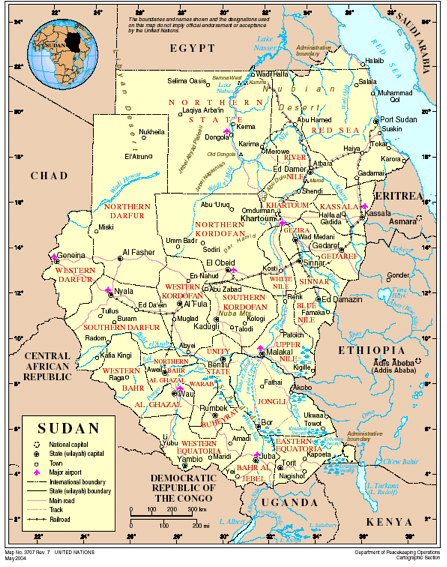

Map 2: Oil
concessions in Sudan
Source: ONGC Videsh. Operations: Sudan (5A
& 5B)
Note: The blocks with green colour constitutes
Block B, owned by Total led consortium
References
Al-Mahdi, Sadiq. Hal Anqatha Alinqilabion Asudan ?, “Did the Coup
leaders Rescued Sudan?”. Al-Haqaeq. June 18th 2006. http://www.alhaqaeq.net
BP. Statistical Review of World
Energy. 2006. http://www.bp.com/productlanding.do?categoryId=91&contentId=7017990
Connell, Dan. Sudan Recasting U.S. Policy. Foreign Policy in Focus. vol. 5, No.
40. Nov. 2000. http://www.fpif.org/fpiftxt/1498
CSIS. US Policy to End Sudan war, Report of the CSIS Task Force on U.S.-Sudan
Policy. CSIS, Washington DC 2001.
The Economist Intelligence Unit. Country Report Sudan. UK. March 2005.
Hoile, David. Farce Majeure: The Clinton Administration’s Sudan
Policy. The European – Sudanese Public Affairs Council. London. 2000.
http://www.espac.org/usa_sudan_pages/farce_majeure.asp
Jiang, Chung-lian. Oil: A new Dimension in Sino-African Relations. African Geopolitics No. 14. Spring 2004 http://www.african-geopolitics.org/home_english.htm
ONGC Videsh. Operations: Sudan (5A & 5B). http://www.ongcvidesh.com/op_sudan2.asp
ONGC Videsh. Operations: Sudan (GNOP).
http://www.ongcvidesh.com/op_sudan.asp
Patey, Luke A. A complex reality: The Strategic Behaviour of
Multinational Oil Corporations and the New Wars in Sudan. Danish Institute
for International Studies (DIIS). 2006.
http://www.diis.dk/graphics/Publications/Reports2006/lpa_complex_reality_sudan.pdf
Petronas.
Petronas Purchases Lundin Petroleum’s Interest in Sudan’s Block 5A. April 28th
2003.
http://www.petronas.com.my/internet/corp/centralrep2.nsf/frameset_news?OpenFrameset
Petronas. Petronas
Opens First Service Station, Awarded New Exploration Block in Sudan.
August, 29th 2003.
http://www.petronas.com.my/internet/corp/centralrep2.nsf/frameset_news?OpenFrameset
Petronas. Petronas Awarded First Offshore Block in
Sudan. August, 30 2005.
http://www.petronas.com.my/internet/corp/centralrep2.nsf/frameset_news?OpenFrameset
Reuters,
Sudan Says “Abundant” Oil found in war torn Darfur. April 19th 2005.
http://sudantribune.com/article_impr.php3?id_article=9147
Reuters, “Sudan opens oil pipeline able to pump 500,000 bpd”, April 10th
2006. http://www.sudantribune.com/article.php3?id_article=14988
Sayed A., Asser. Addawr Elamriki Fi Mushkilat Janob Asudan,”The American
Role in The Southern Sudan Question”. Aljazeera Net. 2004 ( In Arabic)
http://www.aljazeera.net/NR/exeres/E55B739F-8EC4-4BFC-BDF5-12889A9717AE.htm
Sha’rawi, Helmi. Almasa’la Asudaniya: Ro’ya Men Aljanoub, “The
Sudanese Question: The vision From the South”. AARC. Cairo. ( In Arabic)
http://www.aarcegypt.org/arc10/other-studies/file/files/ALMCAALA%20ALCWDNYA.doc
Sudanese Petroleum Corporation. Statistics: Blocks Details.
http://spc.sd/table1.php
Total. History and News:History of Total’s Presence in Sudan. 2006
U.S. Department of State. Sudan Peace Act. Washington DC.
Oct. 2002. http://www.state.gov/documents/organization/19897.pdf
Verney, Peter.
Raising the Stakes: Oil and Conflict in Sudan. Sudan Update.UK.
1999
Zweig, David and Jianhai, Bi. China’s Global Hunt for Energy. Foreign
Affairs, vol.84 Issue 5, Sep/Oct 2005.