|
The War Economy of Iraq
Christopher Parker and Pete W. Moore
Christopher Parker is assistant professor of political and
social science at Ghent University in Belgium. Pete W. Moore is
associate professor of political science at Case Western Reserve
University.
|
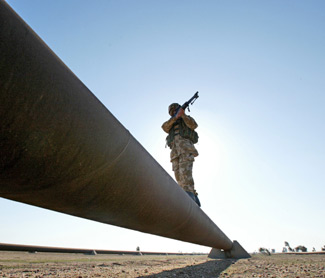
British Soldier on patrol in Basra province. (Toby
Melville/Reuters/Landov) |
On
May 26, 2003, L. Paul Bremer declared Iraq “open for business.”
Four years on, business is booming, albeit not as the former head of
the Coalition Provisional Authority intended. Iraqis find themselves
at the center of a regional political economy transformed by war.
Instability has generated skyrocketing oil prices, and as US
attitudes to Arab investment have hardened in the wake of the
September 11 attacks, investors from the oil-producing Gulf
countries are seeking opportunities closer to home. This money,
together with the resources being pumped in to prop up the US
occupation, is fueling an orgy of speculation and elite consumption
in the countries surrounding Iraq. The sheer volume of loose change
jingling around the Middle East would be potentially destabilizing
even if fighting did not persist in Bremer’s erstwhile
domain.
War
and profit have always gone hand in hand. In Iraq, as well, a “war
economy” is firmly rooted, yet it has gone largely unexamined in the
stacks of books and articles dissecting Washington’s grandiose
venture gone bad. Armed with ideological assumptions and economic
quick fixes, US occupation officials pursued policies that, at a
minimum, aggravated the severe social dislocation wrought by war,
privatization and sanctions before 2003. Today, militias supporting
or opposing the Iraq government—not the government itself—control
import supply chains and, indeed, regulate whole sectors of the
Iraqi economy. At the same time, the people who earned a living
through the antecedent networks of the war economy are attacking the
new US-sponsored political order. These insurgents include not only
those “Iraqis who miss the privileged status they had under the
regime of Saddam Hussein,” as President George W. Bush would have
it, but also—indeed mostly—ordinary working people who are
protecting livelihoods they built in the shadow of Baathist
dictatorship. Countless other civilians are caught in the crossfire
as the struggle to make ends meet has become deeply
politicized.
Evidence of Iraq’s war economy is fragmentary. Amman—arguably
the city where the business of occupied Baghdad is really done—is a
veritable rumor mill. Leads are difficult to follow and confirm, as
the individuals involved are wary of admitting to war profiteering
and economic data are uneven. But the fragments start to form a
recognizable pattern when set in a comparative frame. The Iraqi case
fits well within the large scholarly literature on the economics of
civil war. Not all civil conflicts are the same, of course; some end
quickly, while others endure. When available evidence on Iraq is
compared with the lengthy civil wars in Lebanon from 1975–1991
and in Algeria in the 1990s, ominous parallels come into view.
During those civil wars, much of the money to fund militias and
state-sanctioned violence alike came from the control of external
trade and the taxation of regions under militia or state control.
These dynamics did not simply emerge in the chaos of war, but were
grounded in longer trajectories of international involvement, state
atrophy and grassroots political economy.
The
US project in Iraq, nothing less than a forced revolution, was more
radical in its means than in its way of viewing the political world.
And while today’s deepening war economy certainly owes a great deal
to the early zeal with which US officials sought to remake Iraq as a
free marketeer’s paradise, any eventual autopsy of the Bush
administration’s imperial fiasco needs to cut deeper than the
blunders of Bremer and his subordinates to reveal the fundamental
failures of political imagination that lay beneath.
Iraq Beyond Saddam
“In
Iraq, the US fights an enemy it hardly knows,” wrote the
International Crisis Group in the executive summary of a 2006
report. “Its descriptions have relied on gross approximations and
crude categories (Saddamists, Islamo-fascists and the like) that
bear only passing resemblance to reality.”[1] Over a year later, US and British officials
from Bush and Prime Minister Tony Blair on down continue to speak in
stereotypes when describing the guerrillas’ motivations. Washing
their hands of any responsibility for the violence that plagues
Iraq, they present the insurgency as springing from a yearning for
lost domination on the part of groups linked to the Saddam-era
state. This is the statist narrative—the idea that Saddam’s regime
controlled everything worth controlling before it was overthrown.
More amorphously, mainstream analysts trace the insurgency’s origins
to the aggrieved “thought world” of Iraq’s Sunni Arab community.[2] Suggesting that the insurgency is rooted in
the “majoritarian mindset” of Iraq’s Sunni Arabs, Fouad Ajami
further notices a Sunni Arab susceptibility to the “dark appeal” of
revived histories that dredge up anti-Shi‘i prejudices and “the
panic of a community that fears it could be left with a ‘realm of
gravel and sand.’”[3]
To
be sure, sectarian fears and religious extremism—as well as foreign
occupation—are powerful causes of the ongoing violence, but the
sectarian narrative renders invisible the everyday concerns and
struggles of people trying to survive in conditions of war. It makes
more sense to locate the roots of resistance and intra-Iraqi
violence in structures of collective action and social regulation
that took shape over the course of the 1980–1988 Iran-Iraq war, and
were consolidated during the state’s economic opening in the 1980s
and the early years of the UN sanctions. Clearly, and contrary to
the assumptions of the statist narrative, the state retreated
considerably from the economy over the last two decades of Baathist
rule, a period that also witnessed plummeting standards of living
for ordinary Iraqis. Yet the social reverberations of these economic
upheavals are rarely considered.
Mainstream accounts of the 1980s and 1990s preserve the
centrality of the state by charting the rise of what Charles Tripp
has referred to as the “shadow state”—a web of informally regulated
networks that leveraged statist agency (e.g., the ability to make
and enforce internationally binding contracts or employ nominally
legitimate coercion) to create domestic enclaves for the private
accumulation of capital and power.[4] Even as the state’s formal regulatory powers
began to shrink during the 1980s, the social impressions left by a
legacy of rent-fueled state centralization and militarization
remained to preserve the essence of Saddam’s power. This narrative
is certainly persuasive as far as it goes. But the tendency to
present the regime, however formally weakened, as the programmer of
economic and social activity elides the agency of the Iraq—some 27
million Iraqis, in fact—beyond Saddam. As statist agency receded, it
was replaced by conditions of multiple jurisdiction and sovereignty:
Localized social structures, transnational trade networks and a
globalized sanctions regime came together to create new economic
opportunities and impose new constraints. Nevertheless, even if “the
regime” as such controlled less than conventional analysis would
suggest, central regime figures were elevated by their ability to
mobilize the state’s remaining powers and control oil resources. In
other words, the regime was able to dominate, but not necessarily in
ways of its own choosing. Understanding the relationship between
conflict and economy in contemporary Iraq requires a recounting of
the rapid economic decline in the 1980s and 1990s.
In
1980, Iraq was a net creditor and considered home to one of the
region’s most advanced economies. By early March 2003, as US
and British forces amassed on its southern border, it had become one
of the world’s poorest and most underdeveloped countries. Average
annual income had fallen from between $3,600 and $4,000 in 1980 to
between $500 and $600 by the end of 2003.[5] On the eve of the invasion, Time
reported: “Industry has ceased to exist and unemployment may be
as high as 50 percent. The agricultural sector is in
complete disarray, leaving more than 60 percent of the
population to rely on the UN Oil for Food program [for basic needs].
About 40 percent of the nation’s children are suffering from
malnutrition.”[6]
This
dramatic decline in living standards coincided with a long
deterioration of Iraq’s major industries. In the first year of the
Iran-Iraq war, oil production fell from 3.4 million barrels per day
to just under a million.[7] Oil revenues continued to drop off for the
duration of the conflict—totaling $11 billion, less than half the
pre-war amount, in 1988—while military spending remained high.[8] The result was the increase of foreign debt to
over $80 billion by 1988, the draining of foreign reserves and the
abandonment of development projects.[9] The war also led to a wider militarization of
Iraq’s economy, draining human and financial resources away from
manufacturing and agriculture. By the time the war with Iran ended,
more than 20 percent of the labor force—over one million
people—were employed in Iraq’s armed forces. While Saddam claimed
victory in the war, his adventure had left a heavily indebted state
with a physical infrastructure in great need of repair.
|
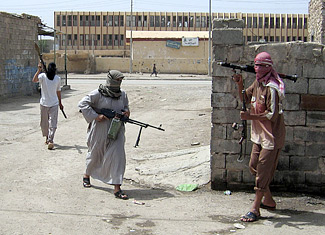
Masked insurgents on patrol in Ramadi. (Ali
Mashadani/Reuters/Landov) |
Saddam responded to the crisis of state accumulation by
implementing a sweeping program of economic liberalization
(infitah). The program had its origins in efforts at
reforming the agricultural sector in the early to mid-1980s, but its
scope and intensity increased dramatically by late 1987 and into
1988. All industries deemed non-essential to the health of state
coffers and military preparedness were jettisoned in a frenzy of
privatization. As Kiren Chaudhry notes, “Whereas Egypt’s widely
publicized infitah policy resulted in the privatization of
exactly two factories over a period of 15 years, in a single year
the Iraqi government sold 70 large factories in construction
materials and mineral extraction, food processing and light
manufacturing to the private sector.” The selloff was, if anything,
more sudden in agriculture. By 1989, 99 percent of Iraq’s
agricultural land—half of which had been state-owned since the
1960s—was either privately owned or leased from the government by
private investors on favorable terms. The main beneficiaries of
Saddam’s infitah were by and large the same people who, by
virtue of their connections to government power brokers, had
profited from the massive amounts of government spending on
construction during the oil boom of the 1970s. Laws were changed to
allow for large-scale, cross-sectoral investment, and the tax on
corporate profits was reduced to 35 percent. In the end, most
of the new captains of industry and agribusiness sacked
40–80 percent of their workers.[10] The end of the Iran-Iraq war also brought
the decommissioning of over 200,000 soldiers, who were simply put
out on the street amidst high unemployment and food
shortages.
These moves had the knock-on effect of making many state
regulatory agencies redundant, sparking massive layoffs in the
public sector and precipitating the collapse of effective economic
regulation by the state bureaucracy. Thus, while Saddam’s government
remained in control of oil and other strategic industries, and
remained the agency of necessity and choice with regard to large
investment or trade contracts with large foreign firms, broad
swathes of economic life were simply left to the vagaries of petty
market action and struggle. Meanwhile, inflation began to
skyrocket.
The
international response to Saddam’s invasion of Kuwait—a devastating
military campaign during the early months of 1991 and draconian
sanctions in place for the next 13 years—pushed Iraq’s economy from
bad to worse. More of Iraq’s economic infrastructure was destroyed
in six weeks of allied bombing than in the eight years of war with
Iran.[11] Sanctions further eroded the gross domestic
product and wrought havoc upon the personal finances and life
chances of untold numbers of Iraqis. Following the freezing of Iraqi
banks’ foreign assets and the subsequent devaluation of the dinar,
“savings of 2,000 dinars that once would have paid out $6,000 were
suddenly worth only $2.”[12] Experienced technicians and professionals
working in Iraq’s crumbling hospitals, laboratories and universities
found themselves forced to emigrate or seek income-generating
opportunities in the informal sector to make ends meet. The
precipitous decline in the number of children attending school in
the sanctions years may have caused the adult literacy rate to drop
from 80 to 58 percent.[13] In 1996, the World Health Organization
concluded that sanctions had set back Iraq’s health care system by
50 years.
Inevitably, as the ability and willingness of state officials
to govern economic life through formal channels dissipated, new
configurations of regulatory power arose to take their place. These
configurations were not necessarily congruent with, or contained
within, Iraq’s borders. Transnational tribal allegiances were
mobilized to facilitate and regulate trade across international
borders. Businessmen-politicians in neighboring countries cultivated
links with members of Iraq’s Republican Guard (among others) in
order to facilitate and protect networks of transport and
distribution. And small-time trade networks emerged to profit from
differentials between countries in prices for petroleum and other
products. Major multinational corporations also took advantage of
the multiple jurisdictions. Consider the case of RJ Reynolds, whose
involvement in cigarette smuggling to Iraq was the subject of
European Union legal action in 2002. Coordinating operations from
Switzerland, home to congenial bank secrecy and business privacy
laws, the company sent master cases containing 10,000 cigarettes
each for loading and unloading at ports in Spain, from whence they
were shipped onward through holding companies in Cyprus, before
being redistributed through the free zone in Mersin, Turkey. They
were then transported over the mountains between Turkey and Iraq via
Silopi Pass, moving through the hands of agents operating in
Kurdish-controlled regions of northern Iraq before ending up at one
of the many smoke stands located along Iraq’s roads and highways.[14]
Cats of the Embargo
It
is difficult to imagine any regime surviving intact—much less
retaining statist agency in the economy—through turmoil such as that
experienced by Iraq over the past three decades. Nevertheless,
observers have been remarkably consistent in presenting capital
formation and livelihood in Saddam’s Iraq as variables strongly
determined by state intervention. As late as 2003, observers
could note that the state sector accounted for 80 percent of
Iraq’s GDP,[15] a figure which hardly measures state power
or economic centralization. Nevertheless, it is typical for an
author writing on the present day to first assert that transforming
“a centrally planned economy to a market economy” is a primary
challenge facing the engineers of change in Iraq, only to later note
that “the United States found [in Iraq] an economy that essentially
needed to be rebuilt from scratch, crushed by decades of wars,
sanctions and atrophy due to Saddam’s neglect of the population’s
needs.”[16] The contradiction apparent in these
statements reflects the degree to which emphasis on the person of
Saddam Hussein led mainstream observers to imagine the passivity,
even emptiness, of the Iraq that lay beyond his extended
circles.
Claims regarding state control over the economy tend to brush
over key facts. For example, while over 75 percent of Iraq’s
labor force remained employed in the public sector on the eve of the
March 2003 invasion, the average salary of a civil servant was only
$5 per month.[17] Similarly, while more than half of the
population was dependent upon government-controlled food rationing
during the early 1990s, these rations accounted for only
37 percent of per capita caloric intake in the pre-sanctions
era.[18] Inadequate diets and purchasing power placed
a premium upon plots of arable land and their crops. Local tribal
sheikhs were given considerable scope in the regulation of the rural
economy, and used their position and networks to expand and
diversify their economic activities. In short, the kind of formal
accounting upon which claims about the nature of economic transition
in Iraq are made obscures the importance of gray and black markets
to the simple tasks of eating and earning a living over the past two
decades.
In a
very real sense, the conditions that obtained in Iraq from the late
1980s onward resembled conditions of war. People accustomed to “a
culture of laziness” sustained by enormous oil revenues were forced
to take extraordinary measures to make ends meet.[19] Hyperinflation, massive public-sector
layoffs and food shortages shaped Iraqi society as it moved from the
dislocations of the infitah to the devastation of war to the
ruin of sanctions.
Highly profitable transnational alliances between elite
businessmen cum regime figures emerged in the 1980s and
1990s. But smaller-scale networks of trade flourished as well. In
her 1999 study of sanctions-era Iraq, Sarah Graham-Brown
noted:
The people who run the black market in both petrol and
basic foodstuffs, and luxury items like whiskey and Western
cigarettes, are actually members of the lower middle strata of
Iraqi society, hardened war profiteers who managed to survive as
soldiers and smugglers during the Iran-Iraq war as well as the
Gulf war which followed. Many of these “new elements” in society
have links with Iraq’s large and once powerful rural clans.
Coming mostly from the lower echelons of these clans, the new
merchants are both Shiites and Sunnis…. The goods they handle
are mostly smuggled from Syria, Turkey and Iran.[20]
Proprietors of small retail businesses came to rely on the
smugglers’ “taxi service” to stock their shelves. One Baghdad repair
shop owner told Joseph Braude: “My supplier sends me products via
Jordan in trucks. The driver charges you $100—but you are not paying
any tax. As for the border guards, just give them a pack of
cigarettes and a can of Coke—that’s more than enough. They will
leave you alone.”[21] Even petroleum smuggling—typically seen as
an activity requiring the resources of big players operating within
the purview of the regime—was a source of livelihood for thousands
of Iraqis operating beyond the control and surveillance of the
state. Drivers equipped their cars and trucks with extra tanks that
were filled with subsidized diesel and gasoline at filling stations
on Iraq’s border with Jordan, and then simply driven over and sold
to middlemen in Zarqa or Amman.
In
between, one could find the qitat al‑hisar—the “cats of the
embargo.” “Unlike high-ranking Baath Party hacks who lived mainly by
leveraging their government influence,” writes Braude, “the cats
engaged each other in rough-and-tumble competition in what became an
underworld’s dark meritocracy. They spanned Iraq’s ethnic and
sectarian rainbow, including many Shi‘a and Kurds. Cats hailing from
disenfranchised communities maintained a businesslike rapport with
the country’s political bosses, paying them with the bribes they
demanded in exchange for autonomy in the black market.”[22] But outside this “dark meritocracy,” the
system relied on regular working people to drive the trucks carrying
oil and other goods, walk through the mountains from Turkey with
backpacks full of cigarettes and look the other way as some aspect
of state regulatory control was subverted. These activities were not
simply individual acts of opportunism, but practices within a
grassroots political economy of meaning. Today, many of these same
people—people who can hardly be described as beneficiaries of the
Baathist regime—ply their trade under threat from new agencies,
technologies and infrastructures that have been introduced with
US-sponsored “reconstruction.” While presented in the neutral
language of development and modernization, these agents and
infrastructures are hardly politically neutral. Those whose
livelihood depended on the oil tanker trucks, for example, are now
threatened by the repair and restoration of Iraq’s pipelines. Thus
even resistance to foreign control over Iraqi oil is often motivated
by something other than nationalism.
To
date, observers have not fully taken into account how the project of
reconstituting a market in Iraq has selectively criminalized certain
socioeconomic actors and empowered others.[23] The imposition of new rules through the
barrel of a gun has abruptly rendered petty trade networks
constructed over decades untenable or even illegal. Moreover,
sovereignty in Iraq is now even more fragmented than in the 1990s.
The new Iraqi constitution allows for de jure autonomy for
geographic regions—the majority-Kurdish provinces and several
provinces in the south—that are already autonomous de facto. The
current government’s would-be monopoly on coercive violence is
distributed among US forces, Iraqi security forces and private
security contractors who are becoming an increasingly
institutionalized feature of the post-Saddam landscape. Furthermore,
Iraqi security forces have clear and overlapping ties with local
militias: Insofar as security force elements were active in the
informal economy under sanctions, army decommissioning may have
simply led to a privatization of coercive violence from below that
ironically mirrors the Bush administration’s subcontracting of war-
and occupation-related services to US firms.
On the Road
Whether cats of the embargo or regime fat cats involved in
sanctions busting on a grander scale, informal traders were but one
node in wider networks that were regional, even global in scope. It
stands to reason that these networks survived the 2003 invasion, but
the question of how the evolving war economy of Iraq is connected to
regional political economies is a tricky one. By their very nature,
such linkages are not well-advertised. Who is making the money? Who
is deciding who makes the money? In many cases the complete answer
lies outside Iraq, so one place to start is on the road.
|
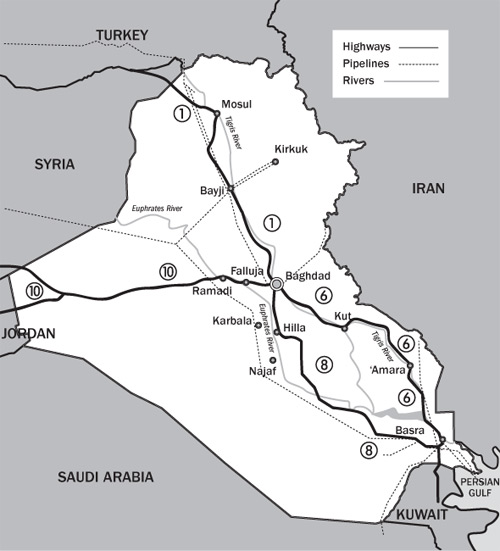
The roads, rivers and pipelines of Iraq. Only major
highways are shown. (Holly Syrrakos/Go!
Creative) |
In
Iraq today, there are three major trade routes that are the loci of
struggle between competing militias and the various agents of
occupation as they seek to shape and regulate economic exchange. The
first follows Highway 1, heading north from Baghdad through the
oil refining and industrial town of Bayji. From Bayji, the route
continues to Mosul and on toward the Syrian border. The second route
is Highway 10, which heads west from Baghdad to Amman, passing
through Falluja and Ramadi—the “Sunni heartland” of al‑Anbar
province—before traversing the vast desert. Highway 6 is the
main road from Baghdad to Basra, with way stations in Kut and
‘Amara—strongholds of Muqtada al‑Sadr’s Mahdi Army. Highway 8
offers a western passage to the south, leaving Baghdad and running
through the town of Hilla—skirting the Shi‘i shrine cities of Najaf
and Karbala’—before heading to Basra, where it meets up with
Highway 6, which continues down to Umm Qasr and Kuwait. These
towns are all noteworthy locales, as either frontier outposts along
long-distance trade routes or nodes of oil infrastructure or centers
of the rise of the Shi‘a. Bayji is also located close to the de
facto border between central Iraq and the Kurdish-regulated areas,
while Hilla and Kut are the gateways to southern Iraq. Not
coincidentally, all of these cities have been flashpoints of
conflict over the past four years.
The
importance of these trade routes cannot be overstated. Like most
Gulf countries, Iraq has been highly dependent on a full range of
consumer and industrial imports since the 1950s. Control of those
supply chains and roads facilitated the selective privatization
begun in the late 1980s, and re-exporting neighbors utilized those
same links for their own political ends. All of this trade was
organized through bilateral protocols ensuring the political control
to reward allies and punish rivals. Of course, these arrangements
were not foolproof, and so smuggling networks concentrated in border
areas thrived, especially as war and sanctions began to take their
toll and Baathist officials lost control over whole sections of the
country. In tandem—formal, state-regulated trade on top and
tolerated local smuggling at the bottom—these arrangements tied Iraq
to its neighbors in politically consequential ways. Powerful
Baathist bureaucrats leveraged their political positions to cement
connections to traders in neighboring states. Lower-level smuggling
also involved cross-border connections, though these were more based
on tribe and kinship than political power. Following Highway 10
to Jordan illuminates how these networks shaped post-2003
Iraq.
Though fears of Iranian influence, Turkish invasion and
Syrian complicity seem to dominate discussion of the external
players in Iraq’s violence, by far the most important country in
political economy terms, to the Sunni insurgency (responsible for
the vast majority of American causalities) is the Hashemite Kingdom
of Jordan. The political and social histories of modern Iraq and
Jordan are bound tightly together. The deep ties between families,
tribes, political movements and economic actors across the borders
of these two countries have a history that, by and large, has yet to
be written. While far from transparent, linkages between the
Jordanian establishment and the constituent elements of Baathist
power—together with connections to the Sunni tribes of al‑Anbar—are
less obscure.
The
war with Iran ended operations of Iraq’s only port, Umm Qasr. By
1982, Jordan’s port of ‘Aqaba became the primary location receiving
imports destined for Iraq and shipped by sea. A number of
Iraqi-Jordanian trade agreements followed, to expand ‘Aqaba’s
capacity, widen Highway 10 and establish a trucking firm to
move goods from ‘Aqaba to Baghdad. Iraq quickly became Jordan’s
largest trading partner. Officials agreed to a protocol whereby oil
priced significantly below market value was supplied to the
Jordanian government in order to fund exports back to Iraq.
Estimates of that fund vary, but reasonable estimates suggest a
value in the hundreds of millions of dollars each year.[24] Wild stories about side deals and the
general graft of the protocol decades still make the rounds in Amman
today.
Like
their Baathist counterparts, Hashemite officials in Jordan chose the
recipients of these lucrative deals. These cronies and their
supporters helped keep the Hashemite regime afloat during its own
financial storms in the 1980s and 1990s. This form of direct
political patronage coexisted alongside extra-legal forms of trade
that were also winked at. Over-invoicing of exports, false bills of
lading at the port of ‘Aqaba and substandard goods were among the
ways Jordanian and Iraqi traders increased their profits. In
addition, the trade networks supported an increasingly important
labor market in Jordan. Thus did gilded trade linkages within and
between Iraq and Jordan tie the political future of each regime to
the other.
Many
but not all of the traders and industrialists connected to Iraq,
then and now, are East Bank Jordanians (as opposed to Palestinians).
Additionally, the transportation labor dependent upon Iraq trade is
composed of lower-income, rural East Bankers located in the southern
part of the country. The economic and political rationales that
linked the Jordanian transportation labor, the Amman-based exporters
and the Sunni importers in Iraq also overlapped with and animated
tribal and religious sympathies. That some of the truckers and
small-time traders might moonlight for the black market was to be
expected. The imposition of sanctions after the invasion of Kuwait
only forced this network to craft more durable and clandestine
mechanisms of operation. Thus, it was hardly a secret that the
failure of the 1990s sanctions to impoverish Baathist elites was due
primarily to sanctions-busting trade routed through
Jordan.
On
the eve of the 2003 invasion, Highway 10 was both sinew and
symbol. It was a mainstay of the Iraqi regime’s political economy of
survival, yet also emblematic of how much its power had dissipated
and been disfigured since the 1980s. If Highway 10 is the path
to understanding Iraq before 2003, then Highway 8 heads south
into the post-2003 period.
Same Truck, Different Driver
In
2003, Highway 8 from Kuwait carried US troops and the
bureaucrats of the Coalition Provisional Authority (CPA) northward
to Baghdad. It also served as the spinal cord of the political
economy of Shi‘i militias and parties freed from Baathist control.
CPA officials came primed to supply Iraq with “the most liberal
investment regime in the entire region.”[25] What they provided instead was a regulatory
vacuum in which local networks of trade found themselves arrayed
against politically favored, well-armed agents of corporate America,
backed by the US military.
While presenting their project as introducing universal
values of free markets and good governance to Iraq, US policymakers,
CPA officials and American firms were themselves deeply implicated
in selecting the winners and losers of the new order, revealing the
deep politicization of the supposedly neutral occupation regime. In
any case, promise of access to the Iraqi market and reconstruction
projects was central to Bush administration efforts to build a
domestic and international coalition in advance of the war. By
luring into Iraq commercial actors whose interests coincided with
dominant perceptions of the US interest, policymakers no doubt
sought to erect an edifice of indirect rule without the undue burden
of direct US military, financial and diplomatic input. Indeed, in
predicting $50–100 billion in oil revenues in the first two to three
years after Saddam’s fall, ex-Deputy Defense Secretary Paul
Wolfowitz drew a picture of a self-financing (and market-regulated)
transformation, thus freeing US strategists to advance wider goals
in the region.[26]
|
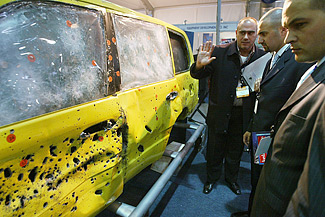
Iraqi businessmen look at a bullet-riddled armored car
during the Iraq Rebuild exhibition held in Amman, April 4,
2005. (Ali
Jarekji/Reuters/Landov) |
Bremer used this new mandate to justify implementation of a
wide-ranging agenda of neo-liberal economic reforms. In the
June 20, 2003 Wall Street Journal, he announced a
“wholesale reallocation of resources and people from state control
to private enterprise.” The makeover list included: revamping the
banking system, modernizing the stock exchange, privatizing some 120
state-owned enterprises, tax reform and removal of all restrictions
on foreign investment through suspension of all customs duties and
tariffs. The idea that free trucking and bartering generate stable
liberal politics has a spotty record in the developing world and is
a uniform failure in the Middle East,[27] but this did not deter Bremer and his staff
of experts. The viceroy himself was no stranger to political risk in
the name of profit, having set up Crisis Consulting Practice in
2001, under the umbrella of insurance company Marsh and McLennan, to
advise major corporations on investing in trouble spots. Anecdotes
about how the CPA’s neat ideological ordering of the world
eventually yielded to reality are now numerous.[28] US economic consultants arrived to find that
“street-corner money-changers, some of whom the US suspects are
linked to organized crime,” were setting the currency exchange
rates. With “no data available to crunch,” experts found themselves
reduced to “figuring out how best to stack money inside a truck.”[29] By the time of the handover in
June 2004, CPA economic and development teams were doing little
more than claiming progress on granting commerce licenses and
visiting business delegations.
Given the pre-2003 roots of the war economy, how much
responsibility do CPA policies shoulder for its maturation? The
blunders of the CPA have become lore, allowing criticism of the
project to focus on failures of execution. It is not hard to pick up
the refrain that if only the US had done this or that, the US could
have succeeded.
The
failure was not in execution, however, but in the delivery itself.
Occupation plans and security contingencies, good or bad, simply
added to the maelstrom of political, social and economic
dislocations that had already had most Iraqis feeling the pinch. Big
cats and small cats, together with American corporations and the
would-be empire builders among returning Iraqis, all saw CPA
policies for what they were, ideological fantasies, and none were
squeamish about using violence to shape the market in their favor.
Just consider the words of an Iraqi businessman quoted in internal
CPA documents: “It is nothing personal. I like you and believe you
could be bringing us a better future, but I still sympathize with
those who attack the coalition because it is not right for Iraq to
be occupied by foreign military forces.”[30]
After the dissolution of the CPA, militias appear to have
carved out or coopted their own areas of economic control and
regulation. If the Algerian and Lebanese experiences are a guide,
then these militias and underground economies are likely
interdependent. Also, far from representing forces that are somehow
excluded from or antithetical to globalization or market forces,
they are firmly linked to big players in the global economy via
connections in neighboring countries. Their trade was not simply in
oil and alcohol, but also in food and consumer goods, and with the
arrival of the CPA, they found themselves suddenly in competition
with well-positioned big traders surfing atop a tidal wave of
duty-free consumer goods and packaged meals.
Down
Highway 8, the main Shi‘i militias and parties—under the nose
of the occupying powers—have monopolistically carved up the economy
in ways that resemble the practices of their Baathist predecessors.
Media reports depict southern cities overrun with goods coming over
the border from Iran and re-exported from Gulf ports, primarily
Dubai. Control over the transportation and lodging of Shi‘i pilgrims
has reportedly been centralized by ‘Ammar al‑Hakim, son of the
powerful leader of the Supreme Islamic Iraqi Council, ‘Abd al-‘Aziz
al‑Hakim. Al-Da‘wa and Sadrist elements can logically be assumed to
be in the game as well. Below the major players, minor smugglers
shuttle smaller amounts of goods across the Iranian border.
Marshland oil smugglers amount to thousands of pinpricks that have
cut southern Iraq’s oil production in half.[31] More sophisticated pipeline attacks
underscore the links between post-2003 acts of sabotage and the
legacy of a grassroots political economy beyond the state. For most
of the past four years, such attacks have been interpreted as a
tactic for undermining the occupation. More recently, however,
observers have become aware of the economic motives for these
attacks. Throughout the 1990s, most of Iraq’s oil was
transported in relatively small tanker trucks—to Jordan and Turkey
with dispensation from Washington and undercover to Syria and the
Gulf. As the pipelines to Turkey and the Gulf were turned back on
in 2003, most of these truckers—many of whom had close ties
with, and indeed colleagues in, neighboring countries—were out of a
job. Hence, it is not surprising to learn that pipeline attacks “are
now orchestrated by [insurgents and criminal gangs] to force the
government to import and distribute as much fuel as possible using
thousands of tanker trucks.” The same news story continues: “Ibrahim
Bahr al-‘Uloum, a former oil minister, said it was obvious that
crude oil pipelines connecting the northern wells with refineries
and power plants farther south, in the Baghdad area, had been
repeatedly struck to force trucks to move the crude. Oil employees
trying to fix the pipelines had sometimes been kidnapped and killed.
Both the trucking companies and groups in the protection rackets
were probably complicit in some way, he said. ‘This is a
business for the people who are working in the trucks.’”[32]
Headed west on Highway 10 the same themes vary slightly.
Thousands of Iraqi trading companies have relocated to Amman,
drastically inflating real estate prices in the upscale
neighborhoods of the Jordanian capital. The families and finances of
former Baathist officials have followed. Re-exports from ‘Aqaba are
up, as is cross-border truck traffic to Iraq. Jordan’s massive trade
deficit is driven in large part by the increase in imports, which
are re-exported to Iraq. Today, Amman is a bizarre menagerie of war
profiteers, not so secret agents, gloomy security consultants and
former Baathists all rubbing elbows in the same upscale bars and
hotels. Interviews with businessmen in Jordan suggest that, after
initial chaos along Highway 10 from Jordan, rural insurgent
groups now protect and manage the trade through internal agreements
and with the cooperation of their Jordanian counterparts. The city
of Falluja is a notorious example of these arrangements.
Strategically located on Highway 10, Falluja is home to
many people who have strong links with their tribal kin across the
border in Jordan and Saudi Arabia. Also, the proportion of Fallujans
in the Iraqi intelligence services is reported to have been the
highest in the country.[33] This combination made Falluja a key node for
underground trade during the 1990s, and a focal point for efforts to
control trade in the post-2003 order. Against this backdrop, it is
no coincidence that the overwhelming majority of foreigners
kidnapped and held in Iraq have been truck drivers, mostly from
Turkey, Egypt and the Philippines.
It
seems most plausible that these various sources of revenue support
the insurgents and local militias as much or more than the foreign
funding vaguely claimed to exist by the US. Recently, US forces have
nodded to the possibility that economic variables are behind some of
the violence in Iraq, going so far as to present this as the basis
for a tactical alliance with erstwhile insurgents. Following a
recent visit to Iraq, Gen. James T. Conway, commandant of the Marine
Corps, reported that Sunni tribal sheikhs in Anbar had decided to
start cooperating in operations against al‑Qaeda jihadis. “Some
commanders said the extremists’ key misstep was to interfere with
the locals’ black market trading, which al‑Qaeda coopted in order to
finance itself.… Cooperation by the sheiks also has quickly created
a Sunni police force in areas where none existed before.”[34] On the surface, this would seem to be a
practical application of the “Sunni buy-in” that was much discussed
by US Embassy officials in late 2005 and early 2006. But
this surprising acknowledgement of a war economy raises some
important questions. One regards the link between jihadi involvement
in trade and connections in neighboring countries: The largely
unreported visit of around 200 tribal elders from the town of Ma‘an
in southern Jordan—a town whose population is historically invested
in long-distance overland trade between Jordan and Iraq—to pay
condolences to the family of slain jihadi leader Abu Mus‘ab
al‑Zarqawi takes on a different significance if we view it in this
light.[35] Second, one might conclude that al‑Qaeda
coopting local economic assets signals an increase, not a decrease,
in the strength of America’s number one enemy in Iraq. Attacks on
infrastructure and roads that were high in the first year and a half
after the US invasion are generally down, not because the insurgents
have retreated, but because they now control access to these assets.
Taking sides among the actors in the war economy is unlikely to
produce stability that will last beyond the departure of US
forces.
There is no US military or even diplomatic solution to the
problem of a war economy in Iraq. The reconstruction and development
plans that have accompanied the “surge” resemble warmed-over CPA
policies. Political economy changes do figure in civil conflict
resolution, but the recent historical examples are not heartening.
Luis Martinez has shown how a strong Algerian state selectively
liberalized investment in the oil sector as a means of enticing
business elements backing the Islamists to the government side.[36] In Lebanon, intra-Christian fighting,
combined with the rise of Shi‘i and Sunni business interests in the
1980s, financially squeezed militias’ business interests, paving the
path to the Ta’if agreement in 1989. In Iraq, by contrast, the
strong state died in the early 1980s, and signs of militia financial
fatigue do not appear.
In
the first two years after the US invasion, business interests,
groups and individuals who might have comprised a professional
middle class on which to build a different Iraq fled. Some of the
initial violence—the road attacks, assassinations and bombings of
civilians—was designed precisely to push out those potential rivals
to the war economy. Unintended effects of more mundane activity in
protection rackets, monopolies and weapons smuggling probably
propelled others to exit. Most of those without the means to leave
lay low and do what it takes to get by. Much of what may be rebuilt
by a weak Iraqi government or a weak US military, therefore, will
eventually fall back into the hands of the guys with the guns and
the money.
The Sorcerer’s Apprentice
|
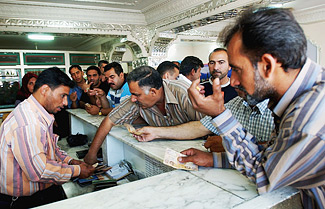
Baghdad travel agent checks passports of Iraqis looking
to leave the country, June 7, 2006. (Ali
Mashadani/Reuters/Landov) |
Queried about the chaos that reigned immediately after the
fall of Baghdad, then Defense Secretary Donald Rumsfeld rejoined,
“Freedom is untidy. People have to make mistakes.” Four years on,
there is little evidence that Bush administration officials have
learned from theirs.
Faith in the capitalist firm as an agent of transition
brought with it only unprecedented levels of graft, plunder and
incompetence. Nevertheless, in the spring of 2007 US officials
helped to fashion a new draft law that, if passed, would go a long
way toward privatizing Iraq’s oil sector. The specter of sectarian
logic—encouraged by US officials as they sought to manage the
residual passions of a political world beyond the market through
intermediaries of their own choosing—now haunts Iraqi political life
with violent consequence. And yet, walls are being built around
Baghdad neighborhoods cleansed of Sunnis or Shi‘a, partially
imprisoning the remaining residents within sectarian cages. Recent
“troop surges” correspond with an intensified campaign of bombings
in civilian areas. As of mid-2007, more than two million Iraqis have
left their country, one million have been internally displaced and
one million have been killed or wounded. Many Iraqis who might have
had the resources to resist the control of violent groups have
departed. Like Goethe’s sorcerer’s apprentice, the architects of
Iraq’s forced revolution find themselves flailing to contain the
ghosts that they themselves called into existence.
To
paraphrase de Certeau, tactics are for the poor, while strategy is
for those who make and control boundaries.[37] Part of the predicament faced by
policymakers lies in the very categories of analysis that made the
project of forced revolution thinkable in the first place. By
dividing the political world into dichotomous spheres of state and
society, regime and market, endogenous and exogenous, and so on,
transitions theory (and the invasion of Iraq was essentially
transitions theory by other means) provided categories that only
remotely corresponded with the lived experience of the Iraqis
themselves. By designating the Iraqi state, the Iraqi economy and
Iraqi society as discrete objects of transition, mainstream analysis
obscured the extent to which state, economy and society were in fact
linked to broader complexes of production and exchange that extended
far beyond Iraq’s borders. For strategists in Washington and London,
war was an instrument of reform: Actors, objects and meanings would
be detached and isolated from their milieux, making it possible to
establish new relations of power and value between them. Strategists
imagined Iraq as an entity that defined the frontiers of global
transition and newness, and they saw their project as one of opening
those frontiers to the agents of a political world remade according
to the “laws of the market.” Yet unlike the frontiers in the neatly
staged Hollywood westerns that seemingly formed the neoconservative
worldview, the frontier that they projected to contain their
strategic vision did not hold, not least because they arrived to
find that they were already there. Not only was Saddam’s Iraq made
possible by a long history of engagement by great powers and global
institutions, but the Iraq beyond Saddam was also shaped by complex
entanglements with regional and global networks of authority and
exchange. And corporate America itself proved ambivalent about the
revolutionary role assigned to it by Pentagon planners, and did not
hesitate to use US military force, political connections and graft
in the pursuit of profit.
Nevertheless, supporters of the forced revolution project
continue to present Anglo-American violence as a facilitator of
historically inevitable transformations. The violence of the
insurgent, by contrast, is presented as emanating from the recesses
of a pre-market culture. Yet the war economy in Iraq does not pit
the dark, essentialist world of the tribal smuggling networks
against the agents of an enlightened and transparent global
capitalism, nor can it be reduced to a conflict between global and
local. Rather—heightened by a peculiarly American sense of manifest
destiny—it provides an extreme example of the violence that
underpins the wider project of neoliberalism, a project that
actively seeks to transform the world in ways that make its
assumptions appear as true. Resistance to such a project is thus
likely to express itself through alternative ideological visions,
thereby projecting the frontiers of conflict in terms of a clash of
worldviews. In the face of the “creative destruction” wrought by
invading forces, regular people articulate alternative paths of
“creative destruction” that may express themselves with reference to
alternative political and economic projects, or simply arise in the
struggle to get by. Absent clear boundaries, strategy is reduced to
tactics. The agents of a war economy thus do not necessarily fight
to win as such: They are engaged within and act so as to reproduce
an emergent, constantly shifting tactical environment. Meanwhile,
there will be no single declaration of victory, no event signaling
the end of one order and the beginning of a new one. Sadly, the one
thing we can be sure of is that Bremer’s cohorts in the political
risk business will be there to profit from his mistakes.
Endnotes
[1] International Crisis Group, In Their Own
Words: Reading the Iraqi Insurgency (Brussels/Amman,
February 2006).
[2] Michael Eisenstadt and Jeffrey White,
Assessing Iraq’s Sunni Arab Insurgency (Washington, DC:
Washington Institute for Near East Policy, 2005),
p. 23.
[3] Fouad Ajami, “Heart of Darkness,” Wall Street
Journal, September 28, 2005.
[4] Charles Tripp, “Iraq: National Power and Local
Authority,” presentation at the British Society for Middle Eastern
Studies, University of Exeter, July 15, 2003.
[5] BBC News, October 10, 2003. See also
Abbas Alnasrawi, “Iraq: Economic Sanctions and Consequences,
1990–2000,” Third World Quarterly 22/2 (2001), p. 215.
According to Alnasrawi, “GDP per capita in 1999 was estimated to be
$883 in 1990 dollars compared with the $6,151 that obtained in
1980.”
[6] Time, April 18, 2003.
[7] Alnasrawi, p. 206.
[8] Tripp, p. 248.
[9] Charles Tripp, A History of Iraq
(Cambridge: Cambridge University Press, 2002), p. 248; and
Alnasrawi, p. 207.
[10] Kiren Chaudhry, “On the Way to Market: Economic
Liberalization and Iraq’s Invasion of Kuwait,” Middle East
Report 170 (May-June 1991).
[11] Tripp, p. 261.
[12] Braude, p. 106.
[13] Richard Garfield, “Changes in Health and
Well-being in Iraq During the 1990s: What Do We Know and How Do We
Know It”(Cambridge: Campaign Against Sanctions on Iraq, 2000), pp.
32–51, cited in Alnasrawi, p. 214.
[14] See “The Cigarette ‘Transit’ Road to the
Islamic Republic of Iran and Iraq: Illicit Tobacco Trade in the
Middle East,” WHO Tobacco Control Papers, University of
California, San Francisco, 2004. See also Wall Street
Journal, October 31, 2002.
[15] Kilian Balz, “Reconstruction of Iraq: Dealing
with Legal Uncertainty,” International Bar News (June
2003).
[16] These quotes come from Bathsheba Crocker,
“Reconstructing Iraq’s Economy,” Washington Quarterly 27/4
(2004), pp. 73, 75.
[17] Braude, p. 101.
[18] Food and Agriculture Organization statistics
cited in Alnasrawi, p. 209.
[19] Braude, p. 115.
[20] Sarah Graham-Brown, Sanctioning Saddam: The
Politics of Intervention in Iraq (London:
I. B. Tauris, 1999), p. 172. Graham-Brown cites “Surviving
Sanctions,” Middle East International, June 25,
1993.
[21] Braude, p. 119.
[22] Braude, pp. 120–121.
[23] See Christopher Parker, “Livelihood,
Aggregation Problems and the Persistence of War: Reframing Iraq’s
Insurgency,” Conflict in Focus 4 (December 2004), pp.
4–9.
[24] Coalition for International Justice, Sources
of Revenue for Saddam and Sons: A Primer on the Financial
Underpinnings of the Regime in Baghdad (Washington, DC,
September 2002).
[25] Transcript of a January 18, 2004 speech by CPA
Chief Policy Officer Richard Jones (former ambassador to Kuwait),
posted at
http://www.cpa-iraq.org/transcripts/jones_kuwait.html.
[26] See Christopher Parker, “From Forced Revolution
to Failed Transition,” UNISCI Discussion Papers 12 (October
2006), especially pp. 84–90.
[27] See Pete W. Moore and Andrew Shrank, “Commerce
and Conflict: US Effort to Counter Terror with Trade May Backfire,”
Middle East Policy 10/3 (2003).
[28] See, for instance, Rajiv Chandrasekaran’s
Imperial Life in the Emerald City (New York: Random House,
2006), which follows the few CPA officials who quickly realized the
senselessness of US privatization programs.
[29] Fortune, July 7, 2003.
[30] See Pete Moore, “The Secret Iraq Documents My 8
Year-Old Found,” Salon.com, May 18, 2007.
[31] United Press International, December 15,
2006.
[32] New York Times, June 4, 2006.
[33] Nir Rosen, “Losing It,” Asia Times, July
15, 2004.
[34] Army Times, April 9, 2007.
[35] Our knowledge of this visit comes from André
Bank, personal communication to Parker, November 2006.
[36] See Luis Martinez, The Algerian Civil War:
1990–1998 (London: C. Hurst and Company, 2000).
[37] See Michel de Certeau, The Practice of
Everyday Life (Berkeley, CA: University of California
Press, 2000).

|