|
The Road to Nahr
al-Barid: Lebanese Political
Discourse and Palestinian Civil Rights
Muhammad Ali
Khalidi and Diane Riskedahl
How long will the state
erect military checkpoints in residential areas, treating them as
though they were camps sheltering wanted people and gunmen, while
all the Palestinian camps, which shelter criminals and wanted
people, enjoy freedom of movement, politically, militarily and in
terms of security, as though they were security islands independent
of Lebanon politically, militarily and in terms of
security?
—Jibran Tuwayni, al-Nahar (July 18,
2002)
|
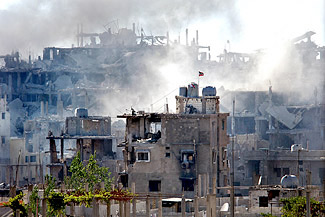
Smoke rises from Nahr al-Barid, July 12, 2007. (Paul
Taggart) |
The view
expressed by assassinated Lebanese Member of Parliament and
editorialist Jibran Tuwayni has become depressingly familiar among
Lebanese politicians since the end of the Lebanese civil war. Though
Tuwayni was a firebrand of what is now the loyalist camp in Lebanese
politics, his perspective is also shared by elements of the current
opposition, particularly members of the parliamentary bloc loyal to
former Gen. Michel Aoun. There may be more than a grain of truth in
the saying that the only thing that unites the Lebanese political
factions today is antipathy for the Palestinians living in their
midst.
The 12
Palestinian refugee camps in Lebanon, home to some 400,000 people
according to official UN figures,[1] have been perceived in the past decade and a
half as zones of lawlessness within sovereign Lebanese territory.
They are regularly described by politicians and pundits as “security
islands,” the implication being that they are regions of insecurity
in a sea of peace. Anyone who has been following events since the
civil war formally ended in 1989, of course, will know that Lebanon
has not been fully secure during this time. Moreover, the camps are
not the only parts of the country that have witnessed the occasional
violent flareup. Yet the impression persists that they are safe
havens for criminals and outlaws.
It is against
this backdrop that the summer 2007 events in the northernmost
Palestinian refugee camp of Nahr al-Barid must be seen. When
fighting broke out in and around the camp in late May, some
commentators blamed it on the fact that the camps were hotbeds of
extremism that defied all efforts by Lebanese security forces to
bring them under control. Indeed, many reports stated that the
Lebanese army and security forces were prevented from entering the
camps due to a secret agreement struck between the Lebanese army and
the Palestine Liberation Organization in Cairo in 1969. Widely known
as the Cairo Agreement, the document authorized Palestinian Armed
Struggle, a security arm of the PLO, to “undertake the task of
regulating and determining the presence of arms in the camps within
the framework of Lebanese security and the interests of the
Palestinian revolution,” according to an unofficial text that was
later leaked to the press.[2] What these press reports missed, however, was
that the agreement was officially rescinded by the Lebanese
parliament on May 21, 1987, exactly 20 years before clashes erupted
in Nahr al-Barid. There is therefore no legal barrier to the entry
of Lebanese troops into the Palestinian refugee camps. In fact,
Lebanese army checkpoints are positioned at the entrances of most
Palestinian refugee camps and Lebanese police regularly enter the
camps to arrest suspects and carry out other functions.[3]
If they are not
really the islands of insecurity that they are claimed to be, why
are the refugee camps represented as such? One answer is surely that
Palestinians have long served as a convenient scapegoat upon which
to blame the civil war and Lebanon’s ills since that war came to an
end with the Ta’if Agreement in 1989. But this answer leads to
another question: If there is a serious interest in eliminating
“security islands” on the part of the state, why has the Lebanese
army not entered the Palestinian refugee camps? The answer to that
question is somewhat more complex. Arguably, in the fragmented
quasi-state that is post-war Lebanon, it suits the interests of
various groups to maintain pockets of the country that can be blamed
for outbreaks of instability. Different factions can use them to
foment unrest, while maintaining “plausible deniability” that they
are the instigators of the disturbances. The losers in this
dangerous political game are primarily the refugees
themselves.
Fatah
al-Islam
|
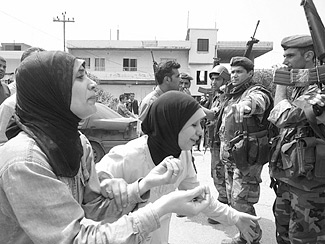
Women from Nahr al-Barid beg soldiers to allow them
back into the camp to find their husbands. (Tariq
Saleh) |
Fighting broke
out in Nahr al-Barid on May 20 after a group designating itself
Fatah al-Islam launched a dramatic nighttime raid against the
Lebanese army, resulting in the deaths of 27 Lebanese soldiers, some
of them killed in their beds. At least some of these militants then
allegedly withdrew to locations within Nahr al-Barid, prompting the
army to unleash an artillery barrage upon the refugee camp, which is
also home to some 35,000 (mainly) Palestinian civilians. The camp is
a densely packed neighborhood of ramshackle concrete buildings, some
three or four stories high. It is bordered to the east by a swath of
agricultural land and is located on the outskirts of Lebanon’s
second largest city, Tripoli.
Reports differ
widely as to the provenance and motivation of the Fatah al-Islam
group. Most accounts agree that it is composed of a few hundred
fighters of various Arab and Muslim nationalities (including
Lebanese, Syrians, Saudi Arabians and others).[4] The Lebanese opposition claims that they were
largely the creation of the loyalist Future Movement led by MP Saad
al-Hariri, while the government accuses them of being a Syrian
implant that infiltrated the country through the porous Syrian
border. Though the subsequent fighting has arguably not been in the
interest of either the government or the opposition, each side may
have had some motivation for encouraging Fatah al-Islam in the first
place and for allowing it to set up shop in Nahr al-Barid. For
pro-government forces such as the Sunni-dominated Future Movement,
there would have been a point to arming a Sunni militia to serve as
a counterweight to the Shi‘i Hizballah. The aim might not have been
to take on the powerful Hizballah militarily, but instead to strike
a bargain to disarm the Sunni militia in return for the disarmament
of Hizballah. For the opposition groups and especially their Syrian
patrons, fomenting unrest may have been desirable in order to topple
the government or put pressure upon it not to pursue its anti-Syrian
and pro-Western policies. Whatever its origin, Fatah al-Islam may
have outmaneuvered both groups and acted independently in attacking
the army and engaging it in a protracted firefight in the camp that,
at press time, was well into its third month.
Eyewitnesses
inside the camp have said that civilian casualties were heavy in the
first few days of fighting. A physician who was attending to the
wounded for the first four weeks of the conflict told us that there
were 17 civilians injured just in the first three days, and an
unknown number of dead who were not brought to clinics. Throughout
the clashes, it has been difficult to obtain precise civilian
casualty figures and it has been widely feared that many civilians
were buried in the ruins of the camp.[5] Human rights activists have warned that if
independent observers were not given access to the camp as soon as
clashes ended, the bodies of the dead might be bulldozed under the
rubble. Since fighting erupted without warning, many camp residents
were unable to flee and were caught in the crossfire. The first mass
evacuation took place on May 23, when 2,000 civilians were allowed
to leave. Subsequent days and weeks witnessed a steady stream of
evacuees, until Lebanese papers reported that all civilians had left
the camp in one final convoy on July 12, apart from the militants’
families and some “wanted” individuals.[6]
When we asked
Milad Salama, a nurse in his twenties, why civilians stayed in Nahr
al-Barid after the first outbreak of hostilities, he said: “I would
turn that question around: How could we leave?” He said no one
provided residents with the wherewithal to evacuate the camp, adding
that “evacuation was spontaneous” and took place under shelling. He
had left on June 17, after four weeks of fighting. He said that he
and an accompanying physician, Tawfiq Salih As‘ad, were the last
health professionals to evacuate the camp. Together they told a tale
of harrowing conditions inside the besieged camp. Salama personally
carried stretchers to houses that had been shelled in order to
evacuate the wounded. The alleyway outside their clinic was so
narrow that two people could scarcely pass each other, yet artillery
shells fell into it on more than one occasion. Garbage accumulated
at every corner, vermin were rife, mosquitoes swarmed everywhere,
and cases of vomiting and diarrhea were common. They gathered fuel
from parked cars to supply their single generator to keep essential
electrical equipment running and to charge mobile phones for
communication with the outside world, they ate moldy bread and drank
non-potable water, and performed their medical duties as best they
could. When they could no longer do so, they managed to get
themselves out.
All men
evacuated from the camp were detained by the Lebanese army for
interrogation. Salama described a three-day ordeal during which he
was held in detention at a military base at al-Qubba near Tripoli.
He said that 420 men and boys, some of them as young as 13, were
held in three rooms with a common bathroom. They slept on the floor,
taking turns to lie down due to overcrowding. Though he was not
physically abused or tortured, he said that some of those with him
were, merely for being bearded or wearing a kaffiyya. But all
were subject to verbal abuse, particularly “crude expressions about
the Palestinian people.” Numerous others corroborate Salama’s
account. Young men in Beirut have even been arrested and physically
abused merely for carrying Palestinian identity papers.
Model
Camp?
|
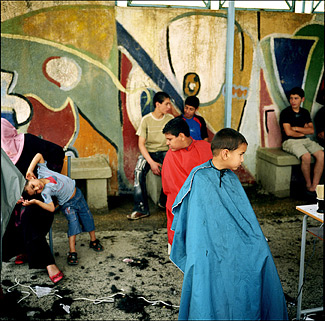
Palestinian refugees, displaced from Nahr al-Barid, in
Baddawi camp. (Philippe Brault/Oeil
Public) |
Lebanese
Defense Minister Elias Murr declared victory in Nahr al-Barid on
June 21, after a month of continuous bombardment. The fighting
showed no sign of abating, however, and wags have subsequently
compared the bold proclamation to President George W. Bush’s
ill-fated “Mission Accomplished” statement. Murr’s intent seems to
have been to declare victory, then designate all subsequent fighting
as “mopping-up operations.” But live images from the camp showed no
sign that the fighting had changed pace: Hulking artillery pieces
continued to pound the camp from the overlooking hills as helicopter
gunships strafed it from the air. The victory declaration seemed to
have been designed to appeal to a largely supportive Lebanese
public, which was hungry for a positive result after a month of
fighting, as well as to the troops themselves, whose morale could
not have been high given the relatively large number of casualties
(more than 100 soldiers dead in the first two months) sustained
against an outnumbered and besieged adversary.[7]
Even though the
Lebanese government may not have been raring for a fight with Fatah
al-Islam, very soon after the conflict began, it began to make plans
to rebuild the camp and transform it into a “model” for the other
Palestinian refugee camps in Lebanon. In the neo-liberal discourse
of the state, the most charitable interpretation of this notion
would involve converting the camp into a Potemkin village, housing
cheap Palestinian labor to replace the Syrian manual labor upon
which the Lebanese agricultural, industrial, service and
construction sectors are still heavily dependent. If the other camps
were to follow suit, they would no longer be an eyesore for the
foreign investors and tourists that the Lebanese government is so
eager to attract, and the country’s dependence on Syrian labor would
be reduced. In the more sinister reading, the government’s plans
would require transforming Nahr al-Barid and other camps into
ghettos that are constantly under the watchful eye, or more likely
the iron fist, of the intelligence services—a situation reminiscent
in some respects of the 1950s and 1960s, when Lebanese military
intelligence’s notorious Deuxième Bureau reigned supreme in the
camps.[8]
Within a couple
of weeks of the beginning of the violence, local television stations
showed Prime Minister Fuad Siniora poring over maps of the camp with
engineers and architects from the engineering consulting firm Khatib
and Alami. A move to rebuild Nahr al-Barid according to the dictates
of the Lebanese government had begun almost as soon as the conflict
began, as though the government knew that the army would embark on a
systematic destruction of the camp. But reconstruction plans do not
seem to have had the welfare of the refugees in mind and there has
been no real attempt to involve the residents of Nahr al-Barid
themselves in rebuilding the camp, an attitude that makes them
understandably nervous. At one meeting of local NGOs with
representatives from the UN Relief and Works Agency (UNRWA) in late
June, tension over this issue was palpable. Meeting near the
entrance of Baddawi camp, where many of those from Nahr al-Barid
have sought refuge, local aid workers expressed their concerns to
the UNRWA officials who are in close contact with the government.
They spoke of rumors that bulldozers were poised to enter the camps,
as soon as the guns fell silent, to raze what had not been destroyed
by military ordnance. A few weeks later, the Lebanese press reported
that bulldozers equipped with searchlights were indeed being readied
behind the front lines to destroy the remaining structures and
remove the rubble.[9]
When UNRWA
officials told those assembled that a return to the camp could only
take place some three weeks after the fighting had stopped, one
former resident of Nahr al-Barid pointed out that the people who
were displaced during Israel’s summer 2006 bombardment of Lebanon
had returned to their homes in the south within hours of the
ceasefire, and that there was no reason that Palestinian refugees
could not do the same. But another camp resident, who works for a
local NGO that runs child care centers in most of the Palestinian
refugee camps, shook her head despairingly and muttered under her
breath: “They returned because [Hizballah Secretary-General Hasan]
Nasrallah told them to. We don’t have a marja‘iyya.” In this
context, the Arabic term marja‘iyya refers to a political
leadership that can represent people’s views and respond to their
grievances.
Rights and
Return
One common
complaint among Palestinian refugees in Lebanon is lack of political
representation. The gap was thought to have been filled by the
appointment in May 2006 of Abbas Zaki of Fatah as the PLO
representative in Lebanon, a position that had been dormant for
several years. The crisis in Nahr al-Barid, however, has shown Zaki
to be very loath to criticize Lebanese policies or the conduct of
the Lebanese army. His attitude has made it all the more evident
that the Palestinian refugees need grassroots representation that
would give voice to their concerns rather than a diplomatic mission
from the Palestinian Authority to the Lebanese
government.
Rather more
pressing than the absence of political leadership is the lack of
basic civil and social rights for Palestinian refugees. Nearly 60
years after the establishment of the state of Israel displaced and
dispossessed them, Palestinians in Lebanon are still without such
basic rights as the right to employment, property ownership, health
care and social security. In a brief moment of cooperation among the
principal Lebanese political actors after the Syrian military
withdrawal in April 2005 and before Israel’s war in July-August
2006, the government took a few timid steps to change their
circumstances. Palestinians were allowed to work in some jobs
provided they were granted a work permit—whose cost is, however,
prohibitive for most of them. Most professional jobs remain closed
to Palestinians and there is no sign that that will change. Doctors
like Tawfiq As‘ad can only practice medicine within the refugee
camps; although some work clandestinely at Lebanese clinics, they
are always at risk of being fined or arrested by the
authorities.
The
justification traditionally given by Lebanese officialdom for the
deplorable conditions of Palestinian refugees is that withholding
civil rights ensures that their presence in Lebanon is temporary.
The bugbear of resettlement or naturalization (tawtin) is
regularly invoked in Lebanon to justify all manner of abuse against
Palestinians, and prohibitions on tawtin are written into the
Lebanese constitution as well as the Ta’if Agreement. But while the
vast majority of refugees themselves insist on their right to return
to Palestine, most also say that this should not preclude their
ability to enjoy basic human rights in Lebanon. Indeed, many argue
that it is only if their civil rights are granted that they can be
empowered as a community to demand redress in the context of a
regional settlement.
Lasting
Impact
Ironically, it
is not the return to Palestine, but rather the return to their
refugee camp that is now the immediate concern of the inhabitants of
Nahr al-Barid. Though this has been their consistent demand, it is
unlikely that they will be allowed to do so when the conflict is
over. The Lebanese authorities and UNRWA have cited the fact that
the camp has been mined and booby-trapped by the Fatah al-Islam
militants to justify preventing the refugees from returning to their
homes as soon as the fighting stops.[10] It has also become increasingly evident that
there will be few if any habitable buildings left to return to due
to massive artillery bombardment by the Lebanese military. The
director of UNRWA recently confirmed that the refugees would not be
allowed back quickly, saying that temporary accommodations would
have to be found for them elsewhere while the camp was being
rebuilt.[11]
Despite the
fact that most Lebanese politicians have been careful to point out
that Fatah al-Islam is not a Palestinian group and that the majority
of its members hold other nationalities, the legacy of the battle
for Nahr al-Barid is likely to be tough times for Palestinian
refugees in Lebanon. The security clampdown on Palestinians has
already been launched, leading to many cases of physical abuse.
According to Human Rights Watch, both the army and the Internal
Security Forces have engaged in wanton harassment of innocent
Palestinian civilians.[12] During a peaceful demonstration just outside
Baddawi refugee camp on June 29, two protesters were shot dead and
dozens more wounded by the army. Human Rights Watch accused the
Lebanese Army of an “unlawful use of force” and called on the
government to launch an impartial investigation into the
shooting.
The US seems as
devoted to this conflict as the Lebanese government, quickly coming
to the aid of the Lebanese army with supplies. The transfer of
military aid was effected in record time and has continued
throughout the fighting. US military hardware was first delivered on
May 25, when several transport planes flew into the Beirut airport,
carrying ammunition and equipment for the Lebanese army; the
following day more planes arrived from US military bases as well as
from US client states in the region. US military aid to Lebanon has
increased dramatically, from $40 million in 2006 to a requested
$280 million in 2007.[13] Most of this military aid is not of the type
that would help the army defend the country’s borders, such as
anti-aircraft weapons to deter the constant Israeli overflights of
Lebanese territory. Rather, it is the kind of hardware that will
enhance the army’s ability to deal with internal “disturbances,”
whose main victims are usually civilians.
The conflict in
and around the refugee camp could inaugurate a new era for Lebanon,
one of a security-obsessed regime in which all citizens are
potential suspects in an extended “war on terror.” Physical and
verbal abuse by the security forces has broadened beyond the
Palestinians to include any suspicious-looking individual,
preferably young, male, bearded and swarthy, in a Lebanese version
of racial profiling.[14] There are also clear signs of jingoism among
the general populace.[15] Despite the fact that the country is sharply
divided by a political and sectarian schism, most factions are
united in backing the army and demanding a tough clampdown on
Palestinians and other suspect elements. If Lebanon does not fall
apart due to internal strife, it may yet turn into another Middle
Eastern police state.
Endnotes
[1] Some estimates put the number of Palestinian
refugees at closer to 250,000, since their numbers have been
depleted by immigration, and to a lesser extent, by naturalization.
See Sherif Elsayed-Ali, “Palestinian Refugees in Lebanon,” Forced
Migration Review 26 (August 2006), pp. 13–14.
[2] An English translation of the agreement is posted
at http://www.dailystar.com.lb/researcharticle.asp?article_id=42.
[3] Jaber Suleiman, “The Current Political,
Organizational and Security Situation in the Palestinian Refugee
Camps of Lebanon,” Journal of Palestine Studies 29/1 (Autumn
1999).
[4] For more on events leading up to the fighting and
Fatah al-Islam’s origins, see Jim Quilty, “The Collateral Damage of
Lebanese Sovereignty,” Middle East Report Online, June 18,
2007.
[5] At press time, the numbers of dead were estimated
at 136 soldiers, at least 100 militants and at least 41 civilians.
Reuters, August 13, 2007. In addition, 65 individuals have been
detained and charged with terrorism, which carries the death penalty
in Lebanon. Al-Jazeera English, August 1, 2007.
[6] Al-Safir, July 13, 2007.
[7] In late July, army commander Michel Suleiman was
quoted as saying that Nahr al-Barid was “the toughest battle of [the
Lebanese army’s] history.” Al-Safir, July 24,
2007.
[8] The hegemony of Lebanese military intelligence
was so complete during these decades that it even affected what
schoolteachers could say in the classroom. See Rosemary Sayigh,
“Sources of Palestinian Nationalism: A Study of a Palestinian Camp
in Lebanon,” Journal of Palestine Studies 6/4 (Summer 1977),
p. 30.
[9] Al-Safir, July 13, 2007.
[10] UNRWA spokeswoman Hoda al-Turk has been quoted
as saying: “We don’t want people who survived the war to die from
UXO [unexploded ordnance] when they go back home.” IRINnews.org,
July 4, 2007.
[11] He also estimated that reconstruction costs
“will certainly run into hundreds of millions of dollars.” Reuters,
July 20, 2007.
[12] See also Sophie McNeill, “Collective Punishment
of Palestinian Civilians in Lebanon,” Electronic Lebanon,
June 22, 2007.
[13] Voice of America, May 25, 2007.
[14] See Fadi Bardawil, “Lebanese Counter-Terrorism:
Mere Side Effects,” al-Akhbar, June 9, 2007.
[Arabic]
[15] See Khaled Saghiyeh, “Support Our Troops,”
al-Akhbar, June 7, 2007 [Arabic]; Sami Hermez, “Cheering to
the Beat of the Palestinians’ Misery,” Electronic Lebanon,
May 25, 2007.

|