|
Refugees in
Limbo: The Plight of Iraqis in Bordering States
Madona
Mokbel
|

An Iraqi woman in Jordan shows the pictures of her
husband’s torture, which she carries with her at all times.
Afraid of being deported since she does not have refugee
status, she plans to show them to police as her reason for
fleeing Iraq. (Annie Tritt) |
Long lines of
Iraqis form early in the morning at the compound of a Damascus
non-profit agency that provides social services for Iraqi refugees.
About 100 men, women and children patiently wait their turn to meet
with the agency’s case workers. Some of the older women begin to
tire and move slowly away from the line to sit on benches located
along the compound’s old walls. Most of the men remain standing in
the queue. They are busy attending to their young children, while
their wives are caring for the babies. Most look anxious, and they
fidget, wary of the long wait ahead. To pass the time, some make
small talk, but generally the crowd is quiet.
Many of these
people are middle-class Iraqis who have fled their homeland to
escape the horrors of war and the ongoing sectarian violence. Ahmad
is an engineer; Wa’il is a pilot; and Samia is a schoolteacher. Now
they are merely faceless refugees whose dignity has been stripped
away; subsisting on rapidly dwindling resources, they are forced to
plead for aid. Many go to the agency to seek help for their sick,
and often traumatized, children, or to enroll them in the few
educational programs available. Others are there to request basic
staples to feed their families. But all are in desperate need of
help, and aid is slow in coming because the rest of the world seems
oblivious to their plight.
In February
2007, UN High Commissioner for Refugees António Guterres declared
the exodus of Iraqis the biggest population shift in the Middle East
since the displacement of Palestinians following the establishment
of the state of Israel in 1948. If the trend continues, the
International Organization for Migration said in the same month, the
unrelenting violence in Iraq could force an additional one million
Iraqis to flee before the year is out. Most of the Iraqi refugees
have settled in Jordan and Syria, but there are sizable communities
in other neighboring states. According to the UN High Commissioner
for Refugees (UNHCR) and local NGOs, the number of Iraqis in Jordan
and Syria is over two million, and it is estimated that about 40,000
live in Lebanon, 100,000 in Egypt, 54,000 in Iran and 10,000 in
Turkey.
The massive
flight of Iraqis has created a humanitarian crisis of dire
proportions, yet it was not until recently that governments, the UN
and the global media began to appreciate the scope of the tragedy.
Initial investigations have revealed an uprooted and destabilized
people, who fell from relative prosperity to disenfranchisement
within a short time. Many Iraqi refugees are now living on the
margins of society in the host countries, and their overall
condition is deteriorating. Most are restricted from obtaining
gainful employment, and have limited access to services such as
education and medical care. As a result, increasing numbers of
Iraqis have now depleted their savings. The extremely vulnerable
among them live in deplorable conditions, unable to meet basic needs
for shelter, sanitation, nutrition and education for their children.
In spite of these conditions, however, the majority of the exiled
Iraqi population express no desire to return to Iraq. The mayhem
they have witnessed in person back home still plays on the nightly
news, and naturally, concern for their own safety has so far
outweighed all other considerations.
Iraqi refugees
face many of the same challenges in every bordering state, but in
each state there are also distinct elements.
Jordan
|
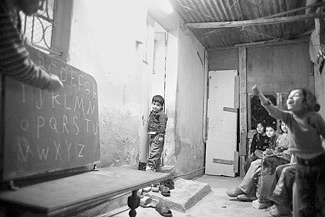
Malak (right), eager to learn, carries a book in which
she has foreigners write every word she asks about, in English
and Arabic. The family had gone to the doctor earlier in the
week and the doctor was concerned about Malak’s weight and
thought it might prevent the family from obtaining a visa.
Malak weighs just 31 pounds at age 7. It is called “failure to
thrive” and common among Iraqi children. (Annie
Tritt) |
The number of
Iraqis living in Jordan is estimated at 750,000 persons.[1] According to UNHCR, the influx of Iraqis has
leveled off somewhat in recent months, partly because of tighter
restrictions at the borders. In February 2007, Iraqis seeking entry
into Jordan were advised they must carry the recently issued new
type of Iraqi passport in order to be admitted. Due to excessive
regulations, however, countless Iraqis find these new passports
difficult to obtain, and consequently false travel documents have
begun to circulate. Diligent Jordanian customs officials are turning
away anyone carrying what appears to be a fake or illegally obtained
passport.[2] In addition, the Jordanian government has
imposed a new policy prohibiting males between 20 and 40 years of
age from entering.[3]
The Jordanian
authorities consider Iraqi asylum seekers to be “guests,” a
designation implying temporary visitor status. Through early March,
no more than 23,000 had registered with UNHCR,[4] due in part to that agency’s incapacity to
process the sheer number of people. These few registered Iraqis
could in the future benefit from the protection offered by refugee
status, as they are deemed by UNHCR to be persons of concern, thus
qualifying for UNHCR’s “durable solutions”—repatriation, integration
in the host country or resettlement to a different country. Since
Jordan has not designated any Iraqis as refugees, integration would
not seem to be a visible option, however. And the vast majority of
Iraqis in the country remain in complete legal limbo.
Jordan has
hosted Iraqi refugees since the early 1990s, including political
exiles, upper-class elites and intelligentsia fleeing Saddam
Hussein’s regime. This group is, for the most part, well-established
and relatively comfortable in Jordan. Others in the 1990s wave,
however, and most of the new arrivals, are not so prosperous. The
majority of the latest wave are from the now obliterated urban,
professional middle class, while others are laborers and farmers
from war-torn areas. Most of the refugees are Muslims, both Sunnis
and Shi‘a, but significant numbers of Christians have also fled.
Whatever their circumstances in Iraq, many refugees are now
struggling to get by because they had to leave in a hurry,
abandoning homes, possessions and most of their savings.
With a
population of only six million, Jordan is chafing at having to
absorb more than 750,000 new people, most of whom have come between
2004 and the present. Press reports attribute the overburdening of
infrastructure and social services to the increasingly large numbers
of Iraqis. Iraqis are also blamed for the rise in the cost of
housing and the greater incidence of traffic jams, among other
things, particularly in neighborhoods around the capital of Amman,
where most of them reside.[5]
Syria
|
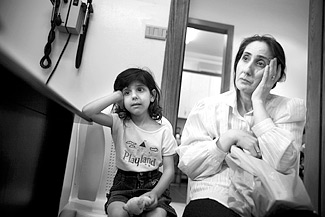
Zahra, 45, an Iraqi in Jordan, is told that no one can
help her with her breast cancer. She needs chemotherapy but
has no means of paying for it. “I am going to die,” she says.
Her daughter, Ashwaq, is diagnosed as having failure to
thrive. (Annie Tritt) |
Syria has
historically implemented relatively generous policies for Iraqi
asylum seekers, granting free admission to schools and, to a limited
extent, access to government health care facilities. As a result,
compared to other neighboring countries, Syria has the larger share
of Iraqi refugees. While exact figures are not available, the number
of Iraqis living in Syria has been estimated at 1,400,000. The bulk
of the Iraqis, many of whom have been in Syria since 2003, are
concentrated in neighborhoods in greater Damascus. There are also
other populations in locations in northern Syria, such as al-Hasaka,
Qamishli and Dayr al-Zawr. UNHCR confirms that the increasing
numbers of Iraqi refugees have made a significant impact “on Syria’s
social services, economic infrastructures and the daily lives of
many Syrian citizens.”[6] Observing this impact, the Syrian government
has implemented increasingly restrictive immigration rules and
greater limitations on access to health and social
services.
Before the
summer of 2007, most Iraqis arrived legally in Syria through the
country’s open (for citizens of Arab countries) border policy that
allowed them a six-month renewable visa. But now, according to
UNICEF, refugees get a 15-day permit; when it expires, they must
leave the country for a month before they can return. The Syrian
government has also further restricted Iraqis’ right to work
legally, and many end up working in informal sectors of the economy.
According to some reports, the unemployment rate among Iraqi
refugees is over 50 percent for men and over 80 percent
for women.[7] Syria’s policy shift created anxiety among
Iraqi refugees, because they are now at risk of deportation to Iraq.
Hence, UNHCR reports a dramatic increase in the number of Iraqis
wanting to register with the agency over the past several months. As
of March 2007, 55,000 had registered and many more were lining up
attempting to do so.[8] Upon registration at UNHCR, Iraqis are issued
a letter declaring them prima facie refugees,
qualifying them for consideration for durable solutions. Many Iraqi
refugees have expressed a strong interest in resettling to countries
in the West, creating concerns within UNHCR about a secondary
exodus.
Lebanon
|
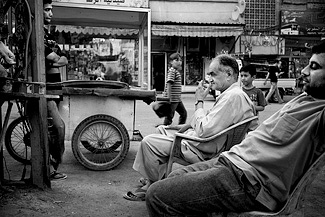
Sayyida Zaynab, Damascus. (Klavs Bo
Christensen) |
Similar to
Jordan and Syria, the numbers of Iraqi refugees in Lebanon have
risen significantly in 2006 and 2007. In early 2007, the estimated
population of Iraqis in Lebanon was approximately 40,000, up from
25,000 in the previous year.[9] There are also undisclosed numbers of Iraqis
who are smuggled over land from Syria into Lebanon. This group is
automatically barred from access to public schools and forbidden to
work.
Many
Iraqis—most of them Shi‘a fleeing Saddam’s regime—have been living
in Lebanon since the 1990s. Since 2005, there has been a steady flow
of Iraqis coming to Lebanon from central and southern Iraq. They are
mainly of middle-class background; many are Christians, although
there are sizable Shi‘i and Sunni communities. Most are single young
men, but there are also some large families. Unlike their cohorts in
Syria and Jordan, Iraqis in Lebanon are not concentrated in
particular city neighborhoods. While 80 percent of them live in
the capital, Beirut, there are significant populations in the south,
in the Bekaa Valley and in the north around Tripoli. In June 2007,
UNHCR reported that 6,500 Iraqis were registered asylum seekers, an
upsurge from the previous year. It is believed that the rise in
registration is due in part to a new UNHCR policy to give Iraqis the
prima facie status that obtains in Syria. Upon registration,
Iraqis are issued a one-year refugee certificate that confers
official status and serves as an identification document.
Furthermore, as
a result of lobbying efforts by UNHCR, in June 2006 Lebanon
implemented a policy of non-refoulement, the principle that protects
refugees from being forcibly returned to the country where their
lives may be in danger. While Lebanon has not gone so far as to give
full protection to Iraqi refugees, there is an unspoken policy of
leniency. No Iraqis have yet been deported, though many are arrested
at checkpoints and other public places, usually for lack of
identification, or because the arresting officers are not aware of
the tolerant stance the government has adopted.
Similarly,
judges may display a subjective approach to the application of
Lebanese immigration laws. Some acknowledge the refugees’
“protected” status and release them immediately, while others apply
a stricter interpretation of the law and find them guilty of
overstay. The punishment for overstay is usually one month in jail
plus a small fine. Lately, the number of detained Iraqis has grown
exponentially, increasing from as few as 50 in May to 375 in early
June.[10] The deteriorating security situation in
Lebanon is heightening suspicion of foreigners, in particular those
without legal status in the country.
Aside from
their legal predicament, Iraqis in Lebanon face high unemployment
because of government restrictions on the issuance of work permits.
In order to survive, many end up working in informal sectors of the
economy as illegal day laborers, making them vulnerable to abuse and
exploitation. Many of the jobs now filled by Iraqis were left vacant
by Syrian laborers after the Syrian army pulled out of Lebanon in
2005. Lebanon’s high cost of living, coupled with inadequate
incomes, makes it difficult for them to cover their basic needs.
Moreover, they suffer discrimination at the hands of Lebanese
citizens, many of whom face equally dim job prospects in Lebanon’s
unstable economy, rendered still shakier by the summer 2006
war.
Housing and
Education
As
non-citizens, Iraqis are not eligible for most of the benefits
offered to the nationals of these host countries. Nonetheless, their
presence in large numbers has put severe strain on the host
countries’ social, economic and health systems. There are no refugee
camps to house them; rather, they live in high-density neighborhoods
mostly in and around capital cities. Many occupy marginal housing,
paying spiraling rents for overcrowded accommodations without proper
ventilation, electricity or water. In a number of cases, report
Caritas workers in Jordan and Syria, poor housing is the direct
cause of health problems, particularly among children.
UNHCR, its
implementing partners and other NGOs have made an effort to provide
humanitarian assistance for the most vulnerable families. Caritas,
for example, offers home visits to “extremely vulnerable
individuals” during which case workers identify particular needs and
allocate assistance accordingly. (Criteria for extreme vulnerability
include mental or physical disability or trauma, being a female head
of household or single parent, being an unaccompanied elderly person
or minor, being elderly or a family with children in extreme poverty
or in need of specialized care, and being children or women victims
of violence.) The assistance can consist of repairing a broken
window, installing a lock on the door of a family home, providing
heaters, blankets and mattresses, and many other basic
necessities.
The demand for
humanitarian assistance is steadily rising because it is difficult
for the Iraqi refugees to work legally. UNHCR estimates that about
15 percent of the refugees qualify as extremely vulnerable
individuals. Their modest savings gone, some Iraqis are
contemplating secondary migration to other contiguous countries like
Egypt and Turkey, and a number of them have uprooted their families
again in search of better prospects.
Another problem
faced by many of the Iraqi refugees relates to the education of
their children. In Jordan, access to public schools was initially
restricted to those with a valid residency permit. Under
international pressure, the Jordanian government claimed several
times to have relaxed these restrictions, but the policies were
confusing and ambiguous, and several Iraqi parents reported that in
practice the restrictions remained in place.[11] Finally, after receiving funding from UNHCR
and UNICEF, Jordan announced on July 26, 2007 that all Iraqi
students could enroll in public schools. Although Syria and Lebanon
offer free access to education for school-aged children, the influx
of refugees, many of whom have large families, has given officials
pause. As the state-run al-Baath newspaper complained:
“75,000 Iraqi students have enrolled in Syrian schools…overburdening
the education sector and overcrowding schools.”[12]
Even if
accepted, many of these refugees cannot afford books and uniforms,
or transportation to get to school. Indeed, it is estimated that
about 30 percent of children in Syria are currently unable to
attend school,[13] contributing to rising delinquency among
Iraqi adolescents,[14] and boding ill for the skill and education
levels of these children in the future. The dire economic situation
of Iraqi refugees is forcing many youths to leave school and seek
menial jobs in order to supplement the family’s meager income. There
are also reports of girls as young as 12 being driven into
prostitution for the purpose of earning a living for themselves and
their families.
Another factor
explaining why Iraqi refugee children do not attend school is the
lack of official documentation issued to children by their Iraqi
schools. This paperwork is a requirement for registration in public
schools, particularly in Syria, and in many cases, Iraqi students
are being placed in lower grades than where they belong. For these
reasons, some families are forced to seek private schooling for
their children, if they can afford it. NGOs such as the
International Catholic Migration Commission, operating through
Caritas and Terre des Hommes, have been instrumental in assisting
Iraqi children with buying books and uniforms. In addition, these
organizations support non-formal education, where students are able
to acquire vocational training and other employment skills. Children
are also benefiting from recreational and educational activities
such as a weekend retreat in the countryside. It is believed by NGOs
that such interventions help keep these children from falling into
delinquent behavior.
Health and
Psychological Care
While health
care is partially subsidized in Jordan, it is not free in Syria and
Lebanon. Consequently, many Iraqi refugees are not able to afford
basic medical care. Local NGOs report a steady increase in demand
both for outpatient and inpatient assistance. To alleviate the
problem, Caritas offers subsidies of expenses like doctor fees and
medication, and the group has also established strong ties with a
number of medical institutions, including clinics located in areas
with high concentrations of refugees. In Lebanon, critical cases are
directed to private doctors, but given the high cost of health care,
preference is given to emergency intervention, as well as delivery
of babies and natal care.
In addition to
inflicting physical wounds on Iraqis, war and displacement is having
devastating psychological effects on those who have lost loved ones
or witnessed horrendous violence. Such effects were apparent among
the previous wave of displaced that left Iraq in the Saddam Hussein
years.[15] Today, NGOs report a number of refugees
fleeing the present Iraq war who complain of symptoms akin to
post-traumatic stress disorder. Care Jordan, an international NGO
operating locally, is proposing to broaden the scope of the almost
non-existent treatment programs to include more referrals to
counselors and social workers specializing in psychological care for
trauma victims.
Moreover, the
sustained contact with refugees recounting horror stories
experienced prior to leaving Iraq is having an adverse effect on the
case workers themselves. Many report having nightmares and other
post-traumatic symptoms, such as burnout and depression. They, too,
are in great need of psychological support in order to continue
serving the increasing numbers of refugees efficiently.
The Human
Face of the Tragedy
Statistics may
convey the magnitude of the Iraqi disaster, but the depth of the
human tragedy cannot be measured purely in data. The Iraqi people
are trapped in the fallout of the 2003 invasion with no prospect of
relief any time soon. Indeed, their choices are to take their
chances in Iraq, amidst the daily carnage of war and sectarian
conflict, or to migrate to a neighboring state and live without
official status, in dreary and uncertain conditions, subject to
exploitation and poverty.
The intensity
of civil war has left indelible psychological scars on the Iraqi
refugees, many of whom have witnessed horrific brutality, and, in
most cases, had one or more family members victimized or even
murdered. Husni, a storeowner from Baghdad, is one of the refugees
standing in the line at the aid agency in Damascus. He weeps while
telling of what led to his flight from Iraq. Holding his ten-year
old son’s hand, he said, “I am here to ask for diapers for my son.
He started wetting his bed after witnessing his sister and his
cousin being killed by a suicide bomber.” A haggard man standing
behind him interjects, “My mother and father were murdered in their
beds. We are Sunnis and they are targeting anyone who they suspect
of collaborating with opposing factions. But my parents were simple
folk with no political affiliation.” Another man in line, Mansour,
was a pharmacist at one of the main hospitals in Baghdad. His voice
indignant, he says, “Look at me…this is where I ended up! I am an
educated man. I had a good job back home, and now I am reduced to a
beggar! I can’t afford to buy medicine for my own sick child.”
Pointing to his wife, sitting on a bench a few feet away, he
whispers, “Her father and two brothers were killed last month by
insurgents. She is barely eating, and most times she stays in bed
not wanting to get up and face another day.”
Maryam’s name
is called. She has been waiting in line for over three hours. An
elegantly dressed middle-aged woman, she sits passively across the
table from the social worker. The dark circles around her hollow
eyes reveal deep sadness and pain. She answers the questions in an
almost inaudible monotone: She was an engineer working at the
central Baghdad power station. She was kidnapped along with four
others by armed men, who questioned her and her colleagues about
their political affiliations and accused them of directing
electricity away from Shi‘i areas. Maryam pauses for a minute, her
chest heaving as she struggles to overcome the urge to cry. Then,
with a quavering voice, she recounts the horrifying events that
followed: “One my colleagues was a young woman just out of
engineering school. The kidnappers kept touching her
inappropriately, which prompted one of my male colleagues to object.
At that point, the thugs turned to him and dragged him to the other
end of the room. He was placed in front of a machine that had hooks
and clamps. They skinned him alive…and then they took my female
friend to another room and took turns raping her. I heard her
muffled screams all night long.” Maryam is sobbing uncontrollably.
Catching her breath, she goes on to say that after she was released
two days later, she went home and hustled her elderly mother and
disabled aunt, who lived with her, off to the airport, to board the
first flight to Damascus. Later, she heard that her house was
ransacked and all her valuables stolen.
Compelling
stories like these are heard all too often at these centers. The
violence in Iraq does not discriminate between combatant or
civilian, man or woman, young or old, Sunni or Shi‘i. They are all
unwilling participants in a war that has thrown their country into
chaos and lawlessness, causing unthinkable damage and
trauma.
Scratching
the Surface
Apart from the
obvious destruction wrought by the ongoing conflict in Iraq, the
demographic disintegration of an entire country has serious
implications for the whole region. The escalating civilian death
toll of many tens of thousands, compounded by the internal
displacement of an estimated 10 percent of Iraq’s population
and the other 10–12 percent that have fled the country, are
likely irreversibly to alter Iraq’s historically established ethnic
and religious balance, as well as rob Iraq of its professionals and
other sources of economic vitality for years to come.
Moreover, the
sheer numbers of Iraqi refugees, in proportion to the population of
surrounding countries, may gravely affect the geopolitical stability
of the region, resulting in further tension, as well as social,
economic and political chaos in an area already hampered with
uncertainty and discord. Syria, Lebanon and, in particular, Jordan
already have large populations of Palestinian refugees, who (for the
most part) have been living in a limbo of their own since 1948.
Furthermore, many of Iraq’s neighbors are already dealing with
internal crises, and therefore have limited capacities to absorb
large numbers of refugees, or even to host them for any sustained
period without domestic consequences.
Short-term
repatriation prospects for these refugees are very slim, and even
with improved security in Iraq, many will undoubtedly be forced to
remain in exile for a number of reasons. Widespread killing and
destruction has left them with no family, home or job to return to,
and some may fear retribution from opposing factions or
recrimination from the new power centers.
One consequence
of the war in Iraq is the disruption of the proclaimed US vision of
a “new Middle East,” one that is democratic and enlisted in efforts
to fight terrorism. The ethnic and religious polarization in Iraq,
felt across the region because of the refugee exodus, is not
conducive to political stability and indeed may engender further
terrorism. Indeed, the Iraqi middle class usually thought necessary
for democracy to flourish will be far more difficult to rebuild when
many of its members have fled the country. In addition, middle
classes in host countries are made anxious by the masses of refugees
in their midst, who they believe are causing disruption to the
social fabric, increasing ethnic and religious divisions, and
generating competition for jobs and other scarce resources. In this
sense, the US project in Iraq may have hindered more than it helped
the cause of democracy in the region.
The unfolding
human tragedy of the Iraqi refugee crisis is great, but the greater
tragedy lays in the world’s apathy and indolence in response. The
large numbers of refugees assert a claim on their host countries’
limited resources, and increasingly tax these countries’ limited
patience and hospitality. Nonetheless, these refugees are not the
responsibility of Iraq’s neighbors, although these countries have
been forced to shoulder the main burden of hosting them.
International
aid is trickling in from Europe and the United States, but it is
only scratching the surface of this enormous and continually
mounting problem. The US, for instance, announced in March
$18 million in contributions to the work of UNHCR and other
charitable organizations operating in the region, and the European
Commission is donating ten million euros. After persistent appeals
from UNHCR, the State Department agreed to resettle about 7,000
Iraqis to the US; Canada also raised its projected intake of Iraqi
refugees from 500 to 1,400 for 2007.[16] So far Sweden has been the most welcoming,
having absorbed about 9,000 Iraqis in 2006 alone, almost half of the
22,000 that other Western nations received in that year.[17] Recent reports, however, indicate a
tightening of asylum policies there as well.[18] Unless other countries take a proactive role
in alleviating this crisis, the Iraqi refugees will remain in a
perpetual state of hopelessness, their plight potentially sending a
ripple effect throughout and well beyond the Middle East.
Endnotes
[1] Interview with Robert Breen, UNHCR representative
in Jordan, March 5, 2007.
[2] Ibid.
[3] IRINnews.org, June 17, 2007.
[4] Interview with Breen.
[5] See, for instance, Christian Science
Monitor, November 29, 2006 and Daily Star, February 20,
2007.
[6] UNHCR, Assessment on the Situation of Iraqi
Refugees in Syria, Damascus, March 2006, p. 4.
[7] US Committee for Refugees and Immigrants,
World Refugee Survey 2007 (Washington, DC, 2007).
[8] Interview with UNHCR community service officer,
Damascus, March 4, 2007.
[9] This estimate was gleaned from several sources,
including a Danish Refugee Council study in 2005, local NGO reports,
and data obtained from the Lebanese General Security Service based
on the number of visas issued to Iraqis, as well as estimates of
those who have stayed after their visas expired.
[10] BBC News, June 24, 2007.
[11] Human Rights Watch, The Silent Treatment:
Fleeing Iraq, Surviving in Jordan (New York, November 2006), pp.
58–62.
[12] Quoted at IRINnews.org, March 25,
2007.
[13] UNHCR, Iraqi Refugees in Syria, p. 32;
interview with Breen.
[14] Interview with Caritas representative, March 3,
2007.
[15] C. Gorst-Unsworth and E. Goldenberg,
“Psychological Sequelae of Torture and Organized Violence Suffered
by Refugees from Iraq: Trauma-Related Factors Compared with Social
Factors in Exile,” British Journal of Psychiatry 172
(1998).
[16] Toronto Star, March 20, 2007.
[17] New York Times, June 13,
2007.
[18] Reuters, July 6, 2007.

|