|
Imagined
Youths
Ted
Swedenburg
Ted Swedenburg, an editor of this magazine, teaches
anthropology at the University of Arkansas.
|
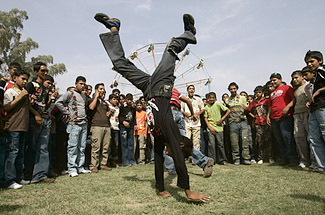
Youth gather in a Baghdad park at the end of Ramadan.
(Ceerwan Aziz/Reuters/Landov) |
Youth—what is
it? The notion tends to be taken for granted, as a natural stage in
human development. But, in fact, “youth” is a socially and
culturally determined category, a transitional phase between
childhood and adulthood that, in its contemporary form, is a product
of modernity. In the pre-modern era, adolescents were usually
regarded as troublemakers, and so it was customary to marry them off
soon after the onset of puberty, giving them adult responsibilities
in order to stave off any social threat and ensure uninterrupted
agrarian and pastoral production. The forces of modernity, and in
particular the forms of education that capitalist production
requires, have greatly extended the period of youth and delayed the
age of marriage. Youth today is typically defined as a phase in life
between the ages of 15 and 24, but in practice one’s youth knows
very fuzzy bounds. Young men in the Middle East may belong to this
social category well into their thirties, due to the economic
difficulties that many of them face in getting married.
Delayed
marriage is one of several socio-economic realities—another being
high unemployment—that has had Western observers and regional
governments worried about a youth “problem” in the Middle East for
decades. Samuel Huntington, for instance, has argued famously that
the large number of unemployed males between 15 and 30 constitute “a
natural source of instability and violence.” And poor countries are
not the only ones thought to have a problem: “Too often Muslims are
against physical labor, so they bring in Koreans and Pakistanis
while their young people remain unemployed,” mused ex-Defense
Secretary Donald Rumsfeld in one of his “snowflake” memoranda. “An
unemployed population is easy to recruit to radicalism.”[1] Such concerns have been felt as urgent because
twentieth-century public health advances have created a “youth
bulge” in the region’s demographic profile: In most countries of the
region, at least 20 percent of the population is between 15 and
24 (though, as the adjacent chart shows, such “bulges” are not
unusual in other populous, non-Western countries). The flip side of
this coin for Westerners is to see the rising generations,
“globalized” by technology and the allure of liberal capitalism, as
the agents of inexorable “change” in countries perceived as mired in
stagnation or worse.
Problem
Children
| Percentage of Population Aged 15-24
(2005) |
| Algeria |
22.6 |
| Bahrain |
16.1 |
| Egypt |
20.8 |
| Iran |
25.2 |
| Iraq |
20.1 |
| Israel |
16.1 |
| Jordan |
20.4 |
| Kuwait |
16.0 |
| Lebanon |
18.0 |
| Libya |
21.7 |
| Morocco |
21.1 |
| Oman |
21.5 |
| Palestine |
19.3 |
| Qatar |
13.9 |
| Saudi Arabia |
18.5 |
| Sudan |
20.1 |
| Syria |
23.2 |
| Tunisia |
20.9 |
| Turkey |
18.6 |
| UAE |
16.3 |
| Western Sahara |
20.1 |
| Yemen |
21.6 |
| Brazil |
18.9 |
| India |
19.3 |
| Indonesia |
19.0 |
| Mexico |
18.2 |
| Nigeria |
20.3 |
| South Africa |
20.0 |
| World |
17.1 |
| United States |
14.3 |
| Source: UN Population Division, World
Population Prospects: The 2006 Revision (2007),
www.esa.un.org/unpp. |
|
It has
frequently been claimed that the so-called youth problem of the
Middle East is essentially a demographic one: There are simply too
many of them. Typically cited as evidence are the high percentages
of young people, that in Iran in 2005, for instance, 25 percent
of the population was between 14 and 25.[2] Others argue, however, that the problem is not
so much demographics as the expectations generated by the forces of
modernization. The Middle East has witnessed a massive and rapid
increase in its educated young population, and in particular, a
dramatic growth in the number of educated females. Large numbers are
entering the labor market and are unable to find jobs commensurate
with their education. High rates of unemployment and
under-employment particularly afflict those with higher levels of
education, and such problems are exacerbated in countries undergoing
“structural adjustment,” where employment opportunities are
declining in state-owned firms and the bureaucracy. In addition,
young people who hope to become financially and socially
independent, which means finding suitable employment, leaving home
and setting up a household as part of a married couple, frequently
face critical shortages of housing. (Somewhat different problems
affect less privileged classes in both urban and rural areas, where
many young people enter the work force at an early age.) And when
marriage is, for most, the only sanctioned outlet for sexual
activity, the issue of what young people do in their spare time
becomes particularly salient for elites.
Youth were not
always perceived as a crisis in the making. During the optimistic
years that succeeded independence (as in Egypt after 1952) or
revolution (as in Iran after 1979), youth symbolized the future of
the modern nation that the state hoped to build. Whereas the older,
under-educated generation represented backwardness, the youth were
imagined to be the recipients of a modern progressive education and
the imbibers of state-propagated ideology. In Iran, youth were
regarded as the index of the success of the state in creating a true
Islamic Republic, until the success of the state’s pro-natalist
policies prompted a rethinking.[3] In Turkey during the Kemalist era, educated
youth were viewed as the main instrument of the state’s national
civilizational project.
The trajectory
of the image of youth in Turkey may be taken as an exemplary case.
During the late 1960s and early 1970s, when violent conflict erupted
on university campuses between leftist and rightist students, youth
came to be reimagined in public discourse as a “threat” to the
national interest.[4] This theme, of “dangerous” youth, has become
increasingly common in public discourse in Middle Eastern countries.
But in contrast to how the theme is understood in the West, where
youth is “dangerous” because the young are self-motivated
delinquents, in the Middle East it is more frequent for young people
to be seen as vulnerable innocents. The forces which are said to
threaten youth are various and changeable, depending on the context,
and depending on the political affiliation of the
commentator.
Westernization
is regarded across the board as one of the greatest sources of
danger to susceptible youth. Western culture and its immoral values
(related forces include Zionism and globalization) threaten youth
with the evils of HIV/AIDS, premarital sex, drugs, suicide, Satanism
and so on. A related threat is the media, held as responsible for
relaying corrupting influences to young people, and therefore film,
music, radio and satellite TV broadcasts, and the Internet are all
foci of great concern. In Egypt such dangers are usually summed up
as the “cultural invasion” (ghazw thaqafi), which foists bad
morals and “vulgar” culture—the macarena, Madonna and Michael
Jackson—upon youth, leaving them without viable national role
models, only alien and decadent ones.[5]
The Daddy
State
Symptomatic of
such perceptions about the dangerous potentiality of youth and their
need for supervision, instruction and protection is the fact that
states explicitly view themselves as surrogate parents (and
especially “fathers”) for the country’s youth. One facet of
this assumed parental role has been the establishment of Ministries
of Youth and Sports, many set up during the 1990s, for instance, the
Palestinian Authority’s in 1994 and Egypt’s in 1998. (In Tunisia,
the parallel body is known as the Ministry of Youth, Sports and
Physical Education.) The purpose of such ministries is to develop a
national youth policy and youth programs.
It is telling,
of course, that government policy and discourse links youth and
sports so intimately. Sports are regarded as a way of channeling
youthful energies into activities that are wholesome and, not
coincidentally, serve as means of bringing glory to the nation.
Saudi Arabia established the General Presidency of Youth Welfare in
1974, in part with the aim of fostering boys’ interest in sports,
and by 1994 it reportedly had established strong programs in 18,000
schools throughout the kingdom.[6] The importance that states attach to sports as
a youth policy can be gauged by the fact that such ministerial posts
are not necessarily honorary sinecures for politically unimportant
figures. Algeria’s current president, Abdelaziz Bouteflika, got his
start in government as minister of youth and sports. ‘Ali al-Din
Hilal Disouqi, who recently gave up his post as Egypt’s minister of
youth and sports, has been touted as one of the main mentors of
Gamal Mubarak, who to all appearances is being groomed to succeed
his father, Husni, as president.[7] And then there is Uday Hussein, son of former
Iraqi dictator Saddam Hussein, and his notorious tenure as head of
Iraq’s Olympic Committee and national soccer team (as well as the
youth television network Shabab).
|
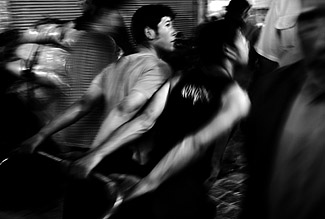
Two young porters in Tehran’s main bazaar. (Bruno
Stevens) |
States also
make great efforts to guide youth through the ideological work of
institutions devoted to education and health, conscription into the
military, and the establishment of state-directed youth and student
unions. The concern of the state, then, is not simply protection of
its youth from danger, but national and social reproduction, the
project of ensuring that young people do not deviate from the
transcendent goal of maintaining the integrity of the nation.[8]
Market
Niche
Dick Hebdige
has observed that the two key themes in modern representations of
Western youth are “youth as trouble” and “youth as fun.”[9] The images of “youth as fun” emerged amidst
post-World War II affluence and the development of the category of
the “teenager.” Such images depend on the ability of youth to
participate as independent agents in consumer culture and on the
growth of market niches targeted at youth. There is evidence to
suggest that youth are a growing target for marketers and
advertisers, particularly in the more affluent Gulf countries. The
Middle East contains some of the globe’s fastest-growing ad markets
and audiences; Dubai is the advertising hub and Saudi Arabia
contains the largest audience, while Lebanon supplies the local
creative talent.[10] The State Department has even dipped into
these waters, launching a slick lifestyle magazine in 2003 called
Hi, aimed at the same affluent Arab youth targeted by Dubai’s
advertising agencies—but apparently failing to gain enough readers,
and ad revenue, to sustain itself.[11] The glossy was “suspended” in
2005.
There is
abundant evidence to suggest that increasing numbers of Middle
Eastern youth are participating, to various degrees and in various
ways, in a globalized capitalist youth culture. Although this is
good for business, the processes of incorporation of youth as
consumers are full of contradictions and pitfalls. In Turkey, for
instance, today’s youth are regarded as shallow, individualistic,
driven by crass desires for consumption, apolitical and
insufficiently nationalist. It is common in Turkish public discourse
for young people to be found wanting in comparison to what are
regarded as the more “heroic” previous generations, especially those
of the nationalist (Kemalist) or revolutionary (“Sixties”) eras.[12] On the other hand, even supposedly
apolitical efforts to promote youth as consumers can spin out of
control, as when Saudi Arabia suspended publication of the
youth-targeted daily newspaper Shams, which was launched in
2005 and was circulated widely in Gulf states, after it reprinted
some of the cartoons of the prophet Muhammad originally appearing in
the Danish newspaper Jyllands-Posten, as part of an editorial
critical of the paper’s action.
One of the most
significant signs of the mobilization of images of youth as fun and
youth consumption is the ubiquity of the “clips” (music videos) on
Arab satellite TV (and the Internet). As Walter Armbrust shows,
hostility to these video clips on the part of pundits and
commentators is as omnipresent as the clips themselves. According to
Armbrust, typical arguments are that video clips are a form of
Western cultural hegemony that “‘make Arab youth want to become what
they can never be’” (Palestinian poet Tamim Barghouthi) and that
undermine patriarchal society through the marketing of sex, which
“‘makes marriage increasingly difficult as a practical course of
action’” (Egyptian professor ‘Abd al-Wahhab al-Massiri).[13]
|
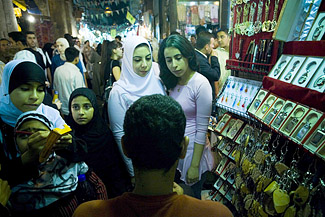
Sisters watch as an artisan prepares a personalized
pendant in the Hamidiyya souk, Damascus. (Kim
Badawi/Redux) |
Mass
consumption, therefore, even when it involves local products, can
also be regarded as posing dangers to youth or producing “youth as
trouble.” One peril is said to be that Arab youth will be tantalized
by the offerings of global culture, yet unable to afford the
commodities of their dreams or get access to public spaces in which
to enjoy the pleasures associated with such products.
Limits of
Disaffection
The discourses
of the state, the mass media, pundits and professional commentators
tend, on the whole, to position Middle Eastern youth as lacking in
agency, needing protection and requiring the tutelage of state
institutions, experts and the nationalist intelligentsia. While such
discourses are correct in their understanding that youth are in a
position of dependency on their elders and the institutions they
control, what about youths’ own motivations and desires?
One of the
countries whose youth have received the most attention is Iran.
Roxanne Varzi, in her important ethnography on Iranian youth, finds
widespread disaffection for the ideology of the Islamic Republic
among the middle-class youth of northern Tehran. While showing how
such youth deploy various features of Western popular culture in
expressing their dissent, Varzi is careful to avoid the trap of many
Western observers who see such Iranian youth as so intensely
disaffected that they are all secular and Westernized. Varzi
demonstrates, on the contrary, that middle-class youth have been
molded by the Iranian state project of religiosity. Religion is very
much a part of their lives, and their expressions of resistance,
rather than being external to them. For instance, one of the modes
of disaffection is an embrace of what Varzi labels “Sufi cool” by
long-haired, bohemian Iranian youth. The state has responded by
producing its own brand of mystical pop music in an effort to
appropriate and compete with Islamic practices outside its
control.[14] In addition, young people in the northern
suburbs typically use Shi‘i religious rituals like ‘Ashura as
occasions to mingle freely and publicly with the opposite sex,
turning such events into street parties. Similar things occur at
mulids (saints’ days) in Cairo, in this case, among youth of
working-class and lower middle-class backgrounds, as depicted in
Yousry Nasrallah’s 1995 documentary, On Boys, Girls and the
Veil.
Marc
Schade-Poulsen’s important ethnographic work in Oran, Algeria in the
early 1990s likewise avoids the errors made by many Western
observers of rai music, who tend to view it, like rock ‘n’ roll, as
a youth-based cultural movement striking blows against the
puritanical and conservative practices supported by an authoritarian
state and backward, intolerant religious mandarins. Schade-Poulsen
demonstrates that there is no inherent contradiction between
listening to rai music and being a believing Muslim, despite the
violent antagonism toward rai artists on the part of some militant
Islamists. And while rai music is associated with youth in Oran, it
is by no means exclusively consumed by them, but, in different ways,
by all generations, and especially, and collectively, at weddings.
Moreover, rai music is not “authored” by young musicians but by
older producers and established studio musicians, and is mostly
performed in nightclubs frequented by well-off adults, rather than
young people who have little disposable cash. For young men in Oran,
rai is not exactly “rebel music” à la punk or reggae; rather, its
lyrics represent a means by which they negotiate the difficulties
they face in meeting and dealing with young women, at a time when
women, as a result of modern education and employment, wield more
social power than in the past.[15]
Armbrust’s
examination of the discourses surrounding video clips likewise
demonstrates the importance of avoiding simplistic stereotypes when
it comes to youth culture and consumption. While many local
observers condemn the clips as corrupting, and Western observers
often view them as sticking it to the man (through depictions of
liberated sexuality), Armbrust shows that the reality is much more
complicated. The video flow includes not only the celebrated (and
maligned) gyrations of sexpots Haifa Wehbe and Elissa, but also the
“family values” clips of ‘Ali Gawhar and clips of the massively
popular Sami Yusuf, which use “pop” conventions to articulate
messages of Islamic piety and devotion.
|

Moroccan rappers Fati Show and DJ Dees rehearsing at a
Casablanca nightclub. (Thomas
Vanhaute) |
All this
suggests the need for careful study of the daily lives of young
people, but also a caution against focusing on the spectacular or
relying overly upon Western models. A spate of articles and books,
for instance, has suggested that Iran’s young people are
overwhelmingly secular and thirsty for Western commodities and
lifestyles. These youth are believed to represent the best hope that
Iran will abandon its fundamentalist ways and rejoin the civilized
community of nations. An analytical focus on Iranian rappers and
young women wearing makeup and allowing their headscarves to slip to
reveal frosted hair obscures a more complicated reality. Young
volunteers man the paramilitary basij, which is on the front
lines of the Islamic Republic’s struggle against “immoral” behavior,
particularly on the part of privileged youth. This is one indicator
of the regime’s continued support among many lower and working-class
youth. Moreover, Iranian university students may be disenchanted but
they are essentially apolitical. They are mostly concerned with
quotidian goals such as landing a job or getting admitted to
graduate school. In fact, 150,000 Iranian professionals leave the
country each year, giving Iran one of the highest rates of “brain
drain” in the Middle East.[16]
Given the
severe limitations on youth incomes, the paucity of public spaces
for youth leisure and the nervousness on the part of authoritarian
states about congregations of young people, “oppositional” youth
movements are unlikely to take the same forms as youth subcultures
in the West. Other Western frames of analysis of youth, such as the
notion of the “generation gap,” can likewise be misleading. As Varzi
shows, for instance, secular youth in upscale precincts of Tehran
rely on the discretion and permission of their parents when they
organize private parties in their homes that sometimes involve
mixed-gender socializing, live music and consumption of alcohol.[17] Claims that mass consumption and access to
the trappings of globalized youth culture will necessarily make
young people materialistic, individualistic, apolitical and lacking
in social consciousness are equally dubious. Palestinian youth who
have embraced rap music, for instance, have typically deployed this
art form to articulate fiercely nationalistic political concerns.
And Turkish youth, widely criticized for their selfish consumerism,
turned out to be at the forefront of relief efforts in the wake of
the Marmara earthquake of 1999.[18]
Liberators
in Trouble
The theme of
“youth as trouble” emerges most clearly—and the fears of Western
observers and Middle Eastern states converge—with regard to militant
Islamism, the supreme ill from which young people must be protected
(or else). In the minds of Westerners prone to “clash of
civilizations” thinking, the supposed susceptibility of Middle
Eastern youth to radical Islam is the factor that most calls into
question the belief that youth will set the region free. If not even
the new generation can be trusted to embrace
“moderation”—acquiescence in the US-sponsored liberal capitalist
order—then there is no hope of coexistence. In the words of Thomas
Friedman, “Young Israelis dream of being inventors, and their role
models are the Israeli innovators who made it to the Nasdaq.
Hizballah youth dream of being martyrs, and their role models are
Islamic militants who made it to the Next World.”[19] In the Middle East, the young may not be
seen as irredeemable, but they are no less at risk: The success of
Muslim “extremists” is often attributed to their ability to prey on
youth, in particular, underprivileged young men who are sexually
frustrated due to their inability to afford the costs of marriage. A
paradigmatic example of such representation in Egypt is the 1994 hit
film The Terrorist (al-Irhabi), in which the young
terrorist (played by the not so young ‘Adil Imam) is recruited when
the Islamist group promises him a wife in return for fulfilling an
assassination mission.
More broadly,
there is a tension in dominant discourses about youth between seeing
them as victims or perpetrators of violence. Consider the great
outrage and distress in the West over Palestinians’ “use” of
children in the first year of the second intifada,
culminating in Palestinian spokespeople being forced to argue that
Palestinian mothers actually do love their children and do not send
them out to force the Israeli army to shoot them. On the one hand,
the denial of agency to the youngest stone throwers allowed
Westerners (and Israelis) to locate the cause of the children’s
victimhood in a flaw of Palestinian culture, rather than the
occupation. On the other hand, the older “stone-throwing youths” of
a thousand wire photos—having acquired agency by dint of their
age—were regarded as purveyors of violence, not victims. This
episode also serves as a reminder that, for Middle Eastern states
worried about their youth problem, the project of national
reproduction has always been managed within an international arena
of (Euro-American) expectation that judges the modernity of other
countries by how those deemed vulnerable are treated. The
category of the vulnerable in the Middle East includes women and
ethnic minorities (Jews, Berbers, Kurds), but also the young. When
Middle Eastern states are judged incompetent in their care for
youth, the response of the West may be to assert surrogate parental
rights of its own, intervening directly to save the
madrasa-bound boys and unschooled girls of Afghanistan, or
encouraging the students of Iranian universities to rebel against
their elders.
In the
post-September 11 era, indeed, the sheer numbers of Middle Eastern
youth have been cited as the Achilles’ heel of the existing
non-democratic order in the region. It has become a media truism,
for instance, that 60 percent of Iran’s population of
70 million is less than 30 years of age, including a
substantial cohort born well after the 1979 revolution. This fact is
frequently adduced to imply that hardline clerical rule has no
future.[20] In a sign that such hopes have not faded in
Foggy Bottom, the State Department has lately employed one Jared
Cohen, 26, author of Children of Jihad: A Young American’s
Travels Among the Youth of the Middle East, to advise its policy
planning staff on how to “divert the world’s impressionable youth
away from ‘illicit actors.’” Cohen told a New Yorker
profiler: “I always say that the largest party in every country—the
largest opposition group in every country—is the youth party.”[21] Yet following the 2005 election of President
Mahmoud Ahmadinejad, which consolidated all the branches of the
Iranian government under conservative control, Iranian youth have
largely been relegated to the role of victim in Western discourse.
“Iran’s youth are as talented as young Indians and Chinese, but they
have no chance to show it,” the ever quotable Friedman has lamented.
“Iran has been reduced to selling its natural resources to India and
China—so Chinese and Indian youth can invent the future, while
Iran’s young people are trapped in the past.”[22] It is a short distance from this avuncular
solicitude to the proposition that Iranian youth could reclaim their
agency—with a helpful nudge from outside.
Youth in the
Middle East are burdened with authoritarian states, corruption and
nepotism that circumscribe their life chances, as well as structural
socio-economic crisis stemming from the failures of state-led
development and the systemic inequalities of global capitalism. Not
the least of their burdens, however, are the expectations and
imprecations generated by the “youth” of the elite imagination. In
the manner of youth everywhere, young Middle Easterners can be
expected to heed the paternalism of their governments and the
projections of outsiders unevenly at best, as they strive to fulfill
their own aspirations, whether they are emancipatory, mundane or
somewhere in between.
Author’s
Note: Thanks to Lori Allen, Arang Keshavarzian and Paul
Silverstein for their helpful and timely suggestions and
comments.
Endnotes
[1] Washington Post, November 1,
2007.
[2] Farzaneh Roudi-Fahimi and Mary Mederios Kent,
“Challenges and Opportunities: The Population of the Middle East and
North Africa,” Population Bulletin 62/2 (June 2007), p. 15.
Future generations can expect to encounter different sorts of
problems, given that the birth rate in many Middle Eastern countries
has declined significantly, in some cases close to European
levels.
[3] Roxanne Varzi, Warring Souls: Youth, Media and
Martyrdom in Post-Revolution Iran (Durham, NC: Duke University
Press, 2006), p. 11.
[4] Leyla Neyzi, “Object or Subject? The Paradox of
‘Youth’ in Turkey,” International Journal of Middle East
Studies 33/3 (August 2001), p. 420.
[5] A mild version of this argument appears in Galal
Amin, Whatever Happened to the Egyptians? (Cairo: Dar
al-Hilal, 1998). [Arabic]
[6] Brian Clark, “A Cupful of Pride,” Saudi Aramco
World (September/October 1994).
[7] New York Times, October 3,
2002.
[8] On this process in Algeria, see Kamel Rarrbo,
L’Algérie et sa jeunesse: Marginalisations sociales et désarroi
culturel (Paris: Harmattan, 1995).
[9] Dick Hebdige, Hiding in the Light (London:
Routledge, 1998).
[10] Tim Burrowes, “Middle Eastern Promise,”
Campaign, May 26, 2006.
[11] Elliott Colla and Chris Toensing, “Never Too
Soon to Say Goodbye to Hi,” Middle East Report Online
(May 2003).
[12] Neyzi, p. 424.
[13] See Walter Armbrust, “What Would Sayyid Qutb
Say? Some Reflections on Video Clips,” Transnational Broadcasting
Studies 14 (Spring 2005).
[14] Varzi, pp. 21, 133, 136.
[15] Marc Schade-Poulsen, Men and Popular Music
in Algeria: The Social Significance of Rai (Austin, TX:
University of Texas Press, 1999).
[16] Kaveh Basmenji, Tehran Blues: How Iranian
Youth Rebelled Against Iran’s Founding Fathers (London: Saqi
Books, 2005), p. 316.
[17] Varzi, p. 166.
[18] Neyzi, p. 426.
[19] Thomas Friedman, “Buffett and Hizballah’s
Surprise War,” New York Times, August 9, 2006.
[20] See, for example, Christian Science
Monitor, June 16, 2003.
[21] Jesse Lichtenstein, “Condi’s Party Starter,”
New Yorker, November 5, 2007.
[22] Thomas Friedman, “A Shah with a Turban,” New
York Times, December 23, 2005.

|