|
|
Home >Country Analysis Briefs >Iraq |
 |
|
|
Home >Country Analysis Briefs >Iraq |
|
|
Page Links |
Iraq Note:
The information contained in this report is the best available as of
September 2001 and can change. Also, please click here for a complete chronology of
events pertaining to Iraq from 1980 through 2001.
On
February 26, 2001, US Secretary of State Colin Powell proposed a
modification of sanctions on Iraq, more carefully targeting them towards
military items sought by the Iraqi government, while allowing freer
movement of civilian goods. In early May, Powell stated that the United
States wanted "to revise the sanctions policy so that it is directed
exclusively at preventing Iraq from a military buildup and developing
weapons of mass destruction." In early July 2001, facing an almost certain
Russian veto, the UN Security Council agreed to postpone indefinitely a
vote on the U.S. "smart sanctions" plan, and extended the oil-for-food
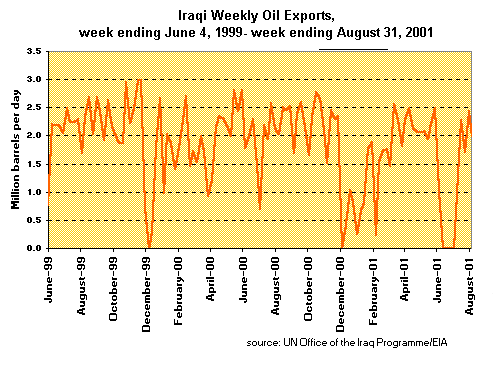
program another 5 months. Following this, Iraq resumed oil exports, which
it had halted on June 4 in protest of the plan.
As of late
September 2001, a dispute within the UN Security Council continued over a
U.K. proposal (supported by the United States) to alter the duration (from
30 days to 15 days) whereby Iraqi oil prices are set. The United States
and the United Kingdom are concerned that Iraq is using oil price
fluctuations to impose a de facto surcharge on oil purchasers, and that
this money goes directly to the Iraqi government outside of UN control. As
in the case of the "smart sanctions" proposal, Russia once again is
supporting Iraq and blocking the U.K.-U.S. proposal. The United States and
the United Kingdom also are attempting to stop Iraq from forcing buyers to
pay a $0.30-$0.60 per barrel surcharge, paid directly to the Iraqi
government.
On October
31, 2000, the UN Sanctions Committee approved an Iraqi request to be paid
in Euros, rather than U.S. dollars, for oil exported under the "oil for
food" program. On November 16, Iraq's State Oil Marketing Organization
(SOMO) demanded that companies lifting cargoes of Iraqi crude oil begin
paying a fifty cent per barrel surcharge directly to the Iraqi government
(in violation of UN sanctions) starting on December 1, 2000. On December
13, Iraq resumed exports of crude oil after a disruption of nearly two
weeks due to a dispute over this issue. In April 2001, the US State
Department urged US oil companies to "take all necessary steps to ensure
that any Iraqi-origin crude you acquire has not been tainted by the
payment...of an illegal surcharge."
Iraq has
been working in recent months to improve relations with a number of
countries, with mixed results. In late August 2000, Venezuela's President
Hugo Chavez met with Saddam Hussein, a move that was strongly condemned by
the United States. In November 2000, Saudi Arabia opened a border crossing
point with Iraq to facilitate Saudi exports to Iraq under the United
Nations "oil for food" program. The land border had been closed since the
Iraqi invasion of Kuwait in 1990. In January 2001, Iraq signed free-trade
deals with Egypt and Syria, and in August 2001, Syria's Prime Minister
visited Baghdad. In April 2001, Iraqi Vice President Taha Hussein Ramadan
met Russian President Vladimir Putin, the highest-level Iraqi-Russian
contact in several years. In June 2001, however, in an apparent blow to
Iraqi-Saudi relations, Saudi Arabia announced that it had seized ownership
of the 1.6-million-barrel-per-day IPSA pipeline that had carried Iraqi
crude oil to the Saudi Red Sea port of Yanbu (Mu'jiz) prior to Iraq's
invasion of Kuwait. The seizure included pumping stations, storage tanks,
and the maritime terminal. Saudi Arabia claimed that the pipeline was
confiscated as a result of aggressive Iraqi actions. Iraq insisted that it
still owned the pipeline. In another negative development, in September
2001, Iraq's foreign minister, Dr. Naji Sabri, warned Kuwait over oil
production near the Iraqi-Kuwait border, specifically at the al-Rakba
field, an extension of Iraq's al-Rumaila field.
In
November 2000, numerous press reports indicated that Syria and Iraq had
reopened the 552-mile-long, Kirkuk-Banias pipeline, with the Middle East
Economic Digest (MEED) reporting initial deliveries of Iraqi crude oil
through the line (and also possibly by rail) at around 140,000-150,000
bbl/d (capacity prior to 1982 was 300,000 bbl/d). The oil, most likely
Basra Light, reportedly is being used in Syrian domestic refineries, thus
freeing up more Syrian oil for export to world markets, earning Syria
extra hard currency oil export revenues (and also earning Saddam Hussein
significant revenues outside the UN "oil for food" program). Since Iraqi
oil exports are allowed only via approved export routes, use of the
Kirkuk-Banias line would represent a potentially serious breach of UN
sanctions against Iraq. On January 23, 2001, the Bush administration
offered to allow Iraqi oil exports through Syria as long as they were
regulated by the UN "oil for food" program.
On
September 19, Iraq denied any connection or involvement with the the
September 11, 2001 terrorist attacks on the World Trade Center and
Pentagon. The United States and the United Kingdom continue to maintain
"no-fly zones"
over Iraq,
and to carry out bombing of various targets periodically.
OIL In
September 1999, more than 50 foreign companies attended an oil and gas
technology exhibition in Baghdad, the first such gathering in 10 years.
Most of the firms were from the Canada, France, Italy, and the United
Kingdom. No U.S. firms attended, although a high-level Iraqi oil official
has stated that Iraq is ready to deal with U.S. oil companies.
To help
attract foreign investment to the country's energy sector, Iraq's oil
ministry recently introduced amendments to existing development and
production contracts (DPCs). Among other things, the duration of DPCs has
been reduced from 23 to 12 years. In addition, Iraq has added a clause
referring to "an explicit commitment to achieve target production within a
set period."
Production Exports During the
first six months of 2001, Iraq averaged oil production of 2.29 million
barrels per day, with large weekly and monthly fluctuations. For the last
full year (2000), Iraq averaged net oil exports of around 2 MMBD. Besides
the 70,000-90,000 bbl/d or so going to Jordan legally (i.e., with UN
permission), and the 450,000-500,000 bbl/d or so consumed domestically,
the rest (not counting illegally smuggled oil and oil products) was
exported either through the Iraq-Turkey pipeline or the Persian Gulf port
of Mina al-Bakr. Although U.N. Resolution 986 mandates that at least half
of the "oil-for-food" exports must transit through Turkey, it appears that
in recent months more Iraqi oil (close to three-quarters) has been
exported via Mina al-Bakr than via Ceyhan. Iraqi oil commonly is sold
initially to Russian firms (i.e., Machinoimport, Rosneftegasexport,
Sidanco, Slavneft, Zarubzhneft), with other large purchasers including
Italian (Italtech), Malaysian (Mastek), French and Chinese companies. Oil
is then resold to a variety of oil companies, including over 600,000 bbl/d
to the United States (overwhelmingly Basra Light oil) through third
parties. During 2000, US importers of Iraqi crude oil included ExxonMobil,
Chevron, Premcor, Valero, Koch, Phillips, Tosco, Lyondell/Citgo, BP,
Clark, Fina, Marathon Ashland, and others. Major customers for Kirkuk oil
in 2000 included Italy (21%), France (16%), Spain and Portugal (14%).
In March
2000, U.N. Security Council agreed to double the spending cap for oil
sector spare parts and equipment (under Resolution 1175 of June 20, 1998),
allowing Iraq to spend up to $600 million every 6 months repairing oil
facilities. U.N. Secretary General Kofi Annan had warned of a possible
"major breakdown" in Iraq's oil industry if spare parts and equipment were
not forthcoming. In August 2000, a senior Iraqi oil official stated that
delays by the United Nations in approving contracts to upgrade Iraq's oil
sector were threatening production levels. The United States has said that
the $300 million should be used only for short-term improvements to the
Iraqi oil industry, and not to make long-term repairs. Iraq claimed in
August 2000 that 508 contracts were on hold or pending approval by the
United Nations. Of this total, 440 were "held" by the United States,
according to Iraq's oil ministry. The Financial Times has reported
that several US oil service companies have submitted contracts indirectly,
through their foreign subsidiaries.
In
addition to U.N.-sanctioned oil exports to Jordan, there have been
periodic reports that Iraq has smuggled up to 450,000 bbl/d of crude oil
and products via a number of routes. These include: to Turkey (as high as
100,000-150,000 bbl/d) and Jordan (possibly 10,000-30,000 bbl/d above
domestic needs) via truck -- with discussion of a possible 250,000-bbl/d
pipeline as well; to Syria (150,000 bbl/d or more; see above for details),
mainly via the Kirkuk-Banias pipeline, to Iran along the Gulf coast and
via Qais Island, and to Dubai with the use of small tankers sailing from
Umm Qasr. Press reports also have estimated that these illegal shipments
may be providing Iraq with as much as $600 million-$2 billion per year in
illegal revenues. In April 2000, the U.S. Navy stopped a Russian tanker,
the Akademik Pustovoit, which it suspected might be smuggling Iraqi oil.
The United Nations later determined that around 20% of the vessel's gasoil
cargo (which Shell said it owned) was of Iraqi origin. In April 2001, an
Iraqi-owned vessel -- the Zainab -- sunk off the Dubai coast, leaking over
1,000 tons of smuggled diesel oil and polluting Gulf waters and UAE
beaches.
Oil
Field Development, War, and Current Status The Kirkuk
field, with over 10 billion barrels in remaining proven oil reserves,
forms the basis for northern Iraqi oil production. Bai Hassan (110,000
bbl/d), Jambur (75,000 bbl/d), Khabbaz (30,000 bbl/d), Saddam (25,000
bbl/d), and Ain Zalah-Butmah-Safaia (17,000 bbl/d) are the other
currently-producing oil fields in northern Iraq. An estimated 60% of
Northern Oil Company's (NOC) facilities in northern and central Iraq were
damaged during the Gulf War. At the end of 2000, production at Kirkuk was
estimated at around 900,000 bbl/d, with output from all northern fields
(Bai Hassan, Jambar, Khabbaz, Saddam, Safiya, and 'Ain Zalah/Butnah)
nearly 1.2 MMBD. Iraq's southern fields -- mainly North Rumaila (750,000
bbl/d) and South Rumaila (500,000 bbl/d), plus al-Zubair (240,000 bbl/d),
the Missan fields (160,000 bbl/d), West Qurna (120,000 bbl/d), Luhais
(30,000 bbl/d), and Bin Umar (10,000 bbl/d) -- were producing around 1.8
MMBD. In early December 1999, Russian energy company Zarubezhneft said
that it was drilling multiple wells at Kirkuk, and that this did not
violate U.N. sanctions (Russian officials have denied that any work was
being done). Zarubezhneft hopes to boost Kirkuk production capacity from
its current 900,000 bbl/d to around 1.1 MMBD. Zarubezhneft also has a
contract to drill approximately 100 wells in the North Rumaila field.
Another
major Iraqi oil field is the 11-billion barrel East Baghdad field, which
came online in April 1989. This centrally-located field currently produces
50,000 bbl/d of heavy, 23o API oil as well as 30 million cubic
feet per day (Mmcf/d) of associated natural gas.
The
Post-U.N. Sanctions Development Plan Russia,
which is owed several billions of dollars by Iraq for past arms
deliveries, has a $3.5-billion, 23-year deal with Iraq to rehabilitate
Iraqi oilfields, particularly the 15-billion-barrel West Qurna field
(located west of Basra near the Rumaila field). Since a deal was signed in
March 1997, Russia's Lukoil (the operator, heading a Russian consortium
plus an Iraqi company to be selected by the Iraqi government) has prepared
a plan to install equipment with capacity to produce 100,000 bbl/d from
West Qurna's Mishrif formation. Meanwhile, in August 2000, Iraqi engineers
reportedly completed work on two degassing stations at West Qurna, with
two more planned for 2001, potentially raising production at the field
(one of the world's largest) to around 400,000 bbl/d. West Qurna is
believed to have potential production capacity of up to 1 MMBD. In October
1999, Russian officials reportedly said that Iraq had accepted a Russian
request to delay work on West Qurna given the continuation of U.N.
sanctions. This followed an Iraqi warning that Lukoil could lose its
contract (and possibly be replaced by another Russian company) at West
Qurna if it did not begin work immediately (Lukoil has been restrained
from doing so by U.N. sanctions). In October 2000, the Iraqi Oil Ministry
expressed frustration with the slow pace of progress by Russian and
Chinese firms, and in January 2001, Shell announced that it had held talks
with the Iraqi Oil Ministry regarding "potential opportunities" at the
1-billion-barrel Ratawi oilfield. In March 2001, the Deputy Oil Minister
announced that Iraq might terminate contracts with the Chinese and Russian
companies.
As of
August 2001, a joint Russian-Belarus oil company, Slavneft, was reported
to be in talks with Iraqi officials on the billion-barrel, Suba-Luhais
field in southern Iraq, and expecting to sign a service contract to begin
drilling later this year. Full development of Suba-Luhais could result in
production of 100,000 bbl/d at a cost of $300 million over three years.
The Saddam
field contains 3 billion barrels of oil and 5 trillion cubic feet (Tcf) of
associated gas. Iraq is seeking foreign assistance for a second-phase
Saddam development, which would raise oil production capacity to 50,000
bbl/d, as well as 300 Mmcf/d of gas. As of early April 2001, Russia's
Tatneft and Zarubezhneft reportedly had received UN approval to drill 45
wells in the Saddam field, plus Kirkuk and Bai Hassan, as part of an
effort to reduce water incursion into the fields.
Besides
West Qurna, PSCs for the three other large southern oil fields are in
various stages of negotiation. The largest of the fields is Majnoon, with
reserves of 10-30 billion barrels of 28o-35o API
oil, and located 30 miles north of Basra on the Iranian border. French
company TotalFinaElf reportedly has negotiated with Iraq on development
rights for Majnoon. Initial output at Majnoon is expected to be 300,000
bbl/d, with later development yielding 600,000 bbl/d or more. Ultimate
production potential is estimated at up to 2 MMBD. As of September 1999,
Elf and Total reportedly needed only "the stroke of the pen" to complete
deals on Majnoon and the 6-billion barrel Nahr Umar field. However, in
December 1999, Iraq threatened that the two companies would lose their
"preferential treatment" if France did not provide sufficient support to
Iraq on the U.N. Security Council. In July 2001, angered by France's
perceived support for the U.S. "smart sanctions" plan, Iraq announced that
it would no longer give French companies priority in awarding oil
contracts, and would reconsider existing contracts as well. Iraq also
announced that it was inclined to favor Russia, which has been supporting
Iraq at the UN Security Council, on awarding rights to Majnoon and Nahr
Umar development.
TotalFinaElf apparently has all but agreed with Iraq on development
of the Nahr Umar field. Initial output from Nahr Umar is expected to be
around 440,000 bbl/d of 42o API crude, but may reach 500,000
bbl/d with more extensive development. The 5-billion barrel Halfaya
project is the final large field development in southern Iraq. Several
companies (BHP, CNPC, Agip) reportedly have shown interest in the field,
which ultimately could yield 200,000-300,000 bbl/d in output.
Smaller
fields with under 2 billion barrels in reserves also are receiving
interest from foreign oil companies. These fields include Nasiriya (Agip,
Repsol), Tuba (Sonatrach, Pertamina, Reliance), Ratawi (Shell, Petronas,
CanOxy, Crescent), Gharaf (Japex, TPAO), and more. Italy's Agip and
Spain's Repsol appear to be strong possibilities to develop Nasiriya.
In
addition to the 25 new field projects, Iraq plans to offer foreign oil
companies service contracts to apply technology to 8 already-producing
fields. Meanwhile, Iraq has authorized "risk contracts" to promote
exploration in the nine remote Western Desert blocs. Iraq has identified
at least 110 prospects from previous seismic work in this region near the
Jordanian and Saudi borders. In late 2000, India's ONGC was awarded Block
8 in the Western Desert region.
Oil
Export Pipelines/Terminals On August
20, 1998, Iraq and Syria (which reopened their border in June 1997 --
after a 17-year closure -- for trade and official visits) signed a
memorandum of understanding for the possible reopening of the 50-year-old,
rusting Banias oil pipeline from Iraq's northern Kirkuk oil fields to
Syria's Mediterranean port of Banias (and Tripoli, Lebanon). As of April
2001, the pipeline reportedly was being used (see above), and there also
was talk of building a new, parallel pipeline as a replacement.
In order
to optimize export capabilities, Iraq constructed a reversible, 1.4-MMBD
"Strategic Pipeline" in 1975. This pipeline consists of two parallel
700,000-bbl/d lines. The North-South system allows for export of northern
Kirkuk crude from the Persian Gulf and for southern Rumaila crudes to be
shipped through Turkey. During the Gulf War, the Strategic Pipeline was
disabled after the K-3 pumping station at Haditha as well as four
additional southern pumping stations were destroyed. As of early 2001,
Iraqi oil ministry officials were claiming that the pipeline had been
rehabilitated, providing Iraq with increased export flexibility. However,
a UN assessment team which visited Iraq in March 2001 concluded that the
country's downstream sector "had declined seriously in many respects" over
the past 18 months, including increased leakage from pipelines,
particularly the North-South "Strategic" line.
In the
Persian Gulf, Iraq has three tanker terminals: at Mina al-Bakr, Khor
al-Amaya, and Khor al-Zubair (which mainly handles dry goods). Iraq also
has additional dry goods ports at Basra and at Umm Qasr, which is being
outfitted to accommodate crude tankers. Mina al-Bakr is Iraq's largest oil
terminal, with four 400,000-bbl/d capacity berths capable of handling very
large crude carriers (VLCCs). Gulf War damage to Mina al-Bakr appears to
have been repaired in large part and the terminal currently can handle up
to 1.3-1.4 MMBD. A full return to Mina al-Bakr's nameplate capacity
apparently would require extensive infrastructure repairs. Mina al-Bakr
also is constrained by a shortage of separation and storage facilities,
most of which were destroyed in the Gulf War.
Iraq's
Khor al-Amaya terminal was virtually destroyed during the Iran-Iraq War,
and has been out of commission since then. As of March 2001, reports
indicated that Iraq had largely completed repairing two berths at Khor
al-Amaya. According to the Iraqi Oil Ministry, the terminal, with export
capacity of 500,000-700,000 bbl/d, would "soon be ready to receive oil
tankers." Upon full completion of repairs, Iraq projects Khor al-Amaya's
capacity will rise to 1.2 MMBD, and will help prevent delays at Mina
al-Bakr while repairs are conducted there. Iraq will need UN Security
Council approval to export from Khor al-Amaya, since it is not part of the
approved export outlet of Mina al-Bakr.
Refining NATURAL GAS Main
sources of associated gas are the Kirkuk, Ain Zalah, Butma, and Bai Hassan
oil fields in northern Iraq, as well as the North and South Rumaila and
Zubair fields in the south. The Southern Area Gas Project was completed in
1985, but was not brought online until February 1990. It has nine
gathering stations and a larger processing capacity of 1.5 billion cubic
feet per day. Gas gathered from the North and South Rumaila and Zubair
fields is carried via pipeline to a 575-Mmcf/d natural gas liquids (NGL)
fractionation plant in Zubair and a 100-Mmcf/d processing plant in Basra.
At Khor al-Zubair, a 17.5-million-cubic-foot LPG storage tank farm and
loading terminals were added to the southern gas system in 1990. In
November 2000, the Siberian-Urals Petrochemical Company (SIBUR) reportedly
submitted a plan to utilize associated gas from Iraq's southern oil
fields.
Iraq's
only non-associated gas production is from the al-Anfal field (200 Mmcf/d
of output) in northern Iraq. Al-Anfal production is piped to the Jambur
gas processing station near the Kirkuk field, which is 20 miles away.
Al-Anfal's gas resources are estimated at 4.5 Tcf, of which 1.8 Tcf is
proven.
In August
2001, Iraqi oil minister Rashid announced that Iraq had reached an
agreement with Turkey to build a $2.5 billion gas pipeline to Turkey, and
possibly on to Europe. Iraq aims to increase its natural gas exports to
Europe, and Turkey could be a key transit center.
ELECTRIC POWER Sources
for this report include: Agence France Presse; Associated Press; BBC
Summary of World Broadcasts; Business Week; CIA World Factbook 2001; Dow
Jones News Wire service; Economist Intelligence Unit ViewsWire; Financial
Times; Gulf News; Hart's Africa Oil and Gas; Interfax News Agency; Janet
Matthews Information Services (Quest Economic Database); Los Angeles
Times; Middle East Economic Survey; New York Times; Oil & Gas Journal;
Oil Daily; Petroleum Economist; Petroleum Intelligence Weekly; Platt's
Oilgram News; Reuters News Wire; Russian Oil and Gas Report; UN Office of
the Iraq Programme; U.S. Energy Information Administration; U.S.
Department of State; Washington Post; Weekly Petroleum Argus; WEFA Middle
East Economic Outlook; World Markets Online; Xinhua. COUNTRY OVERVIEW ECONOMIC OVERVIEW ENERGY OVERVIEW ENVIRONMENTAL OVERVIEW * The
total energy consumption statistic includes petroleum, dry natural gas,
coal, net hydro, nuclear, geothermal, solar, wind, wood and waste electric
power. The renewable energy consumption statistic is based on
International Energy Agency (IEA) data and includes hydropower, solar,
wind, tide, geothermal, solid biomass and animal products, biomass gas and
liquids, industrial and municipal wastes. Sectoral shares of energy
consumption and carbon emissions are also based on IEA data. For more
information on Iraq, see these other sources on the EIA web
site: Links to
other U.S. government sites: UN Office of the Iraq
Program If you
liked this Country Analysis Brief or any of our many other Country
Analysis Briefs, you can be automatically notified via e-mail of updates.
Simply click here, select "international" and
the specific list(s) you would like to join, and follow the instructions.
You will then be notified within an hour of any updates to our Country
Analysis Briefs.
Return to Country Analysis
Briefs home page
File last
modified: September 28, 2001
Contact:
Lowell
Feld URL:
http://www.eia.doe.gov/cabs/iraq.html |
 formations located mainly in the Western Desert region could
yield additional resources, but have not been explored. Iraqi oil reserves
vary widely in quality, with API gravities in the 24o to
42o range. Iraq's main export crudes come from the country's
two largest active fields: Rumaila and Kirkuk. The southern Rumaila field
produces three streams: Basra Regular (normally 34o API, 2.1%
sulfur, but apparently deteriorating); Basra Medium (30o API,
2.6% sulfur); and Basra Heavy (22o-24o API, 3.4%
sulfur). The northern Kirkuk field normally produces 37o API,
2% sulfur crude, although the API gravity reportedly has fallen in recent
years. An additional export crude, known as "Fao Blend," is heavier and
more sour, with a 27o API and 2.9% sulfur.
formations located mainly in the Western Desert region could
yield additional resources, but have not been explored. Iraqi oil reserves
vary widely in quality, with API gravities in the 24o to
42o range. Iraq's main export crudes come from the country's
two largest active fields: Rumaila and Kirkuk. The southern Rumaila field
produces three streams: Basra Regular (normally 34o API, 2.1%
sulfur, but apparently deteriorating); Basra Medium (30o API,
2.6% sulfur); and Basra Heavy (22o-24o API, 3.4%
sulfur). The northern Kirkuk field normally produces 37o API,
2% sulfur crude, although the API gravity reportedly has fallen in recent
years. An additional export crude, known as "Fao Blend," is heavier and
more sour, with a 27o API and 2.9% sulfur.