|
Source: Afghanistan Outlook (1999)
Office of the UN
Coordinator for Afghanistan
General overview
- The extent of destruction: Afghanistan’s economy
has seen widespread destruction over the past two decades of
war. Most of the major formal social, administrative and
economic institutions of the country have fallen apart due
to the Soviet occupation, population displacement, and
continued heavy fighting among various mujahidden factions
in 1992. The nation’s transportation and communication
systems, heavy and small-scale industries, education and
agricultural infrastructure are among the most seriously
damaged sectors that need a tremendous amount of investment
when peace and stability return to the country. At present,
it would be difficult to expect significant improvement in
the economic situation of the country.
- Deterioration of the situation: This
economic decline has exacerbated the level of poverty and
economic hardship throughout the country. Largely dependent
on subsistence agriculture, the country has witnessed
diminishing income levels, declining food security, reduced
access to urgently needed services and an increasing
population.
- Regional disparities: A wide range of disparities
exists between different regions and within each region.
While Herat, Jalalabad and Kandahar have largely benefited
from cross-border trading with neighbouring countries, the
northern provinces, in particular the isolated and chronic
food deficit provinces of Badakhshan and Bamyan, have been
badly affected by natural disasters and heavy fighting that
took place in August and September 1998. The Taliban
authorities reportedly blockade the provinces of Parwan and
Kapisa, which has caused a tremendous increase in prices of
essential items.
- The changing state of the economy: Previously,
the Government of Afghanistan controlled the economy and
major investments were made in the public sector. The
private sector was active in agriculture and trade
activities. During the course of the past two decades, the
reduced role of the central government has encouraged the
private sector to play a prime role in the nation’s
traditional economic activities. The potential for further
improvement of the private sector is still high and a large
number of Afghan businessmen and traders might be interested
in investing in small-scale industries provided that
security and stability exist. However, this depends on the
decision of the future governments of the country and the
economic policy they may chalk out.
- Vulnerability to outside forces: The
Afghan economy has always remained vulnerable to policy
decisions adopted by its neighbouring countries. In the
past, even when peace and stability were in place, the
country’s economy depended on economic relations with the
former USSR. In recent years, the country has become
vulnerable to policy decisions made in Pakistan. An obvious
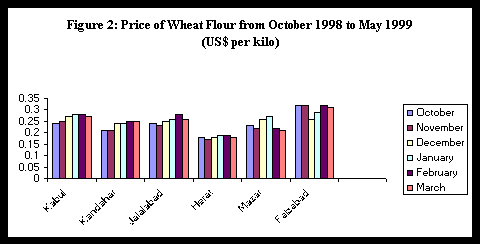
example of such a change can be seen in the markets: an
increase in prices of essential commodities in Pakistan led
to further increase in prices in Kabul, Jalalabad and
Kandahar. (See table 2 and figure 2 below.) Also, the
unofficial devaluation of the Pakistani currency during 1998
further reduced the value of the Afghan currency.
- Establishment of a central authority: The Taliban
movement has established a nominal government in most parts
of the country, which is not yet recognised by the
international community except Pakistan, Saudi Arabia and
UAE. At present, no reliable information is available on
economic indicators such as national income, the government
budget, foreign trade, inflation rate, income distribution,
employment, current level of GDP, GNP, or balance of
payments.
The current status of the economy
Despite continued destruction, blockades of some of the
supply routes and fighting in various parts of the country,
trade and agriculture remained active. The section below
provides a more elaborate study of agriculture and trade
activities and their role in sustaining the Afghan
economy.
Agriculture
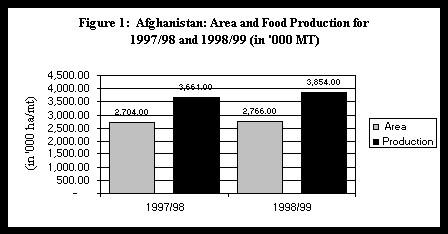
Increase in cereal production: Agriculture
forms the largest sector of the economy and the source of
livelihood for over 85% of the population. With the return of
security to most parts of the country, following the Taliban's
control over 75-80 percent of the territory, agricultural
production has increased over the past few years. The Crop and
Food Supply Assessment carried out by a FAO/WFP mission in
1997 and in May 1998 estimated the last two years’ cereal
production to be the highest in the past several years. The
total 1998 cereal production was estimated to be 3.85 million
tonnes, which is 5 percent higher than 1997, and perhaps the
largest since 1978. The farmers' response to high cereal
prices of the year before (US$ 300 per tonne), favourable
precipitation during winter and spring, and enhanced security
are cited as the main factors for the increase. In the north,
surplus cereal could not be moved to Kabul, Bamyan or
Badakhshan provinces where food scarcity and high prices for
grain prevailed due to the blockade of the supply routes. This
led to a reduction in the price of wheat and other major
cereals in the northern provinces.
Food imports/dependency: A large segment of the
Afghan population still depends on food imported from abroad
or that distributed by the aid community. The total import
requirement for the period of June 1998 to July 1999 is
estimated by FAO at 740,000 tonnes, of which an estimated
140,000 tonnes of wheat would be food assistance provided by
the international community. The bulk of the remaining
imported food comes from Pakistan via Torkham in the east and
Chaman in the south, as well as through a few small border
points in the southeast. Table 1 in Annex 1 shows the yield
and production of main crops for 1997/98 and 1998/99.
Increase in livestock production: Livestock forms a
main source of the household economy in rural areas. Many
families in rural areas sell their livestock to purchase wheat
during the spring months when they run out of stocks. While
this sector has sustained enormous loss due to prolonged
hostilities, there are indications that livestock production
has improved over the past few years, especially in areas
under the control of the Taliban. Table 2 in Annex 1 shows the
estimated number and type of major livestock produced in
Afghanistan during 1998.
Decrease in poppy yields: While cereal production
has increased there seems to be a significant decrease in
poppy yields during 1998. According to UNDCP Annual Opium
Poppy Survey of 1998, although there was a 9 percent increase
in poppy cultivation, UNDCP estimated a 25 percent reduction
in poppy yields when compared to 1997. The total opium
production for 1998 was estimated at 2,102 tonnes against a
total of 2,804 tonnes in 1997. This reduction in the level of
poppy production was reported to be due to unusual climatic
conditions such as heavy and continuous rains and hailstorms
in some of the major poppy producing provinces.
Food prices/inflation
Over the past six months, Afghanistan has experienced
growing inflation, which has been influenced largely by
cost-push and demand-pull forces. The Afghani to US$ rate
changed from 36,000 Afs. to a dollar in October 1998 to 45,000
Afs. to a dollar in mid-April 1999, a devaluation of more than
25 percent in six months.
The prices of essential items have also increased in
different parts of the country. Table 3 (in Annex 1) provides
a list of prices of wheat flour in six provinces for the
months of October 1998 through March 1999. Tables 3 and 4
reflect an interesting picture in the Afghan markets, in
particular the relationship between income through casual
labour and household expenditure. For instance, in Kabul, a
family of seven can earn 1.14 US$ a day if the head of the
family is lucky enough to find employment, while they need to
spend US$ 0.63 to buy twenty-one loaves of bread for the
family. This implies that over 50 percent of an individual’s
income is spent only on bread. The isolated food deficit
province of Badakhshan is the most expensive place to live.
During last winter, WFP distributed over 2,000 tonnes of food
in nine districts of Badakhshan and approximately 4,000 tonnes
to the most vulnerable populations in Hazarajat.
Labour market
A great majority of the Afghan labour force is
self-employed, mostly in agriculture and domestic trade but
also, to a smaller extent, in cross-border trade. Working as a
casual labourer inside Afghanistan as well as in neighbouring
Pakistan and Iran is another major source of employment for
many Afghans. While the income from remittances is not known,
Table 4 (Annex 1) provides interesting information on income
through casual labour. The table reflects a downward pattern
in most cities except for Kandahar, where income through
casual labour has increased by 15 percent. The worst situation
prevails in Faizabad (47 percent decrease) and in
Mazar-i-Sharif (43 percent decrease). In Herat and Jalalabad,
income through casual labour increased between October and
December last year and decreased between January and March
1999. One reason, among others, could be the reduction in
demand for casual labour during the winter months. Recruitment
in military activities has gone up due to the need by warring
factions and lack of employment opportunities. Unemployment
has increased in services, industries and other formal
institutions.
Trade
Domestic trade: Despite continued conflict
and blockades of supply routes in some parts of the country,
domestic trade continues throughout the country. The closure
of the Salang Tunnel has created many difficulties for
domestic merchants, as they are no longer able to bring the
agricultural products of the north to Kabul and to other parts
of the country via Kabul. Even in blockaded areas, merchandise
continues to move, albeit in smaller quantities and with more
difficulties.
Cross-border trade: Cross-border trade in domestic
goods and foreign commodities has increased between
Afghanistan, Pakistan and Turkmenistan over the past several
years. According to a recent newspaper report, there has been
an 11 percent increase in the volume of trade between
Afghanistan and Turkmenistan during the last year. In
September 1998, the Taliban authorities signed an agreement
with the Government of Turkmenistan on the import of petrol,
diesel and jet fuel. The first consignment of the fuel
reportedly arrived in mid-December via Torghundi. This has, to
some extent, reduced Afghanistan’s dependency on fuel imports
from Iran. In December, the Taliban Government signed another
agreement with Turkmenistan for the import of 600 tonnes of
liquefied natural gas.
With souring relations between the Taliban and Iran,
Uzbekistan and Tajikistan, the border points with these
countries have been closed and trade activities have come to a
halt, which has limited Afghanistan’s access to these markets
for its exports and imports. However, the Torghundi border in
Herat has remained open as the Taliban managed to establish a
cordial relation with Turkmenistan. In the past, Afghan
traders used to import goods through Bander-Abbas and Islam
Qala, while now they have switched to
Bander-Abbas-Turkmenistan and Torghundi, which has increased
their transportation costs.
Both Pakistan and Afghanistan benefit from cross-border
trade, despite their claim to have been affected by the
existing trading mechanism--i.e. the Afghan Transit Trade.
Under the agreement of the Afghan Transit Trade, Pakistan
allows Afghanistan to have access to the sea and to undertake
trade and commerce with the international community to the
extent required by Afghanistan's economy and commerce
requirements. Most of the goods imported under the ATT are
reportedly electronics and other consumer items, which cross
Pakistan's territory duty free. Some of these are then
re-exported illegally through smuggling back into Pakistan. On
several occasions, the Government of Pakistan has tried to
limit the amount of goods imported under the ATT by dropping
some thirty items from the ATT list. In 1995, for instance,
the Government of Pakistan made a unilateral decision and took
seventeen items including artificial silk fibre and clothing
off the list of the ATT. During an interview on 2 January
1999, Pakistan’s Federal Finance Minister Ishaq Dar said that
the government had requested the Afghan authorities to review
their transit trade and agree either to pay duties equal to
those in Pakistan or reduce the quantity of commodities to be
imported (The Frontier Post, 3 January, 1999). The
Taliban authorities have not replied to this request.
Despite these efforts by the Government of Pakistan, there
are indications that the volume of re-exports from Afghanistan
to Pakistan has increased during the last fiscal year. After
the ban on the ATT, most of these items are imported via Gulf
countries to the Afghan cities of Kandahar and Jalalabad and
then re-exported into Peshawar and Quetta in Pakistan. A
recent newspaper report indicates that India-made "Modi" tires
are smuggled into Pakistan through Afghanistan via Central
Asia and the Russian ports of Vladivostok and Odessa since the
import of tires under the ATT was banned 1994 (Inter Press
Service 20/4/99).
According to a report published by The News (30
December 1998), it was estimated that goods worth Rs. 23
billion (US$ 500 million) have been imported under the ATT
during the current fiscal year while the same imports for the
previous fiscal year amounted to RS 10 billion (approximately
US$ 218 million). According to another report, between July
and December 1998, the total trade has increased by around US$
43 million over the same period in 1997 (Inter Press Service
20/4/99). According to a World Bank report, the total trade
between Afghanistan and Pakistan was estimated to be US$ 2.5
billion in 1996/97, of which US$ 1.96 billion was estimated to
be the value of re-exported goods from Afghanistan into
Pakistan.
These examples indicate that banning the Afghan Transit
Trade facility alone does not help reduce smuggling activities
in Pakistan and may have negative repercussions for Pakistan
in the longer term. Once Afghanistan manages to have access to
other neighbouring markets, they may retaliate against
Pakistan’s unilateral decision and strengthen their trade
relations with other countries where they may have a
comparative advantage.
Realising the benefit from trade, and upon requests from
the business community in NWFP, the Government of Pakistan
issued Statute Regulatory Order (SRO) No. 138 on 3 March 1999,
which allows the export of all commodities produced or
manufactured in Pakistan, excluding those produced by
manufacturing bond, via land routes to Afghanistan against
Pakistani rupees. These exports will not be entitled to any
duty drawback or zero rating of sales tax (The Frontier
Post, 17 March 1999).
ANNEX 1
Table 1. Afghanistan: Area, Yield and Production of Main
Crops: 1997/98 and 1998/99
| Type of
cereal |
1997/98 |
1998/99 |
% Change
in
production |
| Area (‘000
ha) |
Yield
(MT/ha) |
Production (‘000
MT) |
Area (‘000
ha) |
Yield
(MT/ha) |
Production (‘000
MT) |
| Irrigated wheat |
|
|
|
|
|
|
|
| Rainfed wheat |
|
|
|
|
|
|
|
| Rice (paddy) |
|
|
|
|
|
|
|
| Maize |
|
|
|
|
|
|
|
| Barley (for grain) |
|
|
|
|
|
|
|
| Total |
|
|
|
|
|
|
|
Source: FAO/WFP Crop and Food Supply
Assessment – July 1998.
Table 2. Afghanistan: Livestock Production
| Type of animal |
Headcount survey |
Estimated figure for
Afghanistan |
| Cattle |
1,694,024 |
4,555,311 |
| Sheep |
9,421,582 |
25,185,343 |
| Goat |
3,561,660 |
9,449,364 |
| Horse |
51,566 |
153,032 |
| Donkey |
417,183 |
1,122,526 |
| Camel |
147,879 |
463,675 |
| Poultry |
3,938,189 |
10,673,907 |
| Total |
19,232,083 |
51,603,158 |
Source: FAO – Livestock.
N.B. Data collected from 7,625 villages of 19 provinces and
estimated country data for 1998
Table 3. Price of Wheat Flour October 1998 to March 1999
(in US$ per kilo)
| Province |
October |
November |
December |
January |
February |
March |
% Change October- March |
| Kabul |
|
|
|
|
|
|
|
| Kandahar |
|
|
|
|
|
|
|
| Jalalabad |
|
|
|
|
|
|
|
| Herat |
|
|
|
|
|
|
|
| Mazar |
|
|
|
|
|
|
|
| Faizabad |
|
|
|
|
|
|
|
Source: WFP survey of food prices.
Table 4. Daily Wages of Casual Labour from October through
December 1998 (in US dollars)
| Province |
October |
November |
December |
January |
February |
March |
% Change
October-March |
| Kabul |
|
|
|
|
|
|
|
| Kandahar |
|
|
|
|
|
|
|
| Jalalabad |
|
|
|
|
|
|
|
| Herat |
|
|
|
|
|
|
|
| Mazar |
|
|
|
|
|
|
|
| Faizabad |
|
|
|
|
|
|
|
Source: WFP survey of food prices.
|