When she saw woman patients hesitate to get themselves
examined by male doctors, a dream was conceived. Amid all the
social conservatism, lack of awareness and an essentially
male-dominated arena, the UAE was in bad need of a woman
specialist for breast cancer - the foremost killer disease
among women worldwide. Expat doctors were there, but language
and cultural barriers did pretty little to get local Arab
women come out and get themselves checked up, educated and
made aware of the risk factors involved. Someone from within
the community had to break tradition and take the first step.
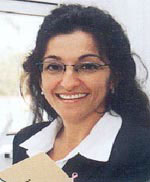
Dr Houriya Kazim decided to take up that challenge and fill
that much-needed vacuum, writes Irum Durrani.
During her internship in Dubai's Rashid Hospital, Dr
Houriya Kazim was witness to the levels of hesitation and
inhibition women had in getting themselves examined by male
doctors, which forced them to ignore pain and let symptoms
persist. "I used to examine women behind the curtains and
speak aloud to make a male doctor write the patient's report.
That was really difficult". This need of local women made her
go to the Royal College of Sugeons in Ireland for a fellowship
in general surgery. She sub-specialised in surgical oncology,
in particular, breast surgery. "It may not have been such a
big issue for any country in the West, but in a society where
women seldom step out and become professionals, let alone a
profession requiring a lot of public interaction, Dr Kazim had
taken a giant step forward.
Unlike other illnesses, breast cancer and its prevention
involves sensitivities of women especially in traditional and
conservative societies. But lack of awareness fuels the spread
of the disease even further. "Local women are least aware of
breast cancer and the cure, they are afraid of lumps cause
they don't know that nine out of ten lumps are not cancerous",
she said.
"Where there is will there is a way," she says with a glint
of confidence in her eyes. "You can do anything in this world
if you want it sincerely", says the lady who is the UAE's
first lady specialist in breast surgery.
Exposure to the glitzy lifestyle and promising job offers
from European countries could have lured her away from her
objective. But her resolve was stronger than the lure. It
could never stop her from coming back and serve her nation.
"It never affected me, I always knew that I'll be coming
back".
Apart from fulfilling the responsible roles of mother and
wife successfully she is spearheading an effort to make local
women aware of the dreaded disease. Apart from attending to
patients' woes, her hands are full of awareness projects. She
actively participates in BurJuman Centre's Safe and Sound
Breast Cancer Campaign, of which Welcare Hospital is the
medical partner.
She writes articles to spread awareness in many
women-related magazines and even conducts programmes in local
clubs, to reach out to the maximum number of women and apprise
them about simple techniques of self-examination. Dr Kazim has
been a strong proponent of young women learning to examine
their breasts properly and making it a regular habit to arrest
any growth and prevent the spread of any tumours. "A patient
has a 95 per cent of full recovery if tumours are found before
they have spread to any gland. Unfortunately, you have to find
it first, and that's not happening here."
Dr Kazim recommends young women to begin having annual
check ups with breast specialists. "My parents never took me
to doctor till I fell sick", she confesses, "but regular
check-ups are necessary." Sophisticated diagnostic tools like
mammograms are also likely to miss growths because young
breast tissue is dense, and even in older women there is only
20 per cent chance of a tumour being detected. Regular self
examinations provide an additional level of precaution against
the spread of the disease."
UAE women over the age of 45 run a higher risk of missing
the warning signs of breast cancer than younger women because
of the lack of education and social stigma attached to it.
"Most women are even shy to examine their own breasts,"
laments Dr Kazim, recalling the incident of a woman patient
who was to undergo a surgery. When asked on the day of surgery
about her lump, she replied, "I don't know I don't want to
touch my breast ." "We want women to be aware of cancer and
never take any changes in their body for granted, points out
the doctor, whose confidence is evident as she speaks with a
glint in her eyes.
The social stigma about a woman losing her breasts to
cancer makes things complex. "If you are discussing heart
disease, nobody minds but for some reason breast cancer is
different and this needs to change," says Dr Kazim. Current
statistics show that breast cancer affects at least one in
eight women but the figures are fast becoming worse and within
10 years one in three women are likely fall prey to the killer
disease.
Although no official data exists on the number of women
suffering from breast cancer in the UAE - much due to its
diverse demographic composition - on a worldwide scale, the
number of cases are definitely on the rise. "Expatriates form
around 80 per cent of the country's population and some of
them may be diagnosed here but treated abroad. This makes it
tough to maintain a cancer registry but there are plans to set
one up in the near future soon.
Despite being a committed career woman, Dr Houriya Kazim
has never taken her family for granted. She married late, had
babies late and feels good about the route her life has taken.
But regret comes from her failure to save a school friend from
breast cancer at a time when she was specialising as a breast
cancer surgeon. "I was not supposed to attend her funeral, I'm
a breast specialist, "she said, trying to hide her tears
without success.
Dr (Ms) Houriya Kazim is Consultant General Surgeon
(Breast Diseases) at Welcare Hospital, Dubai



 THE U.A.E.







 When she saw woman patients hesitate to get themselves
examined by male doctors, a dream was conceived. Amid all the
social conservatism, lack of awareness and an essentially
male-dominated arena, the UAE was in bad need of a woman
specialist for breast cancer - the foremost killer disease
among women worldwide. Expat doctors were there, but language
and cultural barriers did pretty little to get local Arab
women come out and get themselves checked up, educated and
made aware of the risk factors involved. Someone from within
the community had to break tradition and take the first step.
Dr Houriya Kazim decided to take up that challenge and fill
that much-needed vacuum, writes Irum Durrani.
When she saw woman patients hesitate to get themselves
examined by male doctors, a dream was conceived. Amid all the
social conservatism, lack of awareness and an essentially
male-dominated arena, the UAE was in bad need of a woman
specialist for breast cancer - the foremost killer disease
among women worldwide. Expat doctors were there, but language
and cultural barriers did pretty little to get local Arab
women come out and get themselves checked up, educated and
made aware of the risk factors involved. Someone from within
the community had to break tradition and take the first step.
Dr Houriya Kazim decided to take up that challenge and fill
that much-needed vacuum, writes Irum Durrani.