|
|
|
Dynamism is held back by state control
As family dynasties stifle creativity in most of the
industry, the Islamic sector is showing signs of the greatest
vibrancy, reports Roula Khalaf
 The banking industry in the Middle
East reflects the lagging development of the region's economies.
Although generally healthy and reasonably profitable, it has yet to
begin meeting the challenges of globalisation or joining the merger
wave and the internet revolution. The banking industry in the Middle
East reflects the lagging development of the region's economies.
Although generally healthy and reasonably profitable, it has yet to
begin meeting the challenges of globalisation or joining the merger
wave and the internet revolution.
In a region where economic
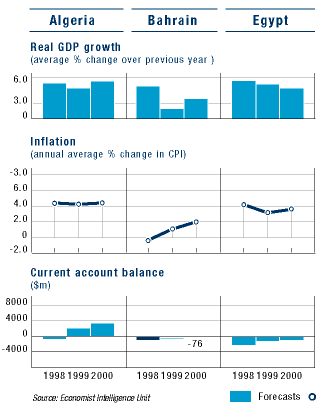
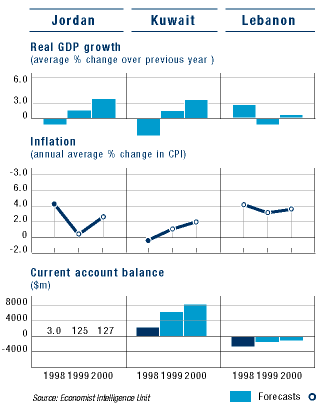
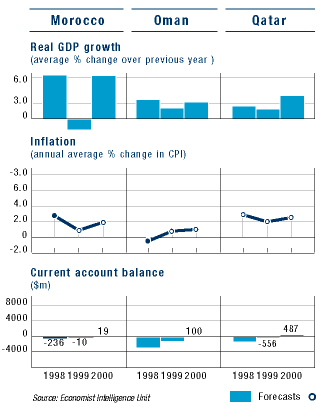
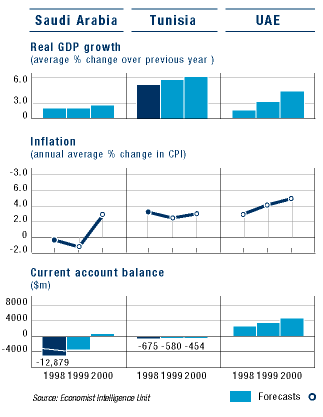
reforms have moved at a snail's pace - and economic growth in the
1990s averaged 3.6 per cent, much less than other developing regions
- the state remains the biggest player in the economy, including in
the banking sector. Strong state control has bred a lack of dynamism
and left the banks missing out on opportunities.
That
evolution comes slowly for Arab banks is not surprising. With the
Middle East home to more than half of the world's oil reserves, easy
profits and protected markets have promoted
complacency.
eanwhile, the concen-tration of the industry in
the hands of family dynasties and the centralisation of
decision-making have stifled creativity.
In many parts of the
region businessmen complain that banks are unwilling to take
sufficient risk to finance small and medium-sized
companies.
Arab banks have benefited from a low cost of
funds. For example, more than 40 per cent of deposits in commercial
banks in Saudi Arabia, the largest market, do not bear interest.
With a largely conservative management - capital-to-assets ratios
are higher than the average for western banks - banks have learned
to weather periods of low oil prices.
Analysts say 1999
results, now being reported, are showing a rise in profits, in spite
of depressed oil prices in the first half of the year. With the
subsequent rise in the price of oil, 2000 profits will pick up
further.
"Year-on-year, there is an increase but it is
nothing too exciting; and, anyway, growth is at times managed
through reserves," says a senior Gulf banker. "Government officials
are happy with this profit and happy that there aren't problems. It
might be sad, but this is the state of affairs, especially in the
Gulf."
Interestingly, the most vibrant part of the Arab
banking industry is Islamic banking, a business attached to
religious values and relying on a strict interpretation of the
Koran, the Muslim holy book, that bans dealing in
interest.
Islamic institutions are multiplying and
conventional banks are opening Islamic "windows", leading to an
estimated growth in deposits of more than 10 per cent a year. But
the development of the Islamic banking industry is hampered by
several factors.
Each bank has its own sharia board - the
group of religious scholars who vet products for their Islamic
credentials - and an instrument acceptable to one institution may be
shunned by another. There is also no lender of last resort for
Islamic banks, and the absence of an interbank market means most of
the products are short-term.
But bankers warn that however
much the Middle East has been insulated in the past, globalisation
and internet banking from western institutions are bound to shake up
the industry.
"There is a great threat from internet banking
coming from international institutions," says Mahmoud Difrawy,
managing director for the Middle East region at Chase Manhattan.
"The banks here are a bit cocooned. Things are happening quite
rapidly in the world and they're not paying enough
attention."
Although some banks, such as National Bank of
Kuwait, are already developing internet arms, most of the region is
just beginning to wake up to the new economy. In several countries
in the region the internet was introduced only in the past
year.
A formidable challenge faces those countries planning
to join the World Trade Organisation. Some bankers say the opening
of domestic markets to foreign competition will keep retail banking
shielded because domestic banks are well entrenched. They argue
that, even in the high-end of the retail market, the personal
relationships between banker and client will give domestic
institutions an edge over the foreign competitor.
Internet
banking, however, can break the barriers to entry. And, with more
than 50 per cent of the population aged under 20 in many countries,
the new generation of depositors and businessmen may put efficiency
before personal touch.
Henry Azzam, a leading economist on
the region, says banks should look at the WTO agreement on financial
services as an opportunity and work to upgrade and modernise their
competitive advantage and to shift from a "power" culture to a
"performance" culture.
He says most of the banks operate
through centralised decision-making in a strict hierarchy tempered
by heavy doses of paternalism and an environment in which lending is
based on relationships rather than risk assessment.
"Reaction
to customer demands should be immediate in order not to give the
competition the opportunity to attract a customer who is waiting for
the bureaucracy to respond to his needs," he
urges.
Privatisation and less government interference in the
banking business are essential to prepare for a more competitive
environment. Even in Egypt, which has opened up to foreign
competition, the government still controls more than 50 per cent of
the banking sector. "You need private sector shareholders to drive
the process and provide incentives to managements,"
says a senior
banker. "They are all talking about privatisation, but not moving
fast enough."
Although generally strong central bank
supervision has kept the industry healthy, it has been accompanied
at times by what bankers view as excessive controls. Analysts say
that in Saudi Arabia, for example, banks must seek the approval of
the Saudi Arabian Monetary Agency before participating in loans
outside the country.
Consolidation is seen as a necessity to
meet the inevitable foreign competition and to compete for project
finance business which now goes to international institutions. The
largest Arab bank today - the Bahrain-based Arab Banking Corporation
- has only $26bn in assets. The combined assets of all Arab banks,
meanwhile, are less than $500bn.
The region has seen two big
mergers in the past two years. In Bahrain, Gulf Internal Bank and
Saudi International Bank created a single entity, and in Saudi
Arabia, the 30 per cent-Citibank-owned Saudi American Bank merged
with United Saudi Bank, which is controlled by the financier Prince
Al-Waleed bin Talal.
Initial predictions that these deals
would usher in a wave of consolidation have not materialised,
however.
"The increase in the oil price gave banks some
respite, and this might be one of the reasons why merger activity
slowed down a bit," says Darren Stubing, senior bank analyst at
Cyprus-based Capital Intelligence, a rating agency.
"We need
more consolidation, but it is not easy to achieve," says Kheiry Amr,
a senior official at Jordan-based Arab Bank. "Banks in the Arab
world are still family businesses, there is not enough
corporatisation. As banking dynasties play a big role, mergers
become personality fits."
Further consolidation would also
help banks build a regional franchise, at a time when cross-border
activity remains timid. In addition to Arab Bank, the most active
player regionally is Arab Banking Corporation. The bank, which
focuses on facilitating trade and investment flows between the
Middle East and other regions, was hard hit by its exposure to Asia,
and is now
concentrating on the Middle East, with a new bank
opened in Algeria and an Islamic bank started in Bahrain.
In
the Islamic banking sector, Kuwait's The International Investor also
is developing a regional strategy. It is trying to lend its
expertise to conventional banks elsewhere in the region by setting
up their Islamic banking windows.
"The banks don't have the
size or capacity to operate internationally so it is more prudent to
concentrate regionally," says Mr Stubing.

Shackled
by tribal politics
Distinctions
show signs of blurring
Technology
proceeds at slow pace
| |
 |
|