Produced by the
Kathryn and Shelby Cullom Davis
Institute for International Studies
Published by
The Heritage Foundation
214
Massachusetts Ave., N.E.
Washington,
D.C.
20002-4999
(202) 546-4400
http://www.heritage.org/

|
The United States has made significant progress in its war
against terrorism in Afghanistan. After the start of the bombing
campaign on October 7, Taliban forces quickly unraveled in northern
Afghanistan, where they had made the mistake of continuing to try to
fight a conventional war against the United Front (Northern Alliance).
Deployed in easily targeted fixed positions along static front lines,
Taliban forces were decimated and demoralized by the cumulative effect
of the U.S. bombing campaign. Bolstered by increased logistical support
from the United States and Russia and by U.S. Special Forces units that
called in precise air attacks against Taliban targets and helped improve
its battlefield coordination, the United Front captured Mazar-i-Sharif
on November 9 and Herat on November 12 and entered Kabul without a fight
on November 13.
The rapid collapse of Taliban
rule in northern Afghanistan was not surprising, given the hostility of
the predominantly Tajik, Uzbek, and Hazara northerners to the harsh rule
of the Taliban, which is comprised chiefly of ethnic Pushtuns from the
south. In northern cities, the United Front was welcomed as a liberating
force. There literally was dancing in the streets to celebrate the rout
of the oppressive Taliban, which had banned music and public
dancing.
The Taliban regime also was
discredited by its increasing dependence on foreign Muslim funding and
militants from Pakistan, the Arab world, Chechnya, and elsewhere. But
the Taliban's pell-mell retreat from Kabul, the Afghan capital, was a
stunning development that indicated that many of the rank-and-file
Taliban do not share the diehard militancy of the Taliban's top leader,
Mullah Mohamed Omar.
As Taliban troops fled from the
advancing United Front forces, local Pushtun tribal and regional forces
mushroomed in southern and central Afghanistan and staked claims to
reassert traditional tribal authority in territory abandoned by the
Taliban. While some Pushtun tribes reportedly have attacked the
retreating Taliban, others appear to be more concerned about the
southern march of the predominantly non-Pushtun forces of the United
Front and are rushing to establish control over southern towns and
villages in an effort to prevent the United Front from consolidating its
control.
The remnants of the Taliban,
clinging to Pushtun-dominated areas near their stronghold, the southern
city of Kandahar, now are trying to regroup and reorganize. Taliban
forces also appear to be hunkering down in the mountains south of
Jalalabad. The remaining Taliban forces are believed to include more
than 2,000 foreign Muslim militants, who have more zeal for carrying on
the fight and less opportunity to defect to Afghan opposition contacts.
The result may be pitched battles fought to the bitter end.
Needed:
Relentless Pressure . The Taliban may hope to fight a
hit-and-run guerrilla war similar to that fought by the mujahideen (holy
warriors) against the Soviets in the 1980s. Although many of the Afghan
Taliban have melted away, the foreign Muslim militants that flocked to
the Taliban's banner have proven to be more stubborn fighters, and some
have fought to the death.
It is critical that the United
States and its Afghan allies maintain relentless military pressure on
the beleaguered Taliban regime to deal it a mortal blow by capturing or
killing its leaders. Taliban forces must be defeated in detail before
they can burrow into the mountains and settle in for a sustained
guerrilla war. The U.S. should not accept any face-saving deal that
Mullah Omar negotiates with anti-Taliban Pushtun forces.
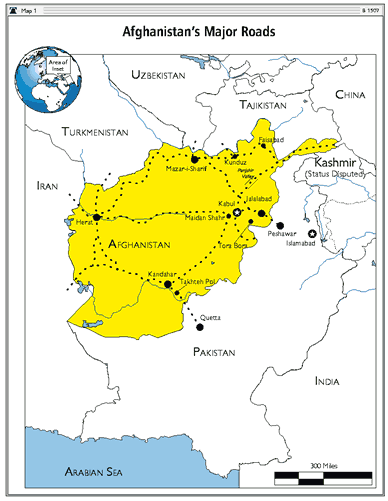
The November 25 seizure of an
airstrip near Kandahar and the aerial deployment of more than 1,000
Marines will enhance U.S. options for launching search-and-destroy
missions against Taliban and al-Qaeda forces, which have progressively
less space to hide in as the territory they control steadily shrinks.
The United States is closing in. In a pinpoint bombing raid on November
14, it eliminated one of Osama bin Laden's chief lieutenants, Mohamed
Atef, who is thought to be one of the planners of the September 11
terrorist attacks.
Recently, bin Laden himself
reportedly was spotted by Afghans in a fortified camp near the village
of Tora Bora, 35 miles southwest of Jalalabad. As more and more Afghans defect from the Taliban and turn against
bin Laden, he runs increasing risks of being located and brought to
justice. But capturing bin Laden will not be easy. He is surrounded by
up to 2,000 Arab militants, many of whom are likely to fight to the
death. Bin Laden's extensive and sophisticated cave complexes are sure
to be equipped with many nasty surprises, including chemical weapons
and, possibly, a "dirty bomb" (conventional explosives laced with deadly
radioactive materials).
WINNING THE ENDGAME IN
AFGHANISTAN
Although the first phase of the
U.S. war in Afghanistan has gone well, much more must be accomplished to
uproot the al-Qaeda terrorist network and its Taliban protectors in
Afghanistan. Anti-Taliban opposition forces appear to have seized control of
all major Afghan cities with the exception of Kandahar.
But control of the cities does
not necessarily bring victory, as the Afghan communists, the Soviets,
British forces, and others have learned to their dismay. The Taliban's
support base lies in the southern hinterland, in the teeming Afghan
refugee camps in Pakistan, and among Pakistani Pushtuns, who comprise
about 8 percent of the population of Pakistan and are concentrated along
the border. If Mullah Omar survives the current onslaught and goes into
hiding in the rugged mountains of Afghanistan or finds sanctuary in the
unruly frontier provinces of Pakistan, he could live to fight another
day. Although many Taliban fighters discarded their black turbans and
joined tribal militias when they saw the balance of power tilt against
the Taliban, they could rally behind Mullah Omar again if the prevailing
political winds change in the future.
Afghanistan's politics are
notoriously fickle. Alliances among contending factions change like the
shifting patterns of a kaleidoscope. If the United Front coalition
dissolves into factional fighting or overplays its hand and exacerbates
the latent hostility of Pushtuns resentful of non-Pushtun domination,
Mullah Omar or a successor could rally renewed support. The Taliban also
could make a comeback by recasting itself as a Pushtun resistance
movement if a post-Taliban government comes to be perceived as a puppet
of foreigners. Another source of support for a Taliban resurgence could
be the radical madrassas (religious schools) in Afghanistan and
Pakistan, funded by Arab fundamentalists.
If introduced on a large scale,
even in humanitarian or peacekeeping roles, American or British troops
could be denounced as an occupying force. This would give Mullah Omar or
a successor a renewed opportunity to tap into Afghan xenophobia and
Islamic zealotry. Even United Nations peacekeeping troops drawn from
Muslim states could provoke a backlash if they were perceived to back a
rival faction in a renewed civil war. The Taliban also could be given a
new lease on life if a new government comes to power in Islamabad and
restores Pakistani support that President Pervez Musharraf withdrew
after the Taliban refused to break its ties to bin Laden's terrorist
network.
For all of these reasons, the
United States needs to score a swift knockout blow against the Taliban's
top leadership and permanently eliminate it as a contender for power.
Washington must transform the recent rout of the Taliban into an
irreversible military and political victory that leads to the
eradication of Osama bin Laden's terrorist infrastructure in
Afghanistan. The United States then should promote the establishment of
a friendly and stable Afghan government that can prevent Islamic
extremists from using Afghanistan as a base for exporting terrorism. To
accomplish these goals, Washington should:
- Work closely with the United Front and help it
maintain its battlefield dominance to defeat the Taliban and eradicate
bin Laden's terrorist network as soon as possible.
With the support of U.S.
air power and its Special Forces, the United Front has been an effective
military ally that boldly advanced southward against a larger and
better-armed Taliban military force. The United States should continue
close military cooperation with the United Front to help it keep
relentless pressure on Taliban forces and bin Laden's al-Qaeda militants
and block their escape. Washington should reward the United Front with
enhanced logistical support, economic aid, and food supplies to enable
it to offer substantial inducements to broaden its support, particularly
among Pushtuns.
The United States should
extend this military and economic support while making it clear that
this does not imply American backing for the United Front or any faction
of it to unilaterally replace the Taliban as Afghanistan's rulers. While
it is popular among the Tajik, Hazara, and Uzbek minority groups in
northern Afghanistan, the United Front does not enjoy widespread support
in southern Afghanistan, the homeland of the Pushtuns, which is the
single largest Afghan ethnic group, comprising approximately 40 percent
of the population. Any future Afghan regime that seeks to exclude the
southern Pushtuns would trigger a destabilizing backlash that could be
exploited by the Taliban or other Pushtun groups.
Pakistan, which backed
the Taliban until recently, opposes the United Front because of its
opposition to Pakistani dominance in Afghanistan and its ties to India,
Russia, Uzbekistan, and Iran. Both Islamabad and the U.S. Department of
State (which often reflects Pakistani views on Afghan politics)
convinced President Bush to call on the United Front to halt its
southern advance outside Kabul until a provisional government including
other groups could be established. Ostensibly, this was done because of
fears that possession of Kabul might fuel the opposition coalition's
ambitions to rule Afghanistan without southern Pushtun
participation.
But this effort to slow
the pace of the war to buy time to cobble together a post-war government
was unrealistic. The United Front would not stand by idly while the
Taliban collapsed because this would allow other groups, possibly backed
by Pakistan, to fill the power vacuum. Moreover, slowing the pace of the
fighting would lengthen the war, raise the death toll among combatants
and civilian refugees threatened by starvation, and increase the number
of U.S. troops needed to defeat the Taliban and al-Qaeda.
The United States cannot
afford to delay military operations that are critical to winning the war
in order to buy time to facilitate unrealistic diplomatic efforts to
impose a pro-Pakistani post-war government. The overriding U.S. military
objective in Afghanistan is to eradicate bin Laden's al-Qaeda terrorist
infrastructure from Afghanistan to reduce the damage that his global
terrorist network can inflict on Americans in future attacks.
Acquiescing to
Pakistan's appeals that the advance of the United Front be permanently
halted would give bin Laden more time to plan and organize attacks to
kill more Americans or, possibly, to escape. Slowing the advance of the
United Front to appease Pakistan also would give the Taliban a breathing
space to regroup, reduce the pressure on wavering Taliban fighters to
defect, reduce the incentives for non-Taliban Pushtuns to join the
United Front to defeat the Taliban, and raise the political costs of the
war to the United States, its allies, and friendly Muslim
governments.
The approaching winter
also puts a premium on pressing forward with the United Front's current
military advantage, because the bitter cold and deep snow soon will
impede the mobility and effectiveness of United Front forces and make
supply logistics more difficult. Although American air power and Special
Forces may remain effective in the Afghan winter, Afghan guerrillas
traditionally scale back their operations, returning to home villages
and refugee camps to await the spring thaw. The farther south the United
Front can advance before it is bogged down in snow, the more leverage
the United States will have to twist the Afghan political kaleidoscope,
induce Taliban defections, and enlist opportunistic southern Pushtun
tribes to dismember the Taliban, and the easier it will be to hunt down
bin Laden and his zealots.
While the United Front
forces fought ably on their home turf in northern Afghanistan, their
ability to sustain an offensive in southern Afghanistan will be
increasingly constrained by extended supply lines, the need to
consolidate their control and apprehend Taliban stragglers in liberated
areas, the need to divert forces to protect the flow of emergency food
supplies and other humanitarian aid, a lack of familiarity with the
terrain of potential battlefields, and lack of support from southern
Pushtuns suspicious of their political goals. This makes it all the more
important that the United States recruit additional help from the
Pushtuns of southern Afghanistan, or at least deprive the remaining
Taliban forces of the local Pushtun support that they would require for
an extended guerrilla campaign.
- Step up efforts to enlist the emerging non-Taliban
Pushtun leaders in southern Afghanistan as allies in the war against
the Taliban and al-Qaeda and include them in the process of building a
post-Taliban Afghanistan.
After a slow start,
Washington should accelerate efforts to recruit the resurgent Pushtun
leaders in the war against the Taliban and bin Laden's organization.
Charismatic local leaders play a critical role in Pushtun tribal
politics. The primary allegiance of most Pushtuns--indeed, of most
Afghans--is to their qawm (the Arabic word for tribe), a group that
shares a common ancestry or territorial homeland. While they may
affiliate with larger organizations such as the Taliban or the old
mujahideen groups that fought the jihad against the Soviets, the true
loyalty of most Afghans is local. They are capable of fighting to the
death for local commanders with whom they share close personal ties, but
their loyalties to more distant leaders can evaporate
suddenly--particularly if their local commander negotiates a better deal
with a rival leader.
Many of the emerging
southern Pushtun leaders played important roles in battling the Soviets
in the 1980s and could be approached through former U.S. contacts. In
return for their cooperation in hunting down Mullah Omar, bin Laden, and
their supporters, Washington should offer local Pushtun leaders military
support, lucrative financial incentives, economic support for their
tribal kinsmen, and the opportunity to participate in a post-Taliban
government. It should be made clear that Pushtun leaders who cooperate
with the United States in fighting Islamic extremists now can expect
great rewards in the future, but those that continue to support the
crumbling Taliban regime will suffer for their actions.
Washington's initial
efforts to whittle away the Taliban's base of support in southern
Afghanistan were undermined when maverick Pushtun leader Abdul Haq was
captured by the Taliban and executed on October 26 to deter other former
mujahideen commanders from turning against the Taliban. Haq had crossed
the border from Pakistan with minimal preparation and no support from
the U.S. Central Intelligence Agency. His kinsmen suspect that he was
betrayed by Pakistan's Inter-Services Intelligence agency, the military
intelligence service that helped create and support the Taliban. Hamid
Karzai, a supporter of exiled King Mohamed Zahir Shah who was named
chairman of the interim administration that will rule Afghanistan for
the next six months, has had greater success in rallying Pushtun
support.
Pushtun tribal leaders
have become increasingly willing to challenge the Taliban since its
defeat in the north and the southern march of victorious United Front
forces. Local Taliban commanders, many of whom originally defected to
the Taliban when it appeared to be on the winning side, now are
returning to swell the ranks of tribal militias.
Afghanistan's tribal
militias, encouraged by the string of Taliban defeats, also have grown
increasingly hostile to Taliban domination. Emboldened by the turn of
events, Pushtun tribesmen led by Gul Agha Shirzai seized the town of
Takteh Pol, 25 miles southeast of Kandahar, on November 24. This action was significant because it occurred so close to the
seat of the Taliban's power and helped to ignite a chain reaction among
other Pushtun leaders still sitting on the fence. Moreover, the uprising
has denied the Islamic extremists the use of the main road to
Quetta.
The United States should
move more aggressively to encourage additional uprisings and enlist
greater Pushtun help in driving the nails into the Taliban's coffin.
Pushtun tribal militias also could be helpful in tracking down bin
Laden, who is hated by many Afghans for hijacking their country to
advance his terrorist agenda.
- Encourage the building of a decentralized post-war
government to give all Afghan groups strong incentives to cooperate
and to avoid factional feuding .
The December 5 agreement
between Afghan factions reached in Bonn, Germany, under the auspices of
the United Nations set up a transitional administration to prepare the
way for a post-Taliban government. Under the pact, Hamid Karzai, an
anti-Taliban Pushtun leader, was appointed chairman of the temporary
administration, which will take power on December 22. The temporary
administration will govern for six months, until a meeting can be
arranged for a Loya Jirga (grand assembly), a traditional Afghan council
that is convened in time of crisis to forge a consensus on vital issues.
Former King Mohamed Zahir Shah will play a symbolic role in the Loya
Jirga, which will elect a transitional authority to run Afghanistan for
two years until a constitution is drawn up and elections are held.
The Bonn talks are a
good first step, but much more negotiation will be necessary to build a
durable consensus on how to form Afghanistan's future government. A
sustained peace can be achieved only through the development of a broad,
inclusive, multi-ethnic government with substantial participation from
the Pushtuns, who historically have played a leading role in Afghan
politics.
Working out a viable
power-sharing arrangement will be a complex diplomatic task. The United
Front, which has borne the brunt of the fighting against the repressive
Taliban, now has the strongest military force. It controls the capital,
Kabul, and holds Afghanistan's seat in the United Nations.
The United Front is
reluctant to share power with exile groups and politicians who do not
control territory or exercise military power inside Afghanistan. Firm
American diplomacy will be required to dissuade the United Front from
overplaying its hand and stubbornly demanding continued political
dominance. This could precipitate a renewed civil war and lead
eventually to the Balkanization of Afghanistan, leaving all factions
worse off.
Burhanuddin Rabbani--the
titular head of the United Front and the former Afghan president who was
forced from Kabul by the Taliban in 1996--has recognized the need for a
broad, inclusive government. On November 25, Rabbani declared that he
was prepared to hand over power as soon as the leading Afghan factions
agree on an interim government. Washington should hold him to this
promise. Rabbani played an important role in resisting Soviet occupation
and Taliban extremism. However, his unilateral extension of his expired
presidential term in 1994 and his lack of hands-on leadership have
undermined his potential appeal as a unifying leader.
To help ensure that
Afghanistan does not disintegrate into factional infighting, as it did
between 1992 and 1996, the next Afghan government should be
decentralized to give all factions a stake in the central government
while permitting them substantial self-determination in their home
provinces. Empowering the provincial governments and giving them
substantial autonomy and access to reconstruction aid also would reduce
the likelihood of all-out power struggles for control of state
institutions centered in Kabul.
A decentralized
government guided by the principles of federalism also would have the
beneficial effect of allowing a new generation of Afghan leaders to rise
within the power structure through political competition rather than
military jousting. Many of these young leaders--such as United Front
Foreign Minister Abdallah, the new chairman of the interim
administration, Hamid Karzai, and popular Herat leader Ismail Khan--rose
within the ranks during the war against the Soviets and learned to
cooperate effectively with other Afghans against a common enemy.
If this new generation
of leaders can spread its wings, there will be some grounds for
optimism. Afghans are war-weary after fighting among themselves and
against the Soviets since the 1978 communist coup.
Afghanistan enjoyed more
than 50 years of stability from 1930 through 1978 before external
meddling disrupted its internal politics. First the Soviet-supported
Afghan communists sought to impose their totalitarian rule on a fiercely
independent traditional society by force. Then the Pakistani-supported
Taliban sought to impose its harsh Islamic extremism by force. Freed of
outside meddling, there is a good chance that the Afghans could reach a
consensus on how to share power, particularly if they were rewarded with
considerable international aid for reconstructing their shattered
infrastructure, economy, and civil institutions.
- Ensure that Afghans become active stakeholders, not
passive clients of United Nations bureaucrats, in post-war
reconstruction.
The United Nations could
play a role in the reconstruction of Afghanistan, but its role should be
a supportive one, such as coordinating humanitarian aid. Washington
should not allow U.N. bureaucrats to install themselves as viceroys
seeking to micromanage Afghan affairs. Such social engineering would
create dependence and resentment that eventually could help Islamic
extremists return to power.
The disastrous attempt
by the United Nations to engineer the modernization of the clan-based
politics of Somalia should not be repeated in Afghanistan. Afghans
fiercely guard their independence and could react violently if consigned
to the status of a colonial mandate of the United Nations. Nor should
the flawed model of U.N. administration practiced in Bosnia be applied
to Afghanistan. Unlike the separatist Bosnian ethnic groups, all major
Afghan factions reject separatism and seek to remain part of a united
Afghanistan. Their quarrel is over who will run the country.
The United States should
work to ensure that the contending post-Taliban Afghan factions are all
stakeholders in the new leadership structure, with responsibility for
the revitalization of their own political system and the reconstruction
of the Afghan economy. Genuine nation-building cannot be imposed from
outside; it must spring organically from the consensus of the country's
constituents. It cannot be administered from the top down by U.N. pashas
who arrogate to themselves the role of state sovereignty. Afghans must
be free to chart their own course for the future and assume
responsibility for rebuilding their own country.
There is a broadly
scattered diaspora of Afghan exiles that could serve as a valuable
source of technical expertise, management skills, organizational
experience, and economic investment once a stable government is
installed and law and order is restored to Afghanistan. Nearly one-fifth
of the country's 27 million people have been forced into exile by more
than two decades of fighting.
Many Afghans who fled to
Europe and the United States have acquired considerable education and
work experience and would welcome the opportunity to share it with their
countrymen if their safety could be guaranteed. Young Afghan expatriate
professionals living in America already have established a nonprofit
humanitarian organization, Afghans for Tomorrow, to assist
reconstruction by providing professional expertise in the fields of
education, agriculture, health and human services, housing and urban
development, energy, transportation, and economics. The United States should encourage the future Afghan government,
foreign non-governmental organizations, and international aid
organizations to recruit these overseas Afghans and reverse the brain
drain that has hurt Afghanistan's development for many years.
Particular care must be
taken to reform Afghanistan's educational system to weed out the
influence of radical Islamic ideologies that have subverted
Afghanistan's tolerant brand of traditional Islam and assisted the rise
of the Taliban (whose name means "religious students"). Many of the
Taliban leaders were trained in madrassas in Pakistan. Some were funded
by Islamic organizations associated with the fundamentalist Wahhabi sect
based in Saudi Arabia. Others preached a virulent mixture of ideas from
the militant Deobandi school of Islam that originated in South Asia.
Washington should press
Pakistan to close or reform the "jihad factory" madrassas and put them
under closer supervision. It should call on Pakistan to use some of its
forthcoming debt relief to rebuild its own crumbling educational system
to help inoculate students against the appeal of Islamic extremism.
Afghanistan will be vulnerable to a resurgence of militant Islam as long
as radical madrassas turn out thousands of young men each year,
providing a reservoir of willing disciples that could be attracted to
future charismatic leaders who may try to follow in the footsteps of
Osama bin Laden and Mullah Omar.
Ultimately, these
ideological hothouses pose a threat to the stability of Pakistan and
Saudi Arabia as well. The United States should press the Saudi
government to restrict the flow of money from Islamic charities and
individual donors to these madrassas, whose graduates have been
recruited by organizations that seek to overthrow the Saudi royal
family.
- Restore Afghanistan's historic role as a neutral
buffer state and halt its neighbors from meddling in its internal
affairs .
The long-term U.S
diplomatic goal should be to facilitate an internal Afghan peace
settlement that will protect the interests of all of Afghanistan's
disparate ethnic groups and ease the security concerns of Afghanistan's
neighbors. Afghanistan should be reconstructed as a neutral buffer state
similar to Austria. The United States, Russia, and Afghanistan's six
neighbors should negotiate a treaty similar to the 1955 State Treaty
that set the ground rules for Austrian neutrality. All of them, and the
new Afghan government, should pledge not to use Afghan territory as a
base for military attack, terrorism, or subversion against each
other.
Afghanistan's
instability over the past 25 years has been exacerbated by interference
from its expansionist neighbors. The Soviet Union played a destabilizing
role in backing the April 1978 communist coup that shattered the
country's political equilibrium. In 1979, Moscow invaded Afghanistan in
a failed effort to prop up its communist clients. Following the 1989
withdrawal of Soviet troops and the 1992 collapse of the Afghan
communist regime, Pakistan sought to extend its influence over
Afghanistan through Islamic extremist mujahideen groups such as
Hezb-e-Islami (Party of Islam) and, after 1994, through the Taliban.
In addition to these
ideological client organizations, Afghanistan's neighbors have sought to
gain influence inside the country through various ethnic and religious
groups that straddle Afghanistan's borders. While Pakistan has tried to
mobilize Afghanistan's Pushtuns, Uzbekistan intermittently has supported
militias drawn from northern Afghanistan's more than one million Uzbeks,
and Iran has cobbled together a coalition of Hazaras in the center of
the country who share its Shiite faith. Russia, Iran, India, Uzbekistan,
and Tajikistan all have funneled aid to various elements of the Northern
Alliance to prevent the Taliban from consolidating its control over
Afghanistan.
The United States should
cooperate with this incipient coalition and encourage China and Turkey,
both of which are concerned about Taliban meddling in their internal
affairs, to add their weight to this group. The goal should be to uproot
the Taliban movement and the extremist Islamic madrassas that support it
in order to encourage the emergence of a stable Afghanistan that poses
no threat to its neighbors.
Pakistan, which until
recently sought to cement its hegemony over Afghanistan through the
Taliban, is likely to be the chief immediate obstacle to such a
settlement. Islamabad still seeks to salvage some of its investment in
the Taliban by including "Taliban moderates" in a future government, but
this phrase is an oxymoron. No high-level Taliban leaders should be
considered for leadership positions in the future Afghan government.
Low-level Taliban members should be allowed to participate in future
governments only if they publicly and explicitly denounce the
Taliban.
The United States
historically has deferred to Pakistan, an important Cold War ally, when
crafting its policy toward Afghanistan. This made sense during the
Soviet war in Afghanistan because Pakistan was an indispensable
front-line ally that was taking considerable risks in opposing the
Soviet invasion of its neighbor.
Since the Soviet
withdrawal, however, Pakistani and American interests have diverged
significantly. Pakistan sought to install the Taliban regime in Kabul to
help tilt the balance of power against India. It wants a subservient
Afghan government that will allow it to use Afghan territory to gain
strategic depth in the event of a war with India. Pakistan favored the
radical pan-Islamic Taliban because it would play down Pushtun
nationalism and help Islamabad escalate the Muslim separatist insurgency
in Kashmir.
Washington should work
to reduce the sense of alarm experienced in Islamabad regarding its loss
of influence in Afghanistan. The United States could help to defuse
tensions between Pakistan and India by offering its good offices to
encourage both sides to undertake confidence-building measures and
discuss their differences over Kashmir. This will encourage Pakistan to
see Afghanistan less in terms of the strategic depth it could provide in
a confrontation with India and more as a conduit for trade to Central
Asia.
Finally, Washington can
help mitigate the loss of Pakistani influence in Afghanistan by
compensating Pakistan with economic aid and help in refinancing
Pakistan's $38 billion international debt. The Bush Administration
already has pledged to provide Pakistan with $1 billion in economic aid,
restoring Pakistan to the position of the third largest annual recipient
of U.S. foreign aid (after Israel and Egypt), a position it also held
during the Soviet war in Afghanistan.
The United States also
should pressure Afghanistan's other neighbors to refrain from fueling
factional conflict. The war in Afghanistan has provided an impetus for
improved Russian-American relations. Moscow has been battling Chechen
separatists, some of whom are supported by the Taliban and bin Laden,
since the mid-1990s. Hundreds of Chechen Islamic radicals are reportedly
fighting on behalf of the Taliban and bin Laden in Afghanistan.
Washington and Moscow
now are cooperating much more closely in fighting Islamic terrorism, but
the surprise deployment of several hundred Russian Emergency Ministry
personnel to Kabul in mid-November, in part to assist the reopening of
the Russian Embassy, is reminiscent of the surprise deployment of
Russian troops to stake a claim on the airport in Pristina, Kosovo, on
June 12, 1999. The Kabul deployment could be a prelude to a stronger
reassertion of Russian influence in northern Afghanistan.
Washington should
coordinate policy with Russia, Uzbekistan, and Tajikistan to prevent the
establishment of zones of influence in northern Afghanistan. Such a
development would eventually discredit the United Front and lead to the
partition of Afghanistan. This would be a formula for continued civil
war and instability.
Iran also may be tempted
to exploit the overthrow of the Taliban regime, which was hostile to
Shiite Iran and to Afghan Shias, whom the Taliban denounced as heretics.
Tehran was close to going to war with the Taliban in 1998 after nine
Iranian officials were executed by Taliban forces in northern
Afghanistan. Instead, Iran increased its aid to Hazara Shias and the
Tajik faction of the United Front. Now that the Taliban has imploded,
Iran may try to parlay this support for the United Front into influence
over the formation of the next government.
Washington should seek
Iranian cooperation in helping the Afghans to build a stable government,
but it should not expect much help. Iran's polarized political dynamics
give its foreign policy a schizophrenic quality. Tehran long has been
the world's most active state sponsor of terrorism because of the
radical policies of hard-liners, led by supreme leader Ayatollah Ali
Khamenei, who control Iran's defense and security establishment. Yet
Iranian President Mohammad Khatami, the leader of the reformist camp who
is waging an uphill struggle to restore the rule of law, continues to
call for better bilateral relations.
Conflicting signals are
coming even from within the reformist camp. Khatami's government has
offered to help rescue downed American pilots but continues to criticize
the U.S. war in Afghanistan. It is doubtful that close Iranian-American
cooperation is possible in Afghanistan until reformers wrest control of
Iran's foreign policy away from Iranian hard-liners who have a long
record of supporting terrorism.
- Avoid tying down U.S. troops in any open-ended
peacekeeping mission in Afghanistan.
The December 5 Bonn
agreement calls for the deployment of a multinational peacekeeping force
to Afghanistan while a multi-party Afghan force is created. The
peacekeeping force would deploy first in Kabul, then to other areas "as
needed." The agreement does not define the size or composition of the
force. While American troops may be required to assure the security of
Kabul until a new government can be organized, they should not
participate in an open-ended peacekeeping operation. Once American
troops have accomplished their military objectives in Afghanistan, they
should be redeployed to other theaters of the war on terrorism. American
troops that are stationed in Afghanistan after the Taliban is defeated
would be lightning rods for terrorist attacks from Taliban sympathizers
for years to come.
The failed American
peacekeeping deployments in Lebanon in 1983 and Somalia in 1993 should
underscore the dangers of open-ended peacekeeping missions in close
proximity to virulently anti-American Islamic radicals. In Lebanon, on
October 23, 1983, 241 Marines were killed by a truck-bomb attack carried
out by Hezballah (Party of God), an Iranian-inspired and
Syrian-supported terrorist group that sought to drive Western influence
out of Lebanon. The Marines were part of a multinational peacekeeping
force that had deployed in Beirut in 1982 to stabilize Lebanon following
the assassination of President-elect Bashir Gemayel.
In Somalia, American
military personnel initially were deployed by the first Bush
Administration in November 1992 to provide emergency food relief to the
starving populace, but the mission was expanded by the Clinton
Administration into an ambitious nation-building experiment that led the
United States into a confrontation with Somali warlord Mohamed Farah
Aideed. In October 1993, 18 U.S. Special Forces personnel were killed in
an aborted raid to capture Aideed. The Somalis who ambushed the Rangers
were reportedly trained by Osama bin Laden's lieutenant, Mohamed
Atef.
There is no
one-size-fits-all model for peacekeeping operations, but one
uncontestable requirement is that there must be a peace to keep.
Washington should seek to delay any deployment of peacekeeping troops in
southern Afghanistan until the war has ended and bin Laden and Mullah
Omar have been brought to justice. Otherwise, the deployment of
peacekeeping troops could freeze the existing military situation and
prolong the Taliban's rule in Kandahar, or interfere with American
operations to hunt down the extremist leaders.
The multinational
peacekeeping force should be recruited from distant countries in the
Muslim world such as Bangladesh, Indonesia, Jordan, Morocco, or Turkey.
This would reduce the incentives for possible terrorist attacks and
reinforce the Bush Administration's declaration that it is fighting
Islamic extremist terrorism, not Islam itself, in Afghanistan.
CONCLUSION
To score a decisive victory in
the war against Islamic terrorism in Afghanistan, the United States must
work closely with the United Front and emerging Pushtun forces to
swiftly uproot the Taliban by rounding up its leaders before they can
regroup for guerrilla warfare. Although the Taliban has sustained a
severe military defeat, many of its fighters have merely "changed
turbans" and could rally once again for the Taliban or a successor
movement if the prevailing political winds change in Afghanistan or
Pakistan.
The United States cannot afford
to relax military pressure on the Taliban to appease Pakistan. It should
be kept in mind that Pakistan played a role in the emergence of the
Taliban problem in the first place. Nor should the U.S. military be
diverted from its paramount goal in Afghanistan, which is the
elimination of Osama bin Laden and his terrorist bases.
The United States must win the
war in Afghanistan as quickly and decisively as possible to set the
stage for subsequent campaigns in the global war against international
terrorism. The Afghan model of deploying American Special Forces and air
power to provide strong support for opposition forces dedicated to
overthrowing a regime that sponsors terrorism could be replicated
against Iraq, Sudan, and other state sponsors of terrorism. The
demonstration effect of the war in Afghanistan could raise perceptions
of the costs of supporting terrorism, deter attacks against the United
States, and even induce some states to stop exporting terrorism.
After winning the war, the
United States must consolidate the peace in Afghanistan to prevent the
future return of Islamic extremism. Washington should work with
Afghanistan's neighbors to encourage the development of a broad,
decentralized, multi-ethnic government. To reduce the incentives for
external meddling, Afghanistan should reassume the role of a neutral
buffer state that poses no threats to its neighbors.
The United Nations can play a
supportive role in Afghanistan but should not establish itself as a
sovereign authority that interferes with Afghan self-determination.
International peacekeeping forces should be drawn from distant Muslim
countries, not from the United States, whose first priority is victory
in the war against international terrorism. Ultimately, only Afghans can
provide effective peacekeeping forces and prevent their country from
being re-infected with the virus of Islamic extremism.
--James Phillips is
a Research Fellow in Middle Eastern Affairs in the Kathryn and Shelby
Cullom Davis Institute for International Studies at The Heritage
Foundation.

Link
to:
| Executive
Summary | PDF(334k)
|
Note: PDF version contains both the
Executive Summary and the Full Text
and is optimized for Adobe
Acrobat 5.0.