|
NMIT Working Papers present preliminary
formulations of new data and thinking from ongoing social
science research on the economic, cultural, policy and social
implications of new media, communication and information
technologies in the contemporary Middle East.
Views expressed are those of the
authors, who welcome feedback and comment from
users.
Need a translation?
|
Changing
Media Habits and Entertainment Preferences In Morocco: An
Inter-Generational Analysis
Mark Tessler,
University of Arizona.
Paper delivered at a
conference on Diffusion of New Information Technology in the
Middle East. Tucson, AZ. April 14-16, 2000
This paper presents selected
sections from "Morocco’s Next Political Generation," which is
forthcoming in Journal of North
African Studies. The section most relevant to the
conference is that pertaining to media consumption and
entertainment, which is included below. Pertinent data are
presented in Tables 1-4. Sections not included (indicated by
ellipsis) deal with issues of religion, gender, and
politics.
In order to put the findings in context,
some of the original paper’s introductory sections are also
included. So, too, is a short discussion of data and
methodology. Finally, although it pertains to the overall
analysis, not just findings about media habits and
entertainment preferences, the original paper’s concluding
section is included as well.
* * * *
As in much of the Arab world, Morocco possesses a massive
number of young men and women who are reaching adulthood and
entering the social mainstream, or who have done so within the
last decade. This cohort of young people, which may be
described as a political generation, offers the country both
hope and an important challenge.
It remains to be seen whether and if so how, the emerging
political generation will differ from those that preceded it,
and with what implications. The present research report
focuses on these questions. It seeks both to contribute some
preliminary answers and to stimulate further inquiry and
investigation. The first part of the paper summarizes the
characteristics and formative experiences of Morocco’s next
political generation. The second part presents the results of
public opinion research carried out in Morocco in 1995-1996.
Data from this research are used to compare the attitudes and
behavior patterns of different age cohorts and also to examine
normative cleavages within the younger generation.
CHARACTERISTICS AND FORMATIVE EXPERIENCES
One major characteristic of Morocco’s emerging political
generation is its size. With more than two-thirds of the
population under the age of 35, men and women who were born
and grew up in the mid-1960s or thereafter constitute the
country’s demographic center of gravity. This is the result,
of course, of rapid population growth. The birth rate did
begin a steady decline in the early 1970s, decreasing from
about 50 per 1,000 until it reached about 30 per 1,000 in the
early 1990s. Nevertheless, even with this decline, the
Moroccan population has nearly doubled during the last
quarter-century (Sabagh 1993). Moreover, the mass of young
people born since 1965 is only now reaching adulthood and
taking its place within the mainstream of Moroccan society,
meaning that only in the future will any effects associated
with the reduced rate of population growth be felt. For the
present, the generation of Moroccan men and women who are
today embarking upon adult life and seeking to secure their
personal and professional situations, those roughly between
the ages of 18 and 30, or perhaps 35, is by far the largest
cohort in this age range that the country has ever
experienced. This political generation thus has great
demographic weight; the attributes, attitudes, and life-styles
of these young Moroccans, whatever they turn out to be, will
be those of the vast majority of the country’s adult
population.
The emerging generation is also more urban and, especially,
better educated than those that preceded it. Although Morocco
at present has an approximately equal number of rural and
urban residents, this constitutes a dramatic and continuing
change from the past. As a result of internal migration for
the countryside to the cities, the rural population annually
increased only 1-1.5 percent on average during the 1970s and
1980s. The urban population, by contrast, increased at an
average annual rate of almost 5 percent per year (Amara 1993,
p. 124). Moreover, the rural exodus appears to be strongest
among younger individuals, meaning that not only is Morocco as
a whole more urban than in the past but urban residence is
more characteristic of younger than older adults.
Even more important has been the significant growth in
education. While scholarization and access to advanced
education lag in Morocco compared to many other Arab
countries, growth has nonetheless been dramatic in absolute
terms. This is particularly true in the cities, where the
difference with the past is striking and where the proportion
of well-educated men and women is much higher in the younger
than in proceeding generations. From independence in 1956
until 1992, for example, the number of students enrolled in
Moroccan universities grew from 1,819 to 230,000 (Eickelman
1997, p. 22). The dramatic increases in both secondary and
post-secondary school enrollments between 1956 and 1992 are
shown in the tables below, which demonstrate just how much
more likely to be well-educated is the cohort of Moroccans
that is now reaching adulthood (source: Bennani 1992; adapted
from Eickelman 1997, p. 23).
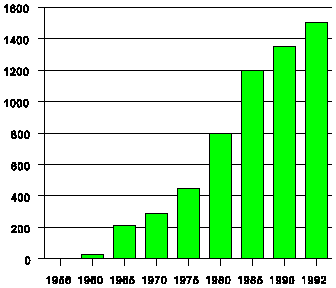
Secondary School Enrollments in Morocco
(1000s)
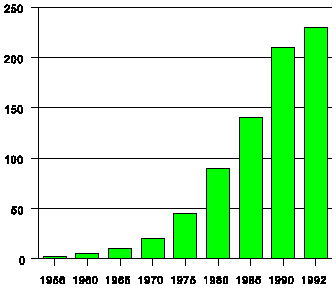
Post-Secondary School Enrollments in
Morocco (1000s)
There are also differences in the character and content of
education. On the one hand, the educational system was made
more "Moroccan" during the late 1950s and early 1960s. Arabic
became the principal language of instruction, and history,
social studies and other curricula were revised to reflect the
circumstances of the newly independent country. On the other,
there have been frequent complaints about educational quality,
with problems brought on, in part, by rapid enrollment growth
at all levels and a resulting strain on resources and
facilities. As summarized by a Moroccan scholar writing in the
mid-1980s, "the quality of education has been a sore point
over the years... [and] has led to insufficient or inadequate
training of thousands of young Moroccans at very high costs"
(Rhazaoui 1987, p. 151). Educated members of the younger
generation were trained in a school system possessing these
characteristics, whereas many older Moroccans, at least those
50 years of age or older, went to school either under the
French or before post-independence educational reforms were
fully implemented and the numbers in school had grown
significantly.
...
A Critical Mass
This, then, is the background for an assessment of the
attitudes and behavior patterns that will be brought into the
social mainstream by the generation of Moroccans now reaching
adulthood, or who have done so during the last decade and are
today in the early stages of their professional careers. This
cohort, as noted, is a product of the turbulent decades during
which its members grew up and acquired their core values. It
is also influenced by as the established political and
economic order with which its members must deal in their
present-day quest for meaningful adult lives. Finally, as
noted as well, this new and emerging political generation is
increasingly urban and well educated, and it is of sufficient
size and demographic weight to give shape to Morocco’s social,
cultural, and political ethos in the years ahead. Thus,
against this background, the present study inquires into the
orientations of young Moroccans between the ages of 18 and 35,
asking both what these men and women believe and whether their
views are similar to or different from those of the
generations that preceded them.
A study of political generations in the Arab world in the
1970s characterized the emerging the cohort as a "critical
mass." Focusing on the first generation to pass through the
formative years of socialization after independence, the study
suggested that "the young Arabs approaching adulthood, the
critical mass of the 1970s, will increasingly determine the
outcome of competing trends." Further, according to the
author:
In addition to employment, the new generation will be
seeking social status and a meaningful identity as Arabs. As
they take their place in Arab society, there may well be
conflicts and eruptions, and new political movements could
arise, based on this class of young adults. Whether they will
eventually turn out to be bridge or blockbuster in the
national culture, cement or tinder in the fabric of the
nation, their impact on the Arab world, its culture and
development, will be critical (Mattson 1970, p.
13).
This assessment was prescient, with insights that foretold
subsequent developments in many Arab countries, Morocco among
them. The present study seeks to make a similar contribution,
focusing on a larger and perhaps even more important political
generation and laying a foundation for observing, and
hopefully for understanding more fully, the evolution of
Moroccan society and politics during the first decade or two
of the twenty-first century.
CITIZEN ORIENTATIONS ACROSS POLITICAL GENERATIONS
The remainder of this study presents the results of public
opinion research carried out in Morocco in late 1995 and early
1996. The attitudes of young Moroccans toward selected social
and political issues are presented, and the nature and
distribution of these attitudes are compared to those of older
Moroccans. In this way, the study will shed light both on the
views of the emerging political generation and on the degree
to which these views portend political and cultural
change.
Data and Methodology
The public opinion data to be analyzed were collected
through systematic interviews with a representative sample of
adults over the age of 18 in Rabat, the Moroccan capital. The
study was part of a cross-national survey research project
sponsored by the American Institute for Maghrib Studies and
carried out in collaboration with social scientists at the
University Mohammed V in Rabat, the University of Oran, and
the University of Tunis. As part of this project, a parallel
survey was also conducted in Oran, Algeria, and data from this
survey are being analyzed elsewhere. Data collection has
recently been completed in Tunis as well and will be available
for analysis in the near future.
The overall design of the project, as well as
methodological procedures pertaining to sample selection,
interview schedule construction, the selection and training of
interviewers, and preliminary data analysis, were developed at
a series of workshops held in Morocco and Tunisia.
Participants, primarily sociologists and demographers,
included five Algerians, four Moroccans, two Tunisians, and
four Americans. Professor Rahma Bourqia of Mohammed V
University directed the Moroccan team that conducted the
survey in Rabat. Support for the project was provided by the
United States Information Agency and the Ford Foundation, as
well as the home institutions of participating North African
and American scholars.
A two-stage procedure was employed to ensure a
representative sample of respondents. In the first, modified
area probability sampling was used to construct a sample of
households. Rabat was first divided into eight socioeconomic
strata, based on the type of housing most commonly found in
each, and 28 districts were then selected at random from
within these strata. Since no listing of housing units was
available, a procedure was devised to ensure some randomness
in the selection of housing units to be included in the
sample. One thousand households were selected, distributed as
follows:
|
Luxury housing: |
6 percent of households
|
|
Modern housing: |
34 percent of households
|
|
Old and new medina: |
29 percent of households
|
|
Poorest housing: |
33 percent of households
|
In the second stage, the University of Michigan Survey
Research Center method was employed to select randomly within
each household one adult to whom a series of attitudinal
questions was then asked. This procedure ensured that the
sample would be generally representative of Rabat’s adult
population with respect to age, education, and other
demographic attributes.
Limiting the sample to Rabat was unavoidable given the
resources available for the research, and this naturally
reduces the degree to which findings can be generalized with
confidence. At the same time, it should be noted that Rabat
itself is a heterogeneous community, with great diversity in
terms of wealth and life-style and with many recent immigrants
from other parts of Morocco, including the country’s rural
areas. Thus, particularly in view of the systematic sampling
procedures employed within the parameters of Rabat, the 1,000
respondents on which the present study is based constitute a
strong, if admittedly limited, foundation for discerning the
orientations of Morocco’s emerging political generation.
Distributions on several demographic variables indicate the
diverse character of the sample resulting from these
procedures. For example, 47 percent of the respondents have
had only primary schooling or less, whereas 20 percent have
had a university education. With respect to living standards
and consumption levels, 54 percent live in homes with a
television set, 30 percent are members of a household with a
car, and 21 percent live in homes that have a satellite dish
antenna. Women are somewhat overrepresented in the sample,
constituting 55 percent of all respondents.
The interviews were conducted by female students
enrolled in the MA program in Sociology at Mohammed V
University. These women received training and were also guided
by an "interviewers manual" that was prepared specifically for
this project. Fieldwork was carried out between December 26,
1995 and January 15, 1996. Only two households refused to
participate in the survey.
In presenting the findings of the Rabat survey, respondents
first have been divided into two categories on the basis of
age. Those aged 35 and less constitute one category,
representing the younger political generation. Older
respondents constitute the second category, those who belong
to a preceding political generation. While this or any other
age division is of necessity somewhat arbitrary, it seems
appropriate given the preceding discussion to define the
younger generation as those who were born in 1961 or later and
who reached the age at which political socialization begins in
earnest no earlier than 1971 or 1972.
In addition to a division based on age, each generation has
been subdivided on the basis of education. Four categories of
education are employed: primary schooling or less, some
post-primary schooling, secondary schooling, and university.
The distribution of respondents possessing each combination of
age and education levels is shown in the table below. It is
not surprising that the proportion of individuals receiving a
university education is much higher among the younger
generation, whereas the proportion receiving no more than
primary schooling is much higher among the older
generation.
|
|
Primary or
less |
Some
post-primary |
Second-ary |
University |
Totals |
|
Younger
(35 or less) |
136
33% |
68
16% |
91
22% |
122
29% |
417
100% |
|
Older
(36 or more) |
324
57% |
90
16% |
68
12% |
82
15% |
564
100%
|
The inclusion of education in the analysis is necessary to
avoid spurious conclusions about generational differences.
Since educational levels are much higher among younger
individuals, an aggregate comparison of younger and older
Moroccans would also be a comparison of populations with
dissimilar amounts of education, thus confounding the effects
of age and education and making it impossible to determine
which of these was responsible for any differences that are
observed. This problem can be avoided by comparing younger and
older individuals with similar levels of education, however.
Further, this has the advantage of indicating the locus across
educational categories of intergenerational differences and
similarities, thereby revealing when, as well as whether,
younger and older Moroccans differ from one another.
Findings
Younger and older Moroccans are compared with respect to
three categories of attitudes and behavior: media consumption
and entertainment, religion and culture, and political
orientations. In each case, habits, practices, and values are
reported for the eight respondent categories based on age and
education that are shown above. Findings are presented in the
form of both graphs and tables in order to facilitate
interpretation.
Media Consumption and Entertainment. Tables 1
and 2 show patterns of newspaper readership, giving
information about both frequency and language. These tables
refer only to newspapers published in Morocco. Table 3 reports
on television viewing habits, focusing on the source of
programs that are watched most frequently. Table 4 gives
information about attitudes toward popular Western music.
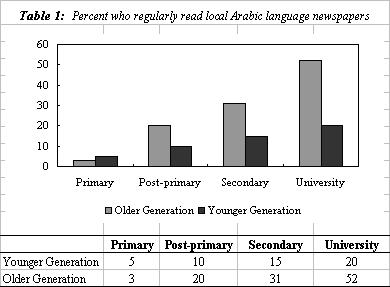
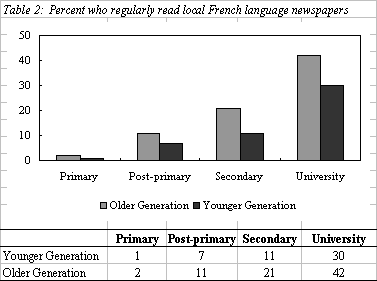
Nor surprisingly, Tables 1 and 2 show that regular
newspaper readership is much more common among those Moroccans
of either age cohort who are better educated. This applies to
both Arabic-language and French-language newspapers. In
addition, however, the tables also show that regular newspaper
readership is significantly less common among younger
individuals, again for newspapers in both Arabic and French.
One possible explanation for the latter finding is that the
younger generation is less interested in public affairs.
Indeed, the preceding discussion suggests that apathy and
alienation have been one response to present-day challenges in
Morocco. Alternatively, it is possible that younger men and
women are simply more inclined to rely on broadcast media for
news and information.
Tables 1 and 2 also reveal a generational difference with
respect to the language of the newspapers read most
frequently. Whereas older university graduates are more likely
to read Arabic-language newspapers, comparably educated
younger men and women are more likely to read newspapers
published in French.
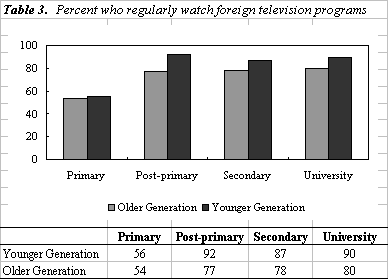
Table 3 shows that most Moroccans watch at least some
foreign television programs, although less well educated
members of both the younger and older generations are
disproportionately likely to watch only programs that
originate in Morocco. Differences between younger and older
individuals are not large at any given level of education. On
the other hand, among persons with more than a primary school
education, it is the case both that almost all members of the
younger generation watch foreign television programs regularly
and that the proportion who do so is consistently higher than
among comparably educated members of older generations.
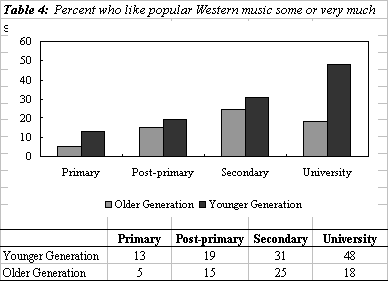
Table 4 shows that appreciation of popular Western music
increases in direct proportion to education among younger
individuals, and also that it is more common at all educations
levels among members of the younger generation. Accordingly,
the greatest generational difference in appreciation of
Western music is among well-educated men and women, and it is
within the younger generation that attitudes toward Western
music differ most significantly as a function of education.
The interview schedule also asked about the appreciation of
classical Arab and popular Arab music, and not surprisingly
most (though not all) respondents liked these as well.
Respondents were not asked which type of music they liked
most.
Taken together, these findings point to two general
conclusions about the emerging political generation. First,
its members are on balance more strongly oriented toward
European language, media, and cultural forms than are the
members of preceding generations. This is especially true of
younger men and women with a university education. They are
more likely to read newspapers in French than in Arabic,
almost all watch foreign television programs regularly, and a
majority likes Western popular music.
This is not to say that well-educated younger Moroccans are
uninterested in things closer to home. For the most part, the
newspapers they read are Moroccan; most watch Moroccan as well
as foreign television programs regularly; and, as noted, most
like Arab and Moroccan music as well as Western music. But it
is clear that these latter tastes and habits do not tell the
whole story. Rather, the best-educated members of the younger
generation are also interested and involved in the world
outside Morocco. Moreover, although the magnitude of
intergenerational differences is not great, they are at least
somewhat more inclined in this direction than are comparably
well-educated older Moroccans.
Second, there is substantial variation within the
younger generation with respect to patterns of media and
entertainment. The difference between the best and the least
well educated members of this generation is particularly
noticeable. The gap in newspaper readership is clear, although
this applies to older as well as younger individuals. The gap
in television viewing and attitudes toward Western music is
much more pronounced among younger Moroccans, however. Younger
individuals with only a primary school education are much less
likely to watch foreign television programs, and relatively
few of them like Western popular music even somewhat. The
least well educated members of the younger generation thus
stand out as much less involved or interested in the world of
Europe than are the most well educated members of the same age
cohort. Accordingly, Morocco’s emerging political generation
is likely to reinforce, and quite possibly intensify, the
existing cultural and linguistic differences associated with
varying levels of education.
...
Gender Differences. Before concluding, it may
be noted that a separate set of comparisons was undertaken
with gender added to the analysis. Specifically, younger men
were compared to older men in each of the four education
categories, and younger women were similarly compared to older
women in each category based on education. Tables showing
these comparisons are not presented, however, since in most
cases intergenerational differences are similar for men and
women. Both among men analyzed separately and among women
analyzed separately, the findings closely resemble those
presented in Tables 1-12 for the sample as a whole.
There are two exceptions, or partial exceptions, reflecting
instances in which intergenerational differences do vary by
gender to a significant degree. First, the tendency of younger
individuals to appreciate Western music, shown in Table 4, is
much more pronounced among men than among women, especially
for those who are less well educated. Younger women with less
than a secondary school education very rarely like Western
music a great deal or even somewhat. Second, while younger and
older individuals tend to have similar attitudes toward women
working outside the home, as shown in Table 7, there is a
generational difference among women in three of the four
education categories: primary, post-primary, and university.
In each of these categories, and especially among less
well-educated individuals, younger women are less likely than
older women to approve of women working outside the home.
These findings do not require any significant modification
of the conclusions to be drawn from Tables 1-12. The do
suggest, however, that in at least some instances the
normative gap between better and less well-educated members of
the younger generation is greater among women than it is among
men.
CONCLUSIONS
Attitudes and behavior patterns are not unchanging. The may
evolve in response to individual maturation or new
environmental stimuli. Thus, it is not known whether the
current orientations of older men and women are the same ones
that these individuals held when they were younger. Nor is it
possible to know the degree to which the orientations
presently held by younger men and women will change as these
individuals mature and acquire additional life experience. The
findings reported in the present study must therefore be
interpreted with caution. It for this reason, as stated in the
introduction, that the goals of this study are to provide a
preliminary account of Morocco’s next political
generation and to stimulate additional inquiry and
investigation. At the same time, the present analysis rests on
an unusually strong empirical foundation and offers valuable
and heretofore unavailable baseline data with which findings
from future research can be compared.
Against this background and with appropriate caution, three
interrelated conclusions may be drawn from the data that have
been presented. First, normative and behavioral differences
between the age cohorts compared to shed light on generational
change turn out, in most instances, to be of limited
magnitude. Perhaps this should not be surprising, since older
as well as younger Moroccans have been marked by the
historical events and present-day circumstances summarized
earlier. In any event, to the extent that change is taking
place, it will be of an evolutionary rather than a
revolutionary nature.
Second, this is not to say there are no discernable or
interesting differences between older and younger Moroccans.
Moreover, these differences, when they exist, consistently
involve lesser attachments to tradition and greater
receptivity to non-indigenous normative and behavioral
patterns on the part of the younger generation. This is seen
in television viewing habits, language preference in newspaper
readership, a taste for Western music, prayer, and attitudes
toward democracy.
Third, there are numerous attitudinal and behavioral
difference associated with education, and these differences
are as pronounced among younger men and women as they are
among older individuals, sometimes more so. Morocco, like
other countries in North Africa and the Arab East, has long
been characterized by a significant normative gap between
better educated and less well educated citizens. The data
presented in this paper suggest that this gap will not be
narrowed appreciably by the emergence of the next political
generation. The entry of this generation into the Moroccan
mainstream will rather reinforce, and to an extent perhaps
even intensify, the cleavages associated with differing levels
of education.
The preceding suggests that the emergence of Morocco’s next
political generation will involve continuity as much as
change, with respect not only to the nature but also to the
distribution of habits, practices, preferences, and values.
Yet the differing educational experiences of younger and older
Moroccans suggest that this is not the whole story. The
younger age cohort contains hundreds of thousands of men and
women with a university education and millions who have
completed secondary school. Two or three decades ago, by
contrast, these numbers were very much lower, being in the
tens of thousands for university graduates and no more than
several hundred thousand for secondary school graduates. This
is partly a result of the larger size of the emerging
generation, but it is also a consequence of the expansion and
to some degree democratization of education.
An important implication of the preceding observation is
that the values and social codes associated higher levels of
education will characterize a much greater segment of society
in the future than they have in the past. This includes an
interest and involvement in the world outside Morocco, support
for non-traditional religious and cultural norms, and a
political culture that is civic and participant in character.
In contrast to the past, when the well-educated men and women
characterized by these orientations represented something of a
modern island in a traditional sea, these attitudes and
behavior patterns will increasingly characterize a demographic
block -- well educated younger individuals -- of sufficient
size to exert broad social and political influence. This can
be expected, at one and the same time, both to bring pressure
for an evolution of Morocco’s social, cultural, and political
ethos and to increase the salience of the gap between
individuals with different outlooks and life-styles.
BIBLIOGRAPHY
Amara, Hamid Ait. 1993. "Demographic Pressures and Agrarian
Dynamics." In I. Wm. Zartman and Mark Habeeb, eds., State
and Society in Contemporary North Africa. Boulder,
Colorado: Westview Press.
Bendourou, Omar. 1988. "The Exercise of Political Freedoms
in Morocco." Review of the International Commission of
Jurists 40: 31-41.
Bennani, Aziza. 1992. "L’université marocaine: évolution et
adaptation." Al Bayane (Casablanca), September 28.
Bennani-Chraibi, Mounia. 1993. Les Représentations du
Monde des Jeunes Marocains. Paris: Thèse de doctorat de
l'Institut d'Etudes Politiques.
Bourgi, Albert. 1989. "Etudiants: où mènera le désespoir."
Jeune Afrique 1519 (February 12): 38-42.
Brand, Laurie. 1998. Women, the State, and Political
Liberalization. New York: Columbia University Press.
Damis, John. 1987. "The Impact of the Saharan Dispute on
Moroccan Foreign and Domestic Policy." In I. William Zartman,
ed. The Political Economy of Morocco. New York:
Praeger.
Dawson, R.E., K. Prewitt, and K.S. Dawson. 1977.
Political Socialization. Boston: Little, Brown.
Dennis, Jack. 1973. Socialization to Politics. New
York: Wiley.
Denoeux, Guilain. 1998. "Understanding Morocco’s
‘Sanitisation Campaign’ (December 1995 to May 1996)."
Journal of North African Studies 3 (Spring 1998):
101-131.
Dévoluy, Pierre. 1998. "Maroc: la cohabitation à bâtons
rompus." Jeune Afrique 1970 (October 12-19): 28-31.
Dwyer, Kevin. 1991. Arab Voices. Berkeley:
University of California Press.
Eickelman, Dale F. 1997. "Muslim Politics: The Prospects
for Democracy in North Africa and the Middle East." In John
Entelis, ed., Islam, Democracy, and the State in North
Africa. Bloomington: Indiana University Press.
Entelis, John. 1997. "Political Islam in the Maghreb: The
Nonviolent Dimension." In John Entelis, ed., Islam,
Democracy, and the State in North Africa. Bloomington:
Indiana University Press.
Kokan, Jane. 1994. "Morocco: Riot deaths as Hassan faces
challenge." The London Times, February 20.
Leveau, Rémy. 1993. Le Sabre et le Turban. Paris:
Edition François Bourin.
Marks, Jon. 1994. "Special Report on Morocco." Middle
East Economic Digest, April 1.
Mattson, James. 1971. "Development in the Arab World." In
Mark Tessler, ed., A New Look at the Middle East.
Milwaukee: University of Wisconsin-Milwaukee.
Moffett, George D. 1989. "North Africa's Disillusioned
Youth." The Christian Science Monitor. May 17.
Nachtwey, Jodi. 1998. "Preliminary Findings from a Moroccan
Survey: Issues of Gender." Paper presented at Mohammed V
University, Rabat, Morocco.
Paul, James. 1984. "States of Emergency: The Riots in
Tunisia and Morocco." MERIP Reports 127
(October).
Rhazaoui, Ahmed. 1987. "Recent Economic Trends: Managing
the Indebtedness." In I. William Zartman, ed., The
Political Economy of Morocco. New York: Praeger.
Sabagh, Georges. 1993. "The Challenge of Population growth
in Morocco." Middle East Report, pp. 30-35.
Seddon, David. 1989. "The Politics of ‘Adjustment’ in
Morocco." In Bonnie K. Campbell and John Loxley, eds.,
Structural Adjustment in Africa. New York: St.
Martin’s.
Sigel, Roberta S. 1970. Learning About Politics: A
Reader in Political Socialization. New York: Random
House.
Suleiman, Michael W. 1987. "Attitudes, Values and the
Political Process in Morocco." In I. William Zartman, ed.,
The Political Economy of Morocco. New York:
Praeger.
Tessler, Mark. 1982. "Morocco: Monarchical Dominance and
Institutional Pluralism." In I. Wm. Zartman, ed., Political
Elites in Arab North Africa. New York: Longman.
_____ 1985. "The Uses and Limits of Populism: The Political
Strategy of King Hassan II of Morocco," Middle East
Review (Spring ): 44-51.
_____ 1986. "Explaining the ‘Surprises’ of King Hassan II:
The Linkage Between Domestic and Foreign Policy in Morocco;
Part I: Tensions in North Africa in the Mid-1980s."
Universities Field Staff International Reports. No. 38.
_____ 1993. "The Alienation of Urban Youth." In I. Wm.
Zartman and Mark Habeeb, eds., State and Society in
Contemporary North Africa. Boulder, Colorado: Westview
Press.
_____ 1997. "The Origins of Popular Support for Islam
Movements: A Political Economy Analysis." In John Entelis,
ed., Islam, Democracy, and the State in North Africa.
Bloomington: Indiana University Press.
_____ 1998. "Preliminary Findings from a Moroccan Survey:
Religious and Political Dimensions." Paper presented at
Mohammed V University, Rabat, Morocco.
Witter, Willis. 1993. "Moroccans See Good, Evil in Possible
Economic Boom." The Washington Times, September 22.
* * * *
Comments on this paper are welcome via email to
the author.
All Rights Reserved. May not be reprinted
in any format without permission of the
Author. |
