|
|
|
|
|
|
| Vol. 12 No. 3 |
May-June 2002 |
|
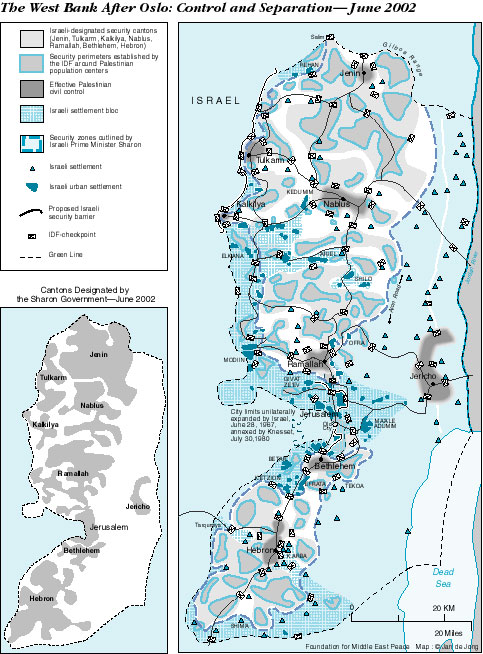
A new, post-Oslo era has begun in the occupied territories. The understandings between Israel and the Palestinians that made possible the establishment of a Palestinian Authority lead by Yasser Arafat and the creation of Palestinian security services with a mandate in Palestinian populated areas [Areas A] of the West Bank have been irrevocably undermined. Likewise, the territorial division of the West Bank that resulted from the Oslo process—the creation Areas A, B, and C—is no longer relevant to the reality in the West Bank and Gaza Strip. As one U.S. official who recently returned from the region remarked, "the Oslo map today is meaningless." The government of Ariel Sharon has effectively destroyed the principle feature of the Oslo era by ending Israel's consent to recognize the security responsibilities of the PA in Area A— covering the principal Palestinian towns in the West Bank. As Amir Oren of Ha'aretz wrote on April 5, 2002, "[In the occupied territories] the IDF has been "color blind" for some months: There is no difference, as far as the army is concerned, between brown (the color on the map of the areas in the territories under full Palestinian civilian and security control [Area A]), white (areas of full Israeli control [Area C]), or yellow (Israeli security and Palestinian civilian control [Area B]). The IDF is doing as it pleases in all of them." Just as he is determined to reinvent a less powerful Palestinian Authority more suited to his preferences, Sharon, more than anyone else on the international diplomatic stage, and to his great advantage, is proceeding from an assumption that the Oslo map is an artifact of history, as relevant to the future as was the 1947 Partition Plan map after the first Israel-Arab war in 1948. Sharon is determined to construct a new map for the occupied territories—one that reflects his understanding of how best to protect Israel's security interests, both domestically and regionally, and to safeguard and expand Israel's settlement enterprise. An Israeli deployment based upon these views now being devised and implemented. When Sharon met U.S. Secretary of State Colin Powell in mid-April, he answered Powell's request to withdraw Israeli forces from Palestinian towns in the West Bank by explaining that the objective of Israel's unprecedented military operation was to deploy the IDF in security zones in the Jordan Valley and in the region east of the Green Line separating Israel from the West Bank. As Ha'aretz reported on April 14, 2002, the logic of his plan was this: a military defeat would convince the Palestinians and the international community to leave these security zones, including major Palestinian population centers, under effective Israeli control for many years. To leave no doubt of his intentions, Sharon showed Powell a map of the West Bank outlining the two security zones. Sharon's territorial preferences were formed decades ago, and they have not changed significantly over time. The settlement plan he unveiled as Minister of Agriculture in 1977 focused on the area of the West Bank east of the Green Line. Sharon planned settlements in this region as a way of preventing the creation of "a solid Arab block" straddling Palestinian towns on both sides of the Green Line and reaching eastward to the populated region joining Jenin, Nablus, Ramallah and Jerusalem. In this latter area, Sharon spearheaded the establishment of numerous small settlements along the mountain ridge. The Sharon map of 1997 proposed the annexation of between 64–70 per cent of the West Bank and thirty-one percent of its Palestinian population to Israel. It acknowledged the need to accommodate the reality of Palestinian sovereignty in a portion of the West Bank within a strategic environment dominated militarily by Israel and without obstructing the expansion of Israeli settlements. The following areas of Israeli sovereignty were proposed by Sharon in 1997: -- A 20 km-wide strip along the Jordan Valley border with Jordan -- A 7–10 km-wide strip along the Green Line border -- Three roadways running in an east-west direction across the West Bank -- Control over "metropolitan Jerusalem" including Bethlehem -- Every settlement to be included in a security zone and will not be isolated This outline was put forward in the context of a final status agreement as outlined in the Oslo accords. In today's environment, Sharon prefers to think in terms of long-term interim measures, which necessarily excludes Israel's de jure annexation of territory. Instead of annexation as part of a final status agreement, Israeli policy is now defined as one of unilaterally defining and constructing security zones as part of a long term interim arrangement.
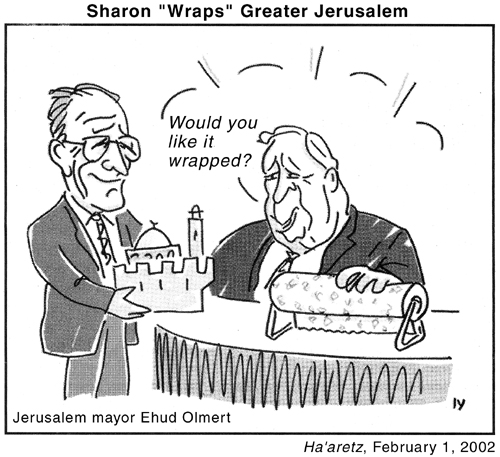
MK Yosef Lapid, after a tour of these areas, noted that 400,000 Palestinians in 108 villages live in Sharon's western security zone now being demarcated along the Green Line. On January 30, 2002 the Sharon cabinet approved the "Wrapping Greater Jerusalem" scheme, a political-security concept for assuring Israeli and settlement security in the metropolitan Jerusalem region. Significant parts of the West Bank—including Givat Ze'ev in the north, Ma'ale Adumim to the outskirts of Jericho in the east, and the Etzion bloc to the south—define its territorial perimeter, which is to be guarded by soldiers from the Border Police. Barriers will be constructed along only 11 km. The area east of Givat Ze'ev to Adam has already been fenced, according to Khalil Tufakji, Head of the Orient House's Mapping and GIS Department. Most of the West Bank roads into this region have already been barricaded, forcing traffic into discreet and tightly controlled access points. These zones, long part of Sharon's vision of Israeli control over the destiny of the West Bank, have now been married to an increasingly vocal popular Israeli demand for "separation" from Palestinians. The idea animating this demand is that no Palestinian, except for humanitarian cases, will be permitted to cross into Israel. Most of the plans for separation or unilateral withdrawal now under discussion, including the one supported by the Sharon government, are first and foremost the product of an Israeli desire not to separate—to remain in the territories in both the security and settlement dimensions—from the West Bank and Gaza Strip. The plan approved by the Sharon cabinet calls for the creation of a security buffer zone with two fortified lines—a western "seam line" running approximately parallel to the Green Line, and another on the zone's eastern perimeter. The former line is 286 km, of which 68 km (11 km of which are to be built around Jerusalem) will feature barricades such as a wall or electronic fence that will indicate not only when someone breaches it but also when someone approaches it. Small sections of the wall/fence have been constructed at local initiative over the years. Parts of it date to 1994. Thirty checkpoints will be established for vehicular passage along this line. Four crossing points will be established for commerce, featuring the cargo transfer system in place between the Gaza Strip and Israel that prohibits the entry of Palestinian trucks into Israel. The four points are to be located at Salim near Jenin, Kalkilya, Tarqumiya, and Jerusalem. The eastern perimeter will not be marked with a fence, but will have various passive and active security and monitoring measures. An idea to mine the area east of the eastern perimeter was rejected because the IDF feared that Palestinians would steal the mines for use elsewhere. Within the West Bank, and in the absence of any agreed upon Palestinian security capability, the IDF will maintain the existing network of scores of checkpoints controlling Palestinian movement into and out of cities and villages. The checkpoints encircling Palestinian areas are meant to enhance the security of Israeli settlements. Results of the government's allocation of a multi-million dollar budget for the scheme are to be expected within the year. Yet previous plans inspired by a similar aspiration to prohibit Palestinian entry into Israel have not materialized. A cooling of public passions and the recognized inability of such measures to assure an increase in the security of the Israeli public have, until 2002, produced many plans but no integrated physical barriers. Under Sharon's leadership, however, some sort of barrier will be erected, notwithstanding its dubious security value, but more significantly because it fulfills a strategic plan for settlement expansion long pursued by the prime minister. As Minister of Internal Security Uzi Landau explained the plan for Israel's separation from Palestinians, "They are there, but we are here, and there as well."
Prime Minister Ariel Sharon is reasserting Israel's control over the entire West Bank, sweeping aside the Oslo arrangements, and imposing a radically different map on the territories. His goals are to cement Israeli control, fortify and expand settlements, further undermine Yasser Arafat's Palestinian Authority, and prevent renewed Palestinian terrorism by even more severe controls over Palestinians. Judging from the resumption of suicide bombings inside Israel, the anti-terrorism component of this strategy, which follows the IDF's recent massive "Operation Defensive Shield", has already failed. The situation is likely to get worse without an early renewal of peace talks with a mutually agreed objective of a viable Palestinian state. Sharon has retained the initiative to pursue his strategy, since the Bush administration is still wrestling over a coherent response. Israeli and Palestinian majorities, the EU, and the Arab states—via the Saudi plan—support two states, two capitals in Jerusalem, an end to most settlements with some border adjustments, and a negotiated solution of the refugee problem. The real obstacles are continued Palestinian terrorism, which undermines Israelis' trust in negotiations for compromise, and Sharon's determination to preserve occupation and settlements, which virtually ensures continued terrorism. Sharon's proposal to wait for Palestinian reform and a new leadership is a diversion, and Washington's proposed Palestinian security reform will not work unless accompanied by forceful American diplomacy that defines the political endgame and a specific plan for negotiations. The situation cries out for this. Philip C. Wilcox, Jr.
SHARON'S
PEACE OF THE VICTOR Washington's understanding of the policies and passions animating Israelis and Palestinians has never been very prescient, and the situation today is no different. As long as Israel and the Palestinians saw some value in muddling through a diplomatic framework established by the Oslo process, however, the price of Washington's misapprehensions was manageable. Today however, the United States finds itself unable to fathom the extent to which Ariel Sharon and Yasser Arafat have changed the rules of the game between them. The April 2002 mission of Secretary of State Powell did succeed, at least for the time being, in its primary objective—limiting the destabilizing fallout from the battle between Israel and the Palestinians—but it failed to alter either Israeli or Palestinian policies. As each party readies itself for the next round, the Bush Administration needs to take account of the realities that dominate the contemporary landscape: Oslo is dead. More precisely, the understandings between Israel and the PLO that made Oslo possible have been repudiated by the Sharon government. What were these understandings? First, Israel, under the leadership of Yitzhak Rabin, recognized that the PLO headed by Arafat was the only reliable interlocutor for Palestinian interests. Second, the PLO was the only Palestinian address for an agreement that could put an end to the rebellion against Israel's occupation of the West Bank and Gaza Strip and thus increase Israeli security. Sharon never believed in either of these propositions at the heart of the bargain between Rabin and Arafat. During the last year, the United States has watched with detached interest as the Israeli prime minister has deftly brought Israel into headlong confrontation with Arafat, the Palestinian Authority, and Palestinian security services in the West Bank. Arafat, for his part, viewed what Palestinians considered grievous concessions—most notably compromises regarding Israeli settlement expansion made to win Israeli approval for the PLO's return to the occupied territories in 1994—as defensible only insofar as Oslo promised the creation of an independent Palestinian state in the territories occupied by Israel in June 1967. By 2000 Arafat's Palestinian subjects, far more than their leaders, had despaired of ever achieving this goal. They only needed to look out of their windows to see that the settler population of the West Bank had doubled, or reach into their pockets, which were emptier in 2000 than they were in 1993, to conclude, like many Israelis, that the "peace process" was a cruel joke being played upon them. Yet it has been Israel that declared the Oslo era at an end through ever-clearer signals that the Bush administration still seems unable to assimilate. The Sharon government has determined that Arafat and the institutions he represents—the PLO and the Palestinian Authority—are no longer diplomatic or security partners. Arafat has failed to play the role outlined for him, and so he is no longer "relevant" to Israeli designs and must go. Arafat's security services, nurtured and paid for by the CIA, have failed to enhance Israeli security and have therefore been decimated. The Oslo map of the West Bank no longer exists. There are no Areas A or B, where the PA once nominally ruled. There is only one area and that area is controlled by the IDF without Palestinian intermediaries. Without an Israeli commitment to Arafat, and the PA and its security services, there is simply no remnant of the previous era left intact to build upon. Sharon is making up the ground rules of the new game as he goes along, while the international community insists without much conviction on playing yesterday's game. Half-hearted prescriptions like the Tenet or Mitchell ideas that once sufficed to keep the lid on in the past are no longer relevant. To this day, by intent or miscalculation, the Bush administration encourages Sharon in his excesses, the most grievous of these being the decision to "let the IDF win." What does an IDF victory mean in the current context? Forget about ending terror. Even the IDF acknowledges that it cannot but fail in this effort. The parts of three Israeli divisions said to be engaged in the West Bank at the height of "Operation Defensive Shield" meant to force Palestinians to abandon all hope of ending Israel's domination, in one form or another, over their lives. Sharon wants to restore the Palestinian despair and fear that enabled Israel to rule all but unchallenged from 1967 to 1988 when hope for independence re-emerged. The longing for those "golden years of occupation" is palpable among Israel's right-wing and the settler community. Sharon wants to turn the clock back to a time when one Israeli jeep with three bored soldiers at the entry to Nablus was sufficient to keep Israelis secure and its settlements unmolested and to put an end to the fiction created during Oslo that Israel is engaged in a process of negotiation with Palestinians over their joint future. For him there is no win-win solution, only one dictated by Israel—the peace of the victor. To the extent that Washington preoccupies itself with all manner of distractions and feints, it encourages Sharon, and the people he leads, to pursue an end in which there are no victors and there is no security.
Question: Yesterday, Secretary of State Powell specifically called on Israel to stop construction of settlements. It is the policy of this government that continued settlement construction does not advance the prospects of peace. I have not heard the President c all on Israel to stop constructing settlements. Mr. Fleischer: That has been longstanding American policy. I can — Question: Does the White House believe that Ariel Sharon should discontinue construction of settlements immediately? Mr. Fleischer: The American position and President Bush's position is that construction of new settlements is not helpful. Question: It's a little bit different, a little nuance there, between that and a call for Prime Minister Sharon to stop. Mr. Fleischer: No, the President agrees with that. Press Briefing by White House press secretary Ari Fleischer, May 3, 2002
Rep. Jerry Lewis (R-California): I recently spent a good deal of time in Israel. A lot of the debate then was saying, what do we do about stopping the desire to extend into the West Bank, the development of communities, et cetera, et cetera. That was really one of the thrusts of the majority-minority debate and there was support on both sides to not do very much. Clearly, that debate went nowhere because there has been nothing but expansion. What has [U.S.] money done to impact that sort of policy that literally has been a major source of unrest—the expansion on the West Bank? Armitage: The settlements, particularly, are a major source of unrest. I do not think there is a truthful answer to you, other than I think that for a lot of complicated reasons— some historical, some political—there has been a reluctance to be very heavy-handed with Israel, because we have no better ally and friend in the region. I do not know what to say, and I don't think that heavy-handedness works, actually. I think we have to be able to develop the proper amount of confidence in the Israelis that we are not going to leave them in the lurch, and try to work with them, as Secretary Powell is trying to do this week, to come to a better way of living, and realize the vision of the secretary, but more importantly the president laid out at the United Nations, of two states, Palestine and Israel, side-by-side, living in peace and secure borders. Testimony of Deputy Secretary of State Richard L. Armitage before the House Appropriations Foreign Operations Subcommittee, April 18, 2002
Something has to be done about the problem of the settlements, the settlements continue to grow and continue to expand. . . . It's not going to go away. Secretary of State Colin Powell on NBC's Meet the Press, May 1, 2002 ————————————— Let's take one thing at a time. Settlements will eventually be an issue. But I think we have to get the context right here. We need to end the terror, create a situation in which there is better security and no violence. National Security Adviser Condoleezza Rice on Fox News Sunday, May 1, 2002 ————————————— Like most of his ministers, [Prime Minister Levi] Eshkol was elated over Israel's control of the West Bank, Jerusalem's Old City and the water sources in the Golan. He was among the initiators of the speedy government decision to unify Jerusalem. At the same time, Eshkol worried about the future. When the [1967] war was over, he believed peace could be reached with Egypt and Syria by withdrawing to the international borders and demilitarizing the Golan Heights and Sinai. He feared for the Jewish character and survival of Israel if territories with large Arab populations were retained. One of his ideas was annexing the Gaza Strip and resettling the refugees in Iraq or Sinai. He proposed drawing the border at the Jordan River, and establishing an autonomous district in Gaza to free Israel from the burden of ruling a million Arabs. Eshkol thus fathered a policy that guided the Israeli government from 1967 until 1973: the policy of biding time and avoiding decision-making, which was to become the trademark of Golda Meir. The government voted to withdraw from the Golan Heights and Sinai on June 19, 1967. Unlike Dayan, Eshkol supported this initiative. From the protocols of the meeting, which appear in this book, Eshkol attacks Dayan for being vague. Eshkol: "When we talk about returning territories, things have to be clear. If the MKs think they can sit here and ignore the refugee problem, and still reach some kind of agreement, let them get it out of their heads right now. . . . An inheritance of a million and a half Arabs falling on us out of the blue is no simple matter." [Moshe Haim] Shapira: "The refugees are now sitting in your country. Now they're your responsibility." Eshkol: "I've said it before: There have always been population exchanges. When coexistence is difficult and countries can't live together, population exchange is the answer. We took in 100,000 Jews from Iraq, so let them take in 100,000 Arabs. They speak the same language. The mentality is the same. They have water. They have land." Shapira: "No." Eshkol: "Why not?" Shapira: "Because they're citizens of this country, and now they're under your control. Why should Arabs who were born here be packed off to Iraq?" [Menachem] Begin: "In Greece, Turks who were born there had to move. And it was based on an agreement." Eshkol: "On the subject of borders, I propose annexing Jerusalem and the Gaza Strip, although I wouldn't talk about them in the same breath. For Jerusalem, we would give our lives, but thinking about Gaza and 400,000 Arabs gives me heartburn." Yigal Allon: "Judging by what we did in Jerusalem, without knowing how the world would react, I think we can allow ourselves to take some broader steps." Eshkol: "I haven't heard any objections to annexing Jerusalem and the Gaza Strip, although I still say there's a difference." Begin: "I think we shouldn't use the word ‘annexation.'" Yaakov Herzog (director-general of the Prime Minister's Office): "Maybe ‘inclusion' is a better word." Later, Eshkol challenges Allon's proposal to build settlements in the territories. "I would wait with the settlement program," he says. "I know it's very popular to talk about getting down to such things right away. I know that using the ‘tower and stockade' approach, we can build dozens of settlements in no time. But I wouldn't rush. First let's see if we can solve the problem of the refugees who will be left in Israel if the Jordan River becomes the border. They'll have to be awarded some kind of political status, maybe autonomy or something." By the end of the meeting, the government voted to accept Eshkol's proposals: offering Egypt and Syria peace in return for demilitarizing Sinai and the Golan Heights, establishing the Jordan River as a border, and turning the West Bank into an autonomous region. It was a secret resolution that was never made public, although the United States was informed. Four months later, true to character, Eshkol had second thoughts on this decision and voted to overturn it. On October 30, 1967, in another secret ballot, the government rejected the principle of borders with Egypt and Syria based on international lines, and adopted instead the principle of borders determined by Israel's security needs—the approach favored by Moshe Dayan. This time around, not even the United States was informed. Yossi Melman, Ha'aretz, "Father of Indecision," May 3, 2002, discussing the recently published Levi Eshkol, The Third Prime Minister: Selected Documents, 1895–1969, edited by Yemima Rosenthal ————————————— Hardball host Chris Matthews interviewing Rep. Dick Armey (R-Texas), leader of the Republicans in the U.S. House of Representatives. Armey: I am perfectly content to have a Palestinian state alongside Israel if it is a state that honors others borders. Matthews: You are in total, 180 [degree] disagreement with Tom Delay who said this week that the entire West Bank belongs to Israel and it belongs to that country that's not an Arab country. Armey: I'm perfectly content to have a Palestinian state. I am not content to give up any part of Israel for the purpose of that Palestinian state. Matthews: Wait a minute. Tom Delay, whose resolution you're going to put on the floor tomorrow and schedule, has said that the entire West Bank, he calls it Judea and Samaria, belongs to Israel. How can you say that this resolution doesn't support the Delay position, which is Israel has a right to grab the entire West Bank? Armey: No, I'm content to have Israel grab the entire West Bank. I'm also content to have the Palestinians have a homeland and even for that to be somewhere near Israel, but I'm not content to see Israel give up land for the purpose of peace to the Palestinians, who will not accept it and would not honor it. It is time to . . . Matthews: Well, where do you put the Palestinian state, in Norway? Once the Israelis take back the West Bank permanently and annex it, there's no place else for the Palestinians to have a state. Armey: No, that's not at all true. There are many Arab nations that have many hundreds of thousands of acres of land and and soil and property and opportunity to create a Palestinian state. Matthews: So you would transport—you would transport the Palestinians from Palestine to somewhere else and call it their state? Armey: Most of the people who now populate Israel were transported from all over the world to that land and they made it their home. The Palestinians can do the same, and we're perfectly content to work with the Palestinians in doing that. We are not willing to sacrifice Israel for the notion of a Palestinian homeland. . . . I am content to have Israel occupy that land that it now occupies and to have those people who have been aggressors against Israel retired to some other area, and I would be happy to have them make a home. I would be happy to have all of these Arab nati ons that have been so hell bent to drive Israel out of the Middle East to get together, find some land and make a home for the Palestinians. I think it can be done. MSNBC, May 1, 2002 ————————————— Excerpts from a May 22, 2002 al-Hayat interview with Sheikh Ahmad Yassin, founder of the Islamic Resistance Movement (Hamas) and its spiritual leader. Question: How do you see the way out from the crisis and from the conflict that has been raging for more than 50 years? Would Israel's withdrawal from the West Bank and Gaza and the establishment of a Palestinian state be sufficient in ending the resistance? Yassin: If the sun were to fall on earth, it would burn it. . . . If the moon were not to rise at night, it would remain dark. . . . If these were to happen, the devil's doors would open. We have a homeland and things we hold sacred. We are faced with an occupation. When this occupation is removed from any part of my land and of my people, I shall be happy. I shall accept, on condition that this removal does not come at the expense of the rest of my land and my country. I will not be the one to give up his ancient land, give up occupied Palestine. I may, in such circumstances, consider stopping the resistance for a year or two, for a month or two, according to conditions. We shall decide in accordance with what really happens. But for Sharon to come along and say: ‘Take 40 percent of the West Bank and make yourself a state, with the settlements remaining in place' this is nonsense. The facts that arise on the ground will determine my role and response. Question: What is the movement's position regarding the Arab peace initiative? Does it find in it an acceptable solution for the Arab-Israeli conflict? Yassin: Any solution that concedes my land in Palestine, I cannot accept. I cannot accept any solution that would take Haifa, Jaffa, al-Joura [Sheikh Yassin's village, destroyed by Israel in 1948] and Asqalan [Ashkelon] from me. I am the son of Asqalan [which contains al-Joura village]. My home and my land are there. I can now walk there with you. No one can force me to give up my land. Egypt refused to give up a single kilometer in Taba and in the Sinai Desert. Am I to give up 80 percent of my land? ————————————— "Dear Reservist," begins a February 20, 2002 letter sent by the commander of an Israeli air force base to aircraft technicians, "You will soon be called to reserve duty protecting communities in Judea and Samaria. There is a war going on in the territories (underline in original) and the standing army does not have enough forces for all its activities." "We haven't held a gun for many years," remarked one reservist who received the letter. "What can we do against saboteurs in the territories?" Ma'ariv, March 26, 2002
February 25 The Israel Defense Forces (IDF) bulldozes over 100 dunams of cultivated Palestinian land linking the Har Adar settlement to nearby settlements. (Arutz 7) February 27 Jerusalem mayor Ehud Olmert, announces the construction of a wall between the Neve Ya'akov settlement community and the Area B villages of Dahyat al-Barid and A-Ram. (Ha'aretz) Israeli forces begin construction of a cement wall outside the Neve Dekalim settlement, west of the Khan Yunis refugee camp. (Hear Palestine) February 28 An IDF soldier and 10 Palestinians are killed after the IDF enters Balata and Jenin refugee camps. Fatah members shoot from Beit Jala at the Gilo settlement community and the Tunnels Highway. (Wafa) Settlers from Ma'ale Amos attack Palestinian civilians from Kisan village near Bethlehem. (Hear Palestine) Israel bulldozes land for settlement expansion in the Ras al-Amud area in East Jerusalem. (Hear Palestine) March 1 Palestinian gunfire from Beit Jala damages forty homes in Gilo. (Arutz 7) More than 50,000 Israeli demonstrators, many of them settlers, call upon the Sharon government "to act with power against the Palestinian Authority and Arafat," and to "destroy the [Palestinian] Authority and bring back security." March 2 The body of a Jerusalem police detective from Ma'ale Adumim is discovered near the Mar Saba monastery in the Judean Desert. He was shot while riding his motorcycle. (Israeline) Schools in Gilo that face Beit Jala and Bethlehem close for the day as a result of shooting incidents on March 1. March 3 A sniper affiliated with Fatah's Al-Aqsa Martyrs Brigade kills seven IDF soldiers and three civilians at Haramiya junction, an army roadblock near the Ofra settlement. The gunman escapes. (Israeline) March 4 A missile fired from the Psagot settlement kills five women and children in Ramallah's al-Amari refugee camp. (Palestine Report) March 5 A female settler is killed in a drive-by shooting near Bethlehem. (Reuters; Los Angeles Times) In Sur Baher in East Jerusalem, a bomb placed at an Arab school injures eight children and one teacher. A group calling itself "Revenge of the Infants" claims responsibility. (Los Angeles Times) A woman from the West Bank settlement of Efrat is killed and her husband wounded in an attack on the Tunnels Highway. (Israeline) The Israeli cabinet decides to tighten travel restrictions, banning Palestinian traffic on most West Bank roads. March 6 Settlers from Yitzhar fire on a nearby Palestinian village and attack Israeli soldiers sent to detain them. In another incident, dozens of settlers in 25 vehicles infiltrate the West Bank village of Huwara, injuring four Palestinians and damaging a mosque and clinic. (Americans for Peace Now) Settlers in Efrat ban all Arabs from the area after an Arab who had worked in the local supermarket was found with a powerful bomb. The decision will be up for review in three months time. (Arutz 7) The IDF confiscates land and bulldozes trees and crops belonging to Palestinians in al-Khader near Bethlehem. According to residents, the fields were destroyed in order to build an Israeli military base. (Hear Palestine) March 7 A Palestinian suicide bomber blows himself up in the settlement of Ariel, seriously wounding one Israeli. (Arutz 7) The IDF takes control of Tulkarm in the West Bank, killing 14 Palestinians and injuring 150, 15 of them children. (Ha'aretz) March 8 A 19-year-old Hamas gunman attacks a yeshiva in the Katif bloc settlement of Atzmonah, killing five students and injuring twenty-four. (Arutz 7) In response to the attack on Atzmonah, Israeli forces enter the village of Khuza'a and kill 17 Palestinians. Israeli tanks and helicopters also hit Palestinian targets in the West Bank. (Reuters; Arutz 7) Settlers from Shilo decide to man the Haramiya checkpoint after the IDF dismantles its checkpoint following the attack there on March 3. The IDF currently employs a roving system to carry out spot checks of Palestinians along West Bank roads. (Arutz 7) March 9 Palestinians kill two Israeli soldiers in the Katif bloc. (Arutz 7) March 10 A Palestinian worker at the Netzarim settlement in Gaza wounds two Israelis before being killed by a settler. (The Daily Telegraph) March 11 The IDF takes over large areas of Qalqilya using helicopters, tanks, and armored personnel carriers. (Arutz 7) The Daily Telegraph reports that Israeli chief of staff Lt.-Gen. Shaul Mofaz is planning a limited call-up of reservists to guard settlements in the occupied territories and to free soldiers for combat operations. March 12 In Gaza, Israeli forces kill two Palestinians believed responsible for firing seven mortar shells into the Netzarim settlement. The IDF also kills two Palestinians believed to be planning another attack on Netzarim. (Arutz 7) An Israeli is killed in a shooting near the West Bank settlement of Kiryat Sefer, east of Modi'in. (Israeline) Hours after it is announced that Palestinian Authority chairman Yasser Arafat is free to leave his Ramallah compound, IDF forces enter and take over most of the city. They also enter the al-Am'ari and Qadura refugee camps. (Hear Palestine) According to a poll by the Jaffee Center for Strategic Studies, 46 percent of Israel's Jewish citizens favor transferring Palestinians out of the territories and 31 percent favor transferring Israeli Arabs out of the country, compared to 38 percent and 24 percent respectively in 1991. There was also a decline from 55 percent in 2001 to 49 percent in 2002 in the number of settlers willing to leave the settlements as part of a permanent status agreement. (Ha'aretz) March 13 Two masked Palestinians stab a settler from Nahliel in his home. The Knesset Finance Committee approves $29 million for settlement projects, including $25 million to subsidize home purchases and "manufacturing activities," $2.4 million to repair water networks at Itamar, Kiryat Arba, and Yitzhar damaged by Palestinians; and $1 million to renovate some of the 1,000 government-owned caravans sited in settlements. Seventy percent of settlers living in such dwellings do not pay any rent to the state. MK Mossi Raz (Meretz), a critic of this policy notes, "Only in a dream is such a situation possible where the state finances the renovation of caravans for the purpose of establishing illegal settlement outposts. The next stage will no doubt be the stationing of a large number of soldiers to endanger their lives in order to protect these outposts." Yediot Aharanot reports that the Israeli government is offering free land and subsidizing half the development cost for housing in the occupied territories and in the Galilee region of Israel in order to "push young couples from the center" of the country and to prevent "hostile control" over land. In order to discourage speculation, participants must commit to live on the property for at least five years. The Temporary International Presence in Hebron (TIPH) reports shooting in Hebron the preceding three nights, forcing observers to dodge bullets at least twice. (Palestine Report) March 14 Palestinians blow up a Merkava-3 tank in Gaza, killing three IDF soldiers accompanying a convoy of settlers. (Reuters) Sharon instructs Minister of Defense Benjamin Ben-Eliezer to gradually withdraw IDF troops from Ramallah. (Ha'aretz) March 16 Settlers in Hebron wound a 15 year-old Palestinian girl from Tarqumiya. (Hear Palestine) March 17 An Israeli Arab driver for the Paz-Gaz company is lightly wounded in a shooting attack on a road connecting the settlements of Beit El and Psagot. (Arutz 7) March 18 Kassam-2 rockets are fired into the Katif bloc. IDF soldiers kill two Palestinian infiltrators, while three others escape. (Israeline; Mideast Mirror) Palestinian gunmen infiltrate an IDF training base in the Jordan Valley, killing one IDF officer and wounding several soldiers. (Mideast Mirror) A 2001 review of assaults on Palestinians or IDF forces in the West Bank reveals that 398 of 537 cases were perpetrated by settlers in Hebron, Kiryat Arba, south Har Hebron and the Etzion bloc. (Americans for Peace Now) March 19 Settlers, under the protection of Israeli soldiers, raid Kufr Harith village for the third consecutive day. (Hear Palestine) Israeli forces destroy a building on the main highway near Netzarim that Palestinians reportedly used for shelter during attacks against Israeli tanks and cars. (Arutz 7) March 20 According to a report prepared by an Israeli border inspection unit, 21,000 Palestinians from the West Bank and Gaza emigrated to other Arab countries in 2001, a substantial increase compared to previous years. Of particular note are Jordan's figures, which rose from 6,000 in 2000 to 9,000 in 2001. (Al Quds) March 21 An Israeli settler opens fire on a group of Palestinian children near Hizma village in northeast Jerusalem, reportedly wounding several. (Hear Palestine) Israeli forces in the Neve Dekalim settlement shell Palestinian homes in Khan Yunis, causing extensive property damage. (Hear Palestine) The Erez Industrial Zone near Gaza, considered the only successful example of Israeli-Palestinian joint entrepreneurship, is reported to be near financial collapse. Approximately 4,500 Palestinians are employed in this area. (Americans for Peace Now) March 22 Hear Palestine reports that Israeli authorities have confiscated hundreds of dunams of Bedouin land in Mikhmas. Settlers have reportedly destroyed property and planted olive trees in preparation for a new settlement in the area. Israeli deputy interior minister David Azoulai issues orders making it easier for settlers to obtain permits to carry personal weapons. (Ha'aretz) March 24 A Palestinian gunman kills a 23 year-old woman from the settlement of Neve Tzuf on her way to work in Ofra. (Israeline) Palestinian gunmen kill a settler from Otniel, south of Hebron, on his way home from Jerusalem. (Arutz 7; Israeline) Two Palestinian children are wounded when Israeli soldiers based in observation towers in the Neve Dekalim settlement open fire at Palestinian funeral-goers west of Khan Yunis. (Hear Palestine) Palestinians armed with hand grenades attempt to infiltrate the settlement of Dugit in Gaza. One is killed by Israeli soldiers. (Arutz 7) Ha'aretz reports that 10 homes have been sold for $1.1 million to private parties on the Golan Heights settlement of Kibbutz Geshur. "The land for the houses," notes Ha'aretz, "is actually given by the Israel Lands Authority for free." Ofra imposes restrictions on Arab entry into the settlement, citing a similar decision by Efrat settlers. (Arutz 7) March 26 A Palestinian gunman opens fire on a car, killing two members of TIPH and wounding a third. The casualties are the first since the observer force, composed of 85 members from six European Union countries, was set up in 1994. (Arutz 7) The YESHA Council accuses Israel's Channel Two television of insensitivity and apathy towards the deaths of settlers after the channel fails to report the killing of an Otniel settler. (Arutz 7) March 27 Ma'ariv reports that 16 Peruvian Indian families who converted to Judaism and recently emigrated to Israel are living in the settlements of Karmei Tsur and Alon Shvut in the Etzion bloc. March 28 A Hamas gunman kills four members of an Israeli family after infiltrating the settlement of Elon Moreh. The gunman is killed after an exchange of fire with Israeli forces. March 29 Israeli tanks enter Arafat's Ramallah compound. Palestinian attacks on Israeli targets, notably a suicide bombing in Netanya that killed 26 people, precipitated the assault. Sharon declares, "Arafat is an enemy, and at this stage he will be isolated." (Ha'aretz) A mortar shell from Beit Jala hits Gilo. March 30 IDF forces take over Beit Jala. April 1 A Palestinian gunman shoots and kills an IDF soldier near the settlement of Har Homa in Jerusalem. IDF troops enter the West Bank towns of Jenin, Qalqilya, and Salfit, and tighten the blockades of Beit Jala, Tulkarm, and other areas near Bethlehem. (Ha'aretz) One Palestinian dies and another is seriously wounded in an attack near the settlement of Kochav Ha'Shahar. Police are investigating the possibility that a Jewish group is behind the attack. (Arutz 7) April 2 Israeli warplanes and infantry attack Bethlehem. (The Guardian) April 3 IDF tanks and helicopters attack Nablus and encircle three nearby refugee camps. (Reuters) The IDF re-takes control of Joseph's Tomb in Nablus. Israel evacuated the site under fire in October 2000. (Arutz 7) April 4 IDF forces enter Hebron, completing its occupation of every West Bank city excepting Jericho. U.S. president George W. Bush calls on Israel to withdraw its forces from Areas A. April 5 Ha'aretz reports that the Jerusalem municipality is building a fence between Gilo and areas next to the Tunnel Highway. April 6 Two Palestinians are killed and one IDF soldier is fatally wounded when two Palestinian gunmen try to infiltrate Rafiah Yam in the Katif bloc. (Arutz 7) IDF forces attack the al-Fawwar refugee camp near Hebron, and enter the town of Yatta. (Palestine Media Center) A battle erupts inside the Rafiah settlement in the Gaza Strip. One Palestinian is killed and three Israelis are wounded. (Al Jazeera TV website) April 9 The IDF bulldozes land in Beit Hanun in the northern Gaza Strip. (Palestine Media Center) April 10 Lebanese guerrillas fire more than a dozen rockets at Israeli positions in the Golan Heights. Israeli warplanes respond with missiles. April 14 The first two Israeli families move into a new settlement locale in East Jerusalem near the Old City's Damascus Gate. Moledet MK Benny Elon promises that additional residents will be settled in the Old Musrarra neighborhood. (Ha'aretz) The IDF evacuates a new settlement outpost 10 km south of Nablus because of fears that it will be used to access Joseph's Tomb. The IDF detains fifteen Israelis after they arrive at the tomb. (Ha'aretz) April 15 Palestinians fire mortar shells at Katif bloc communities. The IDF kills a Palestinian attempting to infiltrate the town of Nisanit in northern Gaza. Two other Palestinians try to infiltrate Atzmonah. (Arutz 7) April 17 Defense Minister Ben-Eliezer authorizes the building of 16 dwellings at the Tel Rumeida settlement site in Hebron. (Ha'aretz) April 18 The IDF kills a Palestinian boy near Dugit. Military sources allege that the boy was carrying a pipe bomb. (Ha'aretz) In the Katif bloc, IDF sappers dismantle a powerful 100-kilo bomb. (Arutz 7) April 19 A Palestinian bomber blows himself up outside the Katif bloc. The IDF kills two Palestinian gunmen attempting to infiltrate the Netzarim settlement. (Reuters) April 20 Armed Israeli settlers attack residents of Urif, near Nablus. (Palestine Media Center) April 21 A Palestinian who tries to enter the Dugit settlement is killed. (Arutz 7) An IDF withdrawal from Nablus is held up by the presence of Jewish worshippers at Joseph's Tomb who have trouble exiting the city. (Ha'aretz) April 22 Palestinian gunmen open fire at IDF soldiers at the Katif bloc junction and at Rafiah Yam. (Arutz 7) Sharon criticizes Labor secretary-general Ra'anan Cohen, who in a cabinet session seconds an anonymous senior IDF official's recommendation that isolated settlements in Gaza be evacuated. (Israel's Channel Two; Ha'aretz) The chief rabbis of Israel are joined by Shas leader Rabbi Ovadia Yosef in issuing a halakhic (religious) ruling forbidding civilians from entering Joseph's Tomb in Nablus. They claim that going to the site without the approval and protection of Israeli security forces unnecessarily endangers one's life. (Americans for Peace Now) Twenty Palestinian families are evicted by Israeli court order from three homes constructed on land owned by Jews in East Jerusalem's Sheikh Jarrah neighborhood. Benny Elon, a former cabinet minister, leads a group of Israelis into the newly vacant homes. A Palestinian family is allowed to return to one house evacuated without authorization. (Yediot Aharanot; Agence France Presse) April 23 Three Palestinians are killed by the IDF as they attempt to infiltrate Netzarim. (Arutz 7) Sharon declares that Israel "will not evacuate one settlement. Such an evacuation will only encourage terror and increase pressure upon us. The fate of Netzarim is that of Nega, Yad Mordechai, and Tel Aviv." (Yediot Aharanot) April 24 Palestinians fire on Israeli soldiers guarding Ganei Tal in the Gaza Strip. (Arutz 7) Ma'ariv reports that 100 apartments will be built on a 4.5 acre site in East Jerusalem's Sheikh Jarrah neighborhood, where Palestinian refugee families were evicted on 22 April. Six Israeli families already live at the site. April 25 The IDF kills four heavily armed Palestinians trying to infiltrate the Katif bloc settlement of Kfar Darom. It is the ninth foiled infiltration in two weeks. In separate attacks, Palestinian gunmen fire upon two residents of the settlement of Beit Haggai and an Israeli motorist in Gaza. (Arutz 7) Ha'aretz reports a new settlement site in the Hebron market area, where five apartments are ready for occupancy. Palestinian store owners had been removed from the market by the IDF in the aftermath of the Ibrahimiya mosque killings by Baruch Goldstein in February 1994. A tender is published for the construction of 31 dwelling units in Ma'ale Adumim. (Ha'aretz) April 27 In the Adura settlement west of Hebron, four Israelis, including a five-year-old girl, are killed by Palestinians disguised as IDF soldiers who enter homes and fire upon settlers. (Ha'aretz) April 29 In response to the attack in Adura, the IDF enters Hebron, killing nine Palestinians and arresting 17 people affiliated with Hamas, Islamic Jihad, and Tanzim. (Israel Radio) April 30 Israeli Border Guard police kill two Palestinians as they attempt to infiltrate the settlement of Kfar Darom. Palestinians fire on Israeli cranes in the industrial center of Neve Dekalim in the Katif bloc. (Arutz 7)
Prime Minister Ariel Sharon said this week that his government will not discuss the possibility of evacuating settlements until the end of his term. Do you support or oppose Sharon's view?
There are those who claim that settlements contribute to national security, while others contend that settlements are a security burden. With which of these two claims do you agree with more?
© Copyright 2002 The Foundation
for Middle East Peace. All Rights Reserved. | |||||||||||||||||||||||||||||||||||||||