|
|
In pointing to the
undeniably negative aspects of Arab and Muslim
societies, a simplistic Western view explains them
away as the ‘inevitable’ consequences of Islamic
determinism. It insists on linking lack of
democracy to the Islamic character of these
peoples, the inequality between men and women to
the imposition of Islam, the violence to ‘Islamic
fanatics’.
In the West, this has
led to the resurgence of a historic memory of
Muslim cultural and religious opposition; while,
on the other hand, Muslim historical memory
vis-à-vis the West is also stirred into renewed
life. These memories have profoundly political
roots – they are the result of a long and
intensive Western (European, US, Soviet) presence
in this part of the world, involving a huge range
of experiences: colonisation; artificial division
into nation states; the creation of Israel; double
standards regarding democracy and human rights;
contempt for the massive suffering of civilian
people, from Kurds to Palestinians, Iraqis to
Afghans.
The need to understand:
beyond ‘Islamic
fundamentalism’
In the West, the
dominant view of the Muslim world revolves around
‘Islamic fundamentalism’. The ghost of ‘Islamic
fundamentalism’ has served to feed prejudices,
planting essentialist cultural views of Islam and
justifying the authoritarian governments of
successive Arab regimes. Above all, it has served
as a barrier to Western understanding, not only of
the diverse social and political realities of the
Arab and Muslim worlds, but also of the real
problems that hinder the development of this
region.
In my opinion, these
problems are centred on a number of key factors:
demographic, economic, political and ideological.
A further, external element cannot be ignored:
Western policy in the Middle East.

The impact
of demographic change
Arab countries
have experienced decades of sharp population
increase, the youth of today comprising their most
important social group (60% of the entire Arab
population is less than 20 years old). Thanks to
urbanisation and the more widespread delivery of
education in the post-colonial period, the
majority of this new generation is urban and
educated. It has also been forced to live through
an acute economic and socio-political crisis.
One should bear in mind
that, after independence, the budget for education
in the various Arab countries increased
considerably. 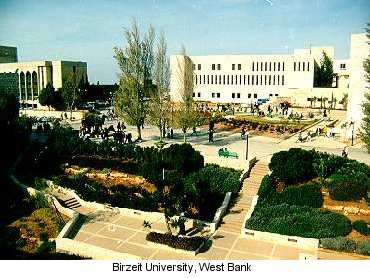 This led to a
higher expectation of social mobility and
advancement, hitherto unheard of amongst young
people. But it also resulted in a longer
transition to adulthood. Previously, one entered
adulthood directly through marriage and the first
job. The development of secondary education in the
1960s and 1970s meant that marriage took place on
average at 24 for males and 20 for females,
thereby considerably lengthening the period of
adolescence. This led to a
higher expectation of social mobility and
advancement, hitherto unheard of amongst young
people. But it also resulted in a longer
transition to adulthood. Previously, one entered
adulthood directly through marriage and the first
job. The development of secondary education in the
1960s and 1970s meant that marriage took place on
average at 24 for males and 20 for females,
thereby considerably lengthening the period of
adolescence.
Another significant
development was the implementation of family
planning policies in the Arab countries, once
their governments realised the economic and social
costs of a high birth rate. This is why recent
legislation on the family tends to set back the
legal age of marriage in societies where marriage
(particularly in the case of women) traditionally
takes place at a very young age. Socio-economic
factors, such as the difficulty in finding work
and housing, have further contributed to the
deferral of marriage.
It is important to note
that contrary to demographic theories predicting a
‘catastrophic’ and irreversible population
increase in the Arab world, specialists in this
region predict a rapid drop in the birth rate in
the decades to come. There are various reasons: a
higher level of education for women; the increase
of the urban population; the decline of the rent
revenue economy; and birth control campaigns.
However, thanks to the
high birth rate of recent decades, the population
in the Arab countries is much younger than
average. Until the mid 1960s, Arab families had on
average seven or eight children. As a consequence,
in the 1990s, the 20–29 age group accounted for
the largest proportion of the total adult
population ever in the history of the Arab world.
It is this prolific generation that now wants to
play a role in these countries.
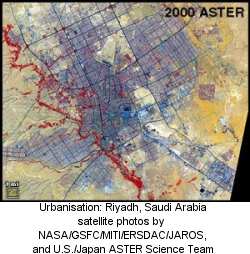 This demographic
phenomenon has been accompanied by a virtually
unstructured, accelerating process of
urbanisation, with rates fluctuating on average
between 50 and 70%. For example, in all the
Maghreb countries and Syria, every second
inhabitant is now a city dweller. In Iraq, the
proportion is two out of three, and in the Gulf
states percentages reach record proportions. This demographic
phenomenon has been accompanied by a virtually
unstructured, accelerating process of
urbanisation, with rates fluctuating on average
between 50 and 70%. For example, in all the
Maghreb countries and Syria, every second
inhabitant is now a city dweller. In Iraq, the
proportion is two out of three, and in the Gulf
states percentages reach record proportions.
This ‘urban explosion’
began with a widespread exodus from the
countryside during the colonial era. After
independence, it sped up as a result of a less
stringent control of population movements
(Morocco) or the implementation of
industrialisation policies (Algeria, Syria).
Regional conflicts contributed to it by sending
enormous waves of refugees into the towns, as was
the case with the Palestinians in Jordan, Syria
and Lebanon.
Different levels of
economic development, different priorities in
national planning policies and the decisive role
sometimes played by ethnic, religious or financial
minorities result, of course, in a great variety
of situations across the different countries.
However, the one universal feature of this link
between demographic and urban trends is urban
youth. This is the new, important actor on the
Arab stage.
The politics of economic failure
Since the 1980s, the
Arab states have been feeling the consequences of
the failure of the protective or distributive
socio-economic model, which characterised all
post-colonial states. In the 1980s, the widespread
bankruptcy that this model brought about obliged
them to resort to economic assistance from the big
international financial institutions, with their
stringently applied structural adjustment
programmes. These programmes have had a major
negative impact on people’s welfare.
According to the
International Labour Organisation, towards the end
of the 1990s the countries of North Africa, the
Middle East, and across sub-Saharan Africa, had as
a region the highest rate of unemployment in the
world (around some 20 million people). This
enormous unemployment rate affects more women than
men and significantly more youth than adults.
Among young people, it is school and university
graduates who are affected most (57% of the
unemployed Arab population have been educated to
secondary level or higher, while in 1984 this
figure stood at 37%). Consequently, the
marginalisation of young people is one of the
primary problems challenging the southern
Mediterranean today.
Combined with this,
Arab regimes have developed a political culture
based on patronage and clientelism, maintaining
themselves in power by means of authoritarian
practices which put the development of efficient
and transparent economic reform well beyond their
reach.
| The root cause of this repression lies in
the importance placed on historical legitimacy
during the construction of these states by the
process of colonisation. Nationalist leaders who
obtained independence were trumpeted as ‘fathers
of the homeland’. Since they had liberated their
countries and founded the modern nation state,
they felt that they deserved to preside over it,
and to bequeath it to their successors. This
political culture has so far impeded any
alternative process and has excluded a new
generation from the political
community.
|
|
Thus, on top of the
grave pressures of economic reform, the
populations of these countries have had to endure
the more sinister aspects of anti-democratic
systems of governance. Together, economic reform
and liberalisation have failed to produce better
democracies. On the contrary, the combination of
demographic growth with political authoritarianism
and inequality in the distribution of wealth is
creating a vicious circle of political and
economic alienation, marginalisation and violent
opposition.
The international
dimension
The sense of stagnation
throughout North Africa and the Middle East is
exacerbated by the failure of these countries to
act as a regional group to exert political
influence on the international community. These
countries have not been able to strengthen the
regional and sub-regional multilateral structures
sufficiently to confront, for example, the
challenges and opportunities brought by
globalisation.
The situation is aggravated
by profound political differences, lack of
financial compatibility between the respective
states, and a resistance to opening up their
borders to the free movement of peoples and trade,
on the grounds that this would undermine the
political and social control on which the survival
of their dictators relies. As a result, commerce
and investment at an inter-regional level is very
low (less than 10% of the total foreign trade
carried out by these countries).
There are, however,
other reasons for ongoing failure in the
construction of common regional structures of
integration and cooperation: namely, the role
played by the United States – pre-eminently in
relation to issues of security, and the
conflicting foreign policies of the
countries.
When the Gulf War of
1990–91 ended, while Arab countries were more
divided than ever, US hegemony in the region had
never been more secure, both in terms of the
military and economic dependence of most of the
countries in the region, and in terms of
commercial competition.
 The US aim in the
Middle East has been to promote the creation of
strategic axes and bilateral alliances. The US
decision to apply a policy of punishment (embargos
and sanctions) to Iraq and Iran, both designated
‘rogue states’ since 1993, has kept Iran
artificially separate from the Gulf states,
undermining all their attempts to establish a
regional forum for dialogue with their ostracised
neighbours. The US aim in the
Middle East has been to promote the creation of
strategic axes and bilateral alliances. The US
decision to apply a policy of punishment (embargos
and sanctions) to Iraq and Iran, both designated
‘rogue states’ since 1993, has kept Iran
artificially separate from the Gulf states,
undermining all their attempts to establish a
regional forum for dialogue with their ostracised
neighbours.
Meanwhile, Iraq remains
condemned to pre-industrial status, generating big
contraband networks with Jordan and, above all,
with Turkey. The reformist sector of Iran, however
much it promotes political and economic
liberalisation and defends diplomatic
normalisation with the Western world, cannot find
sufficient foreign support to resolve its
socio-economic situation and consolidate its
government against the revolutionary ‘old
guard’.
As a close ally of the
United States, Israel’s influential approach to
security within the region, coupled with its lack
of geopolitical integration, is the source of many
of these contradictions, reinforcing the endemic
fragmentation of the area. This cosy relationship
explains why, in 1995, the United States allowed
Israel to escape pressure to sign up to the treaty
on the non-proliferation of nuclear weapons (NPT).
In 1996, it led to the emergence of a strategic
Turkey–Israel axis under a US umbrella, with the
aim of weakening Syria’s influence in the region.
The United States has been consistently opposed to
the institutionalisation of multilateral working
groups, formed as part of the Arab–Israeli peace
process.
As for the
member countries of the Gulf Cooperation Council
(GCC) – Saudi Arabia and the Gulf oil-producing
countries – they have signed a series of defence
and arms-acquisition bilateral agreements with the
United States, Britain and France during the Gulf
War, to protect themselves from future threats.
Motivated as much by mistrust of their Arab
neighbours as by the superiority of Western
forces, GCC members have shown little interest in
the regional security accords, and have not even
signed agreements among themselves.
There is also the issue
of the massive investment in military and defence
spending. Saudi Arabia, the United Arab Emirates
and Kuwait alone spent $44.2 million between 1990
and 1994, vastly endowing the Western arms
industries. To this must be added the enormous
costs of financing the Iraq–Iran war of 1980–88,
and the war over Kuwait of 1990–91. These
expenditures have contributed to a growing
socio-economic crisis, which, along with the
desire to boost oil prices, places these
governments in a very difficult
situation.
So Saudi Arabia, with a
demographic growth rate of 3.5% since the mid
1990s, has had to reduce social spending at a time
when its increasingly aged middle classes are
loudly complaining about the tribalism of the
regime – its absolutism, poor living conditions,
gradual breakdown in education, health and
housing, and the installation of a Western
military presence on home turf. The financial
situation, and the socio-political climate that
governments rely upon, are both in crisis.
Opposition to the regime is visibly on the
increase.
The necessity, and impossibility, of
reform
All of this adds to the
burden of the endemic conflicts of the Middle
East, which have shaken the confidence of foreign
investors in the region, and driven the respective
regimes to dedicate a large part of their budgets
to defence and military spending. The brutal
Israeli occupation of the Palestine territories,
the American military presence in Saudi Arabia and
the Gulf, the embargo on Iraq, sanctions on Iran
and the military response to the 11 September
terrorist attacks in 2001, nurture a growing
anti-Western feeling in Arab public opinion. They
also rule out any possibility of an economic
upturn in the region.
Even Israel, the one
country that might qualify as developed and
productive, now faces an alarming economic outlook
for 2002. In 2001, with a recession of 0.5%, the
Israeli economy registered its worst result since
1953. Its most important sector, new technology,
is actually in decline, while tourism has been
decimated by conflict in the occupied Palestine
territories. Unemployment is clearly heading for
10% as the per capita income dropped 2.9% in 2001
and the national currency fell in value against
the dollar. On top of this, Israel’s military
siege of the occupied territories has meant that
the country is faced with severe socio-economic
difficulties.
Western strategic and
military priorities have so prevailed over those
of development and democratisation in this region
that the tragic experience of civilian populations
is hardly noticed – a neglect that inspires
violent reaction and an explosive social
situation. The same priorities ensure that the
strategic allies of the West in the region are
regimes rooted in tribalism, clientelism and the
pillaging of their countries. This makes them
incapable of promoting efficient and productive
political and economic reform.
But, in this part of
the world, it has been only too well observed that
without democratisation, liberal economic reform
will not be possible. Sooner or later, Western
political chiefs have to abandon their
longstanding assumption that democratisation will
be the inevitable result of economic
liberalisation. They will have to decide which
inescapable changes must be made in their foreign
policy to secure true socio-political, and
consequently economic, stability in this
region.
The ‘war against
terrorism’ and the international policy that it
has inspired, as elaborated by the United States
and pursued by European countries, does not take
these factors into account. Even worse, this adds
to instability in the region by slighting
democratisation and respect for human rights, and
consolidating the sense of impunity with which
some regimes keep the majority of their population
under the thumb of unbearable socio-economic and
political pressure.
The condition of
Islamic politics
This situation is
particularly worrying in the region because terms,
such as ‘terrorism’ and ‘security’, have been
manipulated by governments allied to the West to
suit their own particular interests. The new rules
of this post-11-September game give them even
greater impunity to crush the liberties of their
now desperate civil societies.
Now add to this very
complex and unstable mix one final key factor: the
ideological. Since the 1970s, the system of values
motivating the first post-colonial generation has
gone into crisis. The present generation does not
identify with these values at all. In a brief
moment of optimism, their parents’ generation
placed their faith in state schooling, which
promised a social climb, and in pan-Arabism,
socialism and anti-imperialism. In contrast, the
present generation has experienced the death of
the distributive state as that system of values
began its collapse in the 1967 war.
What follows is an
ever-widening political and cultural chasm between
the new generation and their rulers. Moreover, the
historical experience of the successive failures
of ideological models inspired by the West,
whether liberal or socialist, has prompted the
search for a new model rooted in their origins and
their own cultural legacy. Since the 1980s, the
people of North Africa and the Middle East have
been turning to Islam for cultural
reassurance.
The Islamic movements
have to be seen in a sociological framework much
more profound and complex than their dramatic
impact on world affairs has encouraged us to
understand. But if we are to avoid the fatal
elision that subsumes them all indiscriminately
under the term ‘Islamic fundamentalism’, we need
to identify the different actors of the Islamic
movement and the sociological roles they carry out
in these societies.
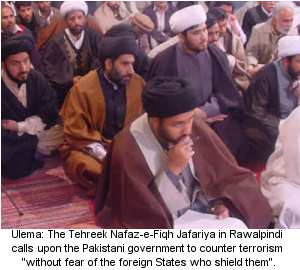 Among the most
ultraconservative actors, the traditionalist
Ulemas stand out. Their role is not so much
political opposition as a close alliance with the
most autocratic governments in the Muslim world.
These Ulemas originate from official
Islamic institutions, nominated by the government
to make up the so-called High Council of
Ulemas. They are ‘faithful civil servants’
serving the seats of power. Among the most
ultraconservative actors, the traditionalist
Ulemas stand out. Their role is not so much
political opposition as a close alliance with the
most autocratic governments in the Muslim world.
These Ulemas originate from official
Islamic institutions, nominated by the government
to make up the so-called High Council of
Ulemas. They are ‘faithful civil servants’
serving the seats of power.
Governments use them as
mouthpieces of society, extracting in return a
political endorsement, which grants them a
monopoly over the political uses of religion.
Governments reciprocate by allowing them to
convert themselves into the censors of society and
guardians of tradition, blocking all social change
and reform or any kind. They are not ‘Islamists’:
they have a hostile relationship to the
latter.
This is the paradox.
When the Western world points the finger at
‘Islamic fundamentalism’, it assumes that this
term embraces all the Islamist opposition
movements. Yet, contrary to what is believed, many
of these Islamic movements have great modernising
potential and, moreover, are in large part alien
to violence.
Within the field of
Islam, therefore, we have to distinguish clearly
between the radical or extremist movements and the
reformists. The radical movements, supporters of
the use of violence, were born in the 1970s. They
are clandestine groups, with a rigid and
intolerant interpretation of Islam, cut off from
mainstream society. Reformists categorically
oppose these extremists, denouncing their violent
actions, including the attacks of 11
September.
Islamic reformism is
the majority social tendency. Its agenda and
evolution have been very different from those of
the extremist wings, including, of course, those
of Osama bin Laden. The Islamic reformist,
unlike traditionalist and institutionalised Islam,
is politically self-determining and involved in
the social and political experiments of all
present-day Muslim societies.
Consequently, they tend
to distance themselves from the ahistorical
vision, which mobilises traditionalists, such as
Ulemas, Wahhabism in Saudi Arabia or the
Taliban in Afghanistan. They are open to new
interpretations of Islamic law. In other words,
the new generation of Islamic reformists does not
exclude the search for a comfortable ground
between modern values and Islamic
legitimacy.
This group as a whole
is very worried about current socio-educational
trends. They are seeking from their own sources to
recover a positive and reassuring self-image. They
are well aware that they are still awaiting
recognition and respect from the West, but the
recovery of Islam is not constructed in hostility
to the West. Rather, they question the way in
which a Western cultural universe has been
arbitrarily elevated into an absolute universal
reference.
If these Islamic
discourses occasionally express resentment towards
the West, it is not because of a disregard for
such values as progress and development, or a
distaste for the public liberties which Westerners
enjoy, but because of the glaring moral arrogance
and double standards when it comes to defending
human rights, democracy or that ever-present open
wound, the plight of the Palestinians.
The new Islamic elites
cast doubt on the identification between modernity
and Westernisation. But they do not reject the
former. Rather, they express a certain longing for
a critical appropriation of modernity, provided
they can participate in its construction. To this
process, it is true, they will bring an entire
series of symbolic references, inspired by Islam
(dress, language, behaviour).
But there is no single
model for a developed Islamic state, one that
represents all reformist projects. On the
contrary, the historical evolution of such an
entity and its adaptation to reality have tended
towards a diversity of political experiments in
the differing national and constitutional
frameworks, against the backdrop of both
pan-Islamic and internationalist world views.
Islamic reformist movements must be distinguished
from the traditionalist Ulemas, with their
government links.
In this context, the
sociological profile of many Islamic militants or
supporters is clear. These Islamists come from the
new spaces that modernisation of the contemporary
Muslim world has created, far distant from
traditional Islamic institutions. They graduate
from the modern schooling system and, often, from
specialist scientific university studies.
University campuses have provided a rather fertile
ground for the spread of Islamic ideas since the
1980s, when proponents supplanted the left-wing
student leadership of the preceding
decade.
In turn, the masses
following these Islamists are not
‘traditionalists’, but the opposite:
urban-dwellers who live by the modern values of
consumerism and social advancement, as the pattern
of Islamic voting in the elections has shown. Some
of them come from the most marginalised sections
of society. They are victims of unequal
development, or the poorest workers in outlying
suburbs, who are attracted to the egalitarian
message of Islam and the effective para-state
social work it performs in the least protected
neighbourhoods.
The Islamic ‘third generation’
However, it would be a
mistake to look at Islamism as an ideology of the
dispossessed. The key to Islamism is not economic
but political; and it is closely related to
identity. It penetrates all groups of society. For
example, representatives of Egypt’s Muslim
Brotherhood are often professionals, such as
lawyers, doctors and engineers.
Why are these Islamists
the primary beneficiaries of the decline of the
old regimes, as opposed to left-wing parties or
other lay sectors? The answer is probably that the
latter identities are associated with a system of
Arab socialist values which, given their
cumulative failures, are perceived as outdated.
Alongside failure in
political and economic independence, one other
realm seems in retrospect to have been sorely
neglected by the nationalist elites who built up
the state: that of identity and cultural
independence. In the Muslim world these are
inseparable from the Islamic framework. In other
words, in sociological terms Islamism becomes the
inevitable response to the need felt by a large
part of the Muslim population to construct a new
modern and democratic order from their own culture
and identity.
Translated into
political action, the evolution of this Islamic
third generation owes less to pan-Islamism than to
its origins in the territorial framework of the
nation state. It is a process of political
maturation, based on pragmatism, which – far from
clinging to socio-cultural conservatism – has
pushed people into realising that they share, with
even non-Islamic political projects, an
appreciation for a culture of consensus (in the
framework of political pluralism, of elections, of
government).
Significant examples of
this include: the 1995 Platform of Rome, jointly
composed of left-wing parties, human rights
movements and Islamists seeking a democratic
political solutions for Algeria; the platform
demanding the democratisation of Egyptian
political life, elaborated as much by Islamic
leaders as by opposition forces in 1999; or, more
recently, the joint proposal in favour of
democratisation in Tunisia, endorsed by the social
democratic party (MDS) and the Islamic al-Nahda.
The founding of the al-Wassat party in Egypt by
Islamic leaders and Christian Copts is further
evidence that the underlying problem is not a
divide between Islamists and non-Islamists, but
the fight for democracy against dictatorship, to
which both may be dedicated.
 The acceptance of
multi-partyism and power-sharing, as well as the
will to build participation in state institutions,
is evidenced by parties such as al-Nahda of
Tunisia, the FIS of Algeria or the Muslim
Brotherhood of Egypt, and echoed in the
parliamentary aspirations of the Muslim Brothers
of Jordan, Hezbollah in Lebanon and, more
recently, the Party for Democracy and Justice
(PDJ) in Morocco. These political initiatives
bring Islamic reformists ever closer to legal,
democratic practices, showing their reconciliation
to pluralism. The governments that respond to this
by acts of exclusion (as in Tunisia, Algeria and
to a great extent in Egypt) tend to be those that
are the most repressive and
dictatorial. The acceptance of
multi-partyism and power-sharing, as well as the
will to build participation in state institutions,
is evidenced by parties such as al-Nahda of
Tunisia, the FIS of Algeria or the Muslim
Brotherhood of Egypt, and echoed in the
parliamentary aspirations of the Muslim Brothers
of Jordan, Hezbollah in Lebanon and, more
recently, the Party for Democracy and Justice
(PDJ) in Morocco. These political initiatives
bring Islamic reformists ever closer to legal,
democratic practices, showing their reconciliation
to pluralism. The governments that respond to this
by acts of exclusion (as in Tunisia, Algeria and
to a great extent in Egypt) tend to be those that
are the most repressive and
dictatorial.
This is why Islamic
reformist parties need to be understood as joint
participants with other parties in the process of
democratic transition. Their adaptation to
representative government has already been proven.
As for their social conservatism and religious
point of reference, if we cease to blind ourselves
with the ‘exceptionalism’ of anything that
originates from Islam rather than from
Christianity, we will realise that in this regard
such parties are hardly far-removed from the remit
of the Christian Democratic conservative parties
that exist throughout the Western
world.
It may be argued that
these parties do not defend a different statute
for men and women. But to do so is to lack
historical imagination. Think back to the roots of
those Christian Democrat parties. In the Muslim
world, Islamists are not the only representatives
of this position. There are many who still think
in this way in all patriarchal societies. Are
there no Ulemas in the United States,
upholding inequality between men and women, and
defending the patriarchal model with all its
consequences?
At least the Islamist
situation is dynamic. It is undergoing a process
of transformation, due to the changes that Islamic
women are introducing from within the movement.
These parties have ensured the active
participation of women (more than traditional
parties, including left-wing parties) in keeping
with their entry into the public sphere at every
working level. These are women who are necessarily
breaking away from that socio-public
marginalisation which traditionalists continue to
insist upon, in defending the domestic sphere as
the natural space of women.
Accessing public space,
perceiving themselves as equal to men, assuming a
double task both public and domestic, and
affirming their individuality – such
behaviour has become an increasing reality among
Islam’s women, as various pieces of fieldwork and
recent surveys testify. Moreover, they are
imposing this reality on Islamic men. These women,
mainly young, cultured and urban, wear the scarf
on their heads (hijab) voluntarily. For
them, far from being an oppressive symbol, it is a
sign of identity.
All of this serves to
show a transformation process which cannot reach
fruition without processes of democratisation and
social change similar to those which took place in
Western societies. These were, until remarkably
recently, just as unequal in law, and just as
patriarchal.
Law, and democracy, are for everyone
It is not just that we
cannot afford to tar Islamic extremists and
reformists with the same brush. We must also be
aware that the marginalisation or repression of
the reformists can only benefit the extremists. In
moments of high risk, these reformists can play
the role of moderation in societies, which are
both roused and worn out by dictatorship and
socio-economic conditions. Such dictatorships
survive only through intensive repression,
including the manipulation of the fear of ‘Islamic
fundamentalism’.
This latter is
the constant, confusing alibi and justification of
the most totalitarian Arab governments in their
desperate quest for political survival. If Islamic
parties have become the bête noire of such
regimes, it is because, far from enshrining
Islamic conservatism, they represent an important
political opposition to those ruling
parties.
This confusion has its
roots in the West’s prevailing view of Islamists.
This does not distinguish between the majority of
Islamist reformists, who are traditionalists
nurtured by their own rulers, and the minority of
radical Islamists who are hyped by the media. The
latter are constantly manipulated by their own
state security forces, who gain the most from
their violent actions and often conflate them with
the reformists, pursuing the whole mongrel mix as
‘terrorists’.
By this means,
autocratic governments have adopted the convenient
image of ‘the good despot’. This is based on the
assumption that the transition to democracy in the
Muslim world can be postponed until they have
‘saved themselves’ from the ‘Islamic
fundamentalists’. The military coup in Algeria in
1992 spawned this mistaken perception. In fact,
the fight against ‘Islamic fundamentalism’ has
provided cover again and again for the brutal
repression of Islamic reformists. It has given
governments free reign, using hastily convened
‘anti-terrorist’ legislation, to pursue all
opposition, both Islamic and non-Islamic, which
seeks democratic reform and an end to their
despotic power.
In adopting the term
‘Islamic fundamentalism’ and paying so much
attention to the ‘divide’ that separates the West
from Arab and Muslim societies, the Western powers
have backed the strategic interests of these Arab
leaders, giving them substantial help to stay in
power.
Unless this deceptive
amalgam is deconstructed, the fight against
terrorism may well become a dangerous witch-hunt
conducted by spurious state interests in the
region, allied and protected by Europe and the
United States. Western silence and complicity has
allowed Israel, for example, to seize a new
opportunity to demonise and banish the individual
and national rights of the Palestinians. Other
states, such as Egypt, Tunisia or Algeria, have
already declared: “Now, at last, you understand
our fight against Islamic fundamentalism!” Such
indiscriminate repression covers a multitude of
sins including the radicalisation, sooner or
later, of some local Islamic movements, and the
emergence of other radical
groups. 
When it comes to the
new brand of extra-territorial terrorism that
appears to have been launched by Osama bin Laden,
what kind of cooperation will the fight against
terrorism elicit? How can terrorism and the
identity of terrorists be reliably defined? We
risk fostering injustices, bitterness and
helplessness among the populations of those
countries. How can we expect the peoples of these
punished societies to join in the battle against
terrorism, if it fails to contribute in any
meaningful way to dignifying their existence; if
it cannot demonstrate its credentials in state
law; if instead, it bears all the hallmarks of
those vested, strategic interests of which they
are the main victims?
This, in my view,
is the crux
of the matter both in legitimising the fight
against terrorism and in decisively winning it.
What is needed is a legal framework in those
countries that want to participate in the
international coalition. Neither accusations, nor
claims against political exiles in Europe and
America, can be freely accepted until this comes
about. Rather than the call for righteous revenge,
with its counterproductive after-effects,
irrefutable incriminatory evidence should be
required, and the recourse to international
tribunals.
We must keep in
mind that a failure to support democracy and state
law in the Muslim world not only fails to improve
the lot of these peoples, but also fails to
protect Western populaces. Problems in the region
have now spilled across their geographical borders
to affect all our societies. Western readers must
understand that what our political chiefs do ‘out
there’ will have repercussions for all of
us.
Copyright © Gema
Martín-Muñoz, 2002. Published by openDemocracy.
Permission is granted to reproduce articles for
personal and educational use only. Commercial
copying, hiring and lending is prohibited without
permission. If this has been sent to you by a
friend and you like it, you are welcome to join
the openDemocracy network.
Gema
Martín-Muñoz is Professor of the Sociology of
the Arab and Islamic World at the Autonoma
University of Madrid. She is the author of El
Estado Arabe: Crisis de legitimidad y contestación
islamista (Barcelona, Edicions Bellaterra,
1999), and editor of Islam, Modernism and the
West (London, IB Tauris, 1999). She gave this
lecture at London’s Goethe
Institute as part of a series on Europe and
Islam. |












.gif)