|
NMIT Working Papers present preliminary
formulations of new data and thinking from ongoing social
science research on the economic, cultural, policy and social
implications of new media, communication and information
technologies in the contemporary Middle East.
Views expressed are those of the
authors, who welcome feedback and comment from
users.
Need a translation?
|
Invention
(Ibtidaa') or Convention (Ittibaa')?
Islamist Cassettes
& Tradition in Yemen
W. Flagg Miller, University
of Michigan
Paper delivered at the American Anthropological
Association, November 2000.
In the spring of 1998, I was walking on the grounds of the
University of Aden, in southern Yemen, just after classes had
been let out. I went into a small university coffee-shop, and
found this pamphlet laying on the glass shelves, free for the
taking. [Show slide.] "Interview with a Famous Personality"
(muqaabilah ma' shakhsiyyah ma`ruufah). The alleged
interviewer asks a series of questions to this "Famous
Personality" in order to produce his "i.d. card":
Name: "Mr. Satellite". (And here is a picture of Mr.
Satellite, busy at work reducing a fairly contemporary urban
Yemeni house to rubble.)
Birth Place: "The lands of the Jews and Nazarenes
(Christians)"
Address: "Atop the rooves of many Muslim's houses"
Principle Occupation: "Undermining the morals of Muslims,
and diverting them from their religion." Then a verse from a
chapter in the Qur'an warns those who might stray of the bond
between the true believer and God.
Debate over the impact of satellite dishes in Yemen has
become heated in recent years. The most virulent opposition to
satellite TV programs -- which include shows like Baywatch and
World Wrestling Federation matches -- has come from Islamist
groups whose memberships and political muscle have increased
dramatically over the past decade (for reasons I won't go into
here.) During my first year of fieldwork in Yafi`a, a rural
region of southern Yemen just north of Aden, I consoled
several friends whose neighbors' satellite dishes had been
removed quietly under pressure from local "zealots," or in one
case, literally shot off the roof in a barrage of gunfire. A
particularly dramatic example of the "reality check" our panel
is concerned with; a case in which the virtual influences of
global media are violently stymied by angry viewers.
The Islamic " public sphere" -- a probability of increasing
interest among those who inquire into the effects of expanding
"new media" technologies on popular, pluralist discussions
about Islam. I'd like to contribute to these discussions today
by beginning with the premise that media messages mean
something to audiences through interpretive "codes" as Hall
and others have suggested. As Eickelman notes, the practices
of message-reception, or decoding, by audiences in the Islamic
world have been far too little studied by scholars. I'll
therefore focus in this paper on a popular debate that is
occurring among audiences in Yemen over the moral registers of
audio and audiovisual media. This debate is being waged in
terms of oral and literate style. In the flood of
sound-bites, musical tunes, printed text material, visual
images, and transmitting technologies, distinctions between
communicative styles are becoming more, not less, salient, as
consumers and producers vie for control over the meaning of
messages in a rhetorical arena of high political stakes.
I'll examine the debate over oral and literate styles by
focusing on one audio-technology in particular: the
audiocassette. Where audiocassettes are not only inexpensive
but record live sound, they can be tailored to audience tastes
far more easily than satellite-TV. Most of my research has
focused on the cassette -- in particular Yemeni vernacular
cassette-poetry -- that is widespread in Yemen. As a
locus of "text formation," the cassette provides insight into
how local discursive practice informs the use and meaning of
media technologies. Now, where cassette-texts are easily
manipulated by users, they might appear less controversial for
Yemenis than the satellite-dish -- more "user-friendly"!
However, cassettes can be no less immune from heated moral
debates, including accusations that they "pour forth
corruption on people." In fact, I argue that cassettes'
facility as recording devices makes them especially
subject to controversy. In their sensitivity to local
sound-scapes, they can amplify chords that are
potentially fractious.
Islamist groups in Yemen have been some of the most
successful in using cassettes to broadcast messages and expand
support bases, especially in rural areas where illiteracy
rates are higher. The Islah "Party," Yemen's largest and most
heteroglot Islamist organization, has surpassed all others in
producing engaging and informative cassettes. Since the 1970s,
Islah's spiritual mouthpiece, Shaykh `Abd al-Majid
az-Zindaani, has produced hundreds of cassettes that entreat
listeners to lessons from the organization's "scientific
institutes." During a pre-1990, pre-unity era of
antagonism between former North and South Yemen, Zindaani
regularly used cassettes to lambaste communist ideologues in
the South. In post-unity years, Zindaani became confronted
with a new task of enfranchising a populace whom he had once
berated. This task has been made particularly difficult by the
fact that most of Islah's membership is drawn from northern
Yemen.
So, in its campaign to win loyalty from Yemenis across the
nation, Islam has become extraordinarily proficient in
tailoring messages to regional audiences. Islah's task
in this regard is particularly difficult given the diversity
of audience tastes in Yemen, a diversity fueled by what is
probably the most vibrant grass-roots recording industry in
the Middle East. The political director of Islah, Muhammad
Qahtan, explained to me that with the proliferation of popular
music and alternative sources of media entertainment, fewer
Yemeni cassette-fans have patience for old-style sermons;
especially younger men and women, who constitute the bulk of
new Islah members. "On the other hand," he confided, "we've
noticed that an interest in folk and traditional songs
(turaath) has been growing in recent years." He then
cited a few song genres that, not incidentally, are especially
popular in southern regions -- precisely the areas in which
Islah has been focusing its campaigns. These genres included
hiwaariyaat -- a playful, flirtatious banter exchanged
between a male and a female singer -- and also sung political
folk-poems released by the musicians whose cassettes I've been
following in southern Yemen.
Evidence from Islah's cassettes confirms the organization's
attention to a broad range of poetic genres, many of them
regionally stylized. The most successful releases regularly
pair the speeches of Zindaani and other Islahi orators within
a motley assortment of creative song and verbal genres. While
I don't have time to go into the variety of poetic and musical
genres, I'll simply say that these include: religious songs
adapted to pop-hit melodies and re-titled "anthems"; tribal
chants traditionally used to rouse spirits of highland
audiences; and mock colloquial dialogues between "typical
citizens" that serve to reinforce what Islahi speakers have
just said, but in a common sense, street-smart fashion.
Now, for those of us keen to the leaking boundaries of
Islamism, tribalism, nationalism, partyism, and so forth,
Islah's cassettes are nothing short of a Golden Calf. The
blurring of discursive boundaries, however, is of interest not
solely to political theorists. In Yemen, such blurring on
cassettes is causing heated debates over the foundations not
simply of a public sphere marked by the typical terms
of civil society, democracy, and pluralism -- but
specifically, of an Islamic public sphere, one
that is as morally just and true as it is inclusive.
For in catering its calls for the application of Islamic
law based on the moral principles of the Islamic community,
Islah has been accused of "invention" or "innovation" --
ibtidaa` -- by one of its principle Islamist
competitors, the Salafis. A loose assortment of adherents
whose spiritual head, Shaykh Muqbil al-Waada`i, resides in the
far northern city of ∑afidah, the Salafis are far less
politically active than Islah, although for that reason are
more appealing to many young Islamist adherents. Like a number
of other Wahhabi-oriented groups, the Salafis practice the
da`wah -- a militant call to action based on legal
interpretations that's typically waged against those who are
deemed to stray from God's divine commandments (Monet 1995).
In recent years, calls for da`wah have often been directed
against mystical Sufi organizations, especially those that pay
homage to local saints. The Salafis argue that in committing
an act of bid`a, apostasy, Sufi members' will confront,
according to the Qur'an, the "severest punishment."
Like az-Zindaani of the Islah party, Muqbil al-Waada`i, the
Salafis' most outspoken leader, has attracted a wide following
through his frequent release of cassettes. Less concerned with
political gains, however, al-Waada`i's cassettes are more
sober in tone, and typically feature his sermons recorded live
on Friday afternoons from his pulpit. One of al-Waada`i's
accusations against Islah is that the organization turns Islam
into "pop-song" (fann). In particular, al-Waada`i
derides Islah's creative use of anthems to couch its messages
to popular audiences. Even more maligned is Islah's use of
musical instruments, which have been occasionally disparaged
by conservatives throughout Islamic history. In a popular
arena of mass-produced sound-bites in which debates over
doctrine and political orientation are waged in registers of
style, persuasion, and entertainment, the aesthetics of sound
has become an especially hot topic.
Islah's reactions to such charges of "invention" are
managed in both subtle and heavy-handed ways. On one cassette,
az-Zindaani speaks to listeners up-front about the authority
that can accrue to those who listen carefully, to his
cassettes or any other aural medium. "He who listens to this
microphone amplifier can reveal to us how we use it, and how
we fix it if it stops. It is the same for whoever listens
to... a car. And everyone who really listens to the audible
world: he is the companion of truth in his orientation, and
his statements, and his explanations. All humans accept this
for every listener." Moral authority rests not in producers'
styles of oratory, Zindaani asserts, but rather with each and
every listener. Whether a message is chanted or recited or
sung to musical accompaniment, the good listener has the
innate ability to hear the truth. Other messages vouchsafing
the moral virtue of song are more explicit. Anthems and songs
can mollify listeners by explicitly focusing on the place of
pop-song in religious devotion. In the opening segments of one
cassette, a chorus repeats the refrain: "I'm enraptured with
song, not for song's sake, but for the sake of those who
listen!"; and later, somewhat cryptically "I have turned song
into my stairway to our candle-lit destination."
Alternatively, cassettes featuring sung anthems can invoke a
series of textual frames that index a literate tradition of
learning. Such cassettes can begin, for example, with the
traditional recitation of a chapter from the Qur'an that
frames the contents within an orthodox tone of piety.
Similarly, an opening traditional sermon that frequently cites
verses from the Qur'an and other key Islamic texts can
foreground attachment to spheres of literate knowledge.
As Islah asserts its adherence to the true path, some of
the most prominent frames levied against the thick and thin of
heteroglot oral invention are visual. [SHOW CASSETTE.] On what
is certainly the most creative collection of songs I've heard
released by Islah -- a cassette called "Yemen's New Dawn" --
the front of side A reads in large letters: "Religion is
convention (ittibaa`), not invention (ibtidaa`)." (Here it is,
in a wonderful green color.) Other cassettes feature such
messages as: "In the summons to God's righteous path, the
Islamic cassette is a superb means", or "May God grant
blessings on whomever helps disseminate this cassette." The
messages on Islah's jacket-covers, however, are perhaps the
most telling of all.
SLIDES:
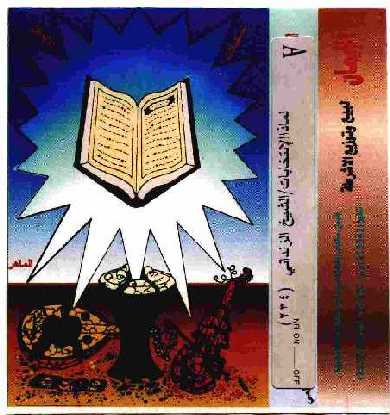
1) Entitled "Why the (national) elections?" Here we have a
picture of the Book, the Qur'an, pulverizing a set of musical
instruments to bits. The source of literate authority doing
its work against possible heterodox oral creativity. This is
clearly a direct response to the Salafis... (Appropriately,
there are no songs on this cassette.) [Cassette #234]
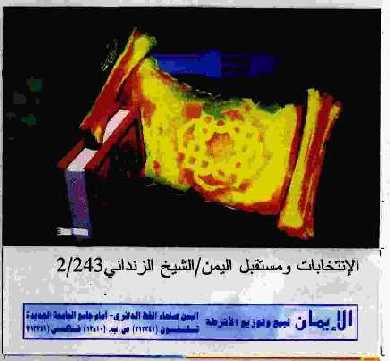
2) Entitled: "The elections and the future of Yemen" Again,
the Qur'an in the foreground, and this ancient scroll... But
you also have in the background this minaret! A nice dynamism
between the oral call and the literate tradition, but the
literate is clearly foregrounded. [Cassette #2/243]
3) "Ask about history" Here's a colorful sketch that I'm
very curious about. It's got a number of classic Islamic
symbols -- the crescent moon, the green color which surrounds
the earth, the paradisal flower -- and here the flower emerges
from a pen. Almost a kind of ecstatic vision... I'd be
interested to hear what some of you think of this... [Cassette
#12]

The imagery on these covers released by Islah is
startlingly consistent: on 80% of cassettes that I have
purchased, the central mantlepiece of the cover features
imagery of the Book or of writing. Such imagery seems to have
grown more prominent, in fact, precisely as Islah's cassettes
are increasingly tailored to the aesthetic preferences of
popular audiences. Just as the markedly literate textual
genres on cassettes frame orally inventive material, so these
visual symbols of literate Islam are meant to frame each
cassette within a history of orthodox literate practice that
carries considerable discursive weight.
Clearly, however, the success by which such frames contain
their cacophonous material is up for debate.
Conclusion
In Habermas's conception of the "public sphere," the
keystone that cements a conditionally new mode of discourse is
the open-ended communication between individuals who are
uninhibited by status or power. Habermas's model of public
discourse remains as analytically insightful as it is
socioculturally problematic. In Yemen, public discourses are
-- to be sure -- directly linked to the spread of media
technologies that facilitate the participation of an
increasingly numerous and diverse citizenship. However, where
such technologies are not only amplifiers of discussion but
are conduits to and from centers of trans-local cultural and
economic production, their mediation of public discourse is
always politically fraught. For some Yemeni Islamists,
satellite-TV is destroying rather than creating a potentially
"global village" of civic-minded inhabitants; its oral and
visual material must be countered with photocopied texts
distributed among literate university students. For others,
audiocassettes are being misused to the boon of a pop-music
lumpenproletariat whose ears seduce them into distorting
Islamic principles.
I would submit that the dilemma facing the Yemeni Islah
organization -- that is, how to promote popular Islamic
audio-recordings without losing touch with learned, literate
Islam -- is an increasingly common one not only for Islamist
movements, but for Muslims in general. The old question of how
modes of orality and literacy are to be managed within the
compass of Islamic communicative practice will remain a
compelling moral issue, especially in the flood of
sound-bites, images, and readable material that is reaching
mass markets. I would argue that McLuhan's medium-message
homology will only become more salient for Muslims as
media networks diversify. Ultimately, however -- and here is
the catch -- if an Islamic public sphere is to be "virtual" at
all, it must be accessible through the textual conventions
surrounding THE Book. As I have shown by examining
audiocassettes in Yemen, oral "invention" renders the
mediation of Book-ish "convention" even more essential to
creating a true and truly public Islamic sphere. Ironically,
Book-ish convention is becoming as much a semiotics of oral
and visual register as it is of literate practice.
The author welcomes comments on this article via e-mail to
flaggm@umich.edu
All Rights Reserved. May not be reprinted
in any format without permission of the
Author. |
