 Watch out for swatch Watch out for swatch
Lebanese-born
Nicolas Hayek turned the Swatch Group into a global
powerhouse. Can his son keep the company on top?
By Gareth Smyth
BEIRUT
Nicolas Hayek, 74, the Lebanese
entrepreneur who transformed the Swiss watch industry, will this
summer call time on his 50-year career, handing over operational
control of Swatch to his 47-year-old son and heir, Nicolas, Jr., who
joined Swatch eight years ago after an early career in film
production. After starting out in the company’s marketing
department, he has gradually assumed more and more
responsibility.
High and low. His father’s story is one of the
most remarkable of Levantine business. Today, Swatch employs 20,000
staff in 157 factories, and accounts for around 25 percent of the
world’s watch production.With nearly 20 brands in its stable, Swatch
is the largest watchmaker in the world. The company’s portfolio is
extensive and covers practically all segments of the market: from
low-end brands like Swatch to mid-segment Tissot to exclusive,
luxury brands Omega, Blancpain and Balmain.
Nicolas Hayek, Sr., has always
come across as a showman, often wearing three watches – from wrist
to elbow – on each arm and mystifying interviewers with obtuse
comments. He was raised in Beirut, where he was born in 1928 to a
Lebanese mother and an American father. Hayek’s early childhood was
comfortable, and his family moved to Switzerland when he was just
seven. He studied chemistry, math and physics at the University of
Lyon, in France, before founding his consultancy firm, Hayek
Engineering.
Perhaps Hayek’s showmanship owed
something to the Levantine business style. But he was not – unlike,
say, Edmond Safra – forged in the hard-nosed, eyeball-to-eyeball
trading of the souks. Like Jac Nasser, late of Ford, or Carlos
Ghosn, of Nissan, he proved he could lead a company in a global
market where customers are thousands of miles away. Few of those
buying a Swatch – including customers in Beirut – likely realize
that the company is headed by a Lebanese.
Whatever his origins, Hayek has
always – or almost always – had a clear vision for his company.
Today, Swatch is one of the few operators in the market that is
completely vertically integrated. The company has its own design
team; it has extensive facilities in Europe and Asia for the
manufacture of components; it has hi-tech manufacturing facilities;
and it has an extensive distribution network with a string of retail
outlets.
Scilla Huang Sun, vice president
and luxury fund manager of Clariden Bank, a subsidiary of the Swiss
financial powerhouse CSFB, is extremely bullish about Swatch. “We
are positive about their business strategy,” she says. “It is very
focused. They are the biggest manufacturer, are vertically
integrated and cover all the segments in the market.”
Mass markets. Although volumes are far higher
for its mass-market products, especially the Swatch brand, the group
makes most of its money from its upmarket, luxury brands. According
to Huang Sun, the luxury brands contribute more than 50 percent to
the group’s operating profits.
Huang Sun says that while the
competition is very strong – and Swatch faces key brands like Seiko,
Citizen and Rolex – Swatch’s strength is its collection of brands,
depth of product range, manufacturing might and market-share muscle.
Swatch has been acquiring big brands over the last few years in
order to consolidate its presence at the luxury end of the market.
Huang Sun says that she doesn’t think the group has overextended
itself. “They have been very careful about where and how they spend
their money,” she says. “I’m not worried.”
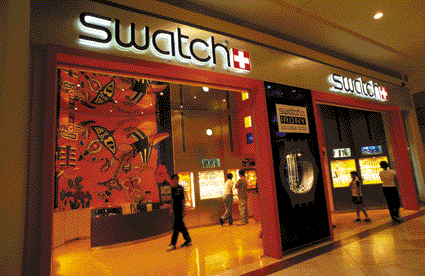
Swatch has taken a strategic
decision to enhance its presence in retail, opening upmarket stores
in key cities across the world. But running a retail store is very
different from designing and manufacturing watches – which is
Swatch’s core strength. “Getting into retail means that Swatch will
have better control over its brands,” points out Huang Sun, “and it
puts the company directly in touch with consumers, giving it a
better idea of exactly what the consumer wants.”
Back in the 1970s – when Hayek
was working as a consultant in cars, telecommunications, watches and
steel – the whole future of the Swiss watch industry appeared
threatened by cheaper Japanese imports. Two companies, SSIH and
Asuag, through brands like Omega, Longines and Tissot, produced most
Swiss watches. But the new quartz technology allowed the Japanese to
undercut Swiss craftsmanship, and Swiss exports halved between 1974
and 1983. Hayek was asked to produce a report by the watchmakers’
bankers, who apparently believed that the industry would have to be
liquidated. Instead, Hayek argued that the Swiss could regain their
pre-eminence by reinventing themselves.
In 1984, Hayek bought a 51
percent share in SSIH and Asuag, merged the companies to form SMH
and launched the first Swatch, a cheap plastic watch made with 51
parts instead of the usual 150. He slashed costs, revolutionized the
industry and produced the bestselling brand of all time.
Skintight. Hayek said later that his key
insight was that realizing the watch was an “emotional” as much as a
functional product. “A watch is something people carry on their bare
skin, sometimes 24 hours a day. We have to convince every individual
that this particular watch fits his or her personal style and
lifestyle the best.”
Swatch, in other words, expanded
the market rather than edged out other watchmakers. Hayek realized
that fashion-conscious consumers would opt to own three or four
watches, choosing which one to wear according to mood or occasion.
Priced at $30, new Swatch models (albeit with many common
components) could be produced every few months. Economies of scale
also eased production costs for Swatch’s upmarket brands.
Hayek has displayed an
extraordinary gift for marketing. Some of his ideas – like charging
a premium for the label “Made in Switzerland” – were extremely
simple. He was also a shrewd player in acquiring other companies.
One of Swatch’s subsidiaries, Nivarox-FAR, is the world’s sole maker
of balance springs and other micro-components – meaning that it is
impossible for anyone to manufacture a quartz watch in Switzerland
without buying the essential parts from the Swatch Group.
One important inheritance from
father to son is an attention to detail. Nicolas, Jr., already
receives daily reports on the sales of each model. This isn’t just
for accounting purposes – Swatch has ruthlessly withdrawn lines that
perform under target.
Nicolas, Jr., dropped out of St.
Gallen, the prestigious Swiss business school, before working in a
foundry and embarking on a short career in film, working as
assistant director on Swiss TV documentaries before setting up
Sesame Films, a film production company in Paris. Recalled by his
father, he helped with Swatch’s ad campaigns, rose to head of
marketing and in 1998 became president of Swatch Watches. The next
step up the corporate ladder, to CEO, looked inevitable.
Good timing. The timing of the current
changeover is crucial. “What comes as a big relief,” says Huang Sun,
“is that Swatch is a company that is not in a turnaround stage or
facing major challenges in the market. Hayek, Sr., will remain a big
shareholder and the chairman of the company and hence he will
continue to influence the policies of the company.”
Last year was a tough one for
most luxury goods companies, with giants Gucci and LVMH reporting
disappointing results. Swatch, by contrast, continued to grow,
although its profits fell marginally. One of the reasons behind this
was that Swatch managed to keep a tight rein on its costs, a key
factor in determining the profitability of a company.
The expectations for the luxury
market for this year are hardly better, as it will continue to be
under pressure as long as there are no clear signs of a broad
economic recovery in the United States, Japan and Europe, which
collectively account for over 90 percent of the global luxury
market. Huang Sun’s predictions for Swatch this year are lukewarm:
“It is a tough year and sales will be largely flat, with a projected
earnings growth of about seven percent, though the fourth quarter
may be better.”
Maintaining momentum requires
constant innovation, which is difficult in any business. Swatch’s
sales fell 1.9 percent to $2.6 billion last year, and its net income
fell 7.7 percent to $312 million. The company also cut its dividend
payout for the first time in seven years. Market analysts have
argued that the company’s shares are undervalued because of concerns
about the group’s strategy and (now resolved) doubts about
succession.
Swatch’s new lines for 2002
include the 007 series – based on James Bond – and the Swatch Skin.
And all the advertising talk emphasizes change – the T Touch from
Tissot has, for example, what the company calls a “revolutionary”
touch-screen mechanism. The sense of constant innovation, essential
if consumers are to keep buying new watches, has been taken up by
many rival watchmakers.
But a watch is, after all, a
watch, and critics say the company has been searching for a new Big
Idea for over a decade. Nicolas, Jr., seems to believe the future is
in a convergence between the wristwatch and telecommunications. A
speaking watch – a phone that literally tells the time – has failed
to set the market alight. Neither has a Swatch with access – via a
nearby computer – to the Internet.
Nicolas Hayek, Jr., clearly
believes he can develop his father’s approach in the new century and
maintain Swatch as one of the world’s best-known names. “Our main
business is watches,” he said recently. “But, for Swatch as a brand,
because we are about lifestyle and fashion, we have huge
opportunities. If you talk about telecoms, jewelry or, who knows,
perfume, Swatch has a perfect name if you control the distribution.
Companies like Hewlett-Packard and Sega are approaching us, because
we have a brand name that speaks to people.”
Additional reporting by Harry
Jenkins in Geneva
Click
here for a FREE copy of Trends magazine

|