
Oman
With relatively modest oil reserves, Oman is important to world oil markets due to its strategic location overlooking the Strait of Hormuz. Oman also opened a facility for the export of liquefied natural gas (LNG) in April 2000, which is undergoing expansion.
Note: Information contained in this report is the best available as of September 2002 and can change.
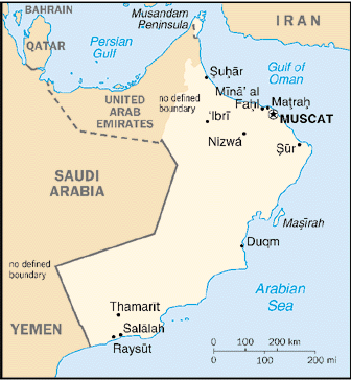
GENERAL BACKGROUND
Oman
remains heavily dependent on oil revenues, which account for nearly 80% of the
country's export earnings and 40% of gross domestic product (GDP). Real GDP
growth was 3.3% for 2001 and is projected at 3.0% for 2002. Inflation is mild,
projected at 0.9% for 2002.
Oman has made privatization and diversification of its economy top policy priorities. Expanded utilization of natural gas is central to Omani diversification plans, for export as well as for domestic use. Natural gas projects include a liquefied natural gas (LNG) project in Sur, which began exports in April 2000, an aluminum smelter and petrochemicals plant in Sohar, and a urea fertilizer plant in Sur. These projects are intended not only to help alleviate Oman's dependence on oil, but also reduce dependence on governmental spending and employment.
In recent years, Oman also has put forth great efforts to attract foreign investments, particularly in light industry, tourism, and electric power generation. Foreign investment incentives include a 5-year tax holiday for companies in certain industries, an income tax reduction for publicly held companies with at least 51% Omani ownership, and soft loans to finance new and existing projects. Oman became a member of the World Trade Organization (WTO) in October 2000.
Constitutional reforms in Oman have been part of an ongoing process of modernization. The Basic Law, announced in late 1996, institutionalized a new structure for the country's political institutions, creating an upper legislative chamber, the Majlis al-Dawla (Council of State), alongside the Majlis al-Shura, for which elections were held in 1997. The two chambers now form the Council of Oman.
OIL
In
many ways, Oman is atypical of Persian Gulf oil producers. Oil was not
discovered in commercial quantities until 1962 - decades after most of Oman's
neighbors. Oman's oil fields also are generally smaller, more widely
scattered, less productive, and more costly per barrel than in other Persian
Gulf countries. The average well in Oman produces about one-tenth the volume per
well compared to neighboring countries. Oman continues to use a variety of
enhanced oil recovery (EOR) techniques in order to minimize the costs of
exploration and further development at new and existing oil fields. Using these
technologies, Oman has succeeded in bringing down the cost of oil production to
$3 per barrel in some fields and $4 per barrel in others - but these figures,
while still low by world standards, are substantially above most other Persian
Gulf oil fields. Oman is not a member of the Organization of Petroleum
Exporting Countries (OPEC) or the Organization of Arab Petroleum Exporting
Countries (OAPEC).
Most of Oman's 5.5 billion barrels in proven oil reserves are located in the country's northern and central regions. In the North, the Yibal, Natih, Fahud, al-Huwaisah and Lekhwair fields combined account for almost half of total Omani oil production. Yibal, which produces around 180,000 bbl/d, is the largest oil field in the country. Crude oil found in this region is mainly medium or light, with gravities in the 32o-39o API range. Northern oil is mostly found along with natural gas. Heavier oil is found in southern Oman, particularly in the Nimr and Amal fields, with gravities averaging 20o API, and normally not associated with natural gas. Oman's main oil export blend is a medium sour crude.
Petroleum Development Oman (PDO), the country's second-largest employer after the government, holds over 90% of the country's oil reserves, and accounts for about 94% of production. PDO is a consortium comprised of the Omani government (60%), Shell (34%), Total (4%), and Partex (2%). However, Shell operates most of Oman's key fields, including Yibal and Lekhwair. As part of a strategy to increase its oil reserves, PDO has set out to develop additional exploration and recovery techniques. PDO' s stated aim is to double its average recovery rate to 50% (a goal known as "Target 50") by investing over $1 billion in enhanced recovery projects over the next five years, but it remains to be seen if this will be possible. Use of enhanced recovery technologies also increases production costs substantially. Despite these efforts, Oman's crude oil production has fallen in the first half of 2002, averaging 918,425 bbl/d, down from an average of 959,816 bbl/d for 2001. Oman had pledged a 40,000 bbl/d cut in output effective January 1, 2002 in support of OPEC production cuts, though the decline may also reflect declining production at mature fields.
Yibal, discovered in 1962, is Oman's largest producing oil field, supplying around one-quarter of PDO's total production. In 1986, the field's output was boosted from 120,000 bbl/d to more than 140,000 bbl/d with the installation of water injection facilities. Production was increased further following the completion of a $200-million development project, called Yibal Shusiba Phase II, in 1994. The project involved drilling 96 wells, mostly horizontal, and modifications to production stations B, C, and D, which included the installation of gas injection facilities. Yibal currently produces around 180,000 bbl/d. Oman's second largest oil field, Nimr, was discovered in 1980 and is located in the southern part of the country. Nimr currently produces about 178,000 bbl/d from more than 307 wells.
Foreign companies recently awarded concessions for exploration include France's TotalFinaElf, which signed a deal for a 100% stake in Block 34 in southern Oman in March 2002, and Hunt Oil, which which was awarded a concession in May 2002 for Block 51 in the Sharqiyah region. China's CNPC also has acquired a foothold in Oman in 2002 - a 50% stake in Block 5 which it acquired after it was relinquished by the Japanese firm Japex.
Most of Oman's crude oil exports go to East Asia, with China, Japan, and South Korea the largest importers. India also is a significant importer of Omani crude oil.
Refining and Petrochemicals
In
1982, Oman constructed its first refinery, at Mina al-Fahal. Subsequently, the
50,000-bbl/d plant was expanded to 85,000 bbl/d. SK Engineering of South Korea
was awarded a contract in June 2002 for the construction of a new
desulfurization unit at Mina al-Fahal. Output from the facility, which is
operated by the state-owned Oman Refinery Company (ORC), is used to meet local
product demand.
A second refinery is planned, near the northern city of Sohar. Bids for construction of the project were solicited in March 2002. A final selection of a construction contractor has not been made.
As part of its effort to diversify its economy and to develop value-added industries, Oman has begun to invest in petrochemical production. Oman is moving ahead with plans to contruct a large-scale joint-venture petrochemical project in Sohar for the production of polyethylene and fertilizer.
NATURAL GAS
Oman has made natural gas -- both for export as well as for domestic
gas-intensive industries -- the cornerstone of its diversification and economic
growth strategy. Through an extensive exploration program, Oman has
consistently increased its natural gas reserves in recent years. As of
January 1, 2002, Oman's estimated proven natural gas reserves were approximately
29.3 trillion cubic feet (Tcf), up from only 12.3 Tcf in 1992, largely of
associated gas. A significant gas discovery by PDO was reported in March
2001 in the Dakhiliya region. Most of these reserves are located in areas
owned by PDO, which produces the majority of Oman's natural gas. More than 10
Tcf of Oman's non-associated natural gas is located in deep geological
structures, many of which are beneath active oil fields.
Oman is extending its existing natural gas pipeline network. Two contracts were awarded to separate firms for projects connecting natural gas deposits in central Oman to the coastal cities of Sohar in the north and Salalah in the south. India's Dodsal Company completed construction of a $124-million line to Sohar in August 2002. A consortium including Italy's Snamprogetti and Saipem completed the $180-million line to Salalah in August 2002. In April 2001, Oman awarded a contract to operate the country's natural gas transportation and distribution infrastructure for the next five years to Canada's Enbridge and BC Gas. The contract includes a provision for technology transfer and training, so operation can be transferred to Omani staff after five years.
Oman also is one of the potential participants in the Dolphin Project, which will provide gas from Qatar's North Dome field to the United Arab Emirates (UAE). Initially, the project will link gas consumers in the United Arab Emirates with gas supplies from Qatar. While Oman originally was discussed as an importer, recent indications are that Oman might export a small quantity of gas to the UAE. Later, if Omani demand for petrochemical plants is sufficient, the flow might be reversed. Recent discussions have focused on possible exporta of Omani natural gas to Fujairah from late 2003 until 2006, when Qatari supplies are to become available, via a relatively inexpensive 30-mile spur pipeline. Oman could also serve as a transit corridor for gas exports from the Dolphin Project to Pakistan through a subsea pipeline, but sufficient demand and financing to make this possible are not expected in the next several years.
Oman made an agreement with Iran in 1997 for the development of the Hengam/Bukha offshore field in the Strait of Hormuz, which straddles the line between the two countries territorial waters. The field is currently producing 40 million cubic feet per day (Mmcf/d) of gas. In May 2000, the two governments agreed that the Iranian share of the gas would be exported to Oman once it is developed.
Liquefied Natural Gas (LNG) Exports
Oman began exports of LNG in early 2000, with the completion of a
6.6-million-ton-per-year liquefaction plant is located at Qalhat, near Sur. The
project was developed by the Oman Liquefied Natural Gas Company (OLNGC), a joint
venture of the Omani government (51%), Shell (30%), Total (5.54%), Korea LNG
(5%), Mitsubishi (2.77%), Mitsui & Co. (2.77%), Partex (2%), and Itochu
(0.92%). The LNG plant consists of two, 3.3-million-ton-per-year, LNG trains
supplied by non-associated natural gas from the Saih Nihayda, Saih Rawl, and
Barik fields. The second train became operational in May 2000, and the
government of Oman approved plans for a third train in May 2002.
Korea Gas Corporation (Kogas) is the anchor customer for the LNG project, having contracted for 4.1 million tons per year of Omani LNG over a 25-year period. Japan's Osaka Gas Company is another client, and will receive 700,000 tons per year for 25 years. The third client, the Dabhol power project in India, may not take its volume due to financial problems. The spot market for LNG relatively strong, so it is not expected that Oman LNG will have trouble maintaining operation at full capacity. New sales agreements have been concluded in the first half of 2002 with Union Fenosa of Spain and Gaz de France for LNG supplies which will become available with the completion of the third train.
In an effort to enhance prospects for future gas-based export projects, Oman has signed a number of joint venture agreements to carry out exploration and development activities. Canada-based Gulfstream Resources Ltd. is planning to invest more than $60 million over the next eight years to develop a gas field in Haffar Block 30. In November 1998, Occidental, Amoco and Neste Oy of Finland announced the establishment of a joint venture firm to develop, explore and produce natural gas reserves in northern Oman. The area consists of five blocks, covering approximately 3,150 square miles. Target markets include the city of Sohar and the northern UAE through the large natural gas supply hub located in Sharjah, UAE. The project will include development, well drilling, construction of a gas collection system and processing plant, as well as building gas transmission lines to Sohar and the Sharjah gas hub.
ELECTRIC POWER
Oman's government is undertaking a major reform of the country's
electric power system. Demand is growing rapidly, at about 4-5% per year,
and the Omani government is seeking to attract foreign investment to ensure
adequate generating capacity. The 90-megawatt (MW) al-Manah power plant
became the Persian Gulf's first independent power project (IPP) in 1996, and an
additional 180-MW of capacity was added there in early 2000. The Omani
government currently is working on a new legal framework for a privatized power
sector, which is to be enacted by the end of 2002. It is to provide for the sale
of existing assets, including transmission and distribution to private owners,
beginning in 2003.
Three new IPPs are planned for the near future. The 280-MW Al-Kamil power project, which reached financial close in March 2001, is being built by International Power PLC. Arab International Contractors of Egypt also in involved in the project. It is expected to be operational by late 2002. AES has been selected for the other IPP project, the 430-MW Barka power plant. It is expected to be completed by April 2003. Both plants will run on natural gas. PSEG of the United States has been chosen to build an integrated power project to supply the Dhofar region. The 200-MW generating plant is under construction. A contract for another 140-MW plant at Qarn Alam in southern Oman was awarded in May 2002 to Bharat Heavy Electricals of India. The facility is scheduled for completion by mid-2004.
Sources for this report include: CIA World Factbook 2001; Dow Jones News Wire service; DRI/WEFA Middle East Economic Outlook; Economist Intelligence Unit ViewsWire; Oil and Gas Journal; Petroleum Economist; Petroleum Intelligence Weekly; Power Engineering; U.S. Energy Information Administration; World Gas Intelligence; World Markets Online.
COUNTRY OVERVIEW
Head of State: Sultan Qaboos bin Sa'id
Independence: 1650 (end of Portuguese rule)
Population (2001E): 2.6 million
Location/Size: Southeast Arabian Peninsula/82,030 sq. mi. (about
the size of Kansas)
Major Cities: Muscat
(capital), Salalah, Sur, al-Khasab
Languages:
Arabic (official), English
Ethnic Groups: Arab,
Baluchi, South Asian (Indian, Pakistani, Sri Lankan, Bangladeshi),
African
Religion: Muslim (Ibadi -- 75%, Sunni,
Shi'a), Hindu
Defense (8/98): Army (43,500),
Navy (4,200), Air Force (4,100), Royal Household (6,500)
ECONOMIC OVERVIEW
Currency: Omani Rial
Exchange Rate
(9/02): $1 = 0.386 Omani Rial
Nominal Gross
Domestic Product (GDP) (2001E): $20.9 billion (2002E): $21.9
billion
Real GDP Growth Rate (2001): 3.3%
(2002E): 3.0%
Inflation Rate (consumer
prices)(2001E): -1.1% (2002E): 0.9%
Major
Trading Partners: Japan, United Arab Emirates, South Korea, United Kingdom,
United States, Thailand
Merchandise Trade Balance
(2001E): $3.1 billion (2002E): $2.8 billion
Major Export Products: Petroleum, fish, processed copper,
textiles
Major Import Products: Machinery,
transportation equipment, manufactured goods, food, livestock, lubricants
Monetary Reserves (2002E, non-gold): $2.4
billion
Total External Debt (2002E): $2.9
billion
ENERGY OVERVIEW
Minister of Oil and Gas: Mohammed al-Rumhi
Proven Oil Reserves (1/1/02E): 5.5 billion barrels
Oil Production (2001E): 963,816 barrels per day
(bbl/d), of which 959,816 bbl/d is crude oil
Oil
Consumption (2001E): 55,000 bbl/d
Net Oil
Exports (2001E): 908,816 bbl/d
Crude Oil
Refining Capacity (1/1/02E): 85,000 bbl/d
Oil
Export Customers (2001): China, Japan, South Korea, Thailand, Singapore,
Taiwan, India
Natural Gas Reserves (1/1/02E):
29.3 trillion cubic feet
Natural Gas Production
(2000E): 320 billion cubic feet (Bcf)
Natural
Gas Consumption (2000E): 221 Bcf
Electric
Generation Capacity (1/1/00E): 2.1 gigawatts
Electricity Production (2000E): 8.1 billion kilowatthours
ENVIRONMENTAL OVERVIEW
Minister of Regional Municipalities and Environment: Dr. Khamis
bin Mubarek bin Isa Alawi
Special Advisor to His
Majesty for Environmental Affairs: Shabib bin Taymur Al Said
Total Energy Consumption (2000E): 0.34 quadrillion Btu*
(<0.1% of world total energy consumption)
Energy-Related Carbon Emissions (2000E): 6.0 million metric tons
of carbon (<0.1% of world total carbon emissions)
Per Capita Energy Consumption (2000E): 135.3 million Btu (vs.
U.S. value of 351.0 million Btu)
Per Capita Carbon
Emissions (2000E): 2.4 metric tons of carbon (vs. U.S. value of 5.6 metric
tons of carbon)
Energy Intensity (2000E): 20,599
Btu/$1995 (vs U.S. value of 10,918 Btu/$1995)**
Carbon Intensity (2000E): 0.36 metric tons of carbon/thousand
$1995 (vs U.S. value of 0.17 metric tons/thousand $1995)**
Sectoral Share of Energy Consumption (1998E): Industrial (44.1%),
Residential (20.0%), Transportation (24.3%), Commercial (11.6%)
Sectoral Share of Carbon Emissions (1998E): Industrial (41.7%),
Residential (19.6%), Transportation (27.4%), Commercial (11.2%)
Fuel Share of Energy Consumption (2000E): Natural Gas (67.6%),
Oil (32.4%), Coal (0.0%)
Fuel Share of Carbon
Emissions (2000E): Natural Gas (63.3%), Oil (36.7%), Coal (0.0%)
Renewable Energy Consumption (1998E): 0 Btu*
Number of People per Motor Vehicle (1998): 6.6 (vs.
U.S. value of 1.3)
Status in Climate Change
Negotiations: Non-Annex I country under the United Nations Framework
Convention on Climate Change (ratified February 8th, 1995). Not a signatory to
the Kyoto Protocol.
Major Environmental Issues:
Rising soil salinity; beach pollution from oil spills; very limited natural
fresh water resources.
Major International
Environmental Agreements: A party to Conventions on Biodiversity, Climate
Change, Desertification, Hazardous Wastes, Law of the Sea, Marine Dumping, Ship
Pollution and Whaling.
* The total energy consumption statistic includes
petroleum, dry natural gas, coal, net hydro, nuclear, geothermal, solar, wind,
wood and waste electric power. The renewable energy consumption statistic is
based on International Energy Agency (IEA) data and includes hydropower, solar,
wind, tide, geothermal, solid biomass and animal products, biomass gas and
liquids, industrial and municipal wastes. Sectoral shares of energy consumption
and carbon emissions are also based on IEA data.
**GDP based on EIA International Energy Annual 2000
OIL AND GAS INDUSTRIES
Organizations: Petroleum Development Oman Ltd. (PDO) controls all
oil resources. PDO is a partnership between the Omani government (60%), Royal
Dutch/Shell (34%), Total (4%), and Partex (2%). Oman Oil Company (OOC) is the
overseas investment arm of the Ministry of Petroleum.
Major Foreign Oil Company Involvement (non-PDO): BP, CNPC, IPC,
Itochu, Japex, Occidental, Phillips
Major Oil
Fields: Roughly 1.8 billion barrels in reserves are located in the large
northern structure containing the Yibal, Natih, Fahud, al-Huwaisah, Lekhwair,
and Shibkah fields. Other key fields are the southern Marmul and Nimr fields as
well as Occidental's 120-million barrel Safah field and the estimated
400-million barrel Amal Eastern High field, which contains heavy crude
oil.
Major Refinery: Mina al-Fahal (85,000
bbl/d)
Major Oil Terminal: Mina al-Fahal
For more information from EIA on Oman, please see:
EIA - Country
Information on Oman
Links to other U.S. government sites:
CIA
World Factbook - Oman
State
Department Country Commercial Guide - Oman (FY 2001)
State Department Consular
Information Sheet - Oman
The following links are provided solely as a service to our customers, and therefore should not be construed as advocating or reflecting any position of the Energy Information Administration (EIA) or the United States Government. In addition, EIA does not guarantee the content or accuracy of any information presented in linked sites.
The
Center for Middle Eastern Studies - Oman
Oman Studies Centre
Oman LNG
Oman Tenders (Bidding
Announcements)
MENA
Petroleum Bulletin
Planet Arabia.com
AME Info Middle East Business
Information
Gulf Wire
If you liked this Country Analysis Brief or any of our many other Country Analysis Briefs, you can be automatically notified via e-mail of updates. Simply click here, select "international" and the specific list(s) you would like to join, and follow the instructions. You will then be notified within an hour of any updates to our Country Analysis Briefs.
Return to Country Analysis Briefs home page
File last modified: September 4, 2002
Contact:
Lowell FeldURL: http://www.eia.doe.gov/emeu/cabs/oman.html
lfeld@eia.doe.gov
Phone: (202)586-9502
Fax: (202)586-9753
If you are having technical problems with this site, please contact the EIA Webmaster at wmaster@eia.doe.gov