|
11 September 2002 One day in Jaramana
Buthaina Shaheen
| This morning I went to the
Jaramana camp in Damascus…I’d like to tell you
about my impressions of it. (mid-length) |
|
 As a Palestinian
refugee, I am really thankful not to be in the same boat
as the people we met today. I live in a Palestinian camp
in Damascus – which is not classified as a camp in the
United
Nations (UN) reports. It doesn’t look or feel like
other Palestinian camps because it has developed a lot
in many ways, and there are different races there. As a Palestinian
refugee, I am really thankful not to be in the same boat
as the people we met today. I live in a Palestinian camp
in Damascus – which is not classified as a camp in the
United
Nations (UN) reports. It doesn’t look or feel like
other Palestinian camps because it has developed a lot
in many ways, and there are different races there.
I visited
Jaramana with a French journalist, Philip, because he is
interested to know what the camps in Damascus look like.
The camp looks different to how it did three or four
years ago, when I last visited. 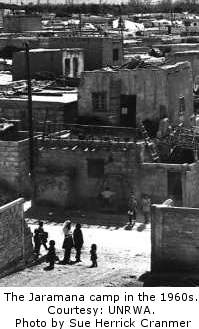 A new street has been
built and a new vegetable market established, which in a
way feels better, even though it is not much,
considering the number of people. A new street has been
built and a new vegetable market established, which in a
way feels better, even though it is not much,
considering the number of people.
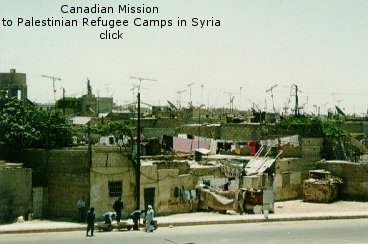
This camp is
not small; about 5,680 people live here – actually, are
crammed in there. It’s situated east of Damascus, on the
street leading to Jaramana (a town in Damascus itself).
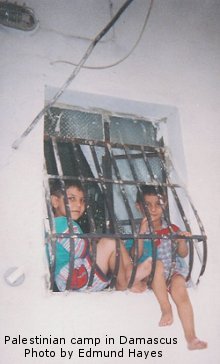
The houses are built very close together, with narrow
alleys – not proper streets – running between them.
Large families live there, with lots of children. They
play soccer in those narrow little alleys, running after
each other, unaware of the bad luck they have, living in
this camp. 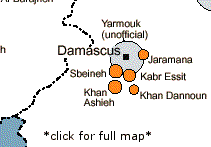
However,
about a year ago, a man from the Arab Gulf helped to
improve the camp. He had a street made, to separate some
of the houses, and a bridge was built in a busy crossing
area – where before, three girls, and a woman and her
daughter were killed in a tragic car accident, just
crossing the street. He also set up a fountain next to
the camp. It really looks very beautiful.
We met a
girl there called Amina, and she told us proudly how
most people in the camp go there for the evening, and
that sometimes there are visitors from outside.
Of course,
people’s houses were destroyed when the street was
built. To compensate, houses were built for them in
other areas of Damascus, and so they moved there. But
now they have debts to pay for their old houses.
When we
first saw Amina, who is a very helpful, nice girl, she
passed us saying ‘Oh my God’ in English. She thought we
were foreigners. I think she thought I was a foreigner
because I look different to the other girls in the camp;
I was wearing a short-sleeved T-shirt, trousers and
sunglasses. Actually, my appearance is different from
theirs simply because they have a certain appearance all
over that camp. Amina told us that all the girls there
cover their heads, so it’s shameful not to. So I asked
her, ‘Well, why are you wearing a hat and not a veil?’
She said, ‘I don’t like to wear a cover. I always wear
this hat and people call me a foreigner because of it.’
That’s why I
like this girl so much; she sounds just like me – she
wants to be herself and break taboos, to express and
show her own personality. I really think, very deeply,
that if this girl had the chance – like me, since we’re
both refugees – to complete her education at school and
university she would change a lot. Because I remember
that I was just like her as a child. But when I got to
university – where I studied English literature and read
many books – many of my ideas changed and I started
to look at things from a different perspective.
When we
started talking to Amina, she was confident and funny.
She was always smiling, in spite of the fact that there
are a hundred reasons to make her sad. I really admire
this kind of person, who can be optimistic and laugh
even though they have so many troubles in their life. We
asked her if we could talk to her family about the camp.
She had been on the way to somewhere else with her
friend, but she took us to her house instead.
She led us
there through a great many narrow alleys, of unpaved,
stamped earth. It’s not something you’d want to
experience for more than one day; there’s a pressure you
feel, because of the narrowness of everything, as though
you can’t even breathe.
Philip said,
‘This camp looks very much like the camps in Gaza.’ And
then I felt a little bit happier – that at least I’m in
a place that looks like something in Palestine,
which I’m not even allowed to see. All I can do is hear
and read stories about it, enviously thinking ‘Oh! Those
people at least are in Palestine,’ or watch movies,
where I imagine myself as one of the actors or
passers-by. And when foreigners tell me that they’ve
been there, I just think, damn it! They’re not even
Arabs!
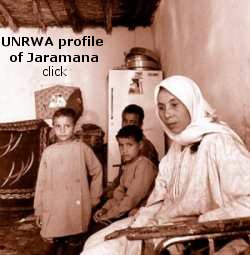 Anyway, we arrived at Amina’s family
house. It is surrounded on all sides by other houses.
They have two rooms and a very small yard. Many people
live in the house – at the moment there are two girls
and three guys, one of whom got married and lives in the
same house. Amina has another sister, who married and
went to live with her husband; and another brother, who
is also married and lives in another camp in Damascus.
There’s also their mother. They don’t have much
furniture in the house, only some mattresses and two
rugs – I saw their clothes lying out on the floor. Anyway, we arrived at Amina’s family
house. It is surrounded on all sides by other houses.
They have two rooms and a very small yard. Many people
live in the house – at the moment there are two girls
and three guys, one of whom got married and lives in the
same house. Amina has another sister, who married and
went to live with her husband; and another brother, who
is also married and lives in another camp in Damascus.
There’s also their mother. They don’t have much
furniture in the house, only some mattresses and two
rugs – I saw their clothes lying out on the floor.
We asked her
about her dad, and we felt her sadness when she said,
‘He was the dearest to my heart’ – the same phrase
repeated by her sister. ‘He died because of illness. We
didn’t have money to take him to the hospital and get
him all the medicine he needed. He used to work for a
building firm, carrying things like earth and sand on
his back until he was unable even to stand up straight.’
Their mother came to Syria when she was six years old:
‘The Israelis displaced us. Palestine is a very nice
country. The only thing my family brought along from
Palestine is the keys of our house. We were told we
would return very soon.’ She was very friendly and nice,
and wore traditional Palestine dress.
We asked
Amina who supports the family. I was surprised to hear
that it is her. She is twenty-two, and works for a
biscuit factory from 8:00 a.m. to 5:30 p.m., earning $80
a month. She complains about her work: ‘I work most of
the day very often under the sun. Once I had sunstroke
and wanted to quit, but my family did not let me. My mum
said, ‘Who is going to work if you don’t?’ My job is
very boring, but what shall I do – work under these
humiliating situations, or be a beggar on the streets?’
I asked her,
‘What about your brothers? Why don’t they contribute?’
She said, ‘No one would ask them to. Simply because
they’re men, no one would have control of them. But of
course, they can dominate me and my sister.’
I was really
astonished to know that it was only Amina who supports
the family, and that it’s okay for men not to work, as
this doesn’t happen very often in Arab society. Usually
men are responsible for supporting their families.
We asked
Amina whether she’d like to move out of the camp. She
said, ‘I’ve got used to living in the camp, but I’d like
to live in Salihaa’ (a rich region in Damascus, filled
with shops). Amina and her sister Eman left school at a
very early age. Amina had to work to help her family. We
asked her if she’d like to read books, and she said,
‘Yes, I’d like to read novels but they are expensive.’
When she
heard Philip and I speaking English to each other, she
started saying the English words she knows. I told her I
could teach her English, and she was very excited. Her
sister, Eman, told us that, in the camp, there are some
courses run by the United Nations Relief and Works
Agency for Palestine Refugees in the Near East (UNRWA). ‘But although the foreign
volunteers work for free, the people who work in the
UNRWA centre made us pay $2 a lesson, which is maybe not
very much, but for us – the people in the camp – it
means a lot. This really irritates me because the
volunteers are very nice and want to help us, while the
people who take our names and run the whole centre are
corrupt.’
When I heard
this story I thought I’d suggest organising new English
lessons, without the UNRWA centres, with the help of my
friends from Europe. That same day, I met a very nice
half-Spanish, half-American guy called Adriano, and when
I told him about this he immediately said, ‘I’m very
excited to teach those children!’ So he’s going to start
very soon. In the Jaramana camp there are UNRWA schools
and a centre for medical treatment, along with some
other centres to distribute food – wheat, canned meat
and so on – from the UN and EU. The UN schools are not
as good as those in the Al-Yarmouk camp. I think this is
because the people who are in a position to assign the
teachers in the UN schools choose their relatives, or
they get payment from others.
Unfortunately,
people think that they are too weak to protest; they are
not aware how important education and learning is for
them.
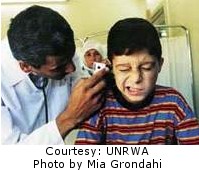 The centre for medical treatment
is no better. Amina’s family told us that they went
there to register their names to have UN aid, but people
there said, ‘You can’t, because you have two unmarried
brothers at home’ – implying that the two single men
ought to be supporting the family. Apparently people
with contacts in the UN are better off. People working
at the medical treatment centre turn some people down,
saying, ‘We’ve run out of this kind of medicine – you
have to go to the drugstore to buy it,’ even though it
is in fact given to some other people. The centre for medical treatment
is no better. Amina’s family told us that they went
there to register their names to have UN aid, but people
there said, ‘You can’t, because you have two unmarried
brothers at home’ – implying that the two single men
ought to be supporting the family. Apparently people
with contacts in the UN are better off. People working
at the medical treatment centre turn some people down,
saying, ‘We’ve run out of this kind of medicine – you
have to go to the drugstore to buy it,’ even though it
is in fact given to some other people.
I am deeply
impressed after being at the Jaramana camp. It has woken
me up to the fact that, although I do have problems,
they can’t be compared with the problems these people
have. I urge people to be helpful to these refugees, and
to think about the terrible conditions they are under.
And for those who can contribute with any form of help,
please do contact me
with your suggestions.
Copyright © Buthaina
Shaheen, 2002. Published by openDemocracy. Permission is granted to
reproduce articles for personal and educational use
only. Commercial copying, hiring and lending is
prohibited without permission. If this has been sent to
you by a friend and you like it, you are welcome to join
the openDemocracy network.
Buthaina Shaheen is
of Syrian–Palestinian origin, and a graduate of Damascus
University. She can be reached at
buthaina@postmaster.co.uk .
|












.gif)