At a glance
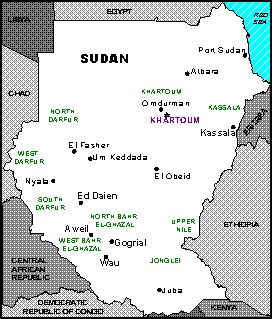
Sudan experienced a severe drought and food
crisis, particularly in western regions, early this year.
Although the international donor response to the problem was
slow and late, Save the Children with other partners solicited
resources in the form of food aid and projects to improve
water supplies, feeding programmes and emergency health
services. Ongoing fighting and displacement in the Upper Nile
and Bahr el Ghazal regions continues to threaten many more
children's lives as they face poverty and violence as well as
the steady deterioration of basic health, education and
welfare services.
Key issues
affecting children
- drought leading to severe food and water shortages, an
increase in child malnutrition, and low crop yields
affecting livelihoods
- conflict and displacement
- abduction of children
- inadequate provision of education, health and welfare
services
Save the Children's
response
- leading agency with demobilised child soldiers in
northern Bahr el Ghazal
- securing 7,000 metric tonnes of food aid for
Darfur
- stocking village grain banks in North Darfur
- feeding programme targeting 20,000 children in North
Darfur
- distributing seeds and tools in S Darfur, Bahr el
Ghazal and Upper Nile
- drilling bore holes, capping wells and providing
hand pumps in Darfur and Bahr el Ghazal and maintaining a
clean water supply in nine internally displaced peoples'
(IDPs) sites in South Darfur
- supporting communities to maintain over 300 hand
pumps in Bahr el Ghazal
- distributing portable fishing equipment in Bahr el
Ghazal and Upper Nile to enhance access to high quality food
for children from IDP and other vulnerable communities ·
supporting people's livelihoods and children's access to
milk and meat through community-based livestock work in Bahr
el Ghazal and Upper Nile
- working with separated and abducted children
- providing education to 25,000 displaced and local
children in north and south Sudan
- distributing food with the WFP
- carrying out a nutritional screening of
under-fives in West Darfur.
- supporting health services for the IDPs
and providing emergency health services for the drought
affected population in Darfur including measles vaccination.
latest developments
Drought and food security
Of the 3
million people facing on-going food insecurity in Sudan
because of civil war, displacement and the current drought up
to 600,000 of the most vulnerable children have been reported
to be at immediate risk of starvation.
Drought has hit both northern and southern
parts of Sudan, particularly northern Darfur and Kordofan
regions as well as Eastern Equatoria and northern Bahr el
Ghazal. In the latter two areas, the drought situation has
been exacerbated by continued fighting. Fighting around the
oilfields has exacerbated the uprooting of people from their
homes and in the oilfields in southern Unity State alone an
estimated 36,000 internally displaced people (IDPs) now also
require food assistance.
Late and erratic rainfall affecting the whole
of the Horn of Africa region has led to poor harvests
especially of sorghum, the staple food in southern Sudan. Only
30-40 per cent of the funding necessary to provide for
people's basic needs has been pledged by international donors.
A joint report (produced last year) from Save the Children and
WFP stated that 62,000 metric tonnes of food aid are urgently
required in southern Sudan to save just under two million
people from starvation. It looks as though problems are likely
to persist in Darfur through the winter and on into next year.
The harvest will fail in some parts of North Darfur, and poor
households will have difficulty meeting their needs. In the
north WFP, working closely with the government and NGOs, has
stepped up food deliveries through food for work activities
and school feeding programmes.
West Sudan emergency
A Save the
Children pre-harvest assessment was conducted in October and
data analysis is now being carried out. Although indications
are that the harvest in most parts of Darfur will be
substantially better than last year (2001), shortfalls are
anticipated in parts of North Darfur. Early indications are
that there is likely to be a requirement for some relief
distribution.
Southern Sudan has seen increased
displacements resulting from intensified fighting with SPDF,
SPLA and GoS-sponsored militia and commanders vying for
control of the area. In Western Upper Nile there has been an
upsurge in conflict over oil fields, leading to displacement,
food insecurity and a loss of assets. The total number of IDPs
in Bahr el Gahzal is approximately 100,000. The total number
of IDPS in the environs of Khartoum and Omudurman is between
1.5 and 2 million.
Child soldiers
A UNICEF initiative
in March 2001 resulted in 3,536 child soldiers and children
associated with fighting forces being evacuated from Bahr el
Ghazal and taken to Rumbek where they were cared for in
interim transit care centres. In August they returned to their
communities. Save the Children and other NGOs, alongside
UNICEF, have expanded support for service provision (health,
water, education, grinding mills, and child protection) in the
reintegration areas. We are also working with a SPLM task
force to plan for future demobilisations, which will not
involve camps or evacuations.
Save the Children, through the provision of a
separated children's database, will focus on reunification and
reintegration activities with children from our areas of
operation in Bahr el Ghazal. The database is currently being
field-tested, and is in the final stages of development. It
will be used in south Sudan.
background
Ongoing
conflict
Sudan has had only 11 years of peace since
independence in 1956; civil war has raged for much of the rest
of the time. Since 1983 rebels from the mainly animist and
Christian south have been fighting for greater autonomy from
the mainly Muslim north. The war is primarily between the
Sudan People's Liberation Army (SPLA) and Sudanese Government.
However, over recent years government troops have been aided
by militias, and the southern forces have factionalised into a
number of groups. The greatest emphasis is on the militias and
the Murahaleen, who are less tribal levies and more Government
of Sudan (GoS) supported bandits. Northerners have formed the
support base of the succession of unstable governments since
independence. The current government, led by President Omar
el-Bashir came to power in June 1989. The President was
re-elected in December 2000 and parliamentary elections were
held in the New Year. Under the president's rule, there has
been an increase in military power and ex-military leaders
close to the president, concurrent with a loss in some of the
power of Islamic fundamentalists.
One important
focus of the conflict lies in oil exploration areas with the
most severe fighting in the Upper Nile region and in the
southern Unity State. Bahr El Ghazal has seen localised
fighting.
Peace talks
under the auspices of the Intergovernmental Authority on
Development (IGAD) have continued for many years but prospects
for a permanent settlement remain poor. The Egyptian / Libyan
peace initiative has also made little progress. It is
estimated that since 1983 more than two million people have
died in the war. As the government becomes more confident
politically, it may be ready to take more risks for peace.
The SPLA and
the government have, for several years, agreed temporary
ceasefires in some areas of the conflict zone to allow the
passage of food aid. Food aid has been delivered primarily by
the World Food Programme (WFP) under the UN's Operation
Lifeline Sudan (OLS) - an existing agreement on the delivery
of humanitarian aid between the UN agencies, major
international agencies (INGOs), the Government of Sudan (GoS)
and rebel groups.
Economy and food security
Sudan's
economy is dominated by agriculture and livestock, which
accounts for one-third of its GDP and 95 per cent of exports.
The main crops are sorghum, millet, groundnuts, sesame, sugar,
gum Arabic and cotton. The civil war and chronic political
instability, as well as adverse weather conditions, poor
infrastructure and a large foreign debt, all affect food
production.
In 1999/2000
oil from the south has been extracted and pumped north to the
Red Sea for export by the GoS. Oil revenues have become an
increasingly important source of income for the government and
are likely to continue in coming years. They are also a
potential source of conflict - much of the fighting in Western
Upper Nile is linked to control of oil resources. The economy
grew by 8.3 per cent in 2000 and inflation halved to 8 per
cent. While military spending has increased significantly,
there has also been increased spending on infrastructure and
social services. However, according to the IMF, 90 per cent of
the population still lives below the poverty line, and oil
revenues do not percolate through to the majority of the
population.
International relations
The UN Security
Council imposed sanctions on Sudan in May 1996. These were
lifted in September 2001 by the General Assembly of the UN .
Since 11 September, the Government of Sudan has tried to align
itself with the US without compromising itself too much.
Events have made very little impact on the security situation.
Independently of the war on terrorism, the appointment of
Senator Danforth as President's Bush representative to Sudan
may offer a new opportunity to encourage the peace process.
There are
increasing signs that several larger donors, notably the EU
and USAID/OFDA are shifting their positions towards ones of
greater sympathy for more 'developmental' approaches.
Relations with the EU have improved recently, though EU
funding remains very low. However, the risk remains that
future resources might be diverted to aid Afghanistan.
Internally
displaced people
Many IDPs have been driven north. The
UN has put them high on the agenda. Most would like to return
home, but this is unlikely to happen unless there is peace and
significant investment in the southern economy infrastructure
and services. It is still unclear as to whether IDPs will be
integrated into the northern population, or will eventually
return to the south. International protection is difficult in
the 'transitional zones' such as the Nuba mountains, the Blue
Nile, and other parts of the Northern Provinces.
key issues
affecting children
Current
emergency
Growing population pressure and the
droughts of recent years have undermined the sustainability of
traditional rural lifestyles. Conflict also makes cultivation
and harvest difficult - families may be forced to abandon
their fields when harvests are good, or be prevented from
planting new crops. The combination of conflict, climate and
economics threatens the very survival of many children, with
some 90 per cent of Sudanese children living below the
official 'poverty line'. Difficulties in rural areas are
leading to increasing migration to urban areas and across
conflict lines.
Severe food
and water shortages are leading to increasing child
malnutrition. Screening of children in El Fasher showed 26 per
cent of children below 80 per cent of their normal weight for
height during the worst of the crisis in 2001.
Ongoing conflict
Children have been the most severely affected
by conflict in Sudan with estimates of up to four million
being displaced. Displacement, physical injury and distress
are all consequences of the conflict. Many children are
separated from their families either in flight or as a result
of abduction. Children have also been recruited into armed
militias and paramilitary groups supported by both sides.
Even more
children are indirectly affected by conflict as limited
resources are diverted to the war effort, reducing the amount
spent on development and social services. Military spending in
2000 was estimated at about $336 million by GoS, while social
expenditure was estimated as at $236 million.
Abduction
The abduction of women and
children from the southern Dinka tribe by the Arab Baggara
tribes of the north is an age-old practice in Sudan. It has,
however, increased significantly since the civil war began,
with pro-government militia being involved in abduction raids.
Abducted women and children are used by families as domestic
and farm labourers. Although some are treated relatively well,
others are beaten, abused and neglected.
Save the Children's response
Save the Children's work focuses on child protection,
health, education and food security.
Drought and
food security
Drought and desertification are growing
in Darfur. People survive through cultivation, consuming wild
foods, selling livestock migration, and by raising income
through wood and grass collection. This year USAID became a
significant contributor to drought relief in northern Sudan.
As a result of a change in policy, food aid will now be
allocated to any part of the country, on the basis of need.
Save the
Children works with GoS Humanitarian Aid Commission, State
governments and WFP with particular focus on food distribution
and water availability. Concentrating on North and West
Darfur, Save the Children has established the Early Warning
System (EWS) - a system that warns of food shortages - and to
ensure the most vulnerable parts of North and West Darfur are
covered. We have completed an assessment of the nutritional
and health status of under-fives in the drought-affected areas
of West Darfur. The global nutritional rate was 21.6 per cent
with 3.9 per cent severe malnutrition. In South Darfur, the
global rate was 14.7 per cent with 2 per cent severe
malnutrition. We have also been working to improve assessment
of the nutritional situation of displaced people in South
Darfur
Save the Children is now the lead agency in local
EWS information and co-ordination. During 2000, using the
Household Economy Analysis[1]
(HEA) methodology, Save the Children provided information,
which formed the basis of much of the UN Food and Agriculture
Organisation (FAO) and WFP reporting as well as reporting
within GoS systems. In November 2000 Save the Children
produced and circulated its own detailed and influential
report for Darfur, thus ensuring that WFP, FAO and INGOs are
all working from common baseline figures. Furthermore, Save
the Children's advocacy and lobbying role with the GoS helped
to ensure that the UN recently launched an amended
Consolidated Inter-Agency Appeal (CAP) for food aid and has
hopefully convinced donors to respond to the increasingly
critical situation.
Save the
Children is running a supplementary
feeding programme in ten rural councils in Darfur. 23,400
malnourished children and 15,400 pregnant women in North
Darfur have been targeted. The feeding programme is funded by
both DFID (six rural councils) and USAID (four rural
councils). We also distributed 7,000 mt of food in Darfur as a
general ration.
In 2000, Save the
Children, along with others, began
raising the alarm about the serious situation arising in the
water sector. For example, in North Darfur alone approximately
443,500 people are either directly affected by or in immediate
danger of acute water shortage. Save the
Children has mobilised its own resources
to install handpumps and rehabilitate 50 non-functioning water
pumps in collaboration with the Drinking Water Corporation and
UNICEF.
Measles vaccination and targeted primary
health care were provided for the drought affected population
in Darfur. The health activities were funded by OFDA and
Government of Netherlands. In the south, where Household
Economy Analysis provides the framework for food security
analysis, Save the Children continues to
second staff to support the Technical Support Unit (TSU) of
WFP. The TSU plays a vital role in the analysis of needs and
coordination of responses, the targeting of food aid, and the
identification of other appropriate food security
interventions.
With support from DfID AND USAID, two
substantial supplementary nutrition projects are now in
progress in ten rural councils of North Darfur. Save the
Children will target approximately 19,900
malnourished chidren. We are concurrently working to improve
the capacity of the Aweil hospital to handle severe
malnutrition cases as part of our ongoing health work. WFP
will continue to deliver food up until the harvest, and in
some parts of North Darfur, beyond it. This, combined with
supplementary nutrition projects, should ensure a lessening of
suffering by the end of the year.
Upper
Nile/Bahr el Ghazal
The agricultural season in northern
Bahr el Ghazal looked promising overall, although there were
pockets where dry spells followed by flooding have damaged
harvest prospects. While food insecurity is rife, communities
in Bahr el Ghazal appear to be coping through fishing and
collecting wild foods through the hungry season.
The lack of
seeds and tools is people's major worry after food needs. Over
the past six months Save the Children has distributed seeds
and tools to villagers and IDPs in Bahr el Ghazal and Upper
Nile. Save the Children also participated in WFP's seed for
food project exchanging 268 metric tonnes of food for 126
metric tonnes of local seed. Save the Children also purchased
146 mt of local seed in Bahr el Ghazal, and imported 93 mt of
seed into the Upper Nile as it was not possible to buy
locally.
Save the
Children constructed 75 new wells, benefitting 75,000 people.
We also supported communities to repair 56 pumps, and aided
the formation of 74 new well committees in villages.
The inability
of households to retain cattle around their homesteads for
much of the year obstructs people's coping capacity. Save the
Children will be providing fishermen with fishing equipment
and mosquito nets in order to improve household food security.
Save the Children distributed 93 metric tonnes of seed in
three states in Upper Nile. Following the looting and burning
of some seed Save the Children has decided to supply more
fishing equipment which is portable and can be taken by
families when displaced.Livestock prices are reported to have
increased as expected, as fewer people are forced to sell
their livestock.
In the Upper
Nile region late and erratic rains followed by a prolonged dry
spell meant that families were facing food deficits of up to
20 per cent. However, rainfall was high in July and August,
and most locations in southern and central Bieh became
flooded. Sorghum, sesame ground nuts and maize have had decent
harvests this year. Cattle have temporarily moved from the low
lying villages to higher ground.
Save the
Children carried out assessments of fighting and drought on
livestock in South Sudan. As a result of these assessments we
have been providing drugs to a veterinary supervisor to help
combat livestock diseases. In future, Save the Children plans
to include construction of cattle troughs next to human water
points thus providing water for both people and livestock
particularly important for milking cows (from which children
will benefit) and small stock staying around settled camps in
the dry season.
Child protection
In Bahr el Ghazal there has
been a marked increase in donor interest in supporting an
expansion of Save the Children's education and protection
work.
Save the
Children has worked to eradicate abductions, and to secure the
release of children abducted in inter-tribal raiding. Out of a
total of 1,733 suspected abduction cases in Kordofan, Khartoum
and South Darfur, 778 have been reunified, and 208 are in
transit care. Save the Children's involvement in the project
began in 1996. It is now run by the government of Sudan with
support from Save the Children and UNICEF Since April 1999,
the involvement has been through support to the government
body CEAWC (Committee for the Eradication of Abduction of
Women and Children). Save the Children is responsible for
supporting CEAWC and the tribal committees in Ed Daein and
Adila Provinces in South Darfur. The project encompasses
reuniting children with their families, training community
members in family tracing, and funding interim care centres
for newly-released children.
Save the
Children has promoted women workers in these centres, in
particular to support girls who have experienced sexual abuse.
Most recently this work has been hindered by insecurity in the
Bahr el Ghazal region making reunification across fighting
lines through Aweil impossible. Therefore, Save the Children
in the north, has concentrated its time and resources on the
care of children who are waiting reunification. In the south,
Save the Children completed a follow-up study last year, which
involved tracing and interviewing returned abductees on their
perceptions of the tracing and reunification process. This
study highlighted a number of issues that abductees face which
affect the reintegration process, including loss of cultural
identity and language. Work in child protection is difficult
in areas of fighting, where insecurity leads to lack of access
to children.
In addition, Save the Children is working in
partnership with UNICEF to provide care and protection to
children and mothers with children rescued or escaped from the
Lords Resistance Army [2]
(LRA) and awaiting repatriation to Uganda. The Government of
Sudan recently stated that large numbers of LRA escapees would
soon flood into Juba. On that basis, capacity of the existing
centre was increased, and additional staff were hired to
enable it to accommodate an influx of 700 people.
Save the
Children is also supporting 28 schools in Bahr el Ghazal which
over 1,500 of the 3,556 child soldiers demobilised to date
will attend.
Health
Save the Children need to secure
funding for its health work with internally displaced persons
(IDPs) in Khartoum for a further year. This work involves
providing clinics in camps with medicines and training staff.
Save the Children believes that cost recovery approaches -
being promoted by donors and some NGOs - will not work. For
most IDPs, free or near free services are essential if they
are to have access to health care.
Health
projects for IDPs are also under way in Bahr el Ghazal,
Khartoum, and South Darfur. These include Mother and Child
health services, the promotion of health and hygiene messages
in communities and primary schools. Children participate in
this project, delivering health messages to other children. In
the Bahr el Ghazal and Upper Nile regions, Save the Children
also distributes essential preventative health and non food
items such as mosquito nets, blankets and shelter materials to
IDPs and to the host community. There have been dramatic
improvements in IDP health and nutrition, particularly in the
nine camps in South Darfur, in which we work. We hope to have
the capacity to continue our health work in Bahr el Ghazal,
North and South Darfur, for another year.
Save the
Children is undertaking a mass measles vaccination programme
to cover the worst affected rural councils in order to reduce
the mortality rate due to measles. Save the Children has also
provided drugs and equipment for health facilities in three
rural councils in North Darfur.
Water and
sanitation projects continue in Darfur and Khartoum and a
major effort is planned for North Darfur in response to the
drought. Meanwhile, water rehabilitation work for IDPs in
South Darfur has come to an end. Sanitation work in selected
Save the Children-supported schools continued.
Save the
Children distributed community survival kits and preventative
health items to IDPs in Wau County to Aweil South county. We
distributed preventative health items in Bieh, Leech, Phou,
Gogrial, Aweil and the south counties. Overall, we distributed
2,500 individual items to IDPs and other vulnerable
households.
Education
Save the Children is one of the
few INGOs seriously engaged in the education sector to revive
basis education for vulnerable children. Emergency service
deliveries for 25,000 IDPs in Khartoum and Bahr el Ghazal
continue until the status of IDPs is made clearer by GoS and
long-term planning can begin. Refunding is now essential and
is under discussion.
Education work
with IDPs in Khartoum continues, with over 11,000 children in
sixteen schools being supported by SC UK projects. Many IDP
children face difficulties in attending government schools and
would probably drop out of education if schools supported by
Save the Children were not available.
Save the
Children also runs education projects for displaced and local
children in Wau, Gogrial and Aweil East/South counties in
south Sudan. Some 27 schools are supported with supplies,
teacher training, children's uniforms and repair kits. On
average 10,800 children attend these schools, in primary
classes one to five. Save the Children also provides pastoral
education to children in Darfur. Save the Children is part of
a Country Education Co-ordination Committee that was formed in
Aweil East to co-ordinate education activities for the
reintegration of demobilised child soldiers.
Save the
Children focuses on capacity building of the education
authorities through training head teachers and supervisors,
and training 30 teachers in accelerated learning for
12-16-year-olds whose education has been interrupted The Upper
Nile area has 14 schools supported in a similar fashion.
Emergency preparedness
Save the
Children is always in a state of emergency preparedness in
Sudan. Save the Children annually prepares proposals to fund
the purchase and distribution of preventative health items,
and to second staff to WFP's technical support unit. Save the
Children's emergency preparedness work has also focused on the
north Darfur drought.
Advocacy
Advocacy is implicit in all of Save
the Children's programme work. Save the Children's advocacy
work has focused on the rights and needs of children in Sudan.
We are trying to secure resources for IDP education, and are
working with UNICEF to stress the importance of work to
prevent child abduction.
Save the
Children recently issued a paper entitled 'Oil and Conflict',
an advocacy tool detailing specific practical measures that
need to be taken in order to begin to address the problem of
human rights abuses in the oil concession areas. In Darfur we
have had some success in discouraging the Baggara tribes from
raiding. We have lobbied EU governments for a response to the
drought. Finally, Save the Children has played a key role in
co-ordinating humanitarian and UN agencies in the region.
History of
the programme
Save the Children (UK) began working in
Sudan in 1950, when it responded to a famine in the south.
After responding to a subsequent famine in the early 1970s,
Save the Children set up a refugee programme in the north in
1979. Since then, Save the Children has continued to work in
both northern and southern areas of the country, assisting
people affected by the conflict in south Sudan, as well as
those who have fled their homes and sought refuge in Khartoum
and the transitional zone.
Due to
problems of access, Save the Children has two management
structures. One based in Khartoum, which co-ordinates
programmes in government-held territory, and one based in
Nairobi which co-ordinates work in rebel areas. Both
structures run emergency relief and development programmes.
Save the Children has focused its work on three main areas in
the south: Bahr el Ghazal, Upper Nile and Jonglei. Emergency
interventions in Western Upper Nile have taken place in the
last nine months as part of the OLS emergency response to the
area.
Save the
Children UK works alongside Save the
Children US, Save the
Children New Zealand and Save the
Children Sweden in Sudan, and receives
funding from Save the Children Denmark and
Norway.
Working with Partners
Save the
Children UK continues to work with UNICEF
in child protection. UNICEF has also been a supportive partner
in Save
the Children's health and nutrition work,
especially in the West. Save the
Children and WFP have collaborated
throughout the drought. Future collaboration may include a
surface water storage project, and village grain banks in
Darfur. In south Sudan, SC has good working relationships with
FAO, WFP and UNICEF. Save the
Children works with local NGOs wherever
possible, and always with local communities.
Footnotes
1. The Household Economy Analysis (HEA) aims
to illustrate various options/strategies that people employ to
secure their access to food and income, how typical "better
off", "middle", "poor" and "very poor" households in a
particular area hire and interact economically and how
households cope when "shocks" occur, either natural or
man-made. (back)
2.
The Lords Resistance Army (LRA) is a rebel group of Ugandan
Acholis from northern Uganda fighting the government of Uganda
and operating from Sudan. Children make up 50 per cent of the
LRA. (back)
Donate online
 Find out about
Kids
for kids - a new fundraising campaign to help people help
themselves. The campaign will raise funds for vital work to
help people in Darfur, Sudan, including a project that loans
goats to families. Find out about
Kids
for kids - a new fundraising campaign to help people help
themselves. The campaign will raise funds for vital work to
help people in Darfur, Sudan, including a project that loans
goats to families.
|