Issue No. 595
Special
Previous issue
Site map
|
18 - 24
July 2002 Issue No. 595 Special |
Current issue Previous issue Site map | |
| Published in Cairo by AL-AHRAM established in 1875 | Recommend this page | ||
A shifting relationship
The late Egyptian novelist and owner of Rose El-Youssef magazine Ihsan Abdel-Qudous talked to Mustafa Abdel-Ghani about his special relationship with Nasser before and after the revolution
Why were you arrested in 1954?
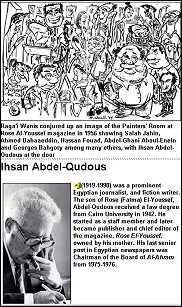
Click to view captionIhsan Abdel-Qudous
I knew Gamal Abdel-Nasser before the Revolution. I used to see him quite frequently, because he would often drop by [Cairo magazine] Rose El-Youssef. Naturally, he never talked about himself or how he felt. That was his nature. You'd never have thought that he was about to become the leader of a revolution that was just around the corner.
I recall the Nasser at that time rarely spoke much, but he would listen intently, and he tended to avoid idle chitchat. Yet, taciturn as he seemed, he often confided in me, in a way that somehow suggested we were friends. That changed after the Revolution when he came to power.
I'm not the type to obey a ruler's every beck and call. I can't write memoirs, articles, statements or news reports on command. What matters to me is that when I write, I write what I think.
In 1954, at the time that freedom of the press was constrained, I wrote an article, the substance of which I had told him about during my ongoing personal dialogue with him. The article was called "The Secret Society that Rules Egypt." I said a lot in that article: "This is not government... We can not remain under the leadership of a clandestine government..." I said that Nasser should leave the army and distance himself from it, and that he should form a political party that expresses the spirit of the Revolution and assumes responsibility for the nation.
When I wrote those ideas, I was certain of Nasser's popularity and I believed in the Revolution. Later I learned that those ideas were conveyed to Nasser in a distorted way. Nasser, himself, later told me that he had not read the article, but rather heard the impression of others, which is why he had me imprisoned.
Because he thought that my article attacked him, he had me detained for three months. I also learned later that Nasser asked for detailed daily reports about me. Perhaps that is why I was not subjected to routine physical torture. Rather, I was subjected to other kinds of torture, of which the most distressful to my mind was that I was kept in an isolation cell. However, after a month and a half the investigation began to make clear to me how much I felt that I was perfectly free. Then time passed so swiftly that when the three months were up I suddenly found myself released.
No sooner had I arrived home after being released than I heard the telephone ring. It was as though the person who was calling knew exactly when I would open my front door and could almost hear my footsteps approaching the phone. As soon as I lifted the receiver I knew who was calling. Even before I said "Hello" Nasser's voice came down the line: "Have you learned your lesson, Ihsan?"
"I don't know what lesson I am supposed to have learned to be able to answer that question," I said.
Then, so tersely it was almost like a command, he said, "Come and have breakfast with me tomorrow."
Naturally I went. I had little choice. In spite of the welcome Nasser gave me and the warmth he showed me, those months in prison had confirmed that things had changed. Gamal Abdel- Nasser was no longer the friend I used to call "Jimmy." That friend was now a ruler, and I found myself calling him, "Mr President."
But, I wasn't the only one to change. He, too, had changed. The way he spoke to me and treated me were different. I felt this, and it affected me so much that when he invited me into the dining room, almost unconsciously I answered, "After you, sir."
"Come on man, go on in."
"I couldn't possibly, sir. After you."
Suddenly, I discovered that my lexicon had new words in it that I never used before: "Sir," "Mr. President" and other such titles of respect. Afterwards, I discovered that whenever I wrote about Nasser, I affixed "The Leader." To his name. Nasser was a perspicacious man. That day he said to me, "Is this what prison did to you, Ihsan?"
"It did more than that, Mr. President, Sir."
For a full month after that, Nasser invited me to dinner every evening. After dinner, each time he'd insist I stay on and watch a film. When he spoke, he'd say the most curious things. On one occasion, he said, his eyes fixed on the screen: "I'm going to give you some psychiatric treatment to help you change. It's true that I had you put in prison without having read that article you wrote. I had you arrested on the basis of what I was told about the article. It seems, Ihsan, that I was misinformed."
He fell silent. When I did not respond, he continued, "Anyway, when I did read the article, I realised you were speaking your mind, as you always do."
Afterwards, because Nasser was now a ruler and not just a friend, I began to part from him politically. Nevertheless, I can say that until the end of his days I enjoyed his personal protection.
I know that some of his aides wanted to have me arrested on more than one occasion. In fact, once I was suspended from my job, and another time I was refused permission to enter the Rose El-Youssef building. Things like that happened frequently. But each time I would learn later that Nasser had had no real advanced knowledge of what happened, and each time when he found out he'd order them to let me go immediately.
For example, in 1955, Sergeant Ahmed Anwar had me arrested and put in prison. The Minister of Interior at the time, Zakariya Mohieddin, called up Ahmed Anwar and ordered him to release me. Because of the delicacy of the situation, Mohieddin had to inform Nasser that Anwar had me arrested. Nasser immediately picked up the phone, called the prison and asked to speak to me in person. Anwar sent for me. I picked up the phone and to my surprise Nasser began to apologize to me profusely:
"What can I say, Ihsan? I never ordered your arrest or anything like that. Since you're in the military prison, I have Abdel-Hakim next to me and he's going to apologise on behalf of the whole army."
And, indeed, Abdel-Hakim Amer apologised to me, and I was released. All that happened in less than three hours.
Was Nasser a democrat until 1954?
Nasser, in my opinion, was concerned first and foremost with the need to sustain the Revolution and its immediate responsibilities in government. However, democracy was Nasser's dream. Why? Because as a young nationalist he had believed in democracy. But, his search was for democratic principles that would ensure the perpetuation of the Revolution and his leadership. I advised him to found a political party, and we developed the idea together. But when he created the Liberation Rally, I told him, "That organisation is not a political party. You created it as a purely governmental organ."
Until his death, Nasser believed that there could be no democracy or plurality of authority, not only outside the framework of the Revolution, but also outside the framework of his personal leadership. Democracy to Nasser was one of the dreams of his youth, but it was a dream he could not realise. That I can say for certain on the basis of my personal knowledge of him.
Does this explain the feud that arose between the Revolution and intellectuals?
Of course. Intellectuals were always making demands about creating democratic organisations. Nasser never disagreed with them in principle. But he felt that none of those organisations could ensure the perpetuity of the Revolution -- under his leadership, in particular. Therefore, he would always reject their demands.
Can you explain why you called for the nationalisation of the press in 1959, especially considering that you owned a publishing house?
There were two reasons I pushed for nationalisation. Firstly, censorship of the press before it was nationalised was already very severe. There was no way an individual could express his opinion in any of the country's newspapers or magazines, including Rose El- Youssef, of course. I said to myself, if I can't be free to write what I want in Rose El-Youssef then it might as well be turned over to the government. What difference would it make? The censors are hovering over us anyway, whether the magazine is privately owned or state owned.
The other reason was personal. Contrary to what people imagined, Rose El-Youssef was not like other publishing firms with big capital assets. Rather, my mother, Rose El-Youssef, herself was like a clever housewife. She could run the magazine on a pittance. That is no longer possible. In addition, before she died, Rose El- Youssef only left LE 750 to the magazine. In fact, immediately after the 1952 Revolution, Abdel-Hakim Amer (with the approval of Anwar El-Sadat) offered us financial assistance. I told him that I did not want financial help, but that I would agree to have the government as a full partner in the firm. Amer asked, "How much that would cost?"
I said, "All that the magazine needs is a bit of a facelift to be able to compete with the other magazines. So say, a million pounds or two."
Amer laughed and said, "Then, the only solution, Ihsan, is that you accept my help."
Eventually, I told them to be realistic. Since everything in the country is being nationalised, down to small stores and coffeehouses, why not nationalise the press as well? That was, in effect, a confession that I was unable to give Rose El- Youssef a boost because of lack of capital. That was the sole reason I was always pushing for nationalisation.
Just before the press was nationalised in the early sixties, I had written an article appealing for that move. On the basis of two sentences in that article, Nasser went ahead and issued the decree to nationalise the press and subsume it under the state party at the time.
Perhaps for that reason, I was the only newspaper owner to be appointed to the board of directors of a newspaper after nationalisation. Unfortunately, it was a position I could not fulfill, nor had the idea occurred to me in the first place. After nationalisation, Rose El-Youssef became a government institution, and it lost its backbone of journalistic skills and talent. Journalists had become government employees. They got their salaries from the government, not from the owner of the newspaper. The owner of the newspaper no longer had a say in the paper, now that the government was the be all and end all, owned everything and issued permissions or prohibitions as it wished. Journalistic talents were completely sapped. That was why I decided to leave Rose El-Youssef soon after the nationalisation decree and why I refused any position of responsibility in any newspaper. The only person I was responsible to was myself, as a writer. I did not want to be a managing-director or any other kind of official employee.
I stuck to that principle for a long time, and I only deviated from it under Sadat. And then it was only after he pleaded with me on the basis of our close friendship, which dated back to before the Revolution. That was the only reason why I accepted the position on the board of Al- Akhbar and then of Al- Ahram. But then Sadat and I began to have our differences, which was why I refused to become editor-in- chief of Al-Ahram as well. The editor-in-chief has to be in constant touch with the president, but by then my ideas had become totally separate from his. Eventually Sadat had to put aside our old friendship and remove me from Al-Ahram.
If you had the chance, would you change your mind and become an editor-in-chief again and own Rose El-Youssef as you did before?
The question is who should be responsible for the press? The old newspaper owners cannot come back into the management. Everything has changed -- journalists, the administration, the newspapers themselves, the entire climate.
I also have a personal reason for not wanting to own Rose El-Youssef again, and that is that I am not physically fit enough to take up my old responsibilities. I think all the old newspaper owners face the same problem. At any rate, there is nobody left, apart from myself, other than Mustafa Amin and Ahmed Aboul-Fath.
After you were released from prison, why did you agree to write some of Nasser's political statements and speeches?
Because Nasser asked me to. After I got out of prison I stopped writing on politics. How could I after what had happened to me? But then Nasser called me up and said, "Why aren't you writing like you used to?"
I said, "I won't know what to write, Sir, until after I tell people where I was during that time I was in prison."
"Then, go ahead and write. Tell people where you were. Tell them you were in prison."
So I did. My article was brought to Nasser to look over personally, and he only crossed out a couple of lines. I was the only detainee whom Nasser allowed to write about his time in prison and why he was put there.
Afterwards, my name appeared along with some others who were accused of receiving clandestine funds. I told Nasser, "You accused me of accepting clandestine funds, which is untrue. I cannot go back to writing until I clear my name of that charge."
Quickly, he answered, "Okay, write something denying the charge."
I wrote a long article in Rose El-Youssef saying that I had never received secret funding of any sort. Again, I was the only journalist who was allowed to openly refute accusations made by the Revolution Command Council.
Does that mean that you believed the ideas you wrote in speeches for Nasser?
Nasser and I shared a number of views of irrefutable value to the national cause, such as the nationalisation of the Suez Canal and the need to stand up to the British. Therefore, the speeches I wrote on those subjects coincided with my full personal convictions.
I also sought to develop the Revolution towards democracy and freedom. By agreeing to write for Nasser, I was acting out of a patriotic sense of duty, which in all events did not conflict with Nasser's.
When you wrote a speech for Nasser reflecting his views, did he stick to the speech when he delivered it?
He never changed a word.
Were the others accused of receiving illicit funds actually guilty?
The sole grounds for the accusation were Nasser's relationship with the accused. So the answer is no. Take for example Mohammed El- Tabie. Someone told Nasser that El-Tabie was on our side, so his name was taken off the list of those accused of receiving clandestine funds before it was announced. Kamel El- Shenawi was not so lucky. He found out that his name was on the list that was about to be announced. He quickly made a number of calls to get his name taken off, but Nasser suspected El- Shenawi's loyalty, so he refused those who pleaded on his behalf.
At all events, the whole purpose of the exercise was to slander political enemies and anyone who might be unfavorable to the Revolution.
Who was behind the attacks on [Abdel-Razek] El-Sanhouri?
The attacks came from a movement founded by Mohamed Naguib and Salah Salem at a time when Nasser had given them free reign to do what they wanted. The first attack against El-Sanhouri took place shortly after the Revolution. Sanhouri at the time had refused to side either with Naguib or with Nasser, but this neutral position did not save him from pressure.
I was close to Sanhouri, which is why I knew him better than most people did. After he was attacked, I visited him in his home and we talked for a long time. Even though I had no political attachments to either Nasser or Naguib at the time, that visit was one of the reasons I was arrested following the 1954 crisis. My own opinion was that Sanhouri was a very enlightened man, a very decent man and a strong believer in democracy.
Do think Nasser ever conspired with the CIA?
Certainly not. Nasser communicated with all foreign agencies -- the CIA, French intelligence and Western governments. And he personally chose the individuals he wanted to mediate in these contacts. However, I could never conceive of Nasser as a CIA agent. No matter how we might disagree on the way Nasser handled things, I am certain his motives were purely and sincerely patriotic. Nasser was an Egyptian and an Arab first and foremost.
Based on an interview conducted in the late 1970s.
|
 |
| |||||||||||||||||
| ARCHIVES Letter from the Editor Editorial Board Subscription Advertise! |
WEEKLY ONLINE: http://www.ahram.org.eg/weekly/ Updated every Saturday at 11.00 GMT, 2pm local time weeklyweb@ahram.org.eg |
 Al-Ahram Organisation |