 |
 |
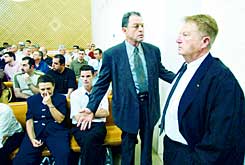
Shaul Weisman (left), who
petitioned against the Large Families Law, and his brother
Nissan Weisman, Sunday in the High Court of Justice. "The law
turns women into a source of production and children into the
means of production."
(Photo: Lior Mizrahi / BauBa) |
|
When the State of Israel wishes
to reward its Haredi [ultra- Orthodox] or Arab citizens, or
alternatively, to hurt them, its lawmakers tend to make use of one
of these two criteria: having many children or lack of military
service. Most Haredim and Arabs meet these two criteria, and so the
objective is realized. On Sunday, the High Court of Justice heard
two petitions to invalidate two laws - one that hurts Haredim and
Arabs, and another that benefits them.
The harmful law -
which is rooted in two sections of the Emergency Economic Program
Law - cuts by 24 percent the children's allowances granted to
parents who did not serve in the army or in national service
frameworks. No fewer than seven petitions were submitted to revoke
this cutback, which came into effect July 1. The petitions were
submitted by MKs Abdulmalik Dehamshe, Mohammed Barakeh, Yossi Sarid
and Ran Cohen, the Association of Civil Rights in Israel, the
Regional Committee of Arab Local Authorities, and a Haredi reserve
soldier. The reserve soldier, Zvika Herbst, 38, from Elad, who
performs 25 days of reserve duty a year in a regional-command burial
unit, claims he is being treated with gross injustice: He was
included in the category of those subject to loss of NII allocations
because he did a shortened regular army service of four months, due
to his enlistment at an older age.
The High Court of Justice
panel, headed by Supreme Court President Aharon Barak, with Justices
Dalia Dorner and Asher Gronis, decided that the subject constituted
a weighty constitutional issue; the justices issued a temporary
restraining order of one month, to freeze implementation of the law.
They decided that any further hearings would be heard before an
extended panel of the court, which will convene in one month's time.
The second petition heard by the same justices on Sunday was
opposed to a beneficial law. It wished to invalidate the "Halpert
Law," an amendment to the National Insurance Law that was initiated
by MK Shmuel Halpert. The amendment determined that families would
receive generous allowance increases from the fifth child and on.
This petition was initiated and spearheaded by Shaul Weisman, who
also enlisted in the effort his daughter Adi, a law student, and his
elder brother, attorney Nissan Weisman. "I've been losing sleep
because of this law," says Shaul, a land assessor by profession and
a Ph.D. candidate in law, who submitted the petition because of the
public interest that he has in the issue.
Indeed, after long
sleepless nights, the "fighting family" produced a detailed
petition, overflowing with colorful graphs and selected references
from the worlds of law, economy, philosophy, Jewish law and
political theory. The petition is drafted in high-flown language,
flowing with metaphors and quotes. It ends with these words: "This
court faces a historical decision, for this time and for the future,
that regards the complexion of the state, and whether it will remain
- in keeping with the words of the Declaration of Independence - a
secular, Zionist, Jewish and democratic state that educates the
individual to eat from the fruit of his labors and not to rely on
the labors of others."
The petition's aim is to prove that
the law undermines the foundations of the State of Israel as a
Jewish and democratic state. Promoting the birth rate through legal
means, the Weismans claim, encourages population growth specifically
in those population sectors that pose a risk to the Jewish and
democratic existence of Israel (the Arabs and the Haredim,
respectively).
"We feel that democracy has to be protected
from demographic and clericalist dangers," states the petition.
In practical terms, the petitioners seek to prove that the
generous allowances granted from the fifth child on have nothing to
do with the struggle against poverty: "The actual purpose of the law
is essentially to support the family of the yeshiva student, for
whom the Torah is his craft, in order to observe the commandment of
`Be fruitful and multiply' without having to concern himself with
the livelihood of his family. This law will encourage large families
that live in poverty, to make childbirth a source of income."
According to Weisman, this inappropriate objective is
attained by improper means, "whose entire aim and purpose is gaining
control of the reins of government through the taxpayer's money."
And this taxpayer, in Weisman's view, is "like Friday and like the
Gibeonites.' [Man] Friday is the servant of Robinson Crusoe, and the
Gibeonites are the woodcutters and water drawers, who by their labor
support the slackers.
In the course of the hearing, Supreme
Court President Barak asked the petitioners: "Assuming that the
purpose of the law is to preserve the coalition, and assuming that
the government wants to encourage a high birthrate, why should we
intervene? Why is this a legal issue, and not a political one?"
Weisman replied that there were innumerable legal problems
involved: discrimination, unsuitable purpose, harm to equality, harm
to property, lack of fairness, lack of proportionality and even harm
to women - "The law turns women into a source of production and the
children into the means of production. That is gender-based
discrimination."
He also summoned a report of the National
Security Council that confirms his claim that the law produces the
opposite outcome of what it set outs to do: encouragement of higher
birthrates will only increase poverty.
Attorney Osnat
Mandel, who heads the High Court of Justice Department in the State
Attorney's Office, represented the state. She responded that "the
share of large families among the poor families is more than double
that of the overall rate in the population." This revelation, which
asserts that families with many children tend to be closer to the
poverty line, should come as no surprise. The disagreement between
the Weismans and Mandel focuses on the connection between the larger
allowances and the solution to the problem; the argument between the
Weismans and the justices revolves around the connection between the
petition and the legal solutions that are in the court's authority
to provide.
The High Court of Justice devoted Sunday morning
to hearings on social troubles that have been exacerbated by
draconian economic measures that have particularly affected
society's weaker elements. Aside from the two petitions that
concerned children's allowances, Barak, Dorner and Gronis also heard
arguments from representatives of pensioners and of handicapped
victims and widows of work accidents, who complained about cutbacks
in allowances and pension payments.
The justices expressed a
sincere concern for the troubles of the petitioners, but also
expressed their doubts as to their ability to offer succor. "The
Basic Laws make it legal to harm property, equality and other
rights. You have to persuade us that this runs counter to suitable
purpose and that the harm is not proportional," said Barak.
Dorner provided more detail: "The purpose is an emergency
program to extricate the economy from its state of crisis. That is a
suitable purpose. It is clear that the law is not socially
beneficial, but that is a matter for the Knesset. We want to be
persuaded that the damage is not proportional. For example, does the
cutback in allowances bring people to the threshold of hunger? That
would constitute damage that is not proportional."
It is
also a matter of statistics. For instance, in a hearing on the
petition that was brought by the pensioners, Dorner told Mandel: "I
have the feeling that in this hasty bit of legislation, there are
things that went unchecked. How many people live on the income
allowance? Is this their only allowance?"
Mandel, armed with
experts and advisors from the National Insurance Institute, tried to
put her finger on the numbers but in the end could only promise to
furnish the information to the court at a later date.
Still
another petition dealt with the higher ceiling for the levy of
National Insurance premiums. Attorney Yehuda Talmon, acting for an
organization of the self-employed, opened with a devastating quote
from George Orwell's 1984: "`Peace is war, freedom is slavery, truth
is lie.' To these I would like to add - and National Insurance is
Income Tax. The finance minister was throwing dust in the public's
eyes when he said the tax burden would not increase."
Again,
Dorner was not impressed: "This is a subject for an article about
public criticism. We will intervene only if the law is
unconstitutional." Mandel said that this was at most a problem
affecting the upper percentiles.
In all of the petitions
heard Sunday, except for the first, the hearings were completed, and
verdicts will be rendered at some time in the future. Only the
petition that considered the cutback of allowances of children whose
parents have not served in the army, was given "preferential
treatment" from the justices, in the form of a delay of the law's
implementation, and the decision to continue the hearing before an
expanded panel of justices.
These are significant
indications that the issue raised by the petition presents
particularly thorny legal questions. Among other things, the High
Court of Justice will have to consider whether it is possible to
"punish" children and hold back their allowance only because their
parents did not serve in the army or in national service.
Shaul Weisman does not understand why his well-grounded
petition on the issue of large families did not receive similar
treatment. He quickly drafted a convoluted, grandiloquent rumination
on why this might be the case, and appended it to the file as a
supplementary argument once the hearing was over.
Weisman
does not only flaunt the magnitude of his arguments but also the
moral and professional backing he gets from high-ranking jurists.
"One retired high-ranking judge told me that the court would do
everything it could to evade your petition. Do everything you can to
prevent them from evading it."
In the meantime, the
Weismans' biggest concern is that the High Court of Justice will
lean toward the opposite pole: Not only would it not invalidate the
benefits to Haredim and Arabs for their contributions to a higher
birthrate, but would go even further, and restore the allowances
they lost for not having served in the army. |


.gif)




