|
![]()
Feeding the TV Habit
writer: Réhab
El-Bakry
photographer: Silvia Dogliani, Mohsen Allam
Egypt's glut of roof-top satellite dishes
hasn't translated into profits for the burgeoning industry - at
least not yet
 |
| Media guru Emad Eddin
Adib | | | Egypt's airwaves may not be as cluttered as North
America's, but they're fast approaching it. Stand on any tall
building in virtually any Cairo neighborhood - even in
lower-middle-class districts - and look down on the rooftops
surrounding you. You'll invariably find a cluster of dishes pointed
toward the heavens, capturing European and American programming,
international news feeds and last Ramadan's most popular soaps for
notoriously television-hungry Egyptians. Even in the capital's
poorest neighborhoods, coffee shops frequently invest in satellite
dishes to lure customers for Egypt's equivalent of must-see TV:
football matches.
Egypt may be an
emerging economy, but our hunger for television bloomed early on.
There are an estimated 19.2 million television sets in the Middle
East today, and some private-sector analysts say about 63% of
Egyptians have ready access to a television, with 8.5 million
household sets recorded last year. Media guru Emad Eddin Adib, the
force behind the financial daily Al-Alam Al-Youm and a senior
adviser to satellite broadcaster Orbit Television, says an even
higher percentage, more than 86% or some 58 million of the country's
67 million inhabitants, spend the first three hours after their
Ramadan iftars watching television.
And while terrestrial broadcasting, the 100% monopoly
of the state-owned Egyptian Radio and Television Union (ERTU), is
still king, private-sector satellite broadcasters are beginning to
make a mark, if not money.
Hussein
Amin, chairman of the department of mass communications and
journalism at AUC, says the roots of Egypt's TV habit are purely
cultural.
"We are visually
oriented. It is no wonder that in the past 10 years we have
witnessed the birth of a large number of [satellite] television
channels. We have also seen an increase in the number of satellite
channels throughout the region," says Amin, who is the very
definition of an industry insider. In addition to his job at AUC, he
holds the posts of chairman of the international division of the
Broadcast Education Association and senior adviser to Minister of
Information Safwat El-Sherif, among others.
"Arabs are very attached to their news sources," Amin
continues, "so newspapers have high circulation numbers and radio is
still a strong medium in this region, although it has lost its place
in many of other societies. But we have had strong viewership ever
since the introduction of television; the number of consumers
increased when the price of the television set decreased, which it
has steadily done over the past few years."
The fact that traditional family values have a tighter
grip on the Arab world than they do on Europe, he adds, ensures that
more people spend more time at home - watching television. Satellite
broadcasters have moved to take advantage of that fact, and while
analysts say few today are operating in the black, profitability is
likely around the corner as the Middle East and North Africa
approach a satellite dish density high enough to attract serious
advertisers.
"Public television
was, as the name implies, public. It was geared towards mass
consumption, and in every country in this region, its content was
strictly monitored by state censors," explains Amin. "That situation
held until the early 1990s when we saw Middle Eastern governments
allowing citizens to own satellite dishes. That marks the beginning
of private television channels in this region."
Targeting an audience
From the outset, this first generation of private
broadcasters sought audiences of uniformly A and A/B consumers,
those with the highest household income and the most discretionary
spending power. The mechanics of watching satellite TV dictated the
audience: While viewers can tune in to terrestrial television
broadcasters with nothing more complicated than a pair of vintage
rabbit-ear antennae, those tuning in to satellite channels, even
free-to-air ones, faced large, up-front cash
outlays.
When the import of
satellite dishes was first made legal in 1996, a decoder and dish
cost in the neighborhood of LE 10,000 to LE 15,000 for a basic
setup. That same setup now costs as little as LE 2500 (and some
subscription-only broadcasters will provide free dishes to those
purchasing a company-supplied decoder and long-term subscription),
still enough to limit viewers to the nation's economic
elite.
But that elite is growing. A
2001 survey of 36 countries in the Middle East, North Africa and
Europe conducted by European satellite operator Eutelsat found 122
million homes had access to satellite or cable television, a figure
equal to about 41% of all homes with TVs and a 3-percentage-point
rise over 2000. Penetration has grown about 8% per year since 1994.
Although Western Europe has the
highest penetration rate at 53%, the Middle East and North Africa
followed at 35% compared to just 27% in Eastern Europe. The MENA
region also posted the fastest rate of growth, with penetration
jumping 23% between 2000 and 2001. While cable still accounts for
58% of all 122 million homes with cable or satellite access, those
with satellite reception grew to 54.3 million homes last year, a
3.7% increase over 2000.
As for
Egypt? The figures are dodgy, but a United Nations report said Egypt
had 150,000 home satellite dishes in 1996, a figure that grew to
669,000 in 1999, and satellite broadcasters with whom Business Today
Egypt spoke put the number in the 2 million range today, or roughly
one dish for every 33 Egyptians.
 |
|
|
"I was the first person to
introduce these talk shows that allow people to call in
and participate live on air," Adib claims. |
| |
|
 |
| ARTform
Predictably, the Egyptian government was the first to
move into satellite broadcasting in Egypt, with the launch of
NileSat 101 in April 1998. Back then, the idea that Egypt might
grant private licenses to satellite broadcasters was as fanciful as
the thought that ERTU would give up its terrestrial broadcasting
monopoly. But when NileSat 102 launched a little over two years
later, Cabinet decided to allow private companies to bid for
satellite broadcasting licenses. El-Mehwar was first out of the gate
in February 2001, followed by Dream TV 1 and Dream TV 2, all three
free-to-air.
But the first to air
was Arab Radio and Television (ART), launched in 1993, and perhaps
the most widely viewed private satellite channel serving the Arab
world. Widely seen as the leading producer of Arabic-language family
programming, ART began broadcasting with five channels in Europe and
the Middle East carried on ArabSat. It has since moved into
world-class broadcast facilities in Avezzano, Italy, from which it
has launched a range of commercial and niche channels that produce
more than 6000 live and recorded shows every
year.
Samy Abdel Aziz is the head
of Cairo University's Mass Communication Department and a marketing
and research adviser to ART chief Saleh Kamel. Abdel Aziz says that
when ART was first introduced, even its most staunch backers knew it
was a gamble.
"We were among the
first to introduce the free-to-air satellite channels," Abdel Aziz
says. "We began with broadcasting to the region to gauge how
receptive the market was to channels that had no government agenda,
but were more in the business of entertainment. The market was
extremely receptive because there was a sense, at least among the
more economically well-off, that this content was not designed to
further any specific agenda. Instead, we were in the business of
disseminating entertainment, and we varied ourselves as much as
possible to attract as many viewers as
possible."
From the word go,
company officials say, ART knew it would have to rely on advertising
for the bulk of its revenues.
"We
have had great success attracting a variety of advertisers on both a
national and pan-Arab level, which was something that national
television could not offer," says Alaa El-Kahky, the general manager
of Arab Reach Media Services, which sells air time for ART channels
in Egypt. "This allowed companies to achieve a couple of goals:
first to reach a certain social group, and second to tap into a
completely different market to which you can export your product.
"We never aimed to replace local
television stations for advertising," El-Kahky continues, "We were
just an option to reach a targeted audience, which is something that
companies never had before." Of ART's Egyptian clients, El-Kahky
estimates 70% are targeting ads at A-class consumers in Egypt while
30% are looking to broaden their name recognition in Arab
nations.
 |
| Hussein Amin, chairman of the
department of mass communications and journalism
at
AUC | | | Distant profitability
"The content was the key to bringing in both the
audience and the advertisers," says AUC's Amin, "that's why many of
these satellite channels began with entertainment and moved on to
'infotainment,' - information dissemination disguised as
entertainment. This was completely new to this market and was
pioneered by ART, Orbit and so on. These were the programs that
really kept the audience interested and the more interested they
are, the more advertisers you'll get."
Orbit's Emad Eddin Adib is generally credited with
having pioneered the infotainment approach that some broadcasters
claim attracts 10 million viewers on a good night. (In the absence
of an audience-tracking research group, there is no way to
independently verify industry viewership claims. More on that in a
moment.) A journalist by training, Adib sees satellite television as
the first step in a revolution that will eventually break the
state's cookie-cutter approach to television.
"I was the first person to introduce these talk shows
that allowed people to call in and participate with their opinions
or questions," Adib claims. "It was the first time for television to
be a two-way communication tool rather than a way to just
disseminate information."
|
|
|
"We are visually oriented. It is
no wonder that in 10 years we have witnessed the birth
of a large number of [satellite] TV channels," says
Amin. |
| |
|
|
| But if you
think the popularity of talk television is translating into profits,
think again. Satellite broadcasters face steep infrastructure and
licensing costs. The easiest way to get on air in the Middle East is
through one of the NileSats, solely owned by the Egyptian
government, or via ArabSat, a joint venture by several Arab
governments including Egypt. A NileSat license costs in the
neighborhood of LE 500,000 per channel per signal per year, analysts
say, and basic infrastructure costs fall in the LE 10-20 million
range.
"If you are going into the
broadcasting business for money, then you are wrong," says Adib. "It
is a very expensive business, not only because of the amount of
money and time it takes to get the actual license but because
everything else is very expensive."
"You need studios and qualified personnel to provide
you with high-quality content, which is what brings in the viewers.
I will tell you right now, the amount of advertising we get is not
nearly enough to make this a good revenue-generating business."
Production costs for a
high-quality talk show start at LE 50,000 per hour. Set that against
$450-700 (LE 2029-3157) for a 60-second commercial on an encrypted
satellite channel or $2500-4000 (LE 1125-18,040) for the same spot
on a free-to-air channel and you get the idea. By comparison, a
60-second spot on state-owned television can cost as much as LE
80,000 for the coveted block that airs immediately before popular
soap-opera series. (For more on soap operas, see "When Soaps Get In
Your Eyes," Egypt Today, page 72).
Cairo University's Adbel Aziz agrees with Adib, saying
there isn't a single satellite channel that he is aware of that
makes enough from advertising to cover its costs.
"Not even the government-owned
satellite channels generate enough [ad] revenue to cover their
costs. That is why in the mid-1990s, many satellite channels became
encrypted and began to depend on subscriptions. The way we see it is
that our target audience is someone who can afford a satellite dish
and can therefore afford to pay to see the content they want. That
was the trend that this market began to depend on. It's the
subscriptions that generate revenue, definitely not the
ads."
El Kahky says that most
companies see satellite channels as backups for their campaigns but
rely primarily on national television to get their message
out.
"Advertisers are after the
masses, and we are certainly not the masses," he says. "We might
reach the rich and powerful in society, but they still make up less
than 5% of the population, at least in Egypt. There is power in
numbers. Egyptian television will always be the tool to reach the
masses," he says, suggesting that only 3.5 million Egyptians have
access to encrypted satellite channels. For its part, ART has
200,000 subscribers in Egypt and as many as 1 million
worldwide.
Limited
influence
Satellite channels'
narrow audience is one reason why the Egyptian and other Arab
governments hardly see the private-sector broadcasters as political
or economic rivals.
"Let's take
Egyptian government television as an example," says Adib. "They
allow us to use the airways, but they control ground transmission.
When you have more than 85% of the population living on very limited
incomes, the government is well aware that they will not be too
influenced by satellite channels, because most potential viewers
just don't have access. They will not be affected by the ideas in
the programming, nor will their consumer habits be affected by what
advertisers say on our airwaves. The government broadcasts to
everyone; we broadcast to a selected few."
Advertisers are aware of the satellite broadcasters'
limited reach, says MobiNil CEO Osman Sultan, but the channels
nonetheless play an important role in highly targeted ad
campaigns.
"I think that all
advertisers are aware that government television is the best way to
reach the masses," says Sultan, "but we at MobiNil think that we
have to reach our consumers through as many platforms as possible.
Just like we conduct research on what ads to run during which shows,
we conduct research to see what ads to run on which channels."
Satellite channels may not attract the lion's share of his business,
but Sultan says they cannot be ignored.
One of the problems in courting big spenders like
MobiNil is the fact that many satellite broadcasters can't offer
figures on how many viewers they attract, let alone provide
demographic profiles of their viewers or who is watching what and
when. And there's no independent ratings agency either, meaning
advertisers have to rely on media planners' subjective pitches when
it comes to which shows and timeslots to chose.
Not even AC Nielsen, the world's premiere television
research agency, has numbers. Ghada Soliman, managing director of AC
Nielsen Egypt in Cairo, says there is no syndicated market research
available because "We don't have the rating week like they do in the
US, which basically determines what the audience tunes into at any
given time."
"A specific client
might hire us to do market research for their product," Soliman
says, "where we would then conduct a very specific study, based on
which we recommend [how] they plan their advertising. Other times we
will research how a specific product will perform on a specific
channel or during a specific period of the day, and we sell the
results of that research. But there is no overall study conducted to
rate viewership of either government or satellite
channels."
Sultan says that puts
the onus of profiling a given show's viewers and providing a
"guesstimate" of the number who watch it on advertisers' own market
research divisions or their outside consultants. "It is based on
this information that we decide what ad should run, when, and how
often," he concludes.
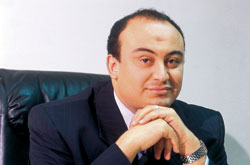 |
| Alaa El-Kahky, the general manager
of Arab Reach Media Services
| | | Paying through the nose
With advertising unlikely to prove a viable revenue
stream until satellite viewership grows, many broadcasters have
turned to offering what the industry calls "bouquets" of encrypted
channels on a monthly subscription basis.
"There is a global trend towards specialized channels,"
says Amin. "As the number of satellite channels increases, so too
will the consumer's demand for the type of programming they want to
watch. For example, if you enjoy sports, you will not enjoy watching
soap operas. Instead, you will flip from one channel to the other
until you find a sport you enjoy. As far as the station is
concerned, it is losing that member of the audience, and that means
one fewer consumer for the advertisers on that channel. That is why
in the mid- and late-1990s, satellite broadcasters became more
geared towards specialized television."
ART was the first private-sector player to offer
subscription services for specialized movie, sports, family and
other channels. "The way we saw it is that the audience will pay to
see decent content," explains Abdel Aziz. "The more you tailor this
content to the taste of your viewer, the more viewers you will get
and the more they will pay for the service. That was the idea behind
ART's specialized channels. That knowledge allowed us to encrypt the
channels in order to make money off subscriptions, but it also
allowed us to provide advertisers with an even better tool to reach
their audience."
|
|
|
"We never aimed to replace local
television stations for advertising," El-Kahky says. "We
were just an option to reach a targeted audience."
|
| |
|
|
| And the rising
popularity of credit cards on the Egyptian market has provided
satellite broadcasters with an even better tool with which to bill
their audience. Today, most subscribers pay by credit card, not
monthly payments that have to be made in person at one of the
broadcaster's local offices. Industry insiders say credit-card
billing has reduced "churn" - the number of subscribers who allow
their subscription to lapse through non-payment - it has dropped
more than 45% for most broadcasters in the past 18 months as more
subscribers are billed automatically each month.
That level of security, to say nothing of the need to
create the perception that subscribers are getting value for their
money, led ART to buy the Arab-world broadcast rights for the
African Cup Championship through 2004. Practically, this means
anyone who wants to watch the games must buy an ART subscription or
go somewhere with a subscription to watch the games.
That move boosted viewership for
ART Sports and gave advertising a nudge, but the broadcaster's
similar play for the exclusive rights to the phenomenally popular
2002 World Cup led to a public backlash in Egypt. ERTU eventually
stepped in and bought additional rights to broadcast many of the
games.
The private sector's focus
on specialized channels forced ERTU and other governments to play
the game as well, Amin says. "The government might have control of
the information being disseminated on the terrestrial channels, but
it was imperative for it to have a share of the information being
transmitted via satellite as well. That's why the Egyptian
government first launched its satellite specialty channels. This was
both an attempt by the government to tap into the advertising market
and a bid to introduce change within its content."
With specialty channels targeting
A and A/B consumers, the government had the chance to experiment
with alternative messages, Amin says. "That's why you saw the
introduction of social talk shows on the national channels. While
these talk shows never discuss political issues, they allow for
analysis, and on occasion criticism, of the social status quo," he
says.
Censorship-free?
It's the uncensored nature of satellite feeds that
those in the industry think is most attractive to viewers.
"The ability to watch a movie or a
show without censorship is still a good marketing feature for many
satellite services," says El-Kahky, "because many people resent
being told what they can and cannot watch. This does not mean that
the content is for adults only, but this means that the content can
contain as much or as little criticism of the political and social
status quo in any country - and no government can control it."
Satellite television is built on
self-censorship, meaning the channels' owners have to make conscious
decisions about the type of content that best suits their audiences.
"Because we do not fall under any
government form of censorship, this gives complete creative freedom
to the owners of the channel as well as those working there," says
Adib. "It means that you have to be a responsible and ethical
broadcaster. It also means that no one can do anything to prevent
you from broadcasting. That is both a privilege and a
responsibility," he adds, warning that the line between news,
entertainment and sensationalism is often fuzzy.
It's that conflict between ethics and sensationalism
that has sparked debate over whether satellite television fills real
information gaps for Middle East audiences. Al-Jazeera, the
Qatar-based Arabic-language news service often called the "CNN of
the Middle East," is the most high-profile example, but Dream TV has
also started to make international headlines.
Dream, majority owned by development tycoon Ahmed
Bahgat (ERTU is the only other shareholder at 10%), is no stranger
to controversy here at home. Styling itself as the channel unafraid
to walk where other purveyors of infotainment fear to tread, Dream
landed high-profile Mohamed Hassanein Heikal - the dean of Egyptian
journalists who is both the former editor of Al-Akhbar daily and was
once a senior adviser to Nasser - and respected journalist Hamdy
Kandil. Both host shows known for their willingness to tackle
controversial issues, but it is Dream vice president Hala Sarhan who
tends to draw the biggest audiences with her own talk show. (For
more on Sarhan's controversial talk show, see "Telling The Truth,"
page 39).
"Dream is different. They
present a lot of information that is socially shocking," says Amin.
"Not to say that there is no market for these kinds of shows, but it
just illustrates the varied sense and degrees of censorship that
satellite television can offer."
At press time, Dream was the focus of an international
controversy after a prominent American Jewish lobby condemned as
"anti-Semitic" Dream's upcoming Ramadan serial "Horse Without
Horsemen," the broadcaster's first in-house drama
production.
Abraham H. Foxman,
national director of the Anti-Defamation League of B'nai B'rith,
demanded that the Bush administration and European governments
pressure Egypt to ban the broadcast. Foxman and other US Jewish
groups were outraged that the 41-part series, co-written by noted
actor Mohammed Sobhi and Mohamed Baghdadi and scheduled to air this
month, uses the Protocols of the Elders of Zion as a plot device in
its story of one Egyptian's resistance to British occupation and
Zionism between 1855 and 1917.
Officials at the Ministry of Information were
unavailable for comment at press time, but government spokesman
Nabil Osman told the New York Times that the Jewish lobby's
complaint was "the same old gimmick - to raise the issue of
anti-Semitism when it's convenient." Saying the state had no plans
to prevent the broadcast, Osman noted, "There is a world of
difference" between anger at Israel's policies toward Palestine and
anti-Semitism.
Al-Jazeera is no
stranger to that sort of controversy. The news channel gained
international notoriety in the opening days of the second intifada
in September 2000 as it boldly criticized several Middle Eastern
governments for their reactions to events unfolding in Palestine.
Al-Jazeera's reporters also interviewed several Israeli politicians
and analysts, something few other Arab broadcasters have attempted
before or since.
The broadcaster's
international notoriety grew after 9/11 as Al-Qaeda chose to release
videos and statements to Al-Jazeera first, prompting CNN to offer
the broadcaster a partner agreement.
"Al-Jazeera is a very interesting example because it is
a satellite channel that is considered a national channel in Qatar,
but it is also considered an Arab news channel," explains Amin. "It
was not the first Arab news channel, but it was the first to gain a
reputation for controversial content. As a matter of fact, their
office in Jordan was shut down after they aired a program about the
Jordanian royal family, and it is rumored that the Saudi government
withdrew its representatives from Qatar because of several shows
that aired about the Kingdom."
Amin says that while Al-Jazeera says its mission is the
pursuit of the truth, it is also sensationalist.
"They might have their facts straight, but they are not
always making the best decisions when it comes to packaging this
information, which completely breaks with broadcast traditions in
the region. What is perplexing is that they never look at the files
of Qatar itself or criticize any of the decisions of that
government. So it's not a matter of principle," Amin says, although
the Qatari royal family's backing of the station may have something
to do with that silence.
And if the
airwaves seem cluttered today, wait until the next generation of
Al-Jazeera and Dream TV copycats spring onto the
scene.
"You haven't seen cluttered
yet," says Amin. "Right now, we have encrypted channels, and soon
you will get more pay-per-view shows, which are only available on a
limited basis at the moment. These channels will become such major
players that they will no longer be viewed as advertising
supplements to national television, but rather the backbone of
specialized advertising." bt
|
|