Contaminated goods
Osama El-Baz* reminds
Arab and Islamic proponents of anti-Semitism that they are purveying
shoddy goods of purely Western make. The article is an abridged version
of a three-part study published in the Arabic daily Al-Ahram
 Over the last three centuries European society has given rise to an
idiosyncratic series of events and ideas that are absolutely specific,
both geographically and historically. The peoples of the Middle East,
like other non-Europeans, remained remote from these developments, not
only in terms of physical distance but also in terms of their outlook on
human nature and their own social and psychological circumstances. They
have found -- and continue to find -- it difficult to comprehend the
nature of such developments, to understand the ethos and spirit that
gave rise to an important body of humanitarian thought. Europe witnessed
several revolutions and widespread social upheaval while simultaneously
experiencing rapid and intensive scientific and technological progress.
It also witnessed many manifestations of a blend of blind prejudice and
a sense of inherent superiority over other "uncivilised" and "backward"
peoples producing, among other things, an imperialist colonial movement,
which proceeded in tandem with a vaunted spirit of enlightenment and the
prodigious philosophical, intellectual and practical accomplishments
that benefited all mankind.
Over the last three centuries European society has given rise to an
idiosyncratic series of events and ideas that are absolutely specific,
both geographically and historically. The peoples of the Middle East,
like other non-Europeans, remained remote from these developments, not
only in terms of physical distance but also in terms of their outlook on
human nature and their own social and psychological circumstances. They
have found -- and continue to find -- it difficult to comprehend the
nature of such developments, to understand the ethos and spirit that
gave rise to an important body of humanitarian thought. Europe witnessed
several revolutions and widespread social upheaval while simultaneously
experiencing rapid and intensive scientific and technological progress.
It also witnessed many manifestations of a blend of blind prejudice and
a sense of inherent superiority over other "uncivilised" and "backward"
peoples producing, among other things, an imperialist colonial movement,
which proceeded in tandem with a vaunted spirit of enlightenment and the
prodigious philosophical, intellectual and practical accomplishments
that benefited all mankind.
Another manifestation of the irrationality peculiar to the European
mindset was the prevalent attitude towards Jews, collectively and as
individuals. Jews were inferior and the object of suspicion because they
were "different" in their religion, appearance and behaviour. And it was
precisely these differences that served as pretexts for intimidation,
persecution and, at times, the annihilation of entire populations. Fear
and hatred of Jews existed across all of Europe and assumed its most
virulent forms in the Russian pogroms and, later, in the Nazi holocaust.
It was during this period of glaring inconsistency between leaps
forward in material and intellectual progress and jumps backwards in
moral attitudes and behaviour that the term anti-Semitism was first
used, coined in Germany in 1873 by Wilhelm Marr. Subsequently, some
European intellectuals would distinguish between "anti-Jewish" and
"anti-Semitic" sentiments.
The former, they argued, denotes prejudice of a purely religious
nature, and is grounded in the Jews non-acknowledgment of Jesus Christ
as the Messiah and their responsibility for his crucifixion. Anti-
Semitism, on the other hand, was directed against a group of people, a
volk, thought to share certain physical and behavioural
characteristics that have no direct bearing on religious affiliation.
The term thus signified a hatred of Jews based on ethnic and racial
prejudices and, consequently, assumed secular connotations. According to
this distinction "anti-Jewish" ceases once a Jew converts to
Christianity whereas "anti-Semitism", a fundamentally racist concept,
persists and pursues its victim regardless of religion.
Because anti-Semitism is a secular concept and not contiguous with
religious affiliation, its proponents required particular proofs to back
the theory. Among the most broadly disseminated "proofs" were the
notorious Protocols of the Elders of Zion and the tales of
Christian blood in Jewish matzo. Although such claims have never been
corroborated, their widespread currency fuelled hatred and fear of Jews.
The so-called Protocols -- of which there were 24 in the
original 110-page version -- were attributed to a cabal of rabbis who
ostensibly published them in 1897, with the purpose of recording their
conspiracy to create a global empire subject to Jewish rule. Freemasons,
liberals, secularists, atheists and socialists were variously accused of
conspiring with these rabbis to achieve their dream of world domination.
There is a large body of evidence suggesting the Protocols
were a forgery. It is hardly credible that a handful of individuals from
a small minority should meet and set down their scheme to rule the world
in a 110-page pamphlet that would be exposed sooner or later. Several
experts have also pointed to a work that appeared in 1864 by Maurice
Joly, Dialogue in Hell Between Machiavelli and Montesquieu, or
Politics in the 19th Century, which has many stylistic similarities
to the Protocols. And is it not a little strange that a group of
rabbis would write a document of this type without using a single word
of Hebrew, the language of the Torah and Talmud, or Yiddish, the
language of Ashkenazi Jews which is still used in newspapers in Europe
and the Americas today?
Given the revolutions and upheavals Europe experienced in the late
19th and early 20th centuries it is likely that the Protocols
were produced by conservative elements seeking to halt what they
perceived as decline by attributing it to a vast conspiracy masterminded
by European Jews. One needs only read the opening pages of the
Protocols to realise its fraudulent nature. In the first
protocol, for example, the authors attribute to themselves the vilest
traits: "Through the press we have gained our influence while we
remained behind the curtain. Through the press we accumulated gold, and
we did not care that that caused rivers of blood to flow." Senior
clergymen of any religion do not voluntarily level such charges against
themselves and their coreligionists and then disseminate them on paper.
The blood in the matzo myth has a long history. In its original form
Jews were accused of killing a Christian, preferably a child, on Easter
to mock Christ on the day commemorating his crucifixion. Since Easter
and the Jewish Pesach, or Passover, fall at the same time in the year,
the tale evolved to include the claim that the Jews used the blood of
their victims in religious rituals, particularly in making matzo, the
unleavened bread used to commemorate the Exodus. It was also said that
Jews used blood in the manufacture of medicines.
Some Arab writers, commentators and individuals belonging to groups
that describe themselves as Islamic have evinced a crude sympathy for
Nazism despite the fact that it is alien to the beliefs and practices of
Arab and Muslim peoples. Nazism is founded on a fanatical racist theory,
expounded by Hitler in Mein Kampf, that holds that the Aryan race
is inherently superior and therefore has the right to subjugate other
peoples. Towards the Jews, the Nazis adopted what they called the "final
solution", rubric for a programme of systematic physical extermination.
Jews were not the only group to suffer such barbarity. The Nazis also
targeted gypsies, Slavs, the infirm, crippled and indigent.
Click to view caption |
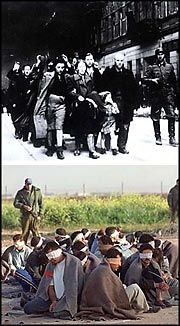
| Nazi soldiers clearing out the Warsaw ghetto in
1943 (top); Israeli soldiers rounding up Palestinian youth in
2002 |
'The Arab cause is just and there is no excuse
for borrowing from a legacy inconsistent with the tenets of our
beliefs and the realities of our history, no excuse for not
presenting our cause in its proper logical and moral
framework'
|
Those who admire Hitler for
his demagogic hold over the masses or for his enmity to Britain, once
the occupying power over Egypt and other Arab countries, would do well
to recall the disasters he inflicted on his people. Hitler executed
those who opposed him. He masterminded the horrors of the concentration
camps into which the Jews and other "undesirables" in Germany and the
countries occupied by the Nazis were rounded up and eventually
exterminated in vast numbers.
Some writers have questioned the numbers of Jews that died as the
result of Nazi atrocities. It is also true that some Jewish writers,
such as Norman Finklestein in The Holocaust Industry, maintain
that Zionist organisations capitalised on the Holocaust, an exploitation
that has tarnished the memory of the victims of the concentration camps,
including the author's mother.
What concerns us here, however, is not scale of the tragedy, or how
it was later used, but rather that it happened at all. Jews in Europe
were the victims of a rabid anti- Semitism. To anthropologists and
ethnologists, the term "Semitic" refers to all peoples, Jews, Arabs and
others descended from Abraham. The apologists for anti- Semitism,
however, do not use the term in its technical sense, but rather to
target Jews in Europe and this, in turn, gave rise to such concepts as
the "Jewish character", "Jewish morals", "Jewish culture", and "Jewish
people".
Such notions are founded on two fallacies. The first is that Jews
share inherent biological, physical and moral traits and tend towards
specific occupations. These allegedly distinct ethnic, behavioural and
cultural traits make the Jews a singular race. To the proponents of such
concepts Jews are "alien", the "other".
Anti-Semitism, as here defined, is a purely European phenomenon, a
manifestation of specific psychological, sociological and historical
realities. And if, in the 20th century, this phenomenon has sometimes
extended beyond the European continent, it has never done so with
anything approaching Europe's fanaticism.
Have the Arabs or Muslims ever been anti- Semitic, in the sense of
anti-Jewish? I believe that the impartial scholar must reply in the
negative. Above all, the Arabs believe that they, like the Jews, are
descended from Abraham and that they are thus cousins. Sharing the same
cultural and ethnic origins, Arabs can hardly regard Jews as inherently
"different". It does not stand to reason that Arabs could harbour hatred
or a sense of superiority towards people that share the same ethnic
origins.
Arab Nationalism was never anti-Jewish. It was not founded on an
ethnic or religious basis, but rather on the basis of common bonds of
language, culture and interests shared by all Arab speaking peoples. Its
aim was to unify these peoples and mobilise their moral and material
energies towards the defence of vital interest, the expulsion of the
"colonialist enemy" and the restoration of freedom and dignity. Only
then could the Arab Nation play a part in world civilisation
commensurate with its cultural legacy, safeguard the collective security
of the Arab peoples, and secure their right to progress. If anything,
therefore, the "other" in that epoch were the colonisers.
Rather than setting itself in juxtaposition to Judaism or
Christianity, Islam presents itself as an extension of the
Judeo-Christian tradition. The Qur'an pays tribute to all the Jewish
prophets, recognises the Jewish and Christian faiths and establishes
Islam as the culmination, or seal, of divinely revealed messages. The
attitude of Islam towards Jews, whom it regards as one of the "peoples
of the Book", should be seen within the context of the principles it
establishes for the relationship between man and his fellow man. The
Qur'an and the Sunna are replete with strictures calling for
peace, mutual tolerance, justice and equality among the "People of the
Book".
Because of the spirit of tolerance inherent in Islam, Muslims, Jews
and Christians coexisted in harmony from the beginning of the Islamic
Empire, through the Ummayid and Abbasid eras until the end of the
Ottoman Empire. Nor should we forget that in Spain both Jews and
Muslims, who had lived peacefully for seven centuries, suffered at the
hands of the Christian inquisitions. It is also interesting to note that
when French Jews began to flee the Nazi occupation of France the only
country to offer them refuge was Morocco under the late King Mohamed V.
This leads us to a second important question: did the spirit of
brotherhood between the Arabs and Muslims, on the one hand, and Jews on
the other, continue after the creation of the state of Israel. Sadly,
one must answer that this spirit was impaired for a number of reasons.
Firstly, the methods used by the founders of Israel against the Arabs of
Palestine were brutal. Secondly, Israel, and the Zionist movement
abroad, frequently used Jewish and Israeli interchangeably. This
confusion caused Arabs to wonder whether the conflict that had erupted
in Palestine and later spread to other Arab countries was between the
Arabs and Israel or between the Arabs and Jews.
Right-wing parties in Israel espoused expansionist beliefs inimical
to peaceful coexistence in the region. The call for Eretz Israel, a
greater Israel extending from the Nile to the Euphrates, naturally
provoked alarm among neighbouring countries.
Since its creation, Israel has also routinely discriminated between
its Jewish and Arab citizens, excluding the latter from military service
and certain civil rights. Indeed, some claim that political society in
Israel discriminates between Ashkenazim and Sephardim Jews.
Israeli leaders have always insisted on the necessity of preserving
the "Jewish identity" of the state. This stress on the ethnic
composition of the state has contributed to the rift between Jews and
Arabs and gives the impression that Israeli society is racist.
Religious political movements on both sides have also generated the
erroneous impression that the conflict is between Judaism and Islam.
That such rhetoric presents the two religions as incompatible deepens
the gulf and creates the impression that the conflict is a battle for
existence in which only one side can survive. And many Jewish and
Zionist groups abroad, especially in the US and Europe, wittingly or
not, have contributed to augmenting the gap between Arabs and Jews by
misrepresenting the nature of the Arab-Israeli conflict as a form of
protracted feud with deep historical roots. They exacerbate matters
further in their anti-Islamic rhetoric and activities while blindly
defending the extremist policies of Israel. It must be stressed here,
however, that not all Jewish groups and individuals abroad are prey to
such attitudes; many remain insistent upon the distinction between
Israel and Judaism and do not hesitate to openly criticise Israeli
policies.
One might possibly understand those Arab writers and media figures
who attack Jews on the basis of the racist fallacies and myths that
originated in Europe had the Arab cause not been firmly grounded in just
demands. But the Arab cause is just and there is no excuse for borrowing
from a legacy inconsistent with the tenets of our beliefs and the
realities of our history, no excuse for not presenting our cause in its
proper logical and moral framework. Most Israeli policies and attitudes
are refutable because they fail to acknowledge the methods by which
Israel was created, the uprooting and expulsion from their homeland of a
people. It is also clear that many Israeli governments pursued policies
inimical to the cause of peace and in violation of agreements signed by
previous governments. It is possible to expose the fallacies and dangers
of Israeli policy through rational argument and there is no excuse for
borrowing from an alien, inhuman and outmoded anti- Semitic lore.
Perhaps it is useful to simplify the issue for the reader by posing
two questions. First, let us suppose that the Jewish state was founded
on a land other than Palestine and accepted by the indigenous
inhabitants of that land. Would the Arab and Islamic peoples have
objected to such a state and entered into conflict with it? Second, if
the people who had founded a non-Arab state in Palestine were not Jews
-- if they were Christians, Buddhists or even non- Arab Muslims -- would
the Arabs of Palestine and elsewhere have been anymore welcoming of that
foreign implant?
The answer to both of these questions is no. The origin of the Arabs'
conflict with Israel has nothing to do with the ethnic or religious
affiliations of its founders. It has everything to do with the threat to
a portion of the Arab national entity, which was eventually severed off
and handed to a foreign people as a solution to a problem in which the
Arabs had no hand in creating. Arab opposition to Israel never emanated
from antagonism by Arab Muslims and Christians towards Jews and Judaism.
The Arab conflict with Israel has always been, and should always be
depicted as, a contemporary conflict over usurped national rights.
In light of the foregoing I have a number of recommendations to make
to fellow Arabs and Muslims and then to Israel and its supporters
abroad. Firstly, to Arabs and Muslims I say:
We must uphold the correct perspective on our relationship with the
Jews, as embodied in the legacy of Arab civilisation and in our holy
scriptures. This legacy holds that ours is not a tradition of racism and
intolerance, that the Jews are our cousins through common descent from
Abraham and that our only enemies are only those who attack or threaten
to attack us.
It is an incontrovertible fact that Hitler forced the Jews of Germany
and the other countries he occupied to wear the Star of David and to
place that symbol on the outside of their homes. This was to facilitate
rounding them up and dispatching them to concentration camps. Although
that star is the emblem on the Israeli flag, if used by others to allude
to the Jews it evokes painful memories of one of the most hideous forms
of racist persecution. I therefore advise against using this symbol when
criticising Israeli officials and policies, all the more so since there
is no need to import such outmoded and abhorrent practices from another
culture.
In addition to avoiding over-generalisations whereby we attribute to
all Jews responsibility for the actions of some, I counsel against
conspiracy theorising. It is all too easy to suggest that Jews or
Israelis who criticise Israeli policy are simply playing the role
assigned to them as part of a greater scheme to deceive the Arabs and
the rest of the world. History cannot be condensed into a series of
conspiracies.
It is also important, in this regard, that we refrain from succumbing
to such myths as the Protocols of the Elders of Zion and the use
of Christian blood in Jewish rituals.
We should not sympathise in any way with Hitler or Nazism. The crimes
they committed were abominable, abhorrent to our religion and beliefs.
We should simultaneously take close heed of the positive aspects of
Jewish affiliations. For example, one cannot help but to admire
Britain's Chief Rabbi Jonathan Sachs who, in an interview with the
Guardian on 27 August 2000 harshly criticised Israeli policies as
radically contradictory to true Jewish values.
We must bear in mind that not all Jews are Israelis or Zionists. It
is sufficient, here, to recall that some of the most outspoken critics
of Israel have been Jews, such as the late American Rabbi Elmer Berger,
Naom Chomsky, Henry Seigmann and Anthony Louis. It is imperative that we
continue to draw a distinction between Jewish, on the one hand, and
Zionist or Israeli on the other. Nor should we regard all Jewish groups
outside of Israel as necessarily pro- Israel and anti-Arab. Most
frequently, such groups' sympathy for Israel emanates from their concern
for the security and safety of Jewish people everywhere. Such anxieties
are understandable: Jews, numbering approximately 14 million, form a
very small minority of the world's population and, more importantly, as
the atrocities suffered by the Jews under the Nazis have made them wary
of any resurgence of anti- Semitism that could lead to other acts of
genocide.
To Israel and its supports abroad I advise the following:
In response to the demand lodged by the leaders of Arab parties in
Israel with the central electoral board, Israel should immediately
redefine itself as "a state for all its citizens" rather than "a
democratic Jewish state".
Israel should cease reiterating such claims to the effect that the
Arabs want to "throw it into the sea". This allegation flies in the face
of the resolutions of successive Arab summit conferences, beginning with
that in Fezin 1982 which called for the need to use all possible means
to reach a just peace in the Middle East, through to the Cairo summit of
1996 in which Arab leaders resolved that peace was their strategic goal
and the Beirut summit of 2001 which adopted the peace initiative of
Crown Prince Abdallah Bin Abdel-Aziz.
Israel must call a complete halt to all settlement activity,
including the expansion of existing settlements.
Israel must cease its attempt to justify its attacks against Arabs
and Muslims on the grounds that it is combating terrorism. Israel is
aware that the crimes it has committed -- officially sponsored
assassinations of Palestinian leaders, killing Palestinians in their
beds while asleep, firing missiles at peoples' homes, demolishing
buildings with people still inside, opening fire at random on
pedestrians -- are terrorist.
Israel must stop acting as though it aims to undermine Arab and
Islamic interests. It should exercise the utmost self-restraint and
objectivity in its behaviour towards the Arab and Islamic world and
refrain from attempts to set countries against one another.
Israelis and Zionists in general should cease accusing anyone who
criticises Israel of being anti- Semitic. This unwarranted misuse of the
term blurs the distinction between an unacceptable racist phenomenon and
legitimate criticism of a state's policies and practices.
Israelis must acknowledge that Arabs are right to want to end Israeli
occupation of their land, a demand backed by the provisions of
international resolutions and humanitarian law. It should be a sobering
thought to Israelis and Jews abroad that Israel's inhuman practices
against the Palestinians have unleashed a new tide of anti-Semitism in
many European countries.
Israel must acknowledge that the legitimacy of the creation of Israel
will remain incomplete as long as Israel persists in evading its legal
and moral obligations and in preventing the establishment of a state for
Palestinian people who had lived on that land, uninterruptedly, for
thousands of years. If Israel is truly sincere in affirming the
legitimacy of its existence, it must practically demonstrate its
agreement to the establishment of an independent Palestinian state,
enter immediately into serious peace negotiations on the Palestinian and
Syria tracks and withdraw unilaterally from the stretch of land it still
occupies in southern Lebanon.
Israelis should dismiss from government those officials who incite
racial hatred against Arabs or espouse the notion of "transfer" of
Palestinians in the occupied territories or even in Israel itself.
Transfer is not a far remove from ethnic cleansing.
Israel should issue an official declaration, deposited with the UN
General-Secretariat, stating that Israel has no expansionist designs on
Arab territories. It should further state that it will refrain from
demanding military superiority over all the Arabs, a demand that fuels
Arab suspicions.
President Mubarak has issued a call to make the Middle East a region
free of weapons of mass destruction. Israel should signal its approval
of this initiative and demonstrate its sincerity in this regard by
entering into negotiations towards eliminating its nuclear arsenal in
tandem with the elimination of other weapons of mass destruction in the
region.
Finally, a word to both sides: I believe that it is in everyone's
interests to overcome the accumulated rancour of the past and the pains
of the present and not to yield to the culture of despair. We must set
our sights towards a better future in which all can live in peace and
security instead of remaining rooted in a cycle of bloodshed,
destruction and ruined opportunities.
* The writer is chief political advisor to President
Hosni Mubarak.