|
|
 |
|
|
|
![]()
Upgrading Egypt
writer: Davin
Hutchins
photographer: Omar Mohsen, Mohsen Allam
If you are waiting for a second it born in
Egypt, keep holding our breath - it's at least 18 months away. But
industry......
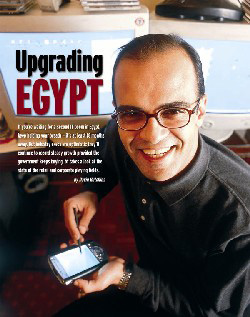 |
| Digital dude: Technology is an
essential part of Ahmed El-Sharkawy's daily life.
| | | When Ahmed El-Sharkawy wakes up at 6:30 a.m. every
morning, the first thing he does - after his shower and morning cup
of java, of course - is boot up his main PC. El-Sharkawy gutted and
retrofitted an old Acer PC, souping it up with two
Pentium III processors, a
CD-rewritable drive and a 40-gigabyte hard drive. Like other
technophiles he knows, El-Sharkawy says he's superstitious and tries
not to be too reliant on one piece of gear.
So in case his Acer breaks down, he has two more
custom-built assembly models right next to it.
All three PCs are connected through a local area
network (LAN) and share a high-speed ADSL internet connection that
can feed 512 KB of data per second.
El-Sharkawy says the fourth PC in the living room
doesn't really count. The family uses this one primarily for
multimedia and educational software. It's connected to a 29-inch TV
monitor so the family can enjoy DVDs and streaming video at their
leisure.
The second El-Sharkawy
slams his car door shut and begins his morning commute, he's on the
phone with clients. Uncharacteristically, he uses an old Motorola
handset; he says it is the only model he can afford that plugs into
his voice recognition kit so he doesn't have to dial while driving.
He has his eye on a new tri-band Nokia 6310 10i handset which will
allow him to speak anywhere in the world.
At the office, he plugs his iPaq 3600 PDA into his
corporate workstation (that's PC number five, but who's counting?)
and syncs his appointments for the day before he's out the door
again. El-Sharkawy needs to stay mobile because his job takes him
all over urban and rural Egypt.
At
first glance, El-Sharkawy appears to be a tech-savvy business
professional of the highest order. Professional, yes, but he
actually works as a network specialist for PaL-Tech Inc., a
subcontractor for USAID. His task: to equip countless private and
public schools across Egypt with the latest technological tools.
For Egypt's information technology
(IT) industry, El-Sharkawy is a dream. Those companies know that
winning the hearts, minds and spending habits of people like
El-Sharkawy is the key to business success. Find a few million more
like him and the country could well be on its way to a second
technology boom.
But the nation's
challenge is not so much finding people like El-Sharkawy as it is
cultivating them. Here, IT is still in its infancy, and consumers
and producers are in short supply. The government is making a major
push to stimulate Egypt's IT sector by offering sweeping education
programs, technology loans, and awarding big contracts. The question
is, Will it be enough to spark another boom? Most executives with
whom Business Today Egypt spoke are skeptical, but they're confident
growth is in their future.
 |
| LinkdotNet's Khaled Beshara says use
of the free internet has increased by 100% in
lower-income areas.
| | | Spontaneous consumption
At the end of 2001, Egypt's IT market was worth an
estimated $849 million (LE 3.89 billion), according to a report by
the American Chamber of Commerce in Egypt. That's a 16% increase
over the $730 million (LE 3.34 billion) charted in 2000. So the good
news is that the industry is still posting double-digit growth
despite a global slowdown. But by all accounts, executives bt
surveyed are finding the choppy waters difficult to navigate.
On one hand, Egypt's currency woes
and the geopolitical uncertainties in Iraq and Palestine are
discouraging many companies from massive IT spending sprees any time
in the near future. On the other hand, ignoring and postponing the
efficiencies created by IT is nothing short of business suicide.
Many execs are finding success lies in being nimble and
patient.
On the consumer side, PC
and internet use remain anemic, but the Egyptian government is
working hard to foster a climate for growth while also attempting to
bridge the digital divide. Of Egypt's estimated 71 million citizens,
only 1.5 million are using the internet regularly, according to
October 2002 data from the Ministry of Communications and
Information Technology (MCIT).
Last year, the 3-year-old MCIT implemented several
initiatives to spur PC and internet use among average Egyptians. The
first occurred overnight in January 2002, when Egypt migrated to a
state-mandated "free" internet model. Although not really free,
users select one of some 30-odd internet service providers, or ISPs,
each time they dial up. Per-minute micro-fees are then charged to
their Telecom Egypt phone bill. (For more on the first year of the
"free" internet project, see News Focus, page
46.)
Khaled Beshara, CEO of
LinkdotNet, the nation's dominant ISP, says the effect of the free
internet is already being felt. "It's been only [12] months, but
what we've seen so far is a real increase in usage in what we would
classify as lower-income areas. The increase in subscriber sign-ups
in that time has been at least 100%," claims Beshara, whose company,
a subsidiary of Orascom Telecom, also owns many of the nation's
leading e-commerce sites, including Otlob, Skill-Link, Career Egypt
and others.
Beshara says one
reason why this MCIT program is working is that it takes into
consideration the spending and usage habits of Egyptians, which
differ greatly from those living in developed economies. In the
United States for example, internet access costs about $20 (about LE
92) per month versus 0.4 cents (about 2 pt) per minute in
Egypt.
Beshara cites two reasons
why internet sign-ups tapered off in 2001, pre-free internet. One,
the average Egyptian could not afford a hefty monthly fee, and two,
credit card usage and direct bank withdrawal were still in their
infancies. Automated billing through Telecom Egypt circumvents both
problems. Beshara adds that because users can switch providers every
time they dial up, ISPs are forced into intense price competition,
which ultimately benefits the customer.
Dial-up will likely remain LinkdotNet's
bread-and-butter revenue stream for 2003. But the company is keeping
fingers in lots of pies. In the portal space, LinkdotNet owns
lifestyle sites like Yallabina.com and operates MSN Arabia. However,
secure business models for advertising-based portals have proven
elusive even in America and Europe, so Beshara remains cautious.
The company is also proceeding
judiciously outside Egypt. In January 2002, it launched a similar
ISP in Jordan, and it has a services and web-hosting firm in
Dubai.
"Our investment outside of
Egypt is not as aggressive as it was a few years ago," says Beshara.
"We still believe in the next year we'll see high dial-up growth
rates in Egypt, anywhere from 50-70%. But the days of companies
reporting 700-800% growth are over."
One logical new area for growth is broadband
connections. Since LinkdotNet owns the marketing pipeline to its
dial-up customers, in theory it should be able to upgrade users to a
premium high-speed service. But Beshara says broadband will probably
remain a niche service in the near-term because, again, the up-front
costs are prohibitive.
"We're not
pushing the ADSL business yet because we're working with suppliers
and Telecom Egypt to perfect the model before we market it
aggressively," he says. "It's a premium service, so if we're going
to charge LE 200-300 per month, we have to make sure we've thought
about value-added services like accessing it from multiple places in
the home. And frankly, the experience from sign-up to installation
is not where we want it to be. If people get disappointed after
paying that much, broadband will never take
off."
A box in your
home
The micro-credit model is also
the cornerstone of an MCIT initiative to put an affordable computer
in every home. The ministry has partnered with Telecom Egypt once
again to allow new PC owners to make payments via their phone bills.
The Ministry of Education has a similar plan for students.
For example, a family can purchase
a locally made assembly model from Centra Computer for around LE
2300-3400. After placing a 10% down payment, users pay installments
of around LE 100 per month. A major brand can cost twice that, and
is usually paid up-front.
The
strategy is two-pronged: provide ways for families and students to
own PCs and stimulate Egypt's domestic PC industry. Like Sony and
HP-Compaq, Egyptian manufacturers such as Centra and Boraq are
essentially assemblers, using the same chips and memory cards as
their competitors. The difference is top brands have to pay import
taxes and suffer from a shortage in dollars.
Hazem El-Zorkany, vice president for product management
at Boraq, says in addition to these inherent advantages, the
company's factory in Sixth of October City takes advantage of
low-cost labor and streamlined production processes.
"Our PCs are on average 35% less
than name brands, but we still put them through the same benchmark
tests required by our licensors like Gigabyte and Microsoft," says
El-Zorkany. In addition to making low-cost desktops and laptops,
Boraq also saves by manufacturing its own Intel-approved
motherboards and memory cards, which it also sells to other PC
makers.
El-Zorkany says the
government's "affordable PC" program could create a seismic shift in
the consumer PC industry in just a few years.
"This initiative, in a matter of a few months, has
raised demand for us by 30,000 PCs," says El-Zorkany. "We expect the
market will change from a standard import and distribution model to
the model of home-grown assembly of PCs and bundling with ISP
services directly delivered to the computer through credit."
For 2003, the company plans on
competing with the big boys on their home turf. Boraq expects to get
the European stamp of approval - CE, for conformité européen - which
will allow it to export its low-cost PCs and motherboards to
Germany. El-Zorkany says while Europe holds some appeal,
Egyptian-made PCs will likely remain a low-end, entry-level niche
market.
He says the company will
remained focused on penetrating the Middle Eastern market while
rolling out an export strategy in Africa. Egypt has multilateral
free-trade agreements with many of the member states of COMESA
(Common Market for Eastern and Southern Africa) which allows it to
export PCs and components without paying taxes levied on Asian
competitors.
"Long term, it will
be almost impossible to saturate this market, whereas in Europe the
market is already saturated," says El-Zorkany, adding that as long
as developing countries keep developing, companies like his can
expect modest but continual growth. "Even if you are making a
second- or third-tier product, if it is a quality product, you will
still succeed," he says.
Despite
the appeal of low-cost educational software, most new entrants
purchase a PC for simple narrow-band applications like web browsing
and real-time chat. Both Beshara and El-Zorkany agree connectivity
is the driving force behind both PC and internet sales, and their
fate is deeply intertwined. One can't succeed without the
other.
 |
| Raya Holdings' Medhat Khalil says
diversity in non-consumer sectors has been key to
surviving the downturn.
| | | The pipes
With
the government playing such a large role in stimulating the consumer
sector, success depends on implementation, and major infrastructure
problems abound. In October 2002, the MCIT reported that 223,000
Egyptians were still waiting for phone installation, and service
repair for dilapidated wires is often lacking.
Many analysts have speculated that Egypt's
infrastructure problems are one of the main reasons the wireless
sector exploded so rapidly. Thanks to major players MobiNil and
Vodafone Egypt, 4.2 million Egyptians owned mobile phones in October
2002. That's a fivefold increase since 1999, and about four times as
many people who currently connect to the
internet.
But Beshara and
El-Zorkany are bearish on wireless spurring another tech boom in the
near-term. They say enhanced mobile phones and wireless PDAs are
cost-prohibitive for almost everyone but the most affluent
executives and avid technology addicts.
Another major factor is speed. Egypt's DBRS wireless
standard offers connection speeds of only 9.6 kilobits per second.
So aside from voice calls, SMS and the occasional e-mail, there are
few applications those speeds will support. LinkdotNet has a deal
with MobiNil to provide WAP and SMS data like stock quotes to
enhanced mobile phones. But for Beshara, it will remain on the back
burner for 2003.
"Wireless is
growing, but not fast enough," says Beshara. "We can't ignore
wireless because in two years we would have to catch up as a
latecomer to the game. By the virtue of being partners with MobiNil
and having enough resources to hedge our bets, we make sure we are
in the space, but I don't think in 2003 it will be a significant
part of our revenue."
Both MobiNil
and Vodafone Egypt declined to be interviewed for this article. In
an interview with bt soon after taking over last spring, Vodafone
Egypt CEO Ian Grey would only say that his company will upgrade to
GPRS, which provides faster data-transfer speeds using existing
infrastructure, "just before enough customers want it. It won't be
in Egypt this year [2002], but it's inevitably coming. I lived
through GPRS going live in the UK before coming here, and it's great
for business users."
As for
third-generation (3G) wireless? "That's a completely new ballpark,
as we'd need a new license. But the network we've built is capable
of going over to GPRS very easily," Grey said.
B2B or B2G?
There are only about 1 million computers in Egypt, a
penetration rate of about 0.6%, according to fall 2002 data from
MCIT and the IDSC, a state statistics clearinghouse. It's not
surprising that most IT companies are not counting on consumer
spending to ignite another boom. Most of Egypt's IT growth is
happening in B2B - industry jargon for business-to-business.
Perhaps, it is more accurate to say B2G -
business-to-government.
Raya
Holdings is very much in the consumer space. Through its subsidiary
ProTech, Raya sells personal computers, software and mobile phones
to retail outlets and corporate clients. In fact, it is the largest
consumer electronics distributor in the country. It also holds
around a 70% market share for mobile sales, thanks to an exclusive
deal to distribute Nokia handsets.
Medhat Khalil, CEO of Raya Holdings, says diversity in
non-consumer sectors has been key to surviving the economic
downturn.
"From the beginning, we
were very careful to run a real corporate operation, not a one-man
show," says Khalil. "We tried very much to increase our value-added
services, like telecommunications, software development and high-end
IT applications. This includes professional services, building our
own data network and things like that. Many of our competitors have
completely left the market now."
Generally speaking, Khalil says IT spending levels were
up 20-30% in 2002, thanks largely to the government. In what it
calls the e-Government Plan, MCIT is coordinating with several other
ministries to modernize operations. On paper, they are far reaching.
MCIT wants to automate a wide range of government processes
including court records, marital dispute offices, authentication
offices and consular services. It's also looking to update the
antiquated computer networks, software and databases that the
ministries use to make them more efficient.
As long as the government continues spending, Khalil
says the IT industry can ride out the doldrums created by weakened
private firms. But there's a danger in becoming too reliant on the
public sector for too long.
"The
government represents 70-80% of IT spending in Egypt," says Khalil.
"They are the most important component in its development. While I
would agree that their business cycles are slow and their staff
needs basic IT training, we cannot ignore the fact that unless the
public and private sector are developed, we won't be able to grow
this industry."
By and large,
e-government explains the continued double-digit growth in the IT
sector for 2002. However, Khalil says private-sector clients are
still spending, albeit at a cautious pace.
Raya has succeeded in the enterprise solutions market
by understanding its clients and providing complex solutions to
solve some of the simplest problems. One of its most successful
ventures is Ciranet, an automated call center that handles customer
service, telemarketing and phone orders for McDonalds and Microsoft
Egypt.
Khalil also says that IT
providers are benefiting from the maturation of industries including
retail banking and telecommunications, despite the macroeconomic
malaise. Khalil says in this age of belt-tightening, many customers
are taking a piecemeal approach. It all depends on
management.
"What kind of solutions
we provide really depends upon the management team of our clients
and how they see IT in their role," he says. "For example, one
client, Banque du Caire, had a management change and is reassessing
its IT needs globally. So they want a complete integrated system to
address all kinds of banking functions from the beginning. Others
have urgent and specific needs to control inventory and account
tracking."
Raya is making its foray
into telecommunications this year. Subsidiary Raya Telecom completed
the construction of a high-speed data network known as a CLEC
(competitive local exchange carrier) that serves about 60 Egyptian
companies. Khalil says Raya decided to build it with a post-boom
philosophy.
"We decided not to take
the 'build it and they will come' approach," he says. "Other [CLEC]
competitors invested a lot of money for large capacity. We, on the
other hand, were the last network to be built. Because we were last,
we also used the latest Cisco technology. We elected to increase
geographical coverage but invest modestly in data capacity until
there was a need. We can always add to it as long as the loads
justify the cost. We only invested around LE 40 million, but some of
our competitors spent four to five times as much."
 |
| IBM's Tawfik says the consultancy
industry will remain tied to hardware and software
sales.
| | | Driving growth
MCIT estimates that 797 companies provide IT services
in Egypt, triple the number in 1999. Raya, IBM, HP-Compaq and NCR
dominate the enterprise solutions field and while they have many
private-sector clients, the main contracts involve state-owned
enterprises.
"I would say that
much of Egypt's growth in the enterprise sector comes from
telecommunication companies, government departments, banks and
petroleum," says Ahmed Samy, country manager for HP's Enterprise
Systems Group.
Globally, HP has had
a difficult year. In addition to a worldwide downturn in IT demand
and thousands of layoffs, it also began its merger with Compaq
Computer, perhaps the largest and most complex in the history of IT.
HP and Compaq have had a few management changes and are
consolidating their offices in Egypt, but layoffs have been
negligible. Samy says many IT multinationals that cut staff or
pulled out of the Middle East altogether probably weren't serious
about the region in the first place.
"From the early beginning, we knew that the Middle East
region would not be highly affected by the merger in terms of
layoffs," says Samy. "Too many companies speak about commitment to
the Arab region and the Egyptian market; unfortunately, only a few
match their words with deeds. Simply put, commitment means
investment of time, resources, capital and a genuine transfer of
know-how."
In addition to staying
engaged, another way to succeed in Egypt is to specialize by
becoming an expert IT provider for certain industries. NCR Egypt is
tightly focused on retail banking. Banks have undergone a major
transformation as liberalization of the sector has allowed European
conglomerates to enter the Egyptian market and offer services like
automated teller machines, online banking and especially customer
relations management software (CRM).
CRM software allows employees to collect, analyze and
interpret a customer's history of transactions with the company in
order to predict their future needs.
Magdi Abdel Sayed, general manager of NCR Egypt, says
this is forcing some of Egypt's older financial institutions to
upgrade in order to stay in the game.
"The success of every one of these businesses depends
on the customers," says Abdel Sayed. "And in banking, whether it be
ATMs, online banking or even customer relationship management, they
are the same expenditures for everybody. Very few of our clients are
seeking a total makeover. Most have automation plans they execute in
phases starting with automation then later moving on perhaps to CRM
to spot trends."
Executives also
think IT consulting has a big future in Egypt, but perhaps not in
the purest sense. On the world stage, IBM has been very successful
over the past decade, redefining itself as an e-business consultant.
The jewel in the crown was the recent acquisition of
PricewaterhouseCoopers' consulting arm, one of the largest business
and technology consultancies in the world. Consultants like those at
the former PwC are efficiency experts who can analyze and criticize
inefficient business processes.
(PricewaterhouseCoopers continues to operate as an
independent company offering accounting, tax and financial planning
services.)
IBM Egypt General
Manager Amr Tawfik says consultancy in Egypt will probably remain
tied to selling hardware and software. "In Egypt, the consulting and
outsourcing is still in its early stages. Customers still consider
the consultancy role of IT providers as part of the hardware and
software purchase deal. The mindset simply is not prepared for such
a service in Egypt, except for some minimum managed
operations."
Raya's Khalil agrees,
saying many of his subsidiaries' clients are still in the early
stages of IT development. "Pure, unbiased consultancy is not what
we're doing because our companies are selling whole solutions.
Advice is part and parcel of the IT purchase."
IT enabling the MobiNils, BPs and Americanas of Egypt
will likely proceed on course as long as there are efficiencies to
be realized. But what about the local Omar
Effendi?
Microsoft is betting hard
on business from small and medium-sized enterprises (SMEs) in Egypt.
Like the consumer PCs, the market is almost completely untapped.
Many pharmacists, furniture stores and restaurants still conduct
transactions and balance their books on ledger paper.
Emre Berkin, Microsoft's vice
president for Europe, the Middle East and Africa, says a simple
program could transform a small business.
"[SMEs] are a huge potential market in Egypt. Some
people say it ranges from 40,000 businesses to as high as 400,000.
No one really knows the actual number. It's about teaching these
companies what technology can do for them. This would be in terms of
what cost-savings, business-productivity and revenue-generating
things they can do with our Windows XP or Office XP applications.
We're also working with local software providers that have small,
inexpensive packages, like for health-care clinics or pharmaceutical
industries."
Microsoft Egypt
conducts seminars for forward-thinking SMEs about what its core
suite of products can do. Berkin says applications like Microsoft
Word, Outlook and Excel are basic tools that could save companies
with under 10 employees money and time. Medium-sized businesses can
choose from Microsoft's Great Plains applications for basic
accounting, low-volume CRM and even e-business.
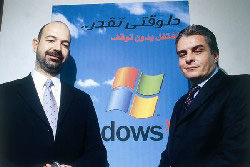 |
| Microsoft's Berkin and Ramadan want
to sell to Egypt's small- and medium-size
businesses.
| | | However, Berkin says the e-commerce revolution that has
ignited in the rest of the world will have trouble sparking in
Egypt. For one, entrepreneurs can't afford back-office PCs, so
selling wares over web servers is a pipe dream. Two, he believes
e-commerce took off in developed economies because it was an
extension of their credit card and catalog culture. Egypt is still
largely a cash society.
"It will
likely be a promotional tool, if anything. There's a lot more basic
groundwork that needs to be done before people say 'Instead of
buying the product at the store, I'm going to buy it
online.'"
Microsoft says it's in
discussions with MCIT to convince the ministry to extend its
affordable PC program to SMEs sometime next
year.
People
power
According to an April 2002
study on IT by the American Chamber of Commerce in Egypt, software
only represents 14% of the local IT market in Egypt, but it's the
fastest-growing segment. One of the companies driving that growth is
Sakhr Software.
English is the de
facto language of business and IT, but Sakhr is trying to capitalize
on its home-field advantage by developing software specifically
tailored to the needs of the Arab market and Arabic-language users.
While it has developed
Arabic-language spreadsheet and word processing for the consumer
market, it's focusing now on Arabic document management and Arabic
speech-recognition technologies.
"The demand for Arabic software and technologies has
increased with the increase of government initiatives to automate
their operations, with the gradual, though disparate, change which
we are witnessing towards e-governments," says Fahad Al-Sharekh,
director of business development for Sakhr Software. "The solutions
and technologies which we offer are comparable with the products
offered by international IT companies, with the added advantages of
Arabic language treatment and being developed with the local user
and culture in mind."
Sakhr's
products include ArabDox, an Arabic document management solution;
IDRISI, an Arabic-language search-engine technology; and Ibsar,
which enables the blind to read Arabic books and
documents.
However, developing
home-grown software applications and solutions in Arabic may not
result in huge growth. On one hand, the market for Arabic-language
solutions is limited to the Arab world. Two, multinational
corporations have deep pockets for research and development and come
up with superior practical solutions, even though they are in
English.
Khalil of Raya - which
also develops some software - is skeptical about software as a
growth driver in the long run.
"You
will not be able to be a major software export business with just a
few hundred programmers. Most domestic firms in Egypt are about that
size. You cannot compete with the multinationals. Software
development won't be a main export product for Egypt without
substantial government support. If you look at what the Indians,
Israelis and Irish did, they approached software development as
something national."
Khalil thinks
instead of focusing on exporting products like software or assembly
PCs, Egyptian IT professionals should focus on exporting themselves.
Ultimately, this has been one of MCIT's goals all along: to create
an IT-literate labor force that can be hired as employees and
consultants in the MENA region.
MCIT has launched several programs to promote IT
literacy at various age levels. Its Smart Schools Network encourages
public and private schools to add five hours a week of IT skills
training into the curriculum and to use computer-based learning
programs. Its professional development program trains recent
university graduates for jobs in Egypt's IT
companies.
A quick look at the
numbers show it's off to a slow but steady start. In October 1999,
MCIT tallied 10,356 IT professionals in Egypt. In October 2002, that
rose to 20,497 with a projected 27,000 by June 2003. There are
trainees in the pipeline: In October 1999, only 500 people were in
government- or university-sponsored IT training programs. In October
2002, that number stood at 10,858.
Karim Ramadan, country manager for Microsoft Egypt,
says sustained human resource training is the best course of action
to keep the IT sector growing. "It has to be a multi-tiered
approach. You have to address it at the school level, where you
begin teaching students about IT and find the advanced students to
teach software development technologies. After graduation, they can
get into the cycle of a productive worker."
Microsoft Partnership Academy - a joint project between
MCIT and Microsoft Egypt - takes that one step further. Instead of
training individuals, Microsoft will share its international
expertise in IT and business management with 20 to 40 of the top
businesses that can sell software or services. The goal is to create
what's being billed as an "export culture," where Egyptian know-how
and software development skills are used throughout the Middle East
and Africa.
"The program isn't just
technology skills," says Ramadan. "We have to train their sales
people on sales training. Give management some management training.
After they graduate, we get them engaged in projects outside of
Egypt - then you begin to incubate these companies in the region and
possibly Europe."
MCIT is
attempting to seed Egypt's software industry through its Software
Exports Development Project, which hopes to increase Egyptian
overseas software sales from $50 million to $500 million in the next
five years.
Microsoft says it's in
Egypt for the long haul. The company is playing it smart by using
training and partnerships to keep its platforms dominant. This
month, it is hosting the first ever Microsoft Developers Conference
in Egypt for Middle Eastern developers so they can learn about the
technology behind the company's .NET platform.
Microsoft's Berkin says Egypt's best hope is to undergo
a transformation like Ireland's or India's, where government
stimulation spawned a nation of IT "supermen" that are in demand
worldwide.
"When it comes to the
knowledge industry, a large population is an advantage. First, you
don't have to look elsewhere, you already have the critical mass.
There are good programs being run elsewhere, but Egypt has an
advantage because of the huge size. Once you do it domestically, you
can export that expertise overnight anywhere else. That's what's
great about the software industry - it doesn't matter where you live
or where you're located," Berkin asserts.
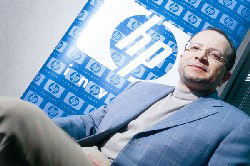 |
| HP's Ahmed Samy says multinationals
who pulled out of the Middle East were not serious
about the region.
| | | 12-month outlook
And what about the next 12 months? IT execs say Egypt
and the MENA region aren't for the faint of heart, and companies
looking for get-rich-quick schemes should probably get
out.
"We're here for the
long-term," says Microsoft's Berkin. "We're ready to ride the storm
out through thick and thin. In terms of the next six to 18 months, I
think we will continue to keep strong relationships with the
government, honor our commitments and deliver our products on time.
From consumers to SMEs, there is a lot of work to be done. I say to
our hardware and technology partners: We have to stay engaged in
Egypt and the Middle East. To our competitors, I say: Go ahead and
leave."
In short, if you're waiting
for a second IT boom, don't hold your breath. But if it's growth you
want, breathe easy.
"We cannot use
the term 'plateau' in Egypt because we are so far from saturation,"
says Khalil. "Egypt has real needs. We're passing through a tough
period in our political economy, especially with Palestine and Iraq.
Raya is planning for two or three more tough years with less than
double-digit growth. But once the economy is in better shape, a
second boom may come." bt
|
| |
 |
 Ancient
Egypt in your hand Ancient
Egypt in your hand
IBM Egypt unveiled the
Eternal Egypt Digital Guide at the Egyptian Museum, in cooperation
with the National Center for the Documentation of Cultural and
Natural Heritage, and the Supreme Council of Antiquities.
| ![]()
|