Where to draw the line
Writer: Azza Khattab
Photographer: Mohsen Allam
The noses they create are too big, the
hair too messy, the eyes too shifty. While writers can only
dream of likening some members of the nation's political elite
to "monkeys," political cartoonists can give their favorite
monkeys long tails and organs to grind as they continue to
push the limits the government has imposed on them.
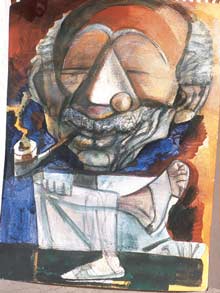 |
| George Bahgouri, left. Below, one
of his paintings of Sadat. Bahgouri typically
depicted Sadat with his eyes closed. Why? We'll
leave it up to you to figure out.
| | | Dial George Bahgouri's number and pray he's not
home - nothing can tell you more about this freaky man than
the message on his freaky answering
machine.
"Hahahahahahahaha!"
the crazed laugh assaults your eardrums. Slowly, the laugh
gives way to the 72-year-old cartoonist and painter's
impression of the voice a child might use when playing a
monster in a school play.
"So, tell me, why did you call George Bahgouri?
Aren't you afraid you might wind up on his sketch
board?"
The voice is crazy
enough that you wouldn't be surprised had he said "in a
boiling pot for dinner" instead of "on his sketch
board."
As any big-name
politician or social figure could tell you, there's not much
difference between the two. Political cartoonists grill their
subjects, and then let them stew in their own juices. Every
issue or person that captures the public's attention is fair
game, and few of them enjoy the honor.
Take Salah Salem, one of the leaders of the Free
Officers' revolution who must have debated a declaration of
war after being immortalized by Bahgouri on the cover of Rose
El-Youssef soon after the revolution. Bahgouri depicted Gamal
Abdel Nasser cleaning the dome of the People's Assembly, his
little - as in physically little - apprentice Salah Salem
holding the bucket.
"He
wasn't a happy camper at all," Bahgouri recalls today. "He
called my editor-in-chief and demanded to know how I could
dare to draw him small when he's one of the leading men on the
revolutionary council. I just saw him that way - that little.
They threatened to fire me for it. Now whenever I drive by
Salah Salem Street, I give him a formal
salute."
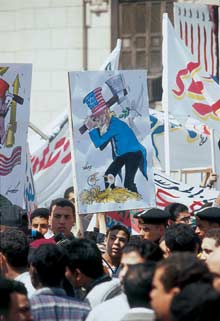 |
| Cartoonists took to the streets
with their own anti-war demonstration.
| | | If the hazards of criticizing a second-tier
official can nearly get you fired, imagine the risks you would
run by making fun of, say, a president. Logic - to say nothing
of self-preservation - would seem to dictate that only former
presidents are safe targets. After all, they tend to be too
dead to complain. But who says Bahgouri believes in logic?
Instead, he stands by shanoua, an "artist-y" concept in Arabic
that has no real equivalent in English.
"It's that mix of madness, energy, and
nervousness that buzzes out of a cartoonist's eye!" Bahgouri
declares proudly.
While Sadat
was still very much alive and in power, Bahgouri made a simple
comment on his presidency, painting the leader as a mechanic
ripping apart a car called Egypt, leaving the parts so widely
scattered that it would be impossible to put back together.
With a confident smile on his cartoon face, Sadat declares in
the caption: "It's ready to go back on the
road."
How did he escape
Sadat's rage? With a sly smile and the equivalent of a thought
balloon that says, "Catch me if you can!" Right after the
death of Bahgouri's idol Nasser, the cartoonist took refuge
from his depression in Paris. "I packed my bags and left when
I had no money, no friends, nothing there. Yet I knew my brush
would put bread on my table wherever I
went."
It didn't take long
for Bahgouri's prophecy to come true. Skewering senior
Egyptian public figures for a Paris-based Arabic-language
weekly, Bahgouri and other dissident writers and intellectuals
found themselves crowning the front page of Akhbar El-Youm
back home in Cairo. All were wanted by Interior Minister
Nabawi Ismail and the prosecutor general for questioning. As
the powers-that-be explained at the time, they constituted a
threat to the national security.
"We sided with the Arab world against the
president's visit to Israel. What's wrong with that?
Presidents are free to make politics, make wars, go to Israel,
put the opposition in prison - but cartoonists as well are
free to make fun of that all," Bahgouri points
out.
His self-imposed exile
became mandatory during Sadat's reign, and his chances of
coming home became slimmer and slimmer. But Paris didn't tame
the Egyptian rebel.
"In
Paris, I overdosed on freedom - freedom to draw, to express
myself, to do literally everything. French cartoonists gave me
my first lesson: One doesn't beg for freedom or democracy, one
has to demand it himself. So, now, I wouldn't ask permission
from you on how I will draw you. I'll just do it my way," he
giggles as a scary, helpless look covers my
face.
"In France, the humor
is ruthless, blunt, even rude. In our Arab world, the cartoon
is decent, well-behaved, veiled. It doesn't give you the
'shock and awe' readers and politicians
deserve."
It's that very
shock that scares many editors away from his work - many, that
is, except for one: the revered Mr. Internet, far more
tolerant than real, live humans programmed to say, "No."
Today, one of Bahgouri's favorite outlets for his work (save
the English-language Al-Ahram Weekly) is his page on
Arabia.com.
Bahgouri was
shocked when he returned to Egypt from Paris in 2000. No one
bothered contacting him, let alone showed interest in seeing
the work he had done in exile. "Actually, the new
administration at Rose El-Youssef threw our paintings away,"
he sighs.
A new generation
had taken over, and they didn't care much about acclaiming the
older cartoonists. Worse, Bahgouri found that while some of
his one-time colleagues were dead, others, like leading
political cartoonists Hegazi and El Labbad, had quit drawing
political cartoons and instead work for children's books and
magazines.
He took refuge in
painting for art exhibitions.
"Many of today's cartoonists have nothing to do
with the caricature. They are either imitators or mercenaries,
as [former Iraqi Information Minister Mohammed] Al-Sahhaf
would tell you," he smiles. "When I see a paper running a
caricature with no value or art, I see
red."
And while he admits
there's more freedom to express your opinion these days
without suffering personal consequences, Bahgouri is less
impressed with a new environment in which he says
editors-in-chief no longer allow cartoonists to
draw.
"Editors-in-chief tell
me to draw anyone I want - anyone but the president, that is.
And I found myself drawing no one but the president. I find it
sad. I feel like we're going backwards. There's a cloud of
mental darkness that overshadows creativity. I blame it on
mingling with Arab countries that are much less evolved than
we are in politics and mental maturity."
As he claims, there's a void in political
caricature in Egypt nowadays. "Even our last hope, Mostafa
Hussein and Ahmed Ragab's daily caricature [in Al-Akhbar] was
crushed when the partnership ended. Together, they had a
strong effect - just like mixing gin with orange juice. It's
never the same drinking each alone."
But Bahgouri doesn't let readers off lightly,
condemning widespread "illiteracy of the eye," as he calls it,
in which people can't read the caricature. That's why he
insists on analyzing his caricature in Al-Ahram Weekly so as
to help readers better understand his cartoon. His last
cartoon of Saddam portrayed him as a hurt lion with his teeth
feral, taking his last breath. Al-Sahhaf, with all due respect
to his fans worldwide, was made a clown.
Even his detractors admit that political
portraits are Bahgouri's main strength. In the 1960s, he
introduced a new style of caricature - new lines that dance on
the page, throwing away the rigid rules of the classic style -
and inspired a new generation of political cartoonists. Yet
his political ideas remain, many claim, unimpressive - or not
as strong as his paintings. His renown today is largely as a
painter.
As I tease him
about it, he stresses that it's not true. "I stopped drawing
caricatures for a time, and that's why people claim I'm no
longer a cartoonist. I don't know what to do to make them
happy. Every time I draw a painting, someone comes out and
says, 'You know what? It looks more like a caricature.' And
then I draw a caricature, and they tell me, "Nice painting,
Bahgouri.' ... I'm destined to be a second-class citizen in
both worlds."
But don't be
misled by that tone of desperation. It lasts just seconds in
Bahgouri's bubbly world. His new book, Rosoum Mamnoua
(Forbidden Drawings), is soon to hit the shelves. El Thakafa
El Gedida publishing house is betting on the book, which will
include all the political cartoons he couldn't publish during
Sadat's time.
"And what about
the cartoons you couldn't publish during the Mubarak era,
Bahgouri?" I ask.
I can't
complain about his answer: A hearty laugh that could rock not
just a regime, but the whole world.
Your bum isn't just part of your anatomy - it's
also a cartoonist's inspiration. If you're a loyal reader of
leading cartoonist Gomaa Farahat's strong political
caricatures, you've probably noticed his fetish for butts.
Look no further than last month, when he drew in Sawet El Umma
one of the strongest and most controversial cartoons yet about
Arab regimes' stance towards the war in Iraq.
In his simple panel, an Arab
character has his back turned to the readers, with a sign on
his full, rounded ass declaring, "Welcome,
USA."
It seems Farahat either
can't learn from his mistakes or enjoys repeating them. In
1998, he drew UN inspectors with magnifying glasses - up-close
and personal - looking into Saddam's ass in their hunt for
weapons of mass destruction. At the time, the caricature
wasn't very popular with Iraqis. They sent him death threats.
Even journalists found it distasteful, and a columnist in El
Esbou newspaper took an entire page to attack that
strip.
"The poor guys didn't
get it. They thought I was insulting Saddam when I was making
fun of the U.S.," he complains. "Love it or hate it, sex works
in cartooning. Sexual innuendo shocks the readers; it's
rabble-rousing, universal, and its effect
inescapable."
What's also
inescapable is the irony in Farahat's life. By day, the bold
cartoonist works for the most conservative national newspaper
in Egypt, Al Ahram. There, his flirtatious and sexual
implications are veiled. And try as he might to work with
newspapers and magazines that share his political viewpoint,
he's more often ended up at places whose ideologies clash with
his, such as Al-Wafd and Al-Shaab after it partnered with the
Islamists.
"These were hard
decisions. I still take Hegazy's words to heart: 'Always
remember: cartoonists are responsible for history, not
geography.'" But after 40 years in cartooning, Farahat
realized that geography isn't to be downplayed. "For example,
when Al-Wafd told me not to draw a cartoon of Minister of
Agriculture Youssef Wali because he owes them money, I didn't.
I used to have more freedom at Rosa [Rose El-Youssef] and that
translated into stronger cartoons - strong enough that Abbas
Tarabelly, the editor-in-chief of Al-Wafd, used to tease me,
'Why don't you give us something as strong as your work in
Rosa?'"
Al-Ahram is a
completely different story. "My work for Al-Ahram is zeft. I'm
never proud of my caricatures there. But I'm exceptionally
happy with my work in Al-Ahram Weekly, Rosa and Sawet El Umma.
Many times, the newspaper shapes your attitude and passion
towards work. But don't get me wrong! When I sit with my
drawing board, I don't have Al-Ahram in mind; otherwise, I'd
have a stroke. I give full and free rein to my imagination and
creativity. At a later stage, I filter what goes to
whom."
He has another
complaint against Al-Ahram. "It's a shame that a big empire
doesn't run daily cartoons - but once a week? They don't
really appreciate or understand the value of the caricature."
During the war on Iraq, the paper canceled the caricature
altogether - substituting pictures instead, as he points out.
But sometimes, it's better
to cancel the caricature than to mess it up. "Analyze this! I
once drew a cartoon on the cabinet shuffle. My main character
was a fruit vendor selling watermelon. He was apologizing to
one of his customers, saying that he had no watermelon because
the ministers bought them all up after being assured they
would all be keeping their seats." According to a popular
Egyptian saying, those who are safest and most secure behave
"as if they have watermelons in their
bellies."
"Al-Ahram took out
every word derived from 'ministerial' or 'minister' and left
the cartoon to read like this: 'Sorry sir! They' - whoever the
hell they are! - 'bought all the watermelon on the market.'
These guys are murderers. They could have easily asked me not
to publish it. But they just ran it like this without even
informing me about the changes."
Yet Farahat is receptive to feedback. The morning
I spoke with him, he received a call from the editor of
Diplomat magazine with a request that infuriates most
cartoonists: explain the day's cartoon.
"I drew a ballot box thrown over the Iraqi
people's heads as a symbol of imposed democracy. I find it
amusing he didn't get the idea," Farahat smiles. "But it can
and it does happen. Through discussion, you reach agreement.
It was simple and straightforward: I wrote 'democracy' on the
box. He asked whether we could make the bolt into a stick of
dynamite. It didn't hurt. If I'm doing the same work for
Al-Ahram Weekly, for example, I wouldn't be using any words.
They would get the message instantly."
In the daily Al-Ahram, though, Farahat is asked
to identify each and every person he's drawing - even if the
subject of the portrait is self-evident. "It's fine with me.
Maybe the reader isn't that smart. After all, Egyptian
readers' education and general knowledge are limited. In the
Weekly, we presume readers are more cultured. So we don't need
a comment."
The caricature
with no comment is the strongest, he says, followed by the
caricature in which the drawing complements the words. The
weakest, which is also the most popular among Egyptians,
Farahat claims, is the caricature that reads more like a joke.
In fact, one of his favorite cartoons didn't register with
readers half as much as his usually lauded sexual-themed ones:
It was during the time of former Minister of Finance Mohamed
El-Razaz, probably the minister most hated by the average
Egyptian in the 1980s. Farahat drew then-Prime Minister Atef
Sedki as a puppet whose strings were being pulled by El-Razaz.
The audience was throwing shoes and tomatoes - at
Sedki.
Despite the fact that
Mostafa Hussein criticized the PM at the same time, Sedki
wasn't as tolerant of Farahat's caricatures as he was of
Hussein's. "Sedki used to tease with Hussein about his
caricatures, and then call my editor to say that he was
seriously unhappy with my cartoons. Mostafa's cartoons were
humorous and light. Mine were serious and harsh. And that's
what tells you who's from Al-Akhbar and who's from Rosa - the
two main schools of caricature in Egypt."
When he's not fighting with editors or ministers,
Farahat is usually brushing off one particular charge: He tops
the Israeli government's anti-Semitic list.
"I'm not anti-Semitic. The
stereotype of the Jewish character with the black hat and the
Shylockean look simply isn't my style. I prefer to portray
them as Nazis. And who in the world isn't against the Nazis?
Isn't capital punishment and demolishing houses a form of
Nazism? The conduct of the Israeli government is typically the
conduct of the Nazis. And just for the record, the Israeli
government isn't the embodiment of
Judaism."
The same message
echoed back in 1997, when the American cultural attaché came
to Farahat, complaining and pleading with him to stop drawing
Jews - meaning Israelis - in an insensitive way.
"These were the golden days
before the U.S. became so arrogant. Nowadays, they wouldn't
bother sending the office boy from the embassy to lecture me.
He was complaining about the crooked nose I drew. I told him,
'Listen! It's simply my way of portraying those I don't like,
be they Islamists, Hindus, whatever.' I showed him different
noses for different cartoons. They were all the same." For
Farahat, a nose is more than just the thing that tells you
whether the other guy's bum smells.
Then he has a suggestion for me: "Stop looking at
your nose, Azza."
Raouf Ayad
has given birth to twins: an ugly fat woman and a bald
middle-class man with a stubbly beard and unhappy features.
They've been haunting him every day since he brought them to
life, spelling out the problems of the middle class in the
weekly magazine Sabah El-Kheir.
"All the focus is on Mostafa Hussein. He's the
only cartoonist who has a daily column in a national
newspaper. Many don't know there's a great cartoonist called
Hegazy. We still use his drawings, which are as relevant to
what's going on today as to the past. Where are the fat-cat
Loan Deputies to read this? He drew two businessmen sitting in
the office of a bank manager while the office boy holds the
safe box in a tray with its lid open. The manager has turned
to the office boy, telling him, 'See what the beys would like
to have?'"
After 38 years
spent with his brush and colored pencils, Ayad has drawn a sad
conclusion: Many editors look at the caricature as a patch to
cover up the white space in their newspapers. And yet editors
can't fathom black humor. Fearing the loss of their titles,
the editors have become paranoid: "There's a mini-censor
sitting inside the editor-in-chief between his left and right
lung. Once he senses a controversial word, the censor pinches
him, and he starts to change the tune."
Yet requests for change are not always evil. For
20 years, Ayad has been working for Al-Ahali. Last month, he
drew Bush calling Uday Hussein, asking him, "Baba fein?" The
paper didn't publish it, for reasons he later found logical
and acceptable.
"They
explained to me that they don't discuss Saddam or his escape
anymore. To hell with Saddam. They're more concerned about the
American occupation of Iraq - the first occupation of its kind
in the 21st century - than the downfall of Saddam. I respect
that."
Voicing the same
complaints as his colleagues, Ayad groans that cartoonists
aren't having their best time nowadays.
"When I was hired by Rosa in 1963, I was paid LE
20 while poet and theater critic Ahmed Abdel Moeti Hegzi was
hired for LE 18. The cartoonist used to get higher pay and
more recognition than the poet. My former editor at the
magazine used to stress that the cartoonist should be
pampered. He's like the seasonal fruit readers crave and
desire. Forty years later, something has gone seriously wrong.
Only those on the blessed list make good money. The majority
don't."
Still, Ayad doesn't
have much to complain about. For years, he has had a whole
page in Sabah El-Kheir all to himself, named Mesaha lel ra'ey
(a space for opinion). Ayad's philosophy is, "The simpler the
better. The majority doesn't read, and those who read don't
want to exert the mental effort to analyze a
cartoon."
Unlike Bahgouri,
Ayad believes that a cartoonist should give his readers not a
lecture, but what they want. He usually uses balloons unless
the situation is so strong and self-evident that it doesn't
need comment, like his latest cartoon with Bush looking
happily at a map of the United States including the new, 51st
state: Iraq.
If history is
any indicator, the best ideas usually come rushing out during
the worst of times, when the censors and cartoonists play
their game of cat and mouse. In Nasser's time, Ayad says, the
cartoonists and the leadership were set on one goal - the call
for a nationalist revolution.
"We rallied around the president because we
believed in his vision. There was no conflict or struggle
between the cartoonists and the regime. No one criticized
Nasser, but we were free to highlight the negative social ills
in society."
The new era of
political cartooning in Egypt started with the signing of the
Camp David accords. "Cartoonists, like the rest of society,
were divided among those who were for and those who were
against," says Ayad. But censors didn't leave opposing
cartoonists with much of a say. After all, they shared the
same offices.
"Yet many
didn't give up, drawing indirect political cartoons that
censors themselves wouldn't understand. They used to ask us
what we meant by this or that. And with an innocent look, we
would say, 'Nothing. It's just a cartoon.' Smart readers used
to get it though."
Nowadays,
Ayad continues, cartoonists have more freedom to criticize
policies and ministers than before. But there are still
restrictions. Last month, Le Monde's leading cartoonist,
Plantu, came to Egypt and met with key cartoonists. He asked
them all whether they could criticize the head of the state.
"We said, 'No.' He asked, 'Why?'"
Ayad paused before slyly smiling and saying to
me, "And that's exactly where you have to draw your own line
if you want your article published."
Then, as if he suddenly remembered something,
Ayad spoke one last time: "So what if the American cartoonists
are free to make fun of Bush and Clinton? I can be a butcher
and do the same, and even worse - with Bush and
Clinton."
Tamer Youssef is a
bit of each and every cartoonist I met: Like Ayad, he gets
angry at those who ask him about his latest joke. He shares
Farahat's belief that editors don't value the caricature or
the cartoonists who draw them, and he's wondering like
Bahgouri why they can't criticize presidents.
And above all else, he's
awfully grumpy for such a young, well-educated, well-traveled
man.
First, "It's so pathetic
and hilarious that some of our Egyptian cartoonists write on
top of their cartoon, 'No comment.' I feel like we treat the
Egyptian reader as if he's dumb when he's smart - at least
smart enough to realize that cartoons can go with no
comment."
Secondly, "Some
cartoonists still resort to their old concepts and characters
when they have expired - they still draw the platonic love
portrayed in the couple sitting on the table with hearts
floating around them. Sorry to disappoint, but this period has
gone with the wind."
Other
cartoonists, he continues, live on their own islands, isolated
from the real people. "They always complain that they suffer
[because of] their editors-in-chief or news organizations. But
they have to be strong. It's normal for cartoonists to have
their work rejected. But we have to keep trying. Usually I
say, 'Thank you,' and go post them on the
Internet."
The confident,
assertive cartoonist says it's hard to edit his caricatures.
"No one changes my opinion. Sometimes they ask me not to draw
a man in a galabeya or with a beard or a veiled woman. But
these are the ones in the streets. I didn't invent
them."
As he sees it,
"Readers aren't loyal to the cartoonists, except for Mostafa
Hussein, because he's the only one who feeds them a daily diet
of cartoons. Besides, for a long time Hussein had a perfect
partner, Ahmed Ragab, who spared him the worst headache a
cartoonist has: taming the idea into drawn
lines."
Youssef loves to
experiment with lines and styles. Some people sees his work as
French, others see it as Oriental. Youssef wrestles with good
ideas, as well. As he explains, Egyptians love editorial
caricatures that have a humorous, funny message. A very
effective way is mixing sports with politics. He drew Kamal
Darwish, the head of the Zamalek Club, on the phone urging his
assistants to sign a contract with an American coach for the
club "before Bush nominates him to run post-war
Iraq."
In another drawing he
has a U.S. soldier reporting that they sent for Arnold
Schwarzenegger and Sylvester Stallone to endorse the coalition
forces in Iraq.
"And
sometimes you just need to kill the ugliness of war with a
funny image. So I portrayed the bombing of Najaf (which in
Arabic translates into chandelier) by firing light bulbs."
Youssef speaks more than one
foreign language, has taken part in around 85 exhibitions, and
has already won international awards. Not bad for a
28-year-old. He's the youngest recognized cartoonist in Egypt
and the first to start an international caricature exhibition
here. He headed the Cairo Caricature Festival and has
organized 27 different events for caricaturists in the last
five years.
He has even
suggested a biennial celebration of the caricature - and a
museum as well. Obviously, the Ministry of Culture wasn't as
excited as this Energizer Bunny artist was. "I have to have a
white beard and walk with a cane for them to take me seriously
and see me as an important cartoonist," he sighs. "But I'll
keep on trying until they do."
But Youssef says he would never advise his
children (still on the drawing board) to work as journalists,
let alone as political cartoonists. Why? Dedicated as he is,
Youssef still hasn't been hired full-time at the newspaper he
works with. The editor-in-chief still doesn't recognize his
face despite his 12 years of service.
One day, though, Youssef grabbed his
attention.
"The big shot
stared at me," taking in Youssef's shaved head and massive
build, "then turned to his assistant. 'Who is this
guy?'"
"Tamer Youssef, a
cartoonist who works with us."
"Is he any good?"
"Yes, sir!"
"Fine! I want him to work for
me."
"Sir, he's just a
cartoonist."
"Yeah. But do
you think I could have him for my personal security
detail?"et
![]() |