|
Western
Saharan Deadlock
Yahia H. Zoubir and Karima Benabdallah-Gambier
(Yahia H.
Zoubir teaches international studies at Thunderbird, the American
Graduate School of International Management, in Arizona.
Karima Benabdallah-Gambier is a doctoral student at the
University of Louvain la Neuve in Belgium.)
|
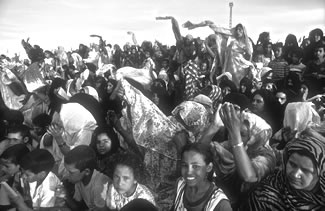
Sahrawi
women and children celebrating the anniversary of the
POLISARIO Front in Algeria. (J.C. Tordai/Panos
Pictures)
|
The Moroccan
occupation since 1975 of Western Sahara, a former Spanish colony, is
in violation of UN Security Council resolutions on the right of the
Sahrawi people to self-determination. The conflict remains
unresolved despite the existence of a UN Settlement Plan (1991) and
the Houston Accords of 1997, brokered by special UN envoy James
Baker and accepted by both Morocco and the Sahrawis. These accords
established a timetable for a referendum allowing Sahrawis to choose
between independence and integration into Morocco. Pro-independence
Sahrawis are poised to win a free and fair referendum carried out in
a timely fashion. Knowing this, Morocco has pursued delaying
tactics, seeking to bolster Morocco's claim on Western Sahara
through outright colonization and "economic development" projects,
as well as an imposing military presence.
The December
1999 UN mission to identify voters in the prospective referendum
ended in impasse. Rejecting the inclusion of three tribes
representing 51,220 possible votes for the Moroccan position, the UN
found a total of 86,386 eligible voters [1] -- a tally that corresponded closely to the
final Spanish census.The Identification Commission rejected the
others because they did not meet the agreed-upon criteria for
eligibility, and they were not Sahrawis from the designated
territory. Morocco sought the inclusion of those Sahrawis who live
in the former Spanish enclaves in southern Morocco. Thus,facing
certain defeat, Morocco refused to hold the referendum. In early
2000, a royal commission headed by former opposition leader Abraham
Serfaty, who until then had strongly supported the Sahrawis' claim
to independence, promoted the concept of autonomy for "Western
Saharan provinces" within the Kingdom of Morocco, taking as a model
the autonomous regions of Catalonia and Andalusia in Spain. [2] Today, Kofi Annan and former Secretary of
State Baker, along with the US, France and Great Britain, are
backing the so-called "third way" -- neither independence nor
integration -- to settlement of the Western Sahara question.
The "third way," a clear concession to Moroccan intransigence
after more than a decade of deadlock, comes at the expense of
international law and UN resolutions.
"Winner-Take-All Mentality"
Following the
results of voter identification, UN Secretary-General Kofi Annan
announced in March 2000 that the referendum would not take place
before 2002. Annan said that Baker needed to further investigate the
feasibility of implementing the Houston Accords and the specific
problems obstructing the execution of the UN Settlement Plan. After
a face-to-face meeting of the parties in London in May 2000, Annan
observed that the Moroccan and Sahrawi views on the referendum were
widely divergent and suggested another way "of achieving an early,
durable and agreed resolution of their dispute over Western Sahara."
The Security Council, approving Annan's report, expected that the
parties would offer Baker "specific and concrete proposals&to
resolve the multiple problems relating to the implementation of the
Settlement Plan and explore all ways and means to achieve an early,
durable and agreed resolution to their dispute." [3] Security Council Resolution 1301, confirming
Baker's new mission, generated disquiet within the UN General
Assembly, the majority of whose members were still supportive of the
peace plan.
During the
remainder of 2000, further meetings in Berlin and Geneva highlighted
the fact that neither party "had shown any disposition to depart
from the 'winner-take-all' mentality." [4] However, "both parties remained attached to
the Settlement Plan despite their fundamental differences and
perceptions as to its correct implementation." In an effort to win
over Sahrawis, Morocco proposed to enter into direct talks with the
POLISARIO Front, the Sahrawis' recognized representative, to seek a
political solution, "subject to stated concerns involving Morocco's
sovereignty and territorial integrity." [5] Baker asked the parties "whether, without
abandoning the settlement plan, they would be interested in pursuing
a subsequent discussion to find another solution that may or may not
be confirmed by referendum." The POLISARIOstated its refusal to
discuss anything outside the Settlement Plan, whereas Morocco
"expressed the wish to further explore other ways and means to
settle the conflict." [6] Morocco pressed for an alternative to the
referendum on self-determination for the Sahrawi people, while Baker
headed off to count dimpled chads in Florida.
Abandoning the Peace Plan
The battle was
rejoined in the summer of 2001. The POLISARIO, backed by
international law and the results of the voter identification,
argued that the Settlement Plan did not envision any enforcement
mechanism, leading Annan to complain that every time the UN proposed
a solution, a new difficulty arose, "requiring yet another round of
protracted consultations." [7] When neither party came up with
the expected concrete proposals for implementing the referendum,
Baker said: "There could be a negotiated agreement for full
integration of Western Sahara with Morocco, or for full
independence." In his view, however, "neither prospect appeared
likely. Alternatively, a negotiated agreement could produce a
solution somewhere between those two results." [8] Baker's words seemed to endorse the Serfaty
commission's call for Sahrawi autonomy within Morocco. In an
astonishing development, Baker and Annan championed this "third
way," submitting it to the parties as a UN "Framework Agreement on
the Status of Western Sahara." [9]
At that stage,
the Security Council had only two options: terminate the mandate of
MINURSO, the peacekeeping force that the UN has kept in Western
Sahara since 1991 at a cost of over $2 billion, [10] or encourage "the parties to discuss the
draft Framework Agreement and to negotiate any specific changes they
would like to see in this proposal." Resolution 1359 adopted the
latter option, but the Council recognized implicitly that it could
not bring the parties to agree on the results of the UN voter
identification. Hence the Council acknowledged the value of the
Moroccan proposal for settling the conflict, while respecting,
ultimately, the principle to self-determination. The Framework
Agreement foresees that Western Sahara would be a part of Morocco
operated under the Moroccan constitution, but remaining autonomous.
Morocco would have exclusive control over foreign relations,
national security and external defense. The eligible voters of
Western Sahara would elect an executive body running the country's
internal affairs, but Morocco would appoint the judges and be
responsible for law and order during the transition. The transition
would be limited to four years, after which a referendum would
decide whether Western Sahara stays Moroccan or becomes a separate
state. The most shocking aspect of this proposal is that Moroccan
settlers who had remained in Western Sahara for more than a year
would be eligible to vote in the referendum. In other words, Morocco
would allow a referendum on self-determination on the condition that
Western Sahara becomes Moroccan.
If it were
implemented, the Framework Agreement would ignore the basic
principles that have informed UN action in the area of
decolonization, allowing a question of self-determination to be
settled under the guidance of the colonial power, with the UN seal
of approval.
In his February
2001 report on Western Sahara, Annan held out the possibility of
expediting the appeals procedures for the voter determination
carried out in 1999. [11] The reference to the appeals procedure was
crucial because the UN itself admitted that it could act on the
issue quickly, thus opening the way again to the successful
conclusion of the referendum. However, Annan's report in April 2001
did not repeat the reference, referring instead to Baker's attempts
to find an alternative to the 1991 UN Settlement Plan. [12] In reality, the idea of abandoning the 1991
agreement is Annan's. Former UN undersecretary-general Marrack
Goulding recently revealed that Annan asked him in 1997 "to go to
Houston to persuade James Baker III to accept an appointment as
Special Representative and try to negotiate a deal based on enhanced
autonomy for Western Sahara within the Kingdom of Morocco." [13]
Against Sahrawi Will
For Sahrawis,
implementation of the peace plan, including the referendum, remains
the most viable and just solution to the conflict. [14] The POLISARIO considered Baker's promotion
of the Framework Agreement as a breach of the 1991 UN Peace Plan and
the Houston Accords.In January 2001, the POLISARIO threatened to
block the route of the Paris-Dakar rally, a desert auto race,
because the organizers had requested permission to cross the Western
Sahara territories only from the Moroccan authorities. This crisis
might have led to renewed hostilities between the POLISARIO and the
Moroccan army, but for last-minute Algerian, UN and US
intervention.
Algeria, home
to more than 165,000 Sahrawi refugees, has maintained a consistent
position in support of a referendum in Western Sahara, though
ambiguities in its stance occasionally emerge. During an official
visit to the US in November 2001, President Abdelaziz Bouteflika
held talks with Baker in which he allegedly stated that Algeria was
not against a "third way." [15] This allegation provoked violent reactions
in the independent Algerian press, prompting the presidency to
reaffirm Algeria's commitment in favor of the right to
self-determination of the Sahrawi people. [16] Civilian and military officials interviewed
after Bouteflika's visit insisted that Algeria's position had not
changed.
Members of the
Security Council did not endorse the Framework Agreement and
requested, again, that Baker produce a plan to implement earlier
accords. In Washington, Senators Edward Kennedy (D-MA), Patrick
Leahy (D-VT) and John Kerry (D-MA) wrote to Secretary of State Colin
Powell expressing their concern that the UN would "abandon the
referendum and support a solution that proposes integrating the
Western Sahara into Morocco against the will of the Sahrawi
people."
France, the US and the "Third Way"
France, the
former colonial power in North Africa, retains the preponderant
great power role. With respect to the conflict in Western Sahara,
France's official "neutrality" is largely influenced by France's
pro-Moroccan policy, presently demonstrated by the friendship
between President Jacques Chirac and King Mohammed VI, and
reinforced by France's economic and cultural relations with Morocco.
Neither conservative nor socialist political forces in France have
provided support for the establishment of an independent Sahrawi
state. [17] Not being part of the French colonial
sphere of influence, an independent Western Sahara could destabilize
a fragile region that France considers vital from economic,
strategic and military points of view.France pays particular
attention to political and social unrest in North Africa, especially
to Islamist groups intent on overthrowing the Algerian
regime.
France aims to
achieve a subtle balance on issues where Algeria and Morocco
disagree -- trying not to alienate Algeria, but opposing actions
potentially detrimental to the Moroccan regime and the leadership of
the young monarch. Hence France displays a position of "neutrality"
on Western Sahara, while working through the UN to elicit support
for a UN resolution or initiative, such as Baker's, which would
fulfill French objectives in the region. Since Chirac's visit to
Algeria in early 2003, an indisputable Franco-Algerian rapprochement
has occurred. Although France still seeks a solution favorable to
Morocco, French policymakers realize that they cannot alter
Algeria's stance on Western Sahara, especially since Algeria is
regaining its role on the international stage.
The United
States is a traditional ally and friend of Morocco, as confirmed by
Baker's nomination to be special envoy and especially by the
evolution in his positions since taking the job. However, the
remarkable improvement in US-Algerian relations has made all-out
support for Morocco implausible. [18] Particularly since September 11, 2001,
US-Algerian relations have improved considerably. Algeria's
impressive hydrocarbon resources and large potential market make it
look more and more like the preferred US ally in North Africa.
Meanwhile, Morocco's strategic significance has declined in
Washington's eyes.
Congress,
despite the pro-Moroccan positions of the pro-Israel lobby, has not
been as pro-Moroccan as the executive branch. Sahrawis, in fact,
have steadfast support among some Republican and Democratic members
of Congress. In this environment, the Bush administration can ill
afford to act in a way that might trigger resumption of hostilities
in the region, as no Congressional majority exists to endorse
military support for Morocco. Growing US interests in the region,
especially in the Algerian hydrocarbon sector, make it doubtful that
the US would welcome further instability in North Africa.
US
administrations have been careful not to alienate Algeria. [19] But, unlike France,
the US has sought a resolution of the Sahrawi conflict -- preferably
in Morocco's favor -- in order to force the process of regional
economic integration. Such integration, policymakers hope, will
create the conditions for a market wide enough to attract US
investment. By favoring Morocco's stance, the US has set a dangerous
precedent for its diplomatic standing in the region. Nonetheless,
both France and the US continue to support the "third way,"
convinced that Morocco will not accept the verdict of a
referendum.
The Fourth Way or the First Way
Following
Algeria and the POLISARIO's rejection of the draft Framework
Agreement, Annan indicated that one option to remedy the "bleak
situation" could be to "explore with the parties one final time
whether or not they would now be willing to discuss&a possible
division of the Territory," "following indications from Algeria and
the POLISARIO of a willingness to negotiate a possible division of
Territory." Annan also mentioned the possibility of ending the
mandate of minurso. After more than 11 years, he recognized, the UN
could not solve the problem of Western Sahara "without requiring
that one or the other or both of the parties do something that they
do not wish to voluntarily agree to do." [20]
If Annan
represented Algerian intentions correctly, his statement
contradicted the Algerian proposal of May 2001, which Baker had
rejected, to place Western Sahara under UN administration in order
to conduct the referendum, following the example of East Timor. The
seeming change in Algeria's position is said to have been designed
to serve US interests -- because the creation or partition of a
Sahrawi state would allow Algeria to transport its oil to ports in
the Atlantic Ocean. Furthermore, the exploitation of oil reserves of
the region requires the stability of North Africa. [21] In the era of George W. Bush's war on
terrorism, Algeria has become a pivotal state in the region for
Washington, which has recently promised Algiers the delivery of
sensitive military equipment. [22] In any event, Morocco reacted angrily to
Annan's suggestion, reaffirming that its "sovereignty" was
inalienable in "Morocco's southern provinces." [23]
In January
2003, James Baker conducted another mission to the region. He
submitted to Morocco and the POLISARIO, as well as to Algeria and
Mauritania, a settlement plan that differed very little from the
proposal he presented in 2001. The proposal is a mere reiteration of
the "third way," with slight modifications. The plan that Baker
proposed -- with the probable support of the US, France and Annan --
would guarantee with all certainty that Morocco, due to the
overwhelming presence of Moroccan settlers and their eligibility to
vote, would win the referendum. The POLISARIO had already rejected
the proposal before the March 31 deadline for the parties to
respond. Algeria is very likely to challenge legally the plan that
Baker has set forth, as it did with the "third way." Sahrawis
rejected the new plan submitted by Baker on May 20, 2003 even before
the Security Council had given its opinion. Sahrawi officials feel
that Baker's new proposal "is keener on taking account of the
Kingdom of Morocco's sovereignty than of the Sahrawis' inalienable
right to self-determination." [24] Furthermore, the new proposal would
basically guarantee Morocco's victory in the referendum, given that
under this plan all residents in the territory, including Moroccan
settlers, would be eligible to vote.
After 30 years
of enduring conflict, the independence of Western Sahara remains
first and foremost an issue of international law. Few options,
except a referendum, can break the stalemate. But the successful
example of decolonization in East Timor may not be emulated in
Western Sahara. Morocco maintains its uncompromising position to
preserve the rich resources of the territory and to ensure the
internal stability of the kingdom. The US, having gone to war in
Iraq ostensibly to enforce UN resolutions, looks on while its former
Secretary of State facilitates Morocco's ongoing defiance of UN
resolutions in Western Sahara.
[1] UN Security Council, Report of the
Secretary-General on the Situation Concerning Western Sahara,
S/2000/131, February 17, 2000.
[2] UN Security Council, Report of the
Secretary-General on the Situation Concerning Western Sahara,
S/2000/131, February 17, 2000
[3] UN Security Council, Report of the
Secretary-General on the Situation Concerning Western Sahara,
S/2000/461, May 22, 2000.
[4] UN Security Council, Report of the
Secretary-General on the Situation Concerning Western Sahara,
S/2000/683, July 12, 2000.
[5] UN Security Council, Report of the
Secretary-General on the Situation Concerning Western Sahara,
S/2000/1029, October 25, 2000.
[6] Ibid.
[7] UN Security Council S/2001/613, June 20,
2001.
[8] Ibid.
[9] Ibid.
[10] UN Security Council, Report of the
Secretary-General on the Situation Concerning Western Sahara,
S/2002/178, February 19, 2002. "As of January 31, 2002...the total
outstanding assessed contributions for all peacekeeping
operations...amounted to $2,165,678,953."
[11] UN Security Council, Report of the
Secretary-General on the Situation Concerning Western Sahara,
S/2001/148, February 20, 2001.
[12] UN Security Council, Report of the
Secretary-General on the Situation Concerning Western Sahara,
S/2001/398, April 24, 2001.
[13] Marrack Goulding, Peacemonger (London:
John Murray, 2002), pp. 214-215.
[14] Letter of Mohammed Abdelaziz, Secretary-General
of the POLISARIO, to Annan, May 30, 2001. Published in UN Security
Council, Report of the Secretary-General on the Situation
Concerning Western Sahara, S/2001/613, June 20, 2001, Annex
IV.
[15] Le Quotidien d'Oran, November 5, 2001.
An Algerian journalist who accompanied Bouteflika on his visit to
the US told Yahia Zoubir that the reporter from Le Quotidien
d'Oran did not give an accurate account of what the president
had said.
[16] Le Matin (Algiers), November 6, 2001.
Deputy Foreign Minister Abdelkader Messahel declared that the
framework agreement is not a proper solution.
[17] See Jean-Pierre Tuquoi, Le dernier roi
(Paris: Editions Grasset, 2001), pp. 269-300.
[18] See Yahia Zoubir, "Algeria and US Interests:
Containing Radical Islamism and Promoting Democracy," Middle East
Policy 9/1 (Spring 2002).
[19] Interviews with high-ranking State Department
officials, Washington, DC, May 2000.
[20] UN Security Council, Report of the
Secretary-General on the Situation Concerning Western Sahara,
S/2002/178, February 19, 2002.
[21] Vicenç Fisas, "Una propuseta de paz para el
Sahara," El Pais, April 27, 2002.
[22] François Soudan, "L'ami algérien," Jeune
Afrique/L'Intelligent (January 2003).
[23] Abla Chérif, "Mohammed VI s'attaque a
l'Algerie," Le Matin, March 7, 2002.
[24] Le Matin (Algiers), May 21,
2003.

|