|
“You’re
Either With Us or Against Us”
Israel Bans Family Reunification for
Palestinian Spouses of Israeli Citizens
|
|
|
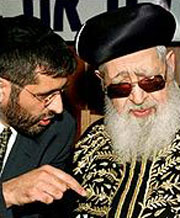
Eli
Yishai, the driving force behind the new legislation, left,
with Shas’ Rabbi Ovadia
Yosef |
And I thought getting married
was easy. Well, for me it was relatively so. Sure, I had to arrange
for my husband’s relatives to fly from Cairo to the UK, and run
around ordering clothes and food, but I had no problems with either
Egyptian or British authorities. After all, I am a nice white
English woman with the all-important British passport. And after
initial rudeness, the British Embassy staff had to accept that my
Egyptian family had every right to come and visit me. And there was
no problem over me joining him to live in Cairo.
However, in Nazareth where I
used to live, marriage just got a whole lot harder for Palestinian
citizens of Israel - at least, if they want to marry another
Palestinian a few miles away on the other side of the 1967 border.
On July 31 2003, the Israeli Knesset passed “The Nationality and
Entry into Israel Law”, which prohibits Palestinians with Israeli
citizenship from marrying Palestinians of the West Bank and Gaza,
that is, if they want to bring their spouse home. (The Israeli
government would no doubt be more than happy if any Palestinian
citizens of Israel want to renounce their rights and leave to the
West Bank or Gaza).
This law does not just apply to
the future, but affects all those couples that have been waiting
through the lengthy process of having their spouse’s citizenship
legalized by the Israeli Interior Ministry. Some have waited for
several years, in an application queue that was completely frozen in
May 2002. Even prior to the new law, Israeli citizenship for a
Palestinian married to an Israeli was by no means guaranteed. This
law, of course, only applies to Palestinians. If I had decided to
marry a Palestinian resident of Nazareth, as a British woman I would
have relatively few problems getting the paperwork done.
Opportunity for such racist legislation came following
the bombing of a Haifa restaurant by a Palestinian with
Israeli citizenship. |
|
This new apartheid law affects
thousands of families, and an estimated tens of thousands of
individuals, many of whom are from the same extended families or
villages, artificially divided across Israel occupation lines. While
this law largely affects the Palestinians inside Israel,
Ha’aretz, the Israeli daily, highlighted the case of a Jewish
woman married to a Palestinian man with West Bank papers whom she
had met in Europe. Even her first class Jewish Israeli citizenship
did not give her the power to arrange the appropriate papers to
legalize her West-Bank-born husband’s status in Israel.
In its appeal to the Supreme
Court, Adalah, the Legal Center for Arab Minority Rights in
Israel, focused on two specific cases. One is a case of from among
its own staff. Attorney Morad El-Sana, an Arab citizen of Israel
living in the Negev town of Lakiyya, married around 6 months ago to
a woman he met on an MA program in Canada. The catch is that Mrs
Abeer El-Sana, is from Bethlehem. El-Sana, a social worker and
lecturer at Al Quds University, East Jerusalem, cannot go and live
with her husband in the Negev, because of her West Bank
identity.
It is difficult to assess just
how many thousands of couples this law affects, as many are living
in secret, hoping that the security forces will never come knocking
at the door. This is a particular problem for people living along
the Green Line in the Little Triangle area, where until the recent
enforcement of the 1967 line, family life and friendships between
villages on both sides went on as if there was no dividing
line.
“Security” Rhetoric Fails to
Hide Racist Demographic Agenda
|

|
|
Scenes
from the Haifa restaurant blast in March 2002, touted as
justification for the controversial new
law |
This latest piece of
discriminatory legislation originates with former Shas Interior
Minister Eli Yishai. In February 2002, he told Israeli daily
newspaper Ha’aretz that “through the back door of the State
of Israel, the right of return [of the Palestinians] is being
realized. The statistics are frightening and a cause for concern,
and threaten the Jewish character of the State of Israel.” As
Ha’aretz notes later, he initially made no mention of
security issues, but was open about Zionist demographic concerns
about the ethnic makeup of the Jewish state.
Yishai’s opportunity to package
such racist legislation to the Israeli public came following the
suicide bombing of a Haifa restaurant by a Palestinian with Israeli
citizenship. While a resident of Jenin, the bomber was able to
travel freely in Israel because his mother was born in the 1948
areas and had passed on citizenship to him. Yishai and his successor
at the Ministry, Avraham Poraz, have continued to mention the
killing of 15 Israelis by this man to engender support for this new
law on the back of a wave of fear stirred within the
population.
Aside from the whole question
of the Palestinians’ legal right of resistance to occupation, the
legal team fighting this law has questioned the Israeli concern over
security within this specific case. Adalah challenged the state’s
argument regarding acts of violent resistance against Israel in the
case of Palestinians who obtained Israeli citizenship through
reunification. Lawyers for the state could only produce six cases
out of many thousands who benefited from the reunification law,
hardly proof of the Israeli claim of “security issues.”
Case for International
Spotlight on Israeli Racism
Even the
US State Department said it was considering whether Israel had
overstepped the mark with this discriminatory
law. |
|
In the four years that I have
been closely following international media coverage of (or the lack
thereof) Palestinian citizens of Israel, this case has received the
most attention in the international public arena. The British
Independent daily newspaper gave the issue front-page coverage, and
the BBC also followed the case. The law has been condemned as
discriminatory by such prominent rights groups as Human Rights Watch
(HRW) and Amnesty International, who wrote a joint letter to the
Knesset before the vote, condemning the law as “profoundly
discriminatory… blatant racial discrimination.” “It’s scandalous
that the Government has presented this bill, and it’s shocking that
the Knesset is rushing it through,” said Hanny Megally of HRW.
Surprisingly, even the American Zionist lobby group, the
Anti-Defamation League (ADL), expressed concern that Israel would be
able to review the law in the future.
In response to an urgent action
petition from the International Federation for Human Rights (FIDH),
the UN Committee on the Elimination of Racial Discrimination
demanded, in a statement of August 14, 2003, that the ban on family
reunification should be “revoked” immediately. The Committee stated
that the law raises serious issues under the International
Convention on the Elimination of all Forms of Racial Discrimination
(ICERD) to which Israel has been party since 1979. This announcement
followed the August 6, 2003 declaration of the UN Human Rights
Committee, which having listened to presentations in Geneva by
attorneys from both sides, urged Israel to revoke the
law.
The European Union also
expressed opposition, suggesting that Israel may face problems in
joining the Wider Europe initiative. The EU ambassador to Israel,
Giancarlo Chevallard, said that such a law established “a
discriminatory regime,” and stressed that "Israeli respect for human
rights constitutes an essential element of Israel's relationship
with the EU." Israel is currently seeking closer cooperation with
Europe. Even the US State Department said it was considering whether
its Israeli ally had this time overstepped the mark on
discriminatory law.
And Israel
Replies…
Israel’s Ambassador to the UN
Yaakov Levy, heading an Israeli delegation of attorneys from various
government ministries in Geneva, said the resolution showed “a
biased approach which singles out Israel.” Sure, Israel isn’t the
only country in the Middle East with discriminatory citizenship
laws. But it is the only one that the West pretends is a
democracy.
Israel
isn’t the only country in the Middle East with discriminatory
citizenship laws, but it is the only one the West pretends is
a democracy. |
|
There were of course Israeli
Knesset members who opposed the law, voiced objections, or tried to
postpone the vote. But when it came down to it, the law was passed
easily by 53 votes to 25, with one abstention. Even Poraz, the
Interior Minister himself, had expressed his concerns about the
necessity of such a law. Ha’aretz commentator Lily Galili remarked,
July 9, that in the past Israel had the Labor left’s “shoot and cry”
policy, but that now it has the “legislate and cry”
action.
Others, of course had no tears
to waste. Yuval Steinitz, a Likud parliamentary leader, told the
International Herald Tribune (August 1, 2003) that he accused the
Palestinian Authority of encouraging Palestinians to marry Israeli
Arabs and move to Israel. “A deliberate strategy,” he said, “to
change the demographic balance in Israel in order to destroy us.” MK
Nissan Slomiansky of the National Religious Party, (Ha’aretz, August
9), “said aloud what others prefer to whisper.” “They say outright
that they want a state… a security element also means changing the
demographics. When there’s a group that is knowingly and purposely
realizing the right of return, of course the state has to protect
itself.”
This new racist law will divide
many families, trapping them on either side of a false border.
Children may live two kilometers from their fathers or mothers, but
be unable to see them. In the future, Palestinians from ’48 and ’67
areas will not be able to consider marrying unless they want to give
up the right to a home in the ’48 areas. Adalah, along with Arab
members of the Knesset and other interested parties, has filed a
motion in the Israeli Supreme Court. Whatever the outcome, or
modification to the law, the racist direction Israeli policy is
continuing to pursue is clear.
I will conclude with the words
of a mainstream Jewish-Israeli writer for those wondering if I am
just yet another one of those people who hate the “only democracy in
the Middle East.” Uri Benziman, in the August 2 2003 Ha’aretz, makes
the straightforward link between this law and the demographic
concerns of maintaining an ethnic state at the expense of another
ethnic group abundantly clear:
[This] vote exposed the
self-righteous hypocrisy… the purpose of the legislation is more
than just to fill a breach in our line of defense. It satisfies the
secret desire of right-wing parliamentarians… to allow their
nationalist inclinations to run rampant.
The present government is
composed of parties whose primary reaction to Arabs… is one of
foreignness and suspicion, if not outright racism… Only a minority
of the establishment… has developed tolerance toward and acceptance
of Arabs… It is not only a rabble-rousing response to the distress
of the security situation, but also an attempt to distance as many
Palestinians as possible from Israel. In this, it emphasizes the
racist character of the legislation and strengthens the argument
that Israel’s claim to be a Jewish and a democratic state at the
same time is groundless.
Isabelle
Humphries is a British freelance journalist and Development
Director at Sawt Al Amel (Laborer’s Voice), an organization
supporting Palestinian workers inside Israel. She has an MA in
Middle East Politics and is also a freelance writer for the Cairo
Times. You can reach her at innazareth@yahoo.co.uk
|