Camera mobile phone may be new
security irritant
Abu Dhabi | By Nadim
Kawach, Bureau Chief | 06-09-2003
Print friendly format |
Email to Friend
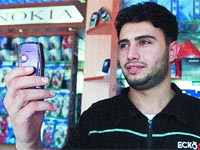
Hussein Mahameed showing a camera mobile phone to
a customer at his shop. | A
20-year-old Arab expatriate strolled happily with his new
camera mobile phone in a packed shopping centre in Abu Dhabi,
looked around and stealthily snapped a shot of two women
walking past.
He had been lucky to find a less
expensive second hand mobile phone but luck betrayed him when
two security men jumped on him. "They seized him because he
photographed two girls with his mobile phone. It is illegal to
do so not only here but in any country," said a security
employee at the Marina Mall.
"People, especially these
teenagers, should be careful because such places are well
secured and they should know it is not nice to do such acts."
Complaints about camera mobile phones have already
started to pour into many countries as more such advanced
handsets poured into the market.
For users, these
phones could be a real joy if they just do not abuse them. For
police they could be another security headache.
Etisalat, the sole telecommunication services provider
in the UAE, has just introduced the advanced Multimedia
Messaging Service (MMS), which makes camera mobile phones a
real delight since user can send pictures to other MMS-enabled
handsets or e-mails.
Since it introduced MMS two months
ago, nearly 100,000 people have subscribed to the service and
the figure is set to swell as more camera phones storm into
the lucrative UAE market, one of the fastest growing mobile
phone markets in the world.
Before the arrival of
camera phones, police had to deal with such abuses involving
teenagers flashing their mobile numbers or sending simple
messages to girls.
"We are facing a new problem now,"
said a security officer. "Some boys or girls take their own
pictures or that of others and send them to mobile phones by
MMS. We are receiving such complaints and I think we are ahead
of a real problem as more camera phones hit the market. The
problem is that Etisalat cannot control this
behaviour."
As mobile phone technology surges at a
revolutionary pace, most phone makers have started to produce
camera mobile handsets in a hectic bid to maintain their share
in a market where scores of new mobile phone firms are
emerging. Customers appear to be the main beneficiaries of the
strong competition among mobile phone producers as it means
lower prices.
"Demand is very strong for camera mobile
phones because their prices have sharply gone down and many
customers want to make full use of the MMS facility," said
Hussein Mahameed of Al Asala mobile phone chain.
"I
have heard of some problems involving taking pictures of women
in public places. We have to expect this because not all
people use technology in the right way. Camera phones are
really great pieces and could be used in many suitable ways to
create joy and fun. I think we should understand and
appreciate them, not abuse them."
Authorities are
trying to cope with such abuses. The UAE has always stressed
it is an open, free market which blocks only dangerous or
obscene material.
But the problem is not confined to
camera phones as most other handsets are equipped with a
downloading capability allowing them to import obscene
pictures from computers and web sites. Some of those pictures
are animated, underscoring their obscenity.
Users could
exchange such pictures over their phones through MMS while
others simply keep them in their handsets even after they swap
them for new handsets.
"The other day I bought a second
hand Nokia mobile phone from a shop on Defence Road for my
wife," said Abdul Bari, an Egyptian government employee. "She
was very excited and happy with it before she went though the
gallery and saw those pictures. They are very rude and
disgusting. I know it is not the mistake of the dealers but
they should erase such things when they buy used
phones." |
.gif) |
|
|











.gif)





.gif)


.gif)



.gif)


.gif)


.gif)




 Top
Top

