The
subject of ethics has increasingly been present in economic
analysis, although not without
considerable debate. Some economists believe that the
importance of economics is purely technical. Others believe
that moral considerations in economic analysis provide a more
accurate picture of possible outcomes since it takes into
consideration the human aspect of economic actors--that is,
people.
I
confess that, as an economist, it makes me nervous to insert
subjective measures such as morality and ethics when I do my
own analysis, both because my conclusions may be applicable
only to a few cases and because morality and ethics are hard
to measure. But since economics is the study of choice, human
behavior cannot be ignored in economic analysis if we want to
have a meaningful insight into people's economic
life.
I
will try to explain corruption, therefore, in economic terms
and show how economic freedom removes opportunities for
corruption and promotes ethics not just for its moral
implications, but also because of its economic
value.
Ethics, according to Merriam-Webster's dictionary,
is "the discipline dealing with what is good and bad...." In
general, we call unethical those actions for which there is a
social consensus that they are a bad thing.
Corruption has several meanings, depending on
whether it takes place in the public or private sector;
however, for most people corruption is something unethical,
something considered a wrongdoing. A closer look at human
behavior in economic life suggests that, in some instances,
corruption does not reflect so much a lack of ethics as it
reflects a lack of economic freedom.
Economic Freedom and Corruption
To
better understand the link between corruption and economic
freedom, let me first describe economic freedom and then
explain how its absence fosters corruption. I will examine the
relationship between economic freedom and corruption both in
the form of informal economic activity and in the
public-sector bureaucracy.
According to The Heritage Foundation/Wall Street
Journal annual Index of Economic Freedom, economic freedom is
"the absence of government constraint or coercion on the
production, distribution, or consumption of goods and services
beyond the extent necessary for citizens to protect and
maintain liberty itself."
The
Index measures the level of economic freedom in 161 countries
around the world. To measure economic freedom, it focuses the
study on 10 different factors:
- Trade policy,
- Fiscal burden of government,
- Government intervention in the economy,
- Monetary policy,
- Banking and finance,
- Capital flows and foreign investment,
- Wages and prices,
- Property rights,
- Regulation, and
- Informal market.
The
Index provides a framework for understanding how open
countries are to competition; the degree of state intervention
in the economy, whether through taxation, spending or
overregulation; and the strength and independence of a
country's judiciary to enforce rules and protect private
property. The 10 factors of the Index allow anyone to see how
much or little economic freedom a country has.
Some
countries may have freedom in all factors; others may have
freedom in just a few. One of the most important findings of
the Index is that, as Frederick von Hayek foresaw more than 60
years ago, economic freedom is required in all aspects of
economic life--that is, in all of the 10 factors--in order for
countries to improve their economic efficiency and,
consequently, the living standards of their people.
The
Index shows that corruption does not always reflect inherent
unethical behavior. This is particularly the case for those
who are forced out of the formal economy into the informal
economy through burdensome regulations, taxation, and weak
property rights.
Economic Freedom and the Informal Economy
Charts 1 and 2 illustrate the relationship between
economic freedom and the size of the informal economy as a
percentage of GDP in OECD [Organisation for Economic
Co-operation and Development] countries and 22 transition
economies. Chart 1 shows a
positive correlation between these two factors. As economic
freedom vanishes, the informal economy takes a larger share of
GDP.

On
average, as shown in Chart 2, the size of the informal economy
in economically unfree and repressed economies is almost three
times the size of the informal economy in free economies, and
almost double the size of the informal economy in mostly free
economies.

These
charts illustrate the perverse effect of economic repression
on the ethics of ordinary people and on the perpetuation of
their poverty conditions. For example, in most developed
countries, people have a better standard of living thanks to
credit access. In the United States, for example, without
credit, I would not have a house, or a car, or a TV, or a
vacation, or many of the products that add comfort and
convenience to my life. Credit makes it possible for me, an
ordinary middle-class person, to improve my standard of living
in many ways.
To
have access to credit, however, I need to prove that I have an
income or property. To prove that I have income, I need a
formal job, and to prove that I have property, I need a
property title.
The
amount of available formal jobs depends, of course, on how
easy or difficult it is for people to invest, whether in a
small retail shop to sell groceries or in a big factory. The
friendlier the business environment, the more likely formal
jobs will be available. According to the Index of Economic
Freedom, however, in most low- to middle-income countries, it
is extremely difficult for small and medium investors--which
are the largest source of jobs--to operate, both because of
the regulatory environment and because of the lack of a strong
rule of law.
Consider labor regulations in Argentina. In this
country, an employer must grant, by law, several employee
benefits, including holidays, vacations, sick leave, health
insurance, paid overtime, an annual bonus, and some paid
months before laying off an employee. Or take France, where
employers must grant, by law, at least 2.5 working days of
paid vacations per month; pay over 30 percent in contributions
to social security; offer a complementary pension scheme, 35
hours of work per week, and time off; and abide by a
burdensome bureaucratic procedure to dismiss
employees.
The
immediate problem with this kind of legislation is that it
assumes that all employees are equally good, equally
responsible, and equally productive, which is not true. If the
employee arrives late, treats customers poorly, and makes the
employer lose money, the law grants that employee the same
benefits that it grants to a good employee.
Perhaps large businesses, like a multinational
factory, can afford to comply with these regulations because
of the size of the business and its diversification around the
world. But the burden of these regulations destroys small and
medium entrepreneurs, who may put their entire savings at
stake in their investment.
Small
and medium businesses therefore choose to do business and
create jobs in the informal sector, where these benefits are
negotiable and tied to performance, and not forced by law.
This is a clear case in which the rules of the state create
perceived unethical behavior by private employers and
employees when what is really in question is the ethics of
such a regulatory burden in the first place.
If
they do not have a job, people can still get access to credit
if they have a property title to use as collateral. According
to Peruvian economist Hernando de Soto, many of the poor in
the developing world have property but the bureaucracy they
have to go through in order to get a property title is, at
best, huge. For example, in Perú,
"to obtain legal authorization to build a house on state-owned
land took six years and eleven months, requiring 207
administrative steps in 52 government offices.... To obtain a
legal title for that piece of land took 728 steps."
It is
just as bad in other countries, such as Egypt, where it takes
77 steps in 31 government offices (anywhere from six to 14
years), or the Philippines, where it takes 168 steps through
53 offices (anywhere from 13 to 25 years). The poor own many
things that they could use as collateral, but it is
bureaucratically impossible for them to validate their
property rights. As a result, they are unable to convert what
they own into capital and, therefore, raise their standard of
living.
Informality is a response to economic repression,
not to something inherently unethical in those who circumvent
legislation. What is most unethical about informality is the
condition in which the government forces the poor to live.
Informally employed people are condemned to a standard of
living that is significantly lower than that of formally
employed people, who have credit access. Also, informality
creates a culture of contempt for the law and fosters
corruption and bribery in the public sector as a necessary
means to navigate the bureaucracy.
Economic Freedom and the Rule of Law
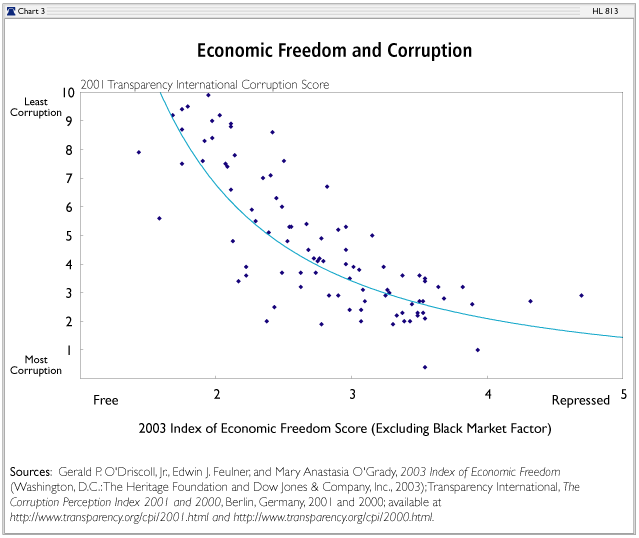
Charts 3 and 4 illustrate the relationship between
economic freedom and the level of corruption in 95 countries
around the world. Chart 3 shows a
strong correlation between these two factors. As economic
freedom vanishes, corruption flourishes. On average, as shown
in Chart 4, the level of perceived morality--as a contrast to
corruption--in economically free countries is almost four
times the level of perceived morality in the public sector in
mostly unfree or repressed economies, and almost 60 percent
greater than in mostly free economies.

Having a weak rule of law
significantly adds to the level of corruption in the public
sector as well as the amount of informal activity. A weak
judiciary is a "blind eye" on anything done outside the law.
With a weak judiciary, corruption goes unpunished and
informality flourishes.
This
is one of the most serious problems we find in the world
today. Of 161 countries evaluated in the 2003 Index of
Economic Freedom, 108 received bad scores in both regulation
and property rights," undermining any effort to improve the
living standards of the poorest in those 108
countries.
Conclusion
To be
sure, there are cases of corruption that respond to the
unethical nature of the corrupt individual. But for the most
part, the unethical behavior stems from the environment in
which individuals must interact. Convoluted regulations and
weak rule of law foster a culture of corruption and
informality both in the private and public sectors.
In
the public sector, convoluted regulations and weak rule of law
provide ample opportunities for public officials to accept
bribes without punishment. In the private sector, those two
factors push some people to do business informally as a means
to survive and others to profit far more than they would if
the possibility of bribery did not exist. The result is an
increasingly unequal society, in terms of the opportunity to
create wealth and improve living standards.
To
fight corruption and informality, it is essential to
understand that corruption is a symptom--of overregulation,
lack of rule of law, a large public sector--not the root of
the problem. The perceived problem is unethical/corrupt
behavior of the private sector, which leads the government to
press more on private-sector activities. The real problem is
the government action/regulations causing undesired behavior
of the private sector. The optimal solution would be to
eliminate burdensome regulations so that unethical behavior
does not occur.
Countries must advance economic freedom in all
possible areas of the economy, with particular emphasis on
regulations affecting small and medium business, in order for
corruption and informality to decrease. The Index of Economic
Freedom is an excellent guide to identify what is obstructing
economic activity and, therefore, perpetuating
poverty.
Countries must also preserve the independence and
effectiveness of the judiciary to punish corrupt actions.
Economic freedom with a strong rule of law will foster a
culture of investment, job creation, and institutional
respect--all essential factors in massively improving the
living standards of ordinary people.
--Ana Isabel Eiras is Senior Policy Analyst for
International Economics in the Center for International Trade
and Economics at The Heritage Foundation. These remarks were
delivered at a conference on the "Ethical Foundations of the
Economy" in Krakow, Poland.


.gif)
.gif)


.gif)
.gif)


