|
Theme: The extraordinary increase in oil exploration
in the area between Spain and the Maghreb highlights the risks
associated with the lack of bilateral delimitation treaties
with Morocco and Algeria.
Summary: Two years ago there were no companies
exploring for oil in Spanish waters bordering on, or near,
Moroccan waters. Today, five oil companies are operating along
the Spanish/Moroccan maritime border in three different areas:
the Atlantic side of Gibraltar, the Alboran Sea and the coast
of the Canary Islands. In two cases, the same company holds
exploration rights on both sides of the maritime limit. This
unusual activity has awakened the interest of the Algerian
government, which has called for tenders for the exploration
of what it considers its territorial waters in East Alboran,
directly on the north-south line with La Manga del Mar Menor.
This includes an area that has traditionally been considered
to belong to Spain.
The large rise in exploration very substantially increases
the likelihood of hydrocarbons being found in at least one of
these zones and also, that extracting them will be
economically viable. In this case, Spain will be faced with
one of the most delicate and complex issues in international
relations: delimiting maritime jurisdictions where hydrocarbon
deposits lie beneath the seabed, something that has led, with
alarming frequency, to conflicts of varying intensity.
Analysis: Repsol takes control of the Atlantic
side of Gibraltar
The Spanish oil company Repsol YPF has recently obtained
permission to explore three zones along the Atlantic coast of
Morocco, from Tangiers south to Larache. The area covers 6,000
km2 (about the size of the province of Gerona),
which the company will explore for eight years. This agreement
is similar to another dozen that Morocco has signed with other
oil companies. The particularity of this agreement is that it
affects Moroccan waters bordering on Spanish ones. Also, it
turns out that Repsol also holds exploration rights on the
Spanish side, off the province of Cadiz, where it has seven
exploration licences adjacent to those it has just received
from Morocco.
 To
determine Repsol’s possible interest in the Tangiers-Larache
zone, it must be kept in mind that in January 2002 Repsol
received nine licences from the Spanish government for
hydrocarbon exploration between the coast of Morocco and the
islands of Lanzarote and Fuerteventura. Rabat reacted harshly
to this concession, sending the Spanish embassy a diplomatic
note that labelled this action as ‘unfriendly and
unacceptable’. The Moroccan Foreign Minister, Mr Benaissa,
claimed that Spain had unilaterally determined the limit
between the areas of interest off the Canary Islands and
Morocco. The note ended ‘insistently inviting Spain to suspend
its application’ (see Petróleo: ¿el próximo conflicto
hispanomarroquí?, by Íñigo Moré,
http://www.realinstitutoelcano.org/analisis/60.asp). It
is true that the Moroccan protest made no reference to Repsol.
However, it can also be assumed that it in no way motivated
Repsol executives to visit Rabat. To
determine Repsol’s possible interest in the Tangiers-Larache
zone, it must be kept in mind that in January 2002 Repsol
received nine licences from the Spanish government for
hydrocarbon exploration between the coast of Morocco and the
islands of Lanzarote and Fuerteventura. Rabat reacted harshly
to this concession, sending the Spanish embassy a diplomatic
note that labelled this action as ‘unfriendly and
unacceptable’. The Moroccan Foreign Minister, Mr Benaissa,
claimed that Spain had unilaterally determined the limit
between the areas of interest off the Canary Islands and
Morocco. The note ended ‘insistently inviting Spain to suspend
its application’ (see Petróleo: ¿el próximo conflicto
hispanomarroquí?, by Íñigo Moré,
http://www.realinstitutoelcano.org/analisis/60.asp). It
is true that the Moroccan protest made no reference to Repsol.
However, it can also be assumed that it in no way motivated
Repsol executives to visit Rabat.
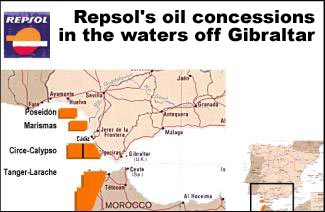
Given these precedents, the only reasonable conclusion is
that Repsol approached Morocco with a clear goal in mind and
weighty arguments to back it up. These arguments are the seven
oil concessions that Repsol operates on the Spanish side of
the Atlantic coast of Gibraltar. All together, these licences
located on the Spanish side of Gibraltar come to 275,410
hectares or 2,754 km2 (larger than the province of
Vizcaya). More importantly, these concessions are the most
fertile in Spain: 90% of domestic natural gas is extracted
from them.
Repsol acquired the Poseidón Norte and Poseidón Sur
concessions in 1995. Both are located in open seas 30 km south
of Huelva. These concessions turned out to be the most
successful ever drilled on the Spanish coast and in 2002
produced 503 million m3 of gas. This volume
represented 90% of all the gas extracted that year in
Spain.
In light of this success, Repsol continued southward along
the coast. In 1997, it requested the Hércules Norte and Sur
maritime concessions, adjacent to Poseidón, but in the
province of Cádiz. These zones turned out to be sterile, so in
2001 Repsol continued southward and in December acquired the
Calypso Este and Oeste, on the maritime perimeters. These are
adjoining and centred on the Bay of Cádiz. Both licences form
a rectangle whose short side runs north to south,
approximately from Chipiona to Conil. Repsol immediately began
preliminary work, which according to the terms of the
concession includes 3-dimensional seismic studies of an area
of 600 km2, geochemical studies and others, all
worth a total of at least €4.1 million.
The company must have found something interesting because
on March 21, 2003, it was able to sell the German company RWE
Dea AG 25% of the perimeters, with an option to acquire up to
30%. This means that the German company will take on part of
the investment, but only as a minority shareholder, remaining
subordinate to the Spanish company’s management decisions.
The consortium immediately drilled appraisal well CO-1 on
the Calypso Oeste licence. It finished drilling on April 27,
having reached a depth of 1,900 m. The next day, April 28, it
began appraisal well CO-2, set to reach a depth of 1,900 m.
One day after finishing this, drilling was begun on CE-1, on
the Calypso Este licence. Like the others, 1,900 m was the
targeted depth.
Repsol has not provided any information on the results of
these tests, but they would seem to be positive, perhaps even
very positive. On May 30, 2003, the company obtained the Circe
licence, which implies extending Calypso to the west. This
suggests that wells CO-1 and CO-2 indicate the existence of
reserves extending to the adjacent zone.
This set of activities by Repsol in the zone suggests that
the company was hoping the success of Poseidón could be
extended to the south, first with the Hércules licences, then
with Calypso and finally with Circe. The Olympian origin of
the names of the concessions suggests that Repsol considers
them part of the same group and, therefore, of a similar
geology. Also, the Olympian connotations clearly suggest the
magnitude of Repsol’s expectations, already confirmed in the
case of Poseidón, the main Spanish gas reservoir. As part of
this strategy , it seems logical for Repsol to study the
adjacent zone to the south; in other words, to apply to
Morocco for concessions. This is not to rule out the
possibility that these reservoirs could also extend to
Portugal, where Repsol YPF is already operating (Offshore
Algarve, Portugal: A Prospective Extension of the Spanish Gulf
of Cadiz Miocene Play, by J. Cakebread-Brown, C.
Garcia-Mojonero, R. Bortz, L. Cortes, W. Schwarzhans and W.
Martínez del Olmo).
From the Moroccan point of view, it also seems natural to
grant the oil concession for its north shore to the company
already operating on the Spanish side. Repsol has inestimable
experience in the zone, knows its geology and has explored it
successfully. This guarantees that the Spanish company has a
precise idea of what could lie below the seabed on the north
coast of Morocco, putting it in the best position to find
hydrocarbons, if any are to be found. This argument could be
solid enough to eclipse other issues, particularly Morocco’s
dramatic interpretation of the Repsol concessions between the
Canary Islands and Morocco.
The Canary Islands and Morocco The coast of the Canary
Islands has been studied by Repsol since the company received
nine adjacent concessions between the Canary Islands and
Morocco. Under the terms of the concession, Repsol was obliged
to invest €10 million in two and three-dimensional geological,
geochemical and seismic-stratigraphic studies. These studies
have already been carried out and are reason for some
optimism. They have been sufficient to lead the Australian
company Woodside to buy 30% of the concessions from Repsol in
2003, while the German company RWE Dea AG bought another 20%.
Both companies will cover their share of the costs, while
accepting Repsol’s management decisions. Woodside’s
participation is very significant, since it is the main
foreign operator on the coast of Mauritania, where it has five
concessions along the central coast of the country. It has
drilled three wells there, locating significant amounts of oil
(Chinguetti-1, Chinguetti-4-2 and Chinguetti-4-3), leading to
hopes for the first hydrocarbon operation in Mauritanian
waters. To date, the Australian company is the only one that
has been successful on the Mauritanian coast and its entry
into the Repsol consortium could be interpreted as the result
of speculation that the Mauritanian reservoir could extend
northward. Much more important is the fact that the entry of
these two companies into the consortium led by Repsol backs
the legitimacy of the concessions, which Morocco has
questioned with unusual harshness. In the early months of
2004, Repsol will drill its first well in the zone. To
the south of this concession, on the shores of the Sahara, are
the controversial concessions granted by Morocco in 2001,
dividing the Saharan coast between the US company Kerr Macgee
and TotalFina. Since then, Rabat has been annually renewing
this ‘reconnaissance licence’ which does not grant drilling
rights. Responding to these concessions, the Polisario
Front contracted the Australian company Fusion Oil to assess
Saharan oil resources. This small Australian company has sold
an option to 35% of its ‘technical assistance contract’ with
the RASD to Premier Oil, a British oil company. The agreement
forces Fusion to provide a free report on oil prospects on the
Saharan coast. As remuneration, it has received a promise of
three oil concessions in the zone, each one up to 20,000
km2, once the Sahara becomes independent. The
modest Australian company was once thought to believe that the
future of the Sahara would take the same course as that of
East Timor, near Australia. It now appears that a much larger
British company with significantly greater experience shares
its vision. To make use of its option, Premier Oil will pay
70% of the costs already incurred, taking 35% of any
concession that Fusion may acquire. It must be kept in mind
that this transaction is part of a ‘general association’
through which the British company has taken stakes in its
Australian counterpart’s concessions on several occasions.
In early October, two representatives of Fusion and
Premier presented the technical study to the Polisario at a
formal event. Fusion claims that ‘it provides reasons for
cautious optimism on the oil geology of the zone’. Premier
Oil, for its part, says that ‘regional studies undertaken by
Premier and Fusion indicate that the area has exciting oil
potential’. Fusion has announced that in November it will
request that the Polisario grant three drilling licences,
though it says that concession of these will have to be
ratified by the UN. It seems, therefore, that the
Polisario has increased support for its pretensions in the
zone, though this will not likely be enough for the conflict
to be resolved in its favour. Repsol puts Alborán under
Spanish influence and awakens Algerian interest This unusual
interest in the limits between Spain and the Maghreb
heightened with Repsol’s arrival in the Alboran Sea, an area
where the US company Conoco operates. This company holds
negotiating rights to a ‘research contract’ that covers the
Moroccan side of Alborán, though its concept of territorial
waters is very broad, since it apparently covers waters that
surround Ceuta, Melilla and even the island of Alborán itself
(see Petróleo: ¿el próximo conflicto hispanomarroquí?, by
Iñigo Moré,
http://www.realinstitutoelcano.org/analisis/60.asp). In a
demonstration of fair play, in 2001 Spain granted this company
oil rights in the Spanish part of Alborán, near the province
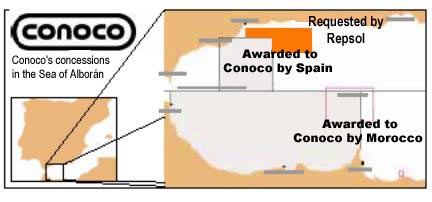
of Malaga. However, last July, Repsol applied for Siroco A, B
and C licenses, all adjacent to one another and located in the
Alboran Sea in line with the province of Malaga. These three
concessions surround those held by Conoco in Spanish waters,
literally blocking off its concessions on the northwest side.
Although there is healthy competition in the Spanish
hydrocarbon exploration sector, there have been a few cases of
similar actions, in which one company requests the perimeter
surrounding another. Obviously, this means that Repsol
considers it likely that there are hydrocarbons in the same
zone that Conoco does. Also, this movement could be considered
unfriendly since it partially closes the American company’s
access to land. This could cause operational difficulties to
Conoco, though it adds a Spanish presence to a situation in
which the American company was benefiting from a monopoly in
the Alboran Sea.
In light of all this interest, Algeria has played its ace
by calling for tenders for oil exploration in what it
considers its territorial waters on a north-south line between
Oran and Cartagena. In the framework of the fourth round of
oil concessions, which will close on December 1 of this year,
Algeria has invited tenders for exploration zones in 12 areas
of the country, with different blocks. Among the most
important of these are 143-2 and 145-1, both located along the
Algerian shore. 143-2 makes a 8,794 km2 rectangle
at the easternmost end of the Alboran Sea, ending opposite
what would be Spanish territorial waters. The other marine
block, 145-1, covers 6,924 km2 along the Algerian
shoreline near Bejaia, approximately on the 5º E parallel,
south of Minorca. In this case, the end of the block is about
200 km from Minorca and also facing Spanish waters. Both
blocks are shown in yellow on the following map prepared by
Sonatrach.
For the moment, the Algerian coast has hardly received
attention and has only been drilled on two occasions (see
The Petroleum Prospectivity of the Deep-Water Margin of
Algeria, by Michael J. Cope).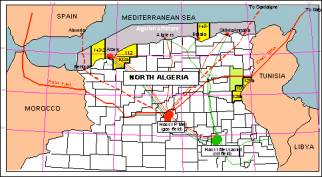 So
far, Sonatrach had preserved its coastline, which was shown on
maps of the Algerian ‘mining domain’ as a ‘research zone’
reserved for the state-owned company. This research has
consisted of a geological study of the seabed, which in the
Cartagena-Oran corridor reaches depths of up to 2 km. The fact
that Sonatrach has invited tenders for the zone could mean
that it has found reasonable signs of the presence of
hydrocarbons. This likelihood is proportional to Sonatrach’s
capacities: as the 11th biggest oil company in the
world, its technical expertise must be very high. Also, with a
business volume of US$18.1 billion in 2002, Sonatrach is
Africa’s main business group, the world’s second largest
exporter of LNG and the third largest exporter of natural
gas. So
far, Sonatrach had preserved its coastline, which was shown on
maps of the Algerian ‘mining domain’ as a ‘research zone’
reserved for the state-owned company. This research has
consisted of a geological study of the seabed, which in the
Cartagena-Oran corridor reaches depths of up to 2 km. The fact
that Sonatrach has invited tenders for the zone could mean
that it has found reasonable signs of the presence of
hydrocarbons. This likelihood is proportional to Sonatrach’s
capacities: as the 11th biggest oil company in the
world, its technical expertise must be very high. Also, with a
business volume of US$18.1 billion in 2002, Sonatrach is
Africa’s main business group, the world’s second largest
exporter of LNG and the third largest exporter of natural
gas.
This is not bad news for Spain, since geology knows no
political boundaries and the same signs could extend into
Spanish waters. Spain could thus reduce its energy dependence
on Algeria (see España profundiza su dependencia energética
de Argelia, by Iñigo Moré, http://www.realinstitutoelcano.org/analisis/86.asp).
Finally, it must be noted that Algeria is not the only
party interested in Spanish hydrocarbons. In 2003, the
prestigious American Association of Petroleum Geologists held
its international conference in Barcelona. In nearly two
hundred presentations, it exhaustively studied Spain’s oil
potential, and specifically regional geology at the main
session of the conference.
Risks and opportunities It must be emphasized that the
existence of hydrocarbons has not been proven in any of the
three zones, though there are well-founded hopes based on
previous experiences such as Poseidón and the exploration on
the Mauritanian coast. Even in the absence of these
precedents, the large amount of exploration on the limits
between Spain and the Mahgreb substantially raises the
likelihood of finding hydrocarbons at one or more of these
sites. If hydrocarbons are found, and if they spread
across both jurisdictions, negotiations on the exploitation of
the resources located would begin between the holders of
rights on either side. The problem is that Spain would start
off on the worst possible footing in this process, since it
has not signed any treaties delimiting its maritime boundaries
with Morocco or Algeria which, as we have seen, do not always
seem to coincide. Spain, meanwhile, has signed this kind of
treaties with countries as unlikely as Italy. Spain has tried
to compensate for this situation by having one of the working
groups created to re-launch Spanish/Moroccan relations focus
on this issue. The group, however, limits its activities to
maritime boundaries in the Canary Islands area. To date, there
has been no public announcement of any agreement, though it
does seem clear that the parties have the will to reach points
of agreement. At least, Rabat has not repeated its protest.
One expression of this goodwill is the successive awards of
concessions to Repsol in Gibraltar-Atlántico. On the
other hand, these concessions are almost obligatory, given the
record of the Spanish oil company in the zone, and the special
circumstances of their location. The limit between Spanish and
Moroccan jurisdiction on the Atlantic side of Gibraltar
coincides with the narrowest point in the Strait, where heavy
sea-going traffic would make the installation of oil rigs
unadvisable, even if hydrocarbons were to be found there.
Although modern technology makes it possible to face all kinds
of technical difficulties, deposits in the Strait, right in
front of Gibraltar, would likely present insurmountable
obstacles. Considering that Repsol is the title-holder on both
sides and that deposits in the middle would be more difficult
than attractive, the zone would seem to present little
potential for conflict in this respect. The situation
on the Saharan coast is more complex, since in addition to the
problem of there being no delimitation of waters, there is the
well-known dispute over the region’s sovereignty. On this
issue, two oil companies have accepted Rabat’s arguments and
two others have sided with the Polisario Front. After several
years of investigation, those working for the Polisario have
now completed their preliminary studies; this is most likely
also the case of those working in Morocco. All of them have no
doubt defined their goals in the zone and are technically
prepared to move on to the drilling stage. The area’s low
level of economic development and its energy dependence are an
incentive for this. However, the companies working with the
Polisario lack the economic resources to undertake activities
on their own. In June 2003, Fusion Oil had assets of only
AUS$16.2 million, while at the end of 2002, Premier Oil had
assets of £101 million. By contrast, the companies with
licences in Morocco are international giants with more than
sufficient economic capacity. A unilateral decision to drill
would cause tensions that could affect Spain; especially
considering that the southern limit of the Canary Islands
jurisdiction would be adjacent to the Sahara, to say nothing
of its effect in the general context of the Saharan conflict.
In this area, it seems that an orderly exploitation of
the eventual riches of the zone, in accordance with
international law, is in the interests only of Spain.
The case of the Moroccan and Algerian sides of the Alboran Sea
involves other considerations. Repsol’s arrival, surrounding
Conoco in the zone, would seem to end the monopoly that the US
company has enjoyed until now. Since the areas requested by
Repsol in the zone are far from the Spanish/Moroccan limit,
this situation is unlikely to lead to any immediate tensions,
unless the company’s endorsement of Conoco’s strategy arouses
Moroccan interest in the zone. It must be borne in mind that
Rabat has negotiated a ‘reconnaissance contract’ with Conoco
that affects the entire Mediterranean shore of Morocco, in a
broad interpretation of its jurisdiction in the zone. At any
time, Rabat could raise this contract to an ‘exploration
licence’ to allow drilling. For its part, Algeria could
contribute to arousing this interest with its decision to
invite tenders for the exploration of two maritime zones,
especially the one located in East Alboran, on the
Cartagena/Oran line. It is important to highlight that the
Algerian decision implies the delimitation of its jurisdiction
in the zone: it sets the northern limit at 36º 55’ latitude
and 0º 30’ W longitude, approximately in line with La Manga
del Mar Menor. A superficial analysis does not necessarily
lead to the conclusion that this point corresponds to the
natural line between the two countries. At this longitude,
Spain ends at Cabo de Palos at 37º 37’ latitude, while the
extreme north of Algeria at that longitude is approximately
35º 55’. The mid-point, therefore, would be about 10’ to the
south of where Algeria sets the limit of this block. For the
moment, the Spanish Ministry of Foreign Affairs has not
reacted publicly, which does not mean it has accepted this.
Technically, it would be necessary for Algeria to officially
grant exploitation rights to the zone to a specific company.
This may never happen. Given the current good relations
between Madrid and Algiers, the most likely cause of this
situation could be a simple cartographic error –a situation
also influenced by a lack of care on the part of Spain, which
does not have an official map of what are, or what it
considers to be, its waters. This situation could well be
solved by a simple conversation. It is significant that Spain,
in late 2001, made the strategic decision to strengthen its
already close energy relations with Algeria. This country is
Spain’s main energy supplier, providing 15% of the total.
Thanks to this decision, this could reach 30% by 2010 (see
España profundiza su dependencia energética de Algeria, by
Iñigo Moré,
http://www.realinstitutoelcano.org/analisis/86.asp).
Apart from territorial questions, and whether or not there are
hydrocarbons in the zone, the proximity of the Algerian and
Moroccan coasts could lead to environmental problems,
aggravated by the fact that opposite some of the exploration
zones there are tourist centres such as La Manga del Mar
Menor, the Costa del Sol and the coast of Cádiz. Such
environmental risk is almost non-existent in Spain thanks to
strict regulations. Before drilling, oil companies must inform
the Ministry of the Environment of their plans, opening a
transparent process of public consultation before any
authorization is granted. In this way, problems can be avoided
which could otherwise be irreparable. However, in countries
such as Algeria and Morocco environmental questions are not
given the priority they receive in Spain and their
environmental regulations are nominal compared to Spain’s,
which applies European standards. Without doubt, Repsol will
operate in Tangiers-Larache with the same diligence as in
Cadiz, but it is impossible to know who will obtain the
Algerian licence across from La Manga or if environmental
commitment will be included in their corporate mission
statement.
Conclusions: All this encourages the Spanish
government to continue its efforts to delimit jurisdictions
with Morocco and to extend this process to Algeria. This will
not always be up to Madrid to decide, since it takes two to
tango. For this reason, it could be useful to establish one or
more Spanish-Mahgreb institutional forums on environmental and
oil-related issues. It would even be interesting to broaden
their scope of action to energy issues in general, given the
electrical connections and gas lines between Spain and the
Maghreb. These institutions would enable information to be
shared and would serve as a basis for purely technical
initiatives such as training or professional practices. They
would even serve to coordinate efforts in emergency
situations. A possible model is the group of cross-border
institutions between the US and Mexico, such as the US-Mexico
Environment Commission or the US-Mexico Border Health
Commission (see El escalón económico entre vecinos. El caso
España-Morocco, by Íñigo Moré,
http://www.realinstitutoelcano.org/documentos/44.asp).
Iñigo Moré
Consultora Mercados Emergentes
mercadosemergentes@hotmail.com |





 Print
Print Send
Send Statistics
