
February 2004
Background | Oil | Natural Gas | Electricity | Profile | Links
United Arab Emirates
Note: Information contained in this report is the best available as
of February 2004 and can change. 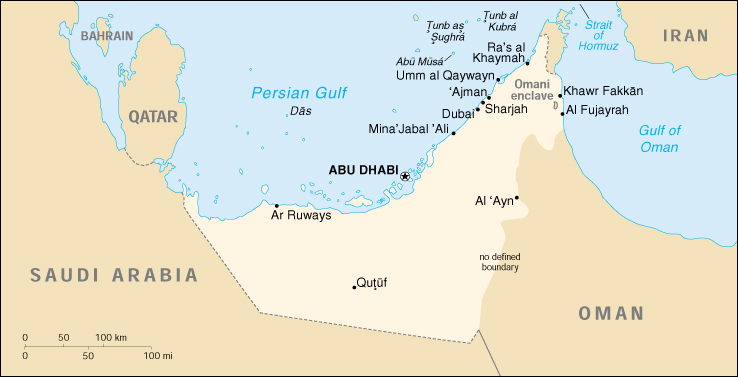 GENERAL BACKGROUND
The overall performance of the
UAE's economy is heavily dependent on oil exports, which account fornearly
30% of total gross domestic product (GDP). Growth in real GDP was 4.0% in
2003, partially due to higher crude oil prices, and it is projected to
reach 4.2% in 2004. The non-oil segment of the UAE's economy and exports
is experiencing strong growth, particularly the petrochemicals and
financial services sectors.
Government Structure
The UAE is a federation of seven
emirates - Abu Dhabi, Dubai, Sharjah, Ajman, Fujairah, Ras al-Khaimah, and
Umm al-Qaiwain. Political power is concentrated in Abu Dhabi, which
controls the vast majority of the UAE's economic and resource wealth. The
two largest emirates -- Abu Dhabi and Dubai -- provide over 80% of the
UAE's income. In June 1996, the UAE’s Federal National Council approved a
permanent constitution for the country. This replaced a provisional
document which had been renewed every five years since the country’s
creation in 1971. The establishment of Abu Dhabi as the UAE’s permanent
capital was one of the new framework’s main provisions.
Other Industry
In recent years, the UAE has undertaken
several projects to diversify its economy and to reduce its dependence on
oil and natural gas revenues. The non-oil sectors of the UAE's economy
presently contributearound 70% of the UAE's total GDP, and about 30% of
its total exports. The federal government has invested heavily in sectors
such as aluminum production, tourism, aviation, re-export commerce, and
telecommunications. As part of its strategy to further expand its tourism
industry, the UAE is building new hotels, restaurants and shopping
centers, and expanding airports and duty-free zones. Dubai has become a
central Middle East hub for trade and finance, accounting for about 85% of
the Emirates’ re-export trade. The UAE has been a member of the
World Trade Organization (WTO) since 1995, and has one of the most open
economies in the region.
Foreign Affairs
The UAE and Iran continue to dispute the
ownership of three islands, Abu Musa and the Greater and Lesser Tunb
Islands, which are strategically located in the Strait of Hormuz. All
three islands were effectively occupied by Iranian troops in 1992. The
Mubarak field, which is located six miles off Abu Musa, has been producing
oil and associated natural gas since 1974. In 1995, the Iranian Foreign
Ministry claimed that the islands are "an inseparable part of Iran." Iran
rejected a 1996 proposal by the Gulf Cooperation Council (GCC) for the
dispute to be resolved by the International Court of Justice, an option
supported by the UAE. In early 1996, Iran took further moves to strengthen
its hold on the disputed islands. These actions included starting up a
power plant on Greater Tunb, opening an airport on Abu Musa, and
announcing plans for construction of a new port on Abu Musa. In the
dispute, the UAE has received strong support from the GCC, the United
Nations, and the United States. Although Iran remains a continuing concern
for officials in Abu Dhabi, they have chosen not to escalate the
territorial dispute. The two governments have recently held high-level
discussions about the territorial dispute. Iran is one of Dubai’s major
trading partners, accounting for 20% to 30% of Dubai’s business.
OIL
The UAE contains proven crude oil
reserves of 97.8 billion barrels, or slightly less than 10% of the world
total. Abu Dhabi holds 94% of this amount, or about 92.2 billion barrels.
Dubai contains an estimated 4.0 billion barrels, followed by Sharjah and
Ras al-Khaimah, with 1.5 billion and 100 million barrels of oil,
respectively.
The majority of the UAE’s crude oil is considered light, with gravities in the 32o to 44o API range. Abu Dhabi's Murban 39o and Dubai's Fateh 32o blends are the UAE's primary export crude streams, though Dubai's production is been falling in recent years due to the decline of its modest reserves. Most of the UAE’s oil fields have been producing since the 1960s or early 1970s. Proven oil reserves in Abu Dhabi have doubled in the last decade, mainly due to significant increases in rates of recovery. Abu Dhabi has continued to identify new finds, especially offshore, and to discover new oil-rich structures in existing fields.
Under the UAE's constitution, each emirate controls its own oil production and resource development. Although Abu Dhabi joined OPEC in 1967 (four years before the UAE was formed), Dubai does not consider itself part of OPEC or bound by its quotas.
The UAE's current OPEC production quota (effective November 1, 2003) is 2.14 million bbl/d, and its crude oil production in January 2004 was 2.25 million bbl/d. OPEC cut production quotas -- effective in November 2003, and declined to raise production quotas at its meeting in December 2003. UAE crude oil production hit a high for the year of 2.35 million bbl/d in March and April 2003, before being cut back. The UAE's total production capacity is 2.50 million bbl/d, making it second only to Saudi Arabia for excess production capacity among OPEC member states.
The Abu Dhabi National Oil Company (ADNOC) is currently planning a limited opening of UAE upstream oil production to foreign firms. The initial asset sale will involve 28% of the offshore Upper Zakhum field. Bids have been solicited from BP, TotalFinaElf, ChevronTexaco, ExxonMobil, and the Japan Oil Development Company (JODCO), and but award has been delayed repeatedly. JODCO already holds a 12% stake in thew field from a previous investment in 1972, when the field was first developed.
Several projects to upgrade infrastructure at existing oilfields are planned or underway. A $318 million project to increase the capacity of the onshore Bu Hasa field is underway, including construction of natural gas separation units, drilling of natural gas reinjection wells, and water injection. The goal is to increase production capacity to 480,000 bbl/d from the present 100,000 bbl/d. A natural gas reinjection project also is planned for the onshore Bab field, which is expected to increase capacity to 350,000 bbl/d from the current 250,000 bbl/d. Upgrades planned for the onshore Asab field are set to raise capacity from the current 280,000 bbl/d to 310,000 bbl/d by 2006. These projects are part of an overall goal of raising the UAE's production capacity to 3 million bbl/d by the end of 2006, at an overall cost of $1.5 billion.
Refining
The UAE has two refineries operated by ADNOC. The
Ruwais refinery has a capacity of 145,000 bbl/d. It produces light
products mainly for export to Japan and elsewhere in Asia. Fuel oil from
Ruwais is sold as bunkers by ADNOC and also used for domestic electric
power generation. A $480-million contract was awarded to the Italian
engineering firm Technip in June 2002 for an expansion of the Ruwais
complex to a capacity of 500,000 bbl/d, including refits of existing units
and expansion of units for production of unleaded gasoline and low-sulfur
fuel oil. Work under this contract is to be completed by 2005. Umm al-Nar,
also owned by ADNOC, has a capacity of 88,500 bbl/d. Since its
construction in 1976, the Umm al-Nar plant has undergone debottlenecking
as well as a recent expansion.
UAE has three other refineries. The Emirates National Oil Company (ENOC) Jebal Ali condensate refinery, with a capacity of 120,000 bbl/d, began operations in Dubai in May 1999. Metro Oil has a 90,000-bbl/d refinery in Fujairah. A 71,250 bbl/d second-hand unit was set up by the Sharjah Oil Refining Company in 2001.
Foreign Downstream Operations
In October 1998, the
International Petroleum Investment Company (IPIC), the UAE’s downstream
investment outfit, purchased 50% of the Hyundai Oil Refinery Company of
South Korea for $500 million. The UAE is the second-largest crude oil
supplier to South Korea after Saudi Arabia. IPIC’s overseas holdings also
include a 10% stake in Spain’s CEPSA and a 19.6% share of Austria’s OMV.
NATURAL GAS
The UAE’s natural gas
reserves of 212 trillion cubic feet (Tcf) are the world's fifth largest
after Russia, Iran, Qatar, and Saudi Arabia. The largest reserves of 196.1
Tcf are located in Abu Dhabi. Sharjah, Dubai, and Ras al-Khaimah contain
smaller reserves of 10.7 Tcf, 4.1 Tcf, and 1.1 Tcf, respectively. In Abu
Dhabi, the non-associated Khuff natural gas reservoirs beneath the Umm
Shaif and Abu al-Bukhush oil fields rank among the world's largest.
Current natural gas reserves are projected to last for about 150-170
years.
Increased domestic consumption of electricity and growing demand from the petrochemical industry have provided incentives for the UAE to increase its use of natural gas. Over the last decade, natural gas consumption in Abu Dhabi has doubled, and is projected to reach 4 billion cubic feet per day (bcf/d) by 2005. The development of natural gas fields also results in increased production and exports of condensates, which are not subject to OPEC production quotas.
Projects
The past few years have seen the UAE embark on a
massive, multi-billion dollar program of investment in its natural gas
sector including a shift toward natural gas-fired power plants and the
transformation of the Taweelah commercial district into a natural
gas-based industrial zone. An ambitious plan, the Dolphin Project, to
interconnect the natural gas grids of Qatar, the UAE, and Oman, also is
underway. Most of the UAE's increased nautral gas needs in the next decade
are to be satisified with imported natural gas from Qatar. Much of the
natural gas development in the UAE itself involves the extraction of
natural gas liquids (NGLs) and reinjection of the gas to maintain pressure
in oilfields.
The second phase of the UAE's $1-billion onshore natural gas development program (OGD-2) at the Habshan complex located directly over the Bab oil and natural gas field was completed in early 2001. This second phase included the construction of four trains to process 1 bcf/d of natural gas, 300-500 tons per day (t/d) of natural gas liquids (NGLs), 35,000-55,000 t/d of condensate and up to 2,100 t/d of sulphur. Additional capacity expansion is planned in the third phase, OGD-3, and will involve the construction of two additional natural gas processing trains. Bechtel was awarded the initial engineering and design work for OGD-3 in May 2002, which was completed in 2003. Bidding on OGD-3 construction projects has begun, and six firms have prequalified to submit offers for the $1.1 billion condensate and NGL recovery facilities to be constructed at Habshan. Other parts of the OGD-3 package will be awarded under four other separate bids, including natural gas processing plants and drilling of reinjection wells at the Thamama gas deposit.
Supplying Dubai
Dubai’s natural gas consumption has been
gowing by nearly 10% annually due to expansion of the emirate's industrial
sector, a switch to natural gas by its power stations, and the need for an
enhanced oil recovery (EOR) system based on natural gas injections for its
mature oilfields. Dubai projects future demand will average 810 Mmcf/d in
2005, with major swings between summer and winter consumption patterns.
Until mid-2001, Dubai’s entire natural gas supply came entirely from
fellow UAE member Sharjah. BP operates three fields and the 800-Mmcf/d
Sajaa processing facility in conjunction with the Sharjah
government. In May 2001, a pipeline from the Maqta area of Abu Dhabi
to Dubai commenced operations, initially delivering 200 Mmcf/d of natural
gas. The capacity of the pipeline is to be raised from the present
550 Mmcf/d to 800 Mmcf/d by the addition of new compressor stations over
the next year.
The Dolphin Project
The Dolphin Project aims to develop
links between the natural gas infrastructures of Qatar, the UAE, and Oman.
It will allow the export of non-associated natural gas from Qatar's
massive offshore North Dome field. A Statement of Principles for the
project was signed in March 1999 between the UAE Offsets Group (UOG) and
Qatar Petroleum. The two firms signed a natural gas sales agreement
in March 2001, with natural gas supplies expected to start in late 2006.
Estimated to cost $8-10 billion over the next decade, the project will
begin as a subsea pipeline from Ras Laffan in Qatar to a landfall in Abu
Dhabi, which will then be extended to Dubai and northern Oman. It will
start at 48 inches in diameter, narrowing to 30 inches by the time it
reaches Oman. In its initial phase, the pipeline is to carry 3 Bcf/d of
Qatari natural gas to the UAE and Oman, accounting for nearly 10% of total
world natural gas supplies shipped by pipeline.
In October 1999, UOG and ADNOC issued a joint declaration dividing up natural gas distribution between them. Natural gas from the Dolphin Project will be the exclusive supply for natural gas-fired power plants, except in the Western Region of Abu Dhabi, and will also supply natural gas for ADNOC contracts with Dubai. Natural gas from the Dolphin Project will use the ADNOC distribution network until the project develops its own network. In March 2000, UOG signed a contract with two foreign firms, TotalFinaElf and Enron, after securing purchase agreements with Abu Dhabi, Dubai, and Oman. Originally, the two main foreign firms participating in the project were Enron and TotalFinaElf. In May 2001, however, Enron announced that it was backing out of the project, and selling its 24.5% stake back to UOG. UOG sold this share to Occidental Petroleum in June 2002 after receiving bids from several foreign companies. Upstream development in Qatar began in 2003, and initial deliveries of natural gas to the UAE are expected to begin in 2006.
Oman already has a natural gas pipeline to Fujairah in the UAE, and until supplies from Qatar become available, Fujairah is importing natural gas from Oman, under a contract held by Dolphin Energy. Supplies of 135 Mmcf/d of Omani natural gas commenced in January 2004 -- the first natural gas transmission across national borders on the Arabian Peninsula. Eventually, Qatari natural gas will be supplied to Fujairah, and the direction of the pipeline will be reversed, allowing for Omani imports of Qatari natural gas.
ELECTRICITY
The UAE’s soaring
demand for electric power, coupled with volatile swings in peak loads, led
the Emirates in 1997 to form a Privatization Committee for the Water and
Electricity Sector. In early 1998, the committee called for a
comprehensive restructuring, including the elimination of the state-owned
Abu Dhabi Water and Electricity Department (ADWED). ADWED was
transformed into a regulatory body, the Abu Dhabi Water and Electricity
Authority (ADWEA). The government plans to take a majority holding in the
new ventures with minority interests held by foreign firms. The
government may gradually privatize its shares through initial public
offerings (IPOs), allowing UAE nationals to become shareholders, though
this is still uncertain.
TotalFinaElf and Tractebel were awarded a contract by ADWEA in August 2000 for an upgrade to the Taweelah A-1 plant, which gives a 20% ownership stake to each of the foreign partners, with the rest remaining with ADWEA. The upgrade was completed in May 2003, and the facility now has an installed capacity of 1,350 Megawatts (MW).
Another step in the reorganization was the expansion of the Taweelah cogeneration facility. The expansion, known as Taweelah A-2, is the UAE’s first independent water and power project (IWPP), and reached financial close in April 1999. It is the second independent power project in the Gulf after Oman’s al-Manah facility. With a price tag of some $800 million, the expansion is to add about 763 megawatts (MW) of power and 50 million gallons of desalinated water to the UAE’s supplies. The first 370-MW came online in July 2000. The rest of the generating units became operational in August 2001. The Taweelah A-2 project is run by Emirates CMS Power, a joint venture between CMS Energy (40% ownership interest) and the newly-formed Emirates Power Company (EPC) (60%).
The al-Taweelah Power Company manages the Taweelah B facility. The plant, which currently has six 122-MW steam turbines and six 13 million gallon-per-day (g/d) multi-stage flash units, is now undergoing a $360 million expansion. The addition of two new natural gas-turbine units will bring the plant’s capacity to 1,220 MW and 103 million gallons per day (g/d) of water. A request for bids on the project is expected to be released in the first quarter of 2004.
The Umm al-Nar Power Company operates the plant by the same name with an 850-MW, 162-million-g/d facility. ADWEA received bids in November 2002 for the partial privatization of the company, which will be structured similarly to the two Taweelah IWPPs. The sale of a 40% was awarded to a consortium including Tokyo Electric Power (TEPCO), Mitsui, and International Power of the UK in April 2003. It reached financial close in June 2003. The consortium will be undertaking a 1,550-MW capacity expansion at the site, to be completed in mid-2006. In mid-2008, the old 850-MW generation unit will be handed back over the ADWEA for decomissioning.
The Abu Dhabi Water and Electricity Authority (ADWEA) signed a contract for the Shuweihat IWPP project in August 2001 with a consortium of CMS Energy and International Power PLC. The $1.6 billion deal provides for the construction and operation of a 1,500-MW combined cycle plant with a desalination capacity of 100 million gallons per day. Construction began in early 2002, with commercial operation expected by the end of 2004.
The UAE also is taking part in a $1-billion plan to build a regional power grid throughout the countries of the Gulf Cooperation Council (GCC). The first phase of the plan would link Saudi Arabia, Kuwait, Bahrain and Qatar; the UAE and Oman would join the grid in the second phase of the plan. GCC electricity ministers signed a final agreement on the project in June 1999. The plan is based on the assumption that each country will have its own unified power grid, and the UAE is doing its part by connecting all the power stations along its western coast with the central region. A contract for impementation of the grid interconnections was awarded to Electricte de France (EdF) in early 2003.
Sources for this report include: CIA World Factbook 2003; Dow Jones News Wire service; Economist Intelligence Unit ViewsWire; Global Insight Middle East Economic Outlook; Gulf News; Oil and Gas Journal; Petroleum Economist; Petroleum Intelligence Weekly; International Market Insight Reports; U.S. Energy Information Administration; World Gas Intelligence.
COUNTRY OVERVIEW
President: Sheikh Zayed bin Sultan Al Nahayan
Prime
Minister: Sheikh Maktoum bin Rashid al-Maktoum
Independence: December 2, 1971 (from United Kingdom)
Population (2003E): 2.5 million
Location/Size:
Persian Gulf between Oman and Saudi Arabia/30,000 square miles
Major Cities: Abu Dhabi (capital), Dubai, Sharjah, al-Ain
Languages: Arabic (official), Persian, English, Hindi, Urdu
Ethnic Groups: Arab (UAE citizens) (19%), other Arab and
Iranian (23%), South Asian (50%), other expatriate (Western and East
Asian) 8%.
Religion: Muslim 96% (Shi’a 16%), Christian, Hindu,
Other 4%
ECONOMIC OVERVIEW
Currency: Dirham (AED)
Market Exchange Rate (2/2/04): US$1 = 3.67 Dirhams
Gross
Domestic Product (2003E): $79.9 billion (2004F):
$85.8 billion
Real GDP Growth Rate (2003E): 4.0%
(2004F): 4.2%
Inflation Rate (consumer
prices)(2003E): 2.5%
Major Trading Partners: Japan, United
Kingdom, United States, Singapore, Germany, South Korea, Iran,
India
Current Account Balance (2003E): $8.1
billion
Merchandise Exports (2003E): $50.2 billion
Merchandise Imports (2003E): $39.7 billion
Merchandise
Trade Balance (2003E): $10.5 billion
Major Export Products:
Crude oil, natural gas, re-exports, aluminum, dried fish, dates
Major Import Products: Manufactured goods, machinery, and
transportation equipment, food
International Reserves (2003E):
$14.0 billion
ENERGY OVERVIEW
Minister of Petroleum and Mineral
Resources: Obeid bin Saif al-Nasiri
Proven Oil Reserves
(1/1/04E): 97.8 billion barrels
Oil Production (2003E):
2.65 million bbl/d, of which 2.24 million bbl/d is crude oil
OPEC
Crude Oil Production Quota (effective 11/1/03): 1.89 million bbl/d
Crude Oil Production Capacity (1st Quarter of 2004): 2.50
million bbl/d
Oil Consumption (2003E): 310,000 bbl/d
Net
Oil Exports (2003E): 2.34 million bbl/d
Major Crude Oil
Customers (2003E): Japan (about 60%), other Far East (about 20%)
Crude Oil Refining Capacity (1/1/04E): 514,250 bbl/d
Natural Gas Reserves (1/1/04E): 212 trillion cubic feet (Tcf)
Natural Gas Production (2001E): 1.59 Tcf
Natural Gas
Consumption (2001E): 1.34 Tcf
Net Natural Gas Exports (2001E):
0.25 Tcf
Electric Generation Capacity (1/1/01E): 5.6
gigawatts
Electricity Production (2001E): 37.7 billion
kilowatthours
ENVIRONMENTAL OVERVIEW
Minister of Electricity &
Water: Humayd bin Nasir al-Uways
Total Energy Consumption
(2001E): 2.1 quadrillion Btu* (0.4% of world total energy consumption)
Energy-Related Carbon Emissions (2001E): 35.3 million metric
tons of carbon (0.5% of world total carbon emissions)
Per Capita
Energy Consumption (2001E): 775.5 million Btu (vs. U.S. value of 341.8
million Btu)
Per Capita Carbon Emissions (2001E): 13.3 metric
tons of carbon (vs. U.S. value of 5.5 metric tons of carbon)
Energy
Intensity (2001E): 32,619 Btu/$1995 (vs U.S. value of 10,736
Btu/$1995)**
Carbon Intensity (2001E): 0.56 metric tons of
carbon/thousand $1995 (vs U.S. value of 0.17 metric tons/thousand $1995)**
Fuel Share of Energy Consumption (2001E): Oil (31.9%), Natural
Gas (68.1%), Coal (0.0%)
Fuel Share of Carbon Emissions (2001E):
Natural Gas (58.9%), Oil (41.1%), Coal (0.0%)
Status in Climate
Change Negotiations: Non-Annex I country under the United Nations
Framework Convention on Climate Change (ratified December 29th, 1995). Not
a signatory to the Kyoto Protocol.
Major Environmental Issues:
Lack of natural freshwater resources being overcome by desalination
plants; desertification; beach pollution from oil spills.
Major
International Environmental Agreements: A party to Conventions on
Climate Change, Desertification, Endangered Species, Hazardous Wastes,
Marine Dumping and Ozone Layer Protection. Has signed, but not
ratified, Biodiversity and Law of the Sea.
* The total energy consumption statistic
includes petroleum, dry natural gas, coal, net hydro, nuclear, geothermal,
solar, wind, wood and waste electric power. The renewable energy
consumption statistic is based on International Energy Agency (IEA) data
and includes hydropower, solar, wind, tide, geothermal, solid biomass and
animal products, biomass natural gas and liquids, industrial and municipal
wastes. Sectoral shares of energy consumption and carbon emissions are
also based on IEA data.
**GDP based
on OECD Purchasing Power Parity (PPP) figures for non-OECD
countries
OIL AND NATURAL GAS INDUSTRIES
Organizations: Abu
Dhabi National Oil Company (ADNOC); Operates three main oil and natural
gas operating companies, five Service companies, three joint ventures to
fully utilize the produced natural gas, two maritime transport companies
for crude oil, refined product and LNG and one refined product
distribution company.
Major Refineries: Ruwais (145,000 bbl/d),
Emirates National Oil Company (ENOC) - Dubai (120,000), Umm al-Nar (88,000
bbl/d), Metro Oil (Fujairah)(90,000 bbl/d), Sharjah Oil Refining Company
(71,250)
Major Natural gas Processing Plants: Bab, Bu Hasa, Das
Island, Habshan (2), Jebel Ali, Ruwais
Major Oil Fields: Abu
Dhabi: ‘Asab, Bab, Bu Hasa, Al-Zakum Dubai: Fallah, Fateh,
Southwest Fateh, Margham, Rashid Sharjah: Mubarak (near Abu Musa
Island)
Major Associated Natural gas Fields: Abu Dhabi:
Abu al-Bukhush, Bab, Bu Hasa, Umm Shaif, Zakum
Ports: Abu
Dhabi: Das Island, Delma Island, Jebel as Dhanna, Ruwais, Abu al
Bukhush, Al Mubarraz, Zirku Island, Port Zayed, Umm al Nar Dubai:
Jebel Ali, Fateh, Port Rashid Sharjah: Mubarak
LINKS
For more information from EIA on United Arab Emirates, please see:
EIA -
Country Information on the United Arab Emirates
Links to other U.S. government sites:
CIA
World Factbook - United Arab Emirates
U.S.
State Department Country Commercial Guide - United Arab Emirates (requires
Adobe Acrobat Reader)
U.S. State
Department Report on Economic Policy and Trade Practices - United Arab
Emirates
U.S. State
Department Consular Information Sheet - United Arab Emirates
U.S. Embassy, Abu Dhabi
U.S. Department of
Energy - Office of Fossil Energy - International section - United Arab
Emirates
The following links are provided solely as a service to our customers, and therefore should not be construed as advocating or reflecting any position of the Energy Information Administration (EIA) or the United States Government. In addition, EIA does not guarantee the content or accuracy of any information presented in linked sites.
Abu Dhabi National Oil Company
(ADNOC)
Abu Dhabi Water and
Electricity Authority (ADWEA)
Dolphin Energy
UAE Goes Green
ArabNet: United Arab
Emirates
University of
Texas Center for Middle Eastern Studies - United Arab Emirates
Maps
of the Middle East
MENA
Petroleum Bulletin
AME Info
Middle East Business Information
Planet Arabia.com
Return to Country
Analysis Briefs home page
File last modified: February 4, 2004
Contact:
Lowell Feld
lfeld@eia.doe.gov
Phone:
(202)586-9502
Fax: (202)586-9753
