|
 |
1c
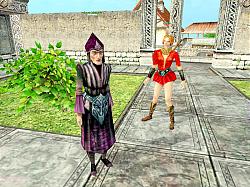
Players of Sphere create alter egos and form
alliances to fight with rival clans. |
| | .gif)
Digital Armies
With 15,000 computer warriors signing up in just
three months, a massive Russian role-playing game, Sphere, spells
big digital business.
By Alexander Osipovich
At first glance, Alexander Fomin, a 27-year-old
system administrator from Novosibirsk, leads a fairly mundane
existence. But in fact, for the past three months, Fomin has been
slaying monsters, storming castles and exploring a vast continent in
a parallel universe slowly headed for annihilation.
Fomin is
one of 15,000 players in an online computer game called Sphere,
which was launched in November by a partnership of three Russian
companies: the software publisher 1C, the game developer Nikita and
the web portal Yandex. To people in the game industry, Sphere is
known as a MMORPG -- a Massively Multiplayer Online Role Playing
Game. The MMORPG genre has existed in the West for several years
(the most popular example, EverQuest, has close to 450,000 players
worldwide), but Sphere is the first MMORPG developed in Russia and
catering specifically to Russian players.
Like many other
MMORPGs, Sphere is based on an alternate reality with a complex
history and mythology. But unlike the Tolkienesque world of
EverQuest, Sphere's history is intertwined with our own. Legend has
it that Sphere came into being in 1348, when a French monk invoked
an ancient Sanskrit mantra for the creation of parallel universes.
But everything went horribly wrong when the monk got burned alive
for heresy just as he was completing the ritual. The world he
created was taken over by hellish monsters bent on destroying it and
then moving on to our own unsuspecting Earth. Luckily, there is a
still a way to stave off our impending destruction -- by becoming
players and paying $5 a month to battle medieval monsters in the
troubled world of Sphere.
Online games such as EverQuest and
Sphere are fundamentally different from traditional video games.
Instead of punching buttons to defeat a computer-generated enemy,
players in a MMORPG have a more complex set of objectives -- to
develop alter egos and form alliances with other players. In Sphere,
the social aspect of the game is critical, because players cannot
accomplish much individually. But by banding together with other
players in "clans," they can take over castles or feud with rival
clans. Joining a clan also has some social advantages. A few lucky
couples have even had virtual weddings.
Personal satisfaction
aside, Sphere represents a breakthrough for the Russian game
industry. As a technical achievement, it is on a par with Western
MMORPGs such as EverQuest or Ultima Online. Reviewers have praised
the game's three-dimensional graphics, which pop up quickly even on
dial-up connections. According to 1C sales director Nikolai
Baryshnikov, getting the game to work on slow Internet speeds was a
challenging task.
"From the beginning, we faced a big
technical problem -- how to make a game that would work well over
our absolutely abominable phone lines," he said in a recent
interview.
The other main problem was economic. Since few
Russians have credit cards, 1C developed another scheme for online
payment, partnering up with Yandex to use Yandex-Dengi, a
ruble-based payment service similar to the dollar-based service
PayPal. Players interested in a low-tech alternative can also
re-subscribe by buying a fresh Sphere CD for about $6 every month. A
monthly subscription to Sphere costs about half as much as
EverQuest's, opening the door to cash-strapped Russian
gamers.
So far, the response to Sphere has been strong, with
15,000 players signing up in the first three months. Baryshnikov
hopes to expand Sphere beyond Russia's borders by setting up Sphere
spin-offs in other languages.
If 1C and game developer Nikita
play their cards right, Sphere could become big business. Worldwide,
MMORPGs form only a small part of the computer game market, but they
are renowned for the loyalty of their players, which notoriously
borders on addiction. EverQuest fans refer to their game as
"EverCrack" because of its addictive pull. Some players will play 20
or 30 hours a week, and the game has also been associated with
depression and suicide.
Just three months into its
existence, Sphere already has its devotees. Some players have
offered real money for fantasy items that increase their characters'
power. In a recent forum posting, one player put up $100 for a rare
magical robe to help his character fight, and, according to 1C game
developer Dmitry Laskov, another player offered $350 to buy an
actual character. With such a character -- in this case, a powerful
wizard -- a player could soar up the social hierarchy of Sphere,
perhaps even becoming a clan leader.
Over a hundred clans,
with dozens of members each, now operate in the Sphere universe.
Some clans even have their own web sites, designed to attract new
members and promote the clan's ideology. On the web site for Mad
Dogs, a self-proclaimed "dark clan," the leaders VIPer and Tezarius
invite other players to support their evil agenda.
Meanwhile, the Defenders of Light call on players to battle
the forces of darkness, which include a few elements from a more
familiar world. In particular, the Defenders hope to defeat the
United States of America -- "a beachhead," they say, "for the
invasion of the Devil." |