“We
Invite People to Think the Unthinkable”
An
Interview with Nizar Saghieh
Nizar
Saghieh is a lawyer and a charter member of Hurriyyat
Khassa (Private Liberties), a Lebanese human rights organization
founded on October 1, 2002. He has published widely in Arabic on
such topics as reform of the judicial system and the memory of war.
Sara Scalenghe, a doctoral candidate in
history at Georgetown University, conducted this conversation with
Saghieh by e-mail in February 2004.
|
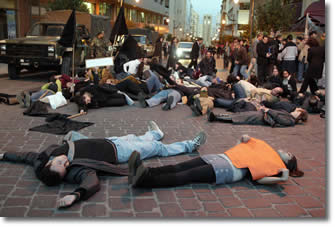
Activists
from Hurriyyat Khassa and others stage a "die-in" in Beirut to
protest the impending executions of three men, January 2004.
The executions were Lebanon's first since 1998. (Joseph
Barrak/AFP) |
What
prompted you to found Hurriyyat Khassa, and what are its
goals?
There was no
particular event that inspired our group’s formation. It was
Lebanese socio-political conditions as a whole. Despite diverse
backgrounds, all of our members agree that individuals should have
sovereignty over their private affairs, while also having access to
equal participation in public affairs. This is called for by the
public interest, as well as justice and reason. However,
Hurriyyat Khassa members have found that the Lebanese regime
often systematically aims for the opposite—to interfere in private
affairs while restricting participation in public affairs.
Confessional sentiments and interests are always used to implement
this policy. (The elaborate system of political power sharing and
social interaction between Maronite Christians, Sunni Muslims,
Druze, and other communities is known in Lebanon as the confessional
system.) Therefore, our members include in the notion of private
liberties the freedom of creed and the freedom not to belong to any
confession at all. Hurriyyat members also lobby for a
personal civil status law that allows people to form bonds outside
of confessional constraints. Such a law would lead to the
democratization of the family and equality of the sexes,
decriminalization of homosexuality, and protection of the rights of
sex workers and domestic workers who are stuck in virtual or actual
slavery. Hurriyyat believes that the current official
multi-confessional lifestyle and political system that is imposed in
Lebanon actually encourages the persistence of sectarianism,
threatens the fulfillment of many individuals and alienates many
from participating in the public sphere. The idea is that advocating
for personal and private liberties—including those that are in
conflict with religious values—would empower dissidence and weaken
confessional affiliation and identity.
Why
would your type of advocacy necessarily lead to broader political
change?
Spinoza argued
that reason remains inefficient vis-à-vis emotions unless it becomes
emotion itself. We believe we can succeed only by allowing reason to
grant legitimacy to non-recognized emotions, which may then become
much stronger than the predominant community feelings and interests.
Our membership includes independent lawyers, artists and journalists
who previously worked on various human rights issues. Others are
leftist activists belonging to the group Khatt Mubashir. A few
identify themselves as gay and are members of an ad hoc group called
HeLeM (“dream,” in Arabic). We use both reason and emotion to lobby
for various causes, including gay rights. We conduct research and we
hold conferences, but we also produce creative short films and
posters to capture the emotions behind the issues. Activism and
participation in demonstrations are often as important to us as
conferences and research. For example, on January 16, 2004,
Hurriyyat led a sit-in against the death penalty in front of
Parliament. Our researchers and lawyers took part in an earlier
“die-in” covered by the Lebanese media. But our main focus has been
to examine amendments to the penal code, proposed in November 2002,
which conflict with human dignity. Three main points grabbed our
attention in this pseudo-reform of the penal code: privatization of
the public sphere, increasing interference in private space and the
marginalization of many segments of society. We organized a very
successful conference last May, and continue to lobby with other
NGOs to implement its published recommendations.
How is
Hurriyyat Khassa involved in promoting the rights of sexual
minorities in Lebanon?
Although some
of our members identify as gays or lesbians and promote community
solidarity, Hurriyyat Khassa’s approach is less concerned with
founding communities upon sexual orientation than with fighting
against exclusion or marginalization. We address sexuality issues
through the wider scope of the right to human dignity, the right to
be different, the right to decide freely about private affairs, the
right to be fully recognized as an individual and a citizen, and the
freedom of creed. The challenge for us is to put an end to the
social taboo related to homosexuality without being marginalized or
considered extremist. While pursuing this objective, we always
strive to create a forum for discussion and, in particular, to find
appropriate discourse that is in harmony with the ambient culture.
We have learned to adopt the Trojan horse method—to introduce a
socially unaccepted idea under the umbrella of a socially accepted
idea. During last May’s forum on human dignity in the penal code,
for example, we showed the filmed testimony of a young gay man,
threatened with death by his own family, and claiming his need for
love. Also, we addressed homosexuality in a paper for a session on
marginalized identities that also included war victims and the poor.
Of course, our lawyers do not hesitate to defend people for
practicing homosexuality without covering it up under another issue.
However, it is rare that we are solicited for such cases, as
homosexual practices are rarely prosecuted by themselves. They are
generally prosecuted when there is some other crime, or the
homosexual act involves a minor, or there are some other special
circumstances. One of the cases we have addressed involved
Hizballah, whose security forces arrested many young men for
same-sex sexual acts in 2003 and delivered them to the Lebanese
police. The men were charged under the current penal code, which
penalizes “unnatural” copulation with up to one year of
imprisonment. They were released shortly afterward and, as yet, no
hearing date has been set. The [May] conference’s recommendations
include the decriminalization of homosexuality and were adopted by
many other human rights organizations. So we have succeeded in
inscribing homosexual rights on the Lebanese human rights agenda.
How has
the Lebanese government responded to Hurriyyat Khassa?
The standard
response of the government to civil society initiatives is: no
repression, no encouragement, distant monitoring, no guaranteed
rights. Our actual legal status is a “civil partnership,” almost a
research center, so we did not require any government-issued
authorization. Has there been any attempt to intimidate us or to
restrain our activities? No, although we are openly raising
controversial issues and have many times strongly criticized the
government’s position. Is there, on the other hand, any cooperation
or encouragement? Not really. We have been invited to send the
recommendations of the penal code conference to the parliamentary
committee on human rights and we are expecting more cooperation from
other deputies and committees. We are often invited by government
bodies, such as those working on children’s rights or AIDS, to
attend meetings and so on. At any rate, one may say that, at this
stage of our development, we are more enthusiastic about finding
allies within civil society, raising awareness in the public sphere,
finding the most convincing language and otherwise building our
capacities. It is too early to appreciate the government’s
willingness to cooperate. In six months, maybe things will be
clearer.
What
about the media and the general public?
The press is
our favorite partner, and has given our activities extensive
coverage. Of course, the extent to which homosexual issues are
tolerated varies from newspaper to newspaper, and even from
journalist to journalist. One time, a major newspaper published one
of our communiqués only after it had removed our reference to “gay
rights.” The same newspaper refused to publish our communiqué
related to the aforementioned Hizballah incident, for political
reasons, I think. Another time, a female journalist from a minor
Lebanese newspaper asked us to abstain from talking about
homosexuality if we wanted to be covered by her newspaper. Of
course, we refused to comply. I learned afterwards that this
journalist, who had attended the entire penal code forum, had a hard
time with her editor, but in the end she succeeded in publishing a
story on the forum, with a brief reference to homosexual rights.
Access to TV networks is more difficult, though we managed to get
coverage of the forum from some channels. Also, we were hosted by a
morning program for six consecutive days to talk about the forum.
Concerning the public, I think we have succeeded mightily in
breaking the taboo without being rejected, labeled or considered
extremists. In 2002, we had true difficulty in attracting
well-positioned people, but now Hurriyyat is ranked among the major
human rights organizations in Lebanon. In the beginning, we were
bothered by the fact that once the topic of homosexuality was
mentioned in meetings, it became the sole subject of debate. We have
now learned how to overcome this blockage, in order to keep the
principles or the concept of Hurriyyat Khassa present in people’s
minds. Finally, I think that the public in Lebanon is more flexible
on homosexual issues than is generally perceived. It is enough to
break the taboo in a non-confrontational manner. One member of the
audience at the forum discussions, in the course of five minutes,
renounced many times his a priori ideas regarding
homosexuality in response to the audience’s reaction. To think the
unthinkable—that is what Hurriyyat invites people to do.
How do
Lebanon’s religious parties and authorities relate to sexual
minorities?
To define
homosexuality legally as an “unnatural act” aims mainly at giving
transcendental basis to its criminalization. Yet homosexuality is
generally only prosecuted in cases in which it is otherwise morally
difficult to mount a defense. In general, there is a great deal of
hypocrisy and denial about homosexuality in Lebanon. In
February-March 2002, a widespread, baseless rumor about “Satan
worshippers” linked to homosexual practices was given credence by
police raids and never-completed legal proceedings, as well as
official statements. During that period, religious voices took
advantage of the occasion to reiterate their traditional position
against homosexuality. They urged parents to safeguard their
children’s morality against “satanic” bid‘a (new practices
which are contrary to religion) such as homosexuality. Moreover, the
“Committee for the Preservation of Moral Values,” representing the
main recognized sects in Lebanon, used the word bid‘a to
demonize homosexuality and even civil marriage. This committee is
currently preparing draft essays on “moral values” and lobbying to
integrate them into school curricula. Apart from the aforementioned
case, Hizballah generally avoids social debates even though it
propagates its moral values among its members and supporters.
If
there is a gay subculture in Lebanon, is it limited to the capital,
Beirut?
In the absence
of statistics and real scientific studies, I can only share my
impressions with you. Maybe one can say that this subculture is
being formed and thus presents lots of uncertainty and
contradictions. There are some practices which vary from one area to
the other. Sure, Beirut is more accustomed to various practices than
other areas. Nevertheless, same-sex practices are widespread and
some cities are even traditionally known for their particular
practices. Most of these practices remain at the stage of behavior,
not lifestyle. They are clandestine and thus marginalized. They are
more widespread among the poor and outside Beirut. As for the
manifestation of homosexuality as an identity, the predominant model
to follow at this stage is the Western model. In both cases, the
people involved are in a state of rupture with their society, a fact
that renders interaction and communication more
difficult.
Do you
mean that “the Western model” is inappropriate within Lebanese
culture?
Hurriyyat
speaks with an Arab voice, as we aim to legitimize homosexual
feelings and relations in the Lebanese context. We believe, of
course, that the homosexual choice responds to human needs and that,
therefore, it has a universal basis. However, we believe that social
recognition requires interaction between the individual and the
society. Such interaction is more likely to occur if the society
recognizes its history related to homosexuality and the human needs
of its citizens, instead of denying them. Further, the possibility
of interaction presupposes that homosexuals themselves have reached
a certain stage of reconciliation between their sexual identity and
the surrounding culture. Producing literature and art in Arabic
related to homosexuality is an important step towards reconciling
homosexuals with their native language. Also, the study of actual
Arab history—laws, practices, poetry—is the best way for society,
and in particular homosexuals, to reconcile with the Arab memory
regarding homosexuality and also to find out the rational rules for
the present time. For example, some notions in the Arab legal
heritage may constitute a basis for the right to privacy, such as
the well-known precept “man satar ‘ala muslim satar Allah
‘alayhi” (“whoever keeps confidential information related to
unlawful sexual acts, his/her reputation will be preserved by God”).
At any rate, Hurriyyat always focuses on the public interest. We try
to prove that the criminalization of homosexuality in Arab history
was related to the Islamic regime requirements (rationalité
axiologique, to use Weber’s classification), and has never been
justified by reasons inherent to homosexuality (rationalité
intrinsèque). So, yes, the emerging Lebanese gay subculture has
been influenced by the West in many ways, through TV, films, the
Internet, periodicals, nightclubs and especially through contact
with the Lebanese diaspora following the civil war. If such
influence seems predominant in homosexual practices and behavior, it
is because it is the only public model for those having such
tendencies. In advocating for legitimacy on the basis of
Arabo-Islamic values and human needs, we hope to render non-Western
models possible, too.
How
does religious sectarianism affect gay identity politics in Lebanon?
First, it is
well-known that all recognized religions in Lebanon condemn
homosexuality. One may expect, in theory, that this fact would
render homosexuals rebellious against the confessional system.
However, reality seems different—the homosexual’s confessional
identity is still stronger than his/her sexual identity. The
solution to this contradiction is to render homosexuals more
confident in the legitimacy of their sexual identity or choices. A
positive example of solidarity across sectarian lines is the
organization of the families of persons who “disappeared” during the
civil war. Those families, coming from different sects, have
successfully cooperated since 1983, even during the war. Their love
overcame their communitarian identities. In Hurriyyat, as well as in
HeLeM, there is no room for confessional cleavages. Finally, it is
worth mentioning that the various confessions are unevenly
distributed across economic and geographic divisions. This implies a
certain difference as to the acceptability of homosexuality in one
confession or another.
Do you
mean that gay identity politics are mainly confined to the (often
Western-) educated middle and upper classes?
I think that
the imitation phenomenon in Lebanon—the communication of new
practices and manners—is important and things are evolving very
fast, in particular inside Beirut and its suburbs. However, while
those who identify themselves as gay people do not belong to one
particular social class, those who assume their sexual identity
socially are mostly from the middle class. Class considerations are
also present in homosexual relationships, in the sense that
homosexuals of different social status are less likely to form
relationships.
Is
Hurriyyat Khassa working on AIDS-related issues?
Hurriyyat works
on AIDS issues from a human rights perspective, that is, we work to
institute the necessary legal reforms to prevent AIDS or
discrimination against HIV-positive people. The institutions working
on AIDS always express their unhappiness about the criminalization
of homosexuality which, by virtue of its targeting of homosexuals,
somewhat hinders progress on AIDS issues. To the best of my
knowledge, HeLeM, our sister organization, is the only organization
which is making the link between the gay community and organizations
working on AIDS. So far, however, HeLeM has not received any funds.
Does
Hurriyyat Khassa cooperate with LGBT rights groups in Europe and in
the US?
So far, there
has been no cooperation with those organizations. Our current focus
in Lebanon is on decriminalizing homosexuality, while Western gay
rights organizations overcame this obstacle decades ago. Hurriyyat
is very concerned with its independence vis-à-vis all kinds of
power, in particular the problem of donor-driven agendas. That said,
we are interested in building relations based on mutual respect with
international or Western organizations, provided they are also
independent and share Hurriyyat’s main ideas about justice and human
dignity. However, I think that our focus, in the future, should be
to create a network for private liberties in the Arab
world.