All Eyes on Google
In six short years,
two Stanford grad students turned a simple idea into a multibillion-dollar
phenomenon and changed our lives. Now competitors are searching for a way to
dethrone the latest princes of the Net
|
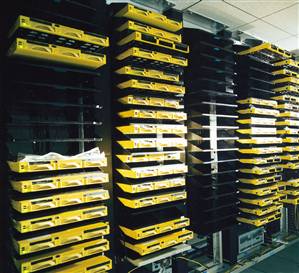
Timothy Archibald for Newsweek Nerve center:
Google's |
|
By
Steven Levy
Newsweek
March
29 issue - Short of "you're under arrest," there are very few things
that the leaders of a young technology company would like less to hear than
"Bill Gates thinks you've kicked his butt and now he wants your
business." But Sergey Brin and Larry Page don't
seem ruffled at all. Hanging out one day in their spacious new headquarters,
the two young cofounders of Google are calm, even
confident, in the face of a rising tide of competitors, technology challenges
and the tricky process of using the principles of disorganization to build a
substantial company out of one unquestionably brilliant idea.
|
advertisement |
Let's
face it—it's good to be Google. Every minute,
worldwide, in 90 languages, the index of this Internet-based search engine
created by these Stanford doctoral dropouts is probed more than 138,000 times. In
the course of a day, that's over 200 million searches of 6 billion Web pages,
images and discussion-group postings. Searches for golf
clubs, song lyrics, tomorrow night's blind date, recipes and the unaltered
screen shots of Janet Jackson's Super Bowl boo-boo. Amazingly, the
majority of those queries evoke satisfactory, even revelatory, results. Google has changed the way the world finds things out, and
enticed it to look for things previously considered unfindable.
|
||||||||||||||||||||||||||||||||||||||||||||||||||||||||||||||||||||||||||||||||||||||||||||||||
 Live
Vote
Live
Vote


Not
only has Google very famously become a verb, but
Here
they are, outlining their plans for getting all the
world's information on their thousands of servers and delivering it to anyone
who can peck a query into a search field. Brin, 30,
the ruminative Russian-born son of a math professor who is Google's
business visionary, won't sit down: he's bothered by a mild injury incurred by
his hobby of gymnastics. As Brin stretches,
31-year-old Page, the guardian of Google's
secret-sauce search techniques, tells a story.
"I
was researching big computer networks the other day, networks," he says. "I
put this really strange query into Google, and got
this research paper with the exact things I wanted. Which
would have been a many-hour process normally. It took all of 30 seconds.
I gave it to a bunch of people in the company, and now we have this project. It's
very likely that I wouldn't have done that at all if it had been more
difficult. I think the value of that can be very large, making the world more
efficient."
|

Exactly. Google
has made such eureka moments as common as sneezing. Who hasn't had such a
revelation on Google, whether the discovery was an
old girlfriend's whereabouts or a cutting-edge treatment for a rare disease? Amazing
to consider that less than a decade ago, search was a backwater, deemed not
very interesting and certainly not very profitable. Instead, Internet companies
put their energy into developing feature-laden "portals." Then came
Larry and Sergey, and search became the center of the
Internet universe. "Search is the ultimate killer online app," says
Bob Davis, former CEO of Lycos. "The Internet without search is like a
cruise missile without a guidance system."
The
rest of the industry has noticed. Boy, has it noticed.
To quote the numbers, Safa Rashtchy
at Piper Jaffray reports that annual search revenues
are just under $4 billion today (about a billion of that is Google's)
and will almost triple over the next four years. But those figures don't
reflect search's real impact; those empty query fields on search pages are the
front doors to the Internet. If you're not indexed by Google,
you pretty much don't exist. And if you're a business with a high page rank—a
key metric that determines whether your site will be displayed high in the
results for a given query, or buried a few hundred mouseclicks
back—you can count on a thriving online trade. A horde of new companies has
arisen whose services focus on performing all the tweaks and playing all the
tricks that supposedly get your Web site listed higher on Google's
results pages. (Google constantly fine-tunes its
system to frustrate such manipulating.) If you can't afford to hire one of
those firms, buy the latest offering in a famous series: "Search Engine
Optimization for Dummies."
|

So
it's no surprise that all the companies that missed out the first time around
are now gearing up for the Search Wars, a clash that will be waged with algorithms,
measured by terabytes and scored by click-throughs. Gunning
for Google are Internet giants, clever new start-ups
and an 800-pound gorilla in
What
does Brin think of the gathering forces? He ...
stretches. "I've seen companies obsessed with competition, say, with
Microsoft, that keep looking in their rearview mirror
and crash into a tree head-on because they're so distracted," he says. "If
I had one magic bullet, I wouldn't spend it on a competitor, I'd
spend it to make sure we're executing as well as we possibly can. I think we're
doing a pretty good job."
The
folks at Yahoo can't disagree. Just over a year ago those at the archetypical
Internet portal realized that while the world was bowing before the altar of
search, their company was little more than an overtaxed Web directory and two
pieces of paper licensing other people's search technology (including you know
whose). People didn't Yahoo anybody—they Googled. And
for the folks at Yahoo, that could not stand.
|
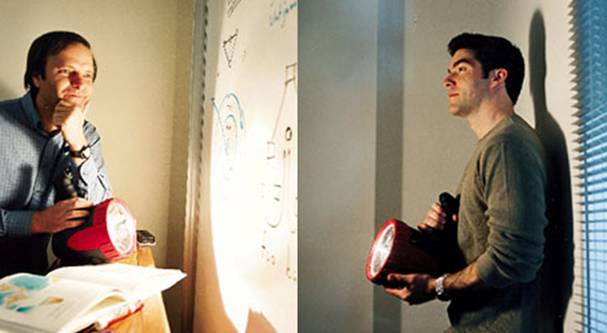
Photos by Timothy Archibald for
Newsweek Up and coming: A9's Udi Manber (left) and Yahoo's
Jeff Weiner both say search engine technology will improve dramatically in
the years to come |
|
Newsweek
It
cost more than a billion dollars—most of it buying technology—but Yahoo is now
making its bid to be a Google buster. Last month it
unveiled a rebuilt engine, which spits out results comparable to the other
guy's. The long-term strategy is to tap the treasure house of information that
lives elsewhere on the busy Yahoo portal. So your search might draw from
Yahoo's traffic reports, shopping services, maps, financial data and hot
Britney gossip. "Search results are not enough," says Weiner.
"We're going to add another layer."
|
advertisement |
Part
of Yahoo's new technology portfolio is Overture, a company that pioneered an advertising practice that certain search purists regard
as blasphemy: mingling "paid inclusions" with the results normally
delivered in response to a search query. "We never claimed it was a better
approach for doing research on 18th-century
Meanwhile,
Google has innovated with a program it calls AdSense, which places ads on Web sites that don't belong to
Google—other businesses, nonprofit
or academic institutions and even blogs. The effects
are only gradually becoming apparent. Software designer Tim Bray was impressed
when he signed up for AdSense ads on his blog—he says it changed an expensive hobby to a profitable
sideline—but worries that the pressure to expose the ads to new users might
tempt people to alter their content to boost ad revenue.
|



Brewster
Kahle, founder of the nonprofit
Internet Archive, is hoping that at least some of the search world remains
beyond the forces of Mammon. After all, when 71 percent of middle- and
high-school students use the Internet as their No. 1 research venue, isn't it a
bit disturbing that homework is becoming a sponsored activity? Kahle is encouraging an alternative. He provides the
infrastructure for would-be search wizards to create their own "open
source" (noncommercial) engines. "I'd like
to see a Google a month," he says.
Competitors
are popping out of the woodwork and even coming back from the dead. One rival
is a rejuvenated Ask Jeeves, a onetime dot-com bubble
casualty. In 2001, it acquired the technology and the engineering team behind
the highly regarded search technology of Teoma.
Of
course, Google's biggest problem may well be (cue
soundtrack from "Jaws") Microsoft. Bill Gates is constitutionally
unable to countenance the idea that a cheeky
The
last time Microsoft felt similarly embarrassed—when it failed to notice that
the Internet was kind of going to be a big thing—Gates started a companywide
jihad that didn't stop until his competitor was eviscerated. Now there's even a
word for what happens when Microsoft leverages its monopoly power to flip a
rival into the toaster: Netscaped. You wouldn't blame
its rivals for quaking in their query fields.
Instead,
Googlers claim that this time it's the Softies who
are out of their league. Anna Patterson, a Stanford search wizard recruited by
both companies (she chose the Googleplex), had the
chance to evaluate Microsoft's talent. Not impressed. "It's a bunch of
people at the first grade," she says. "Eight junior
programmers who don't know anything about search."
Microsoft's
answer: just wait. "I'm more than glad to have people underestimate what
we can do," says the VP in charge of Microsoft's search effort, Yusuf Mehdi. "You can't
remotely discount the level of technical talent we have devoted to this."
|

Though
Microsoft hasn't announced the details of its search strategy, an outline is
taking shape. The first step involves transforming the lackluster
search engine it currently uses in MSN. "We're taking our time to
architect a next-generation system that answers people's questions, an
end-to-end system that will leapfrog what's out there today," says Mehdi. Subsequent stages involve tapping into the company's
unique advantages—the software used by hundreds of millions of people to run
their computers and create their documents. To Microsoft, search will involve
everything on your own machine and other databases to which you have access. Gates
has recently been demoing a program out of his
research division called Stuff I've Seen, which uses "memory
landmarks" to search through e-mails, photographs and documents.
The
next step might well be called "Stuff I Should See."
It involves another process cooked up by its think-tank people called Implicit
Query. "Too often, searching means stopping what you're doing, open a
browser and type in a query," says researcher Eric Horvitz. His
alternative is software that figures out what you might want to ask for,
depending on what you're doing. Only Microsoft, which provides most people's
mail software, word processing and desktop, is positioned to launch such an
approach. And the radically revamped file-handling system planned for the next
version of Windows, codenamed Longhorn, happens to be perfectly suited to
handle complicated searches. In short, if Microsoft pulls off its goals (easier
said than done), it can offer people a richer version of search than Google can deliver—even before they bother to type their
queries into a search field.
Google's CEO and chairman Eric Schmidt—brought in by Brin
and Page as the designated adult to run the company is a veteran of Sun and
Novell, so he knows something about being Netscaped. He
thinks it won't happen to Google. "Why should we
assume that that's any more likely than the 50 other scenarios that we could
come up with that don't involve this diabolical Netscape kind of thing? This
search stuff is very hard to do, and it's really very hard to do at the kind of
scale that Google does it at. People will have
multiple choices, and our goal is to get as many of those choices as possible
to be Google."
|
advertisement |
The
winners will be the ones who innovate best, because the major breakthroughs in the
field are yet to come. "Search is not a solved problem," says Udi Manber, CEO of A9, a new
search company formed by Amazon.com that will focus on e-commerce. Ten years
from now, what we're doing now will look pretty primitive."
Sergey
Brin agrees. "I think we're pretty far along
compared to 10 years ago," he says. "At the same time, where can you
go? Certainly if you had all the world's information directly attached to your
brain, or an artificial brain that was smarter than your brain, you'd be better
off. Between that and today, there's plenty of space to cover."
Indeed,
over the next few years search will evolve in a number of key areas, and Google
faces big competition in all of them.
DEEP CONTENT. Searching the Web can yield amazing
results, but they're still limited and skewed. "What's on the Web is
extremely ephemeral," says Brewster Kahle. "Very little of it was
written before 1995." Amazon took a giant step to address this with its
Search Inside the Book feature that lets people query a library of 120,000
tomes. Despite the pay-for-content controversy, Yahoo's CAP is an intriguing
attempt to lure content providers not on the public Web to submit to its
indexes. "It might take a decade or two to put all the world's information
into Google and do things with it," says engineering VP Wayne Rosing. "But
it's an achievable goal."
MULTIMEDIA. Google has an Image Search function with
almost a billion pictures. Microsoft researchers in China are going full blast
to create software that searches through pictures—possibly identifying faces
and locations. Meanwhile, a Washington, D.C., start-up called Streamsage has
created breakthrough technology that searches audio and video broadcasts by
analyzing speech. And AOL, whose search strategy is to build features on top of
Google technology, recently bought an audio-video search operation called
SingingFish.
PERSONALIZATION. A search engine that knows you're a
sports-car buff is more likely to give you auto sites when you query the word
Jaguar. Google here is at a disadvantage compared with places like Yahoo and
Amazon, which know a lot about their customers.
LOCALIZATION. Last week Google introduced its local
search, which produces a map when you type in a category (say
"restaurants") and a ZIP code. But again, Yahoo and MSN have loads of
information about where its users live. The breakthrough here might come in a
marriage of search engines and cell phones.
ARTIFICIAL INTELLIGENCE. "The ultimate goal is to have a
computer that has the kind of semantic knowledge that a reference librarian
has," says Google's director of technology Craig Silverstein. But truly smart search engines are probably decades away.
|
Google's plan to keep up in
these areas is to unleash its brain power in two ways. First, its engineers try
to whittle down a rolling list of the Top 100 tasks, determined by Brin, Page and other top execs. Then, as dictated by Google's self-professed "bottom-up" management
style, those wizards are permitted to spend 20 percent of their time working on
projects of their choosing. Often these ideas wind up becoming part of the Google collection of features, as was the case for the
popular Google News. Another breakout project was Orkut, a social-networking service designed by a young
engineer named Orkut Buyukkokten.
"My dream is to connect all Internet users so they can all relate to each
other," he says.
Typical Google big-think.
But skeptics are saying that Google's
increasingly varied roster of services shows that the company is losing focus. And
that its bottom-up style causes chronic disorganization. CEO Schmidt isn't
worried. "I believe the disorganization is a feature," he says.
"The culture of companies is set early, and if you changed it, you'd lose
all of the great things. This model has worked very well for us."
The
confidence is reminiscent of the mood at another
With Brad Stone in