Joshua Mitnick - Israel
Correspondent
Djerba, Tunisia — In less than two weeks this island will
mark the second anniversary of an al-Qaeda terrorist bombing
of an ancient synagogue that rocked this normally quiet
resort.
But Youssef Uzon, head of the tiny Jewish
community in Djerba, isn’t planning a ceremony to note the
April 11 desecration of the El-Ghriba synagogue and the murder
of 19 German tourists and Muslim workers.
Instead, the
community is immersed in Passover preparations — most
critically baking matzah for the holiday recalling the rushed
flight of the Israelites out of Egypt to freedom.
“We
Jews are always making ceremonies to remember what happened to
us. Every day on the radio we hear about memorials for people
killed in attacks,” Uzon said. “There is enough misery in the
world. Why do we need to add misery upon misery?”
Undeterred by the attack, the 900 Jews of Djerba have
put the bombing behind them and continued to preserve what is
one of the last remaining Jewish outposts in the Arab world.
Although hundreds of thousands of Tunisian Jews
abandoned the country after the Arab-Israeli wars of 1948 and
1967, those left behind in Djerba doubt immigration to Israel
or France would make them any safer.
In the alleyways
of the city’s Jewish quarter, young boys scurry to Hebrew
school in yarmulkes amid whitewashed walls and a rainbow of
sky-blue windows typical of Tunisian houses. With the surge in
children — some 300 kids attend the Djerban schools — a
nursery is being added to the local yeshiva. The stone frame
of a half-finished community center stands alongside two
synagogues that are more than 300 years old.
“There is
Judaism on the street, in the home and in the synagogue,” said
Uzon, 45, who owns a small jewelry retail shop in Djerba’s
central market. “There’s Torah in Djerba and that’s what’s
protecting us.”
Since the bombing, the Tunisian
government financed the refurbishing of the burned interior of
El-Ghriba, an 80-year-old, single-story whitewashed building
erected on a site of worship believed to be more than 2,500
years old. Outside the synagogue, policemen from the
presidential guard of Tunisian ruler Zine el-Abidine Ben Ali
man barricades put up to prevent future attacks.
Fragi
Mazouz, a venerable rabbi here, escaped the bombing with burns
to the face. Undaunted by the nightmare, he has returned to
El-Ghriba daily to read Jewish mystic texts and recite Psalms.
“We have a strong police,” he said in denying fear of
another strike.
When reports were still emerging about
the bombing, Uzon was interviewed by Tunisian television
affirming Ben Ali’s false assertion that the mayhem was the
result of a car accident. It was a lie, but that was
preferable to embarrassing Ben Ali, a leader that Jews say
protects them, Uzon said.
Ben Ali’s dictatorship has
been something of a blessing to the Jews of Djerba. The
omnipresent president — his picture can be found in every
public place in Tunisia — is more concerned with stifling
Islamic fundamentalists than worrying about what is being
taught to the Jewish children of Tunisia.
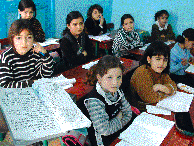
So in the
elementary school supported by the American Jewish Joint
Distribution Committee, teenage girls teach multiplication
tables in Hebrew while introducing the Talmud in the students’
mother tongue of Arabic.
“This is the only place in
the world where girls are teaching Talmud in Arabic,” said
Yechiel Bar-Hayim, the Joint’s liaison to the community. “This
is the largest extant community of Arabic-speaking Jews. This
is because of the relatively moderate policy of the Tunisian
government.”
To be sure, Djerban Jews are well aware
of the threats around them. The Arab-Israeli conflict is
neither brought up in the classrooms nor fodder for casual
interactions with Muslim neighbors. Trips to Israel to visit
relatives serving in the army are not discussed.
After
twin bombings of two Istanbul synagogues in November, Uzon
received permission from the local government to erect metal
poles at the entrance to a road that runs between the shuls.
“It was for security,” said Uzon. “Sometimes a stupid
guy with a car will see a group of Jews and you don’t know
what will happen.”
Some 155 miles north of Djerba, the
500 or so Jews in Tunis live a markedly different existence.
The main synagogue’s domed sanctuary of boldly colored murals
is empty on a Saturday morning. About a dozen men worship in a
small chapel in the corner. When they leave the synagogue,
yarmulkes are not worn in the open.
The wealthier and
less religious Jewish community in Tunis seems to be dwindling
fast. The population consists of either children or
middle-aged and older adults.
That’s because most of
the young move to France once they finish school. The push to
leave Tunis is mainly to find a spouse in the larger Jewish
communities in Paris, Marseilles or Nice, but some also
mention fear of their Arab neighbors.
“Every day
another is going. Tunis is emptying of Jews,” said one
22-year-old. “A lot of people are afraid. If there is another
attack, everyone will go. This is not ours. It is finished in
Tunis.”
But back in Djerba, the community is
determined to keep alive centuries of Jewish heritage on this
island. The El-Ghriba synagogue, located about two miles
outside of the Jewish quarter, is said to contain some of the
oldest Torah scrolls in the world.
With pictures of
Djerba’s16th century Talmud master Shimon Bar Yoshi looking
down on them, young and old men sit in small synagogues
debating dietary regulations after a day’s work.
David
Kidouchin, who has been the principal of Djerba’s
Hebrew-language school for more than 50 years, has children
living in New York and Israel, but he ignores any suggestion
of moving closer to his family. Instead, he fears for the
future of the school.
“If I were to leave, it would
all disintegrate,” he said.
For the past month the
community’s two-room matzah factory has been in operation
weekday evenings. Young men gather here to make loaves of
unleavened bread by the thousands for the local community and
Jews in the nearby city of Zarziz.
The matzah bakers
break for the evening prayer service, their quiet murmuring
mixing with the hum of the dough rolling machines’ belt-driven
motors mingling. As Uzon walks out of the factory and into a
courtyard where a new production room is planned to be
completed by next year, there is little nuance in his answer
when asked to reflect on the holiday’s message and its
relevance for the Jews of Djerba.
“We were once slaves
in Egypt and now we are free people,” he said. “We are free
people.” n | 
 Click Here to Print