|
|
|
 |
| A need to improve special-needs treatment
|
|
|
| By Nir Hasson |
|
| A High Court petition filed last week, which
demands an increase in the number of positions budgeted for
educational psychologists in Bedouin settlements, highlights the
discrimination against children in that sector. |
|
|
This past year, P.A., a four-year-old
girl, has attended a rehabilitational kindergarten in the Bedouin
town of Tel Sheva. When she was two, she developed cancer. The
disease crippled her nervous system, arrested her development, and
apparently caused brain damage. Her mother sent a letter to the
director of the Ministry of Education's southern district office,
Amira Chaim, in which she described the oppressive situation in the
kindergarten: "There are no games and no equipment in the room in
which the girl spends her time. There isn't any place to hang up
their backpacks. There is no playground equipment in the yard, only
rocks and dirt. On one of my visits, I found the girl with her whole
face smeared with cheese that had dried out, still there from
breakfast." She has yet to receive an answer to the letter, which
was sent a month ago. |
|
|
| S.A., another Tel
Sheva resident who is the father of a four-year-old girl who does
not have use of her limbs, suffers from retardation, and is deaf,
was shocked at the state of the kindergarten, to which he has
refused to continue sending his daughter. "When I saw the conditions
there, I would not allow her to stay there," he says. "It's better
for her to be home."
The two parents are among a group of
some 40 parents of Bedouin children with special needs - including
physically handicapped, mentally retarded and autistic children -
who belong to the Council of Bedouin Parents for Special Education.
The council has been operating since 1996 with support from Shatil,
an organization that assists in the development of grass-roots
organizations and movements.
The discrimination against
Bedouin children with special needs as compared to their Jewish
counterparts begins at the stage at which they are supposed to be
diagnosed as requiring special treatment. According to statistical
projections, there should be at least 6,000 special-needs children
in the Bedouin community in the Negev (the estimate does not take
into account conditions unique to Bedouin society, such as families
with many children, poverty, and marriage among family members - all
of which generate a further increase in the number of children
requiring special education). But only about 2,000 such children
have been identified in the entire school system in southern Israel.
"Where are another 4,000 children? No one knows," says Jamal
al-Krenawi, the parents' committee coordinator.
A report
drafted two years ago by al-Krenawi's predecessor, Nabhan
al-Maskawi, cites a few of the factors responsible for the partial
identification of these children: "limited access to
mother-and-child care centers, thereby preventing the identification
of problems in the prenatal stage; dearth of kindergartens for
children aged 3-4; undiplomaed kindergarten teachers; lack of
adequate supervision; shortage of psychologists and truant
officers."
Adalah - The Legal Center for Arab Minority Rights
in Israel, filed a petition to the High Court of Justice on
Wednesday in which it demanded an increase in the number of
positions budgeted for educational psychologists in Bedouin
settlements. The petition, drafted by attorney Morad El-Sana,
details the actual number of positions in each Bedouin settlement,
and compares it with the number outlined in the Education Ministry.
There are six positions in Rahat, for example, compared to 18.8 that
the ministry standards call for. The number of salaried positions in
all Bedouin settlements is 30 percent of what the ministry has set
as the standard. For comparison's sake, the rate in the neighboring
Jewish settlements of Sderot, Ofakim and Dimona is 80 percent. The
shortage of educational psychologists is the reason for the failure
to identify, or delayed identification of, children with special
needs, as well as the faulty assignment of children to
special-education frameworks, the petition says.
Even if a
child is fortunate enough to be diagnosed as having special needs,
the suitable framework is not always available. Shatil knows of 24
Bedouin children identified as having special needs but are not
included in any educational framework. And the frameworks that do
exist also suffer from numerous faults. For example, only about half
of the teachers employed in these frameworks have been trained for
special education. Conversely, in the Jewish sector, teachers who
have not undergone appropriate training are simply not hired. The
situation is particularly serious in the field of communications
clinicians. The entire Bedouin sector has been allocated a single
communications clinician who is supposed to treat some 300 pupils
suffering from various hearing defects. Similarly, there is a
chronic shortage of equipment like that in the rehabilitational
kindergarten in Tel Sheva.
There is also a shortage in the
hours allocated for assisting children that study in ordinary
schools. In several instances, parents said that the schools are
unable to deal with the children without the help of teaching aides.
As a result, some children do not attend school on certain days
during the week, or at all. In an internal document that came into
Adalah's possession, the Education Ministry admits there is a
shortage of school buildings, assistance hours and manpower in the
Bedouin sector. The document also states that these shortages are
expected to worsen in upcoming years.
Another problem with
which the parents have to contend is transportation. Special
education pupils are entitled by law to transportation to and from
school. But many Bedouin parents complain that some vehicles do not
reach their settlements on a regular basis, while others transport,
in contravention to regulations, a larger than permissible number of
children, sometimes without any attendants.
The disparities
between the Bedouin and Jewish sectors are especially noticeable to
those who have managed to transfer their child from a Bedouin
educational framework to a Jewish one. G.A.'s daughter, who comes
from the Bedouin town of Segev Shalom and has Down's Syndrome, was
accepted to the rehabilitational kindergarten in Dimona last year.
"Ever since she started going to the Jewish kindergarten, she has
made enormous progress," her father says. "She now dresses by
herself and has even begun to speak, but only in Hebrew." He is
amazed at the conditions of the kindergarten in Dimona. "There are
computers, a carpentry bench, a music teacher, a communications
clinician, a hothouse for gardening. They treat the children there
100 percent." The problem is that the local Jewish authorities are
not over-excited about taking in Bedouin children due to a shortage
of resources and personnel. And there is also the cultural hurdle:
according to Salim Abu-Medeghem of Adalah, for instance, deaf
children who study sign language in Hebrew have a very difficult
time subsequently learning Arabic.
The Education Ministry
responded to the allegations by stating: "The identification,
diagnosis and treatment of pupils with special needs are the
responsibility of the local authority. Nevertheless, over the past
three years, a number of actions have been taken to identify and
diagnose pupils with defects in the Bedouin
sector.
"Similarly, during the past three years, the ministry
has doubled the training afforded to student-teachers in the special
education field, and two more special education schools are expected
to be built next year, in Aroer and Hura. In conjunction with
Ben-Gurion University and Soroka Hospital, the Education Ministry is
now building a professional treatment compound for pupils with
special needs in Tel Sheva.
"Over the past few years, 12,000
instructional hours have been allocated for integrating children
into the ordinary school system, which is meant to reduce the gap of
hours granted to the Jewish sector, and a sum of NIS 20.5 million
was allocated to special education in the Arab sector as part of the
five-year plan. The ministry also makes sure that unscheduled spot
checks are made to ascertain the quality of the pupil transportation
systems."
The person responsible for the education portfolio
in the Tel Sheva local council, Musa Abu Ghassam, rejects the
parents' allegations about the kindergarten operating in the
council's jurisdiction. "The kindergarten operates according to all
of the standards. We are doing the best we can, but are unable to
supply services that extend beyond the standard. The kindergarten
teachers and the aides have received the appropriate training, and
the facility has all of the requisite equipment."
| |
|
 |
|
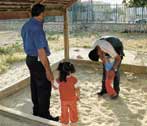
| There is a chronic shortage of equipment in schools
within the Bedouin community, including the rehabilitational
kindergarten in Tel Sheva in the Negev. |
| (Alberto Denkberg) |
|
| Top Articles |
|
| Labor appeals
to Anglos to get active |
|
| The Labor party is taking advantage of the splintered
opposition to make a renewed appeal to English speakers in
Israel. |
|
| By Daphna Berman |
|
| State to
compensate Trans-Israel toll road |
|
| The government is to compensate Derech Eretz, the
concessionaire for the Trans-Israel Highway, for delays in handing
over land for the toll road, even though the company completed that
stretch four months ahead of schedule. |
|
| By Anat Georgi |
| |
|
|
| Special Offers |
|
|
|

 Homepage
.gif)