| Israel's eventual unilateral
withdrawal from Gaza and the erection of its 'security
barrier' in the West Bank – both endorsed by the United
States – could constitute a revolutionary change of the
status quo in the Israeli–Palestinian conflict. The
effective partition is based on an absence of trust
that, in Israel's view, has rendered negotiated peace
impossible for the moment. But strategically, Israel's
moves are an implicit acknowledgment that any post-1967
Zionist aspiration to a 'Greater Israel' extending from
the Mediterranean Sea to the Jordan River is
demographically untenable. On a more tactical level,
they are warnings to the Palestinians that restraining
terrorism remains the sine qua non of reviving the peace
process premised on the 'roadmap' and prospects for the
creation of a Palestinian state. Hamas, the strongest of
the religiously motivated Palestinian terrorist groups,
is the most formidable impediment to these objectives.
Since the second intifada began over three years ago,
Hamas's popularity has steadily increased. The question
remains whether the Israeli withdrawal will make Hamas
easier or harder to control and neutralise.
Hamas mindset
Hamas arose during the first intifada in December
1987. From the beginning, the group has been
uninterested in political compromise. The group's
ideological mission, as articulated in its 'Introductory
Memorandum', is absolutist and inherently violent: 'The
best way to conduct the fight with the Zionist enemy is
… to keep the embers of conflict burning until the
conditions for a decisive battle with the enemy are
complete … Hamas believes it is impermissible under any
circumstances to concede any part of Palestine or to
recognize the Zionist occupation of it.' Hamas, then,
considers Palestine wholly Muslim land, such that
surrendering any of it would be sinful; one passage of
its charter suggests that religious redemption turns on
the destruction of the Jews. Thus, Hamas's leadership
cannot easily endorse even temporary and tactical
acquiescence in, still less public approval of, a
two-state solution. Hamas has rejected peace deals like
the one Israel and the Palestinians were negotiating at
Taba in January 2001.
Reinforcing the group's bias towards force, many
Hamas activists see the Lebanese group Hizbullah's
bleeding of the Israeli Defense Force (IDF) as the cause
of Israel's withdrawal from south Lebanon in May 2000.
Like most political and military organisations, Hamas is
divided between relative doves and hawks. It can
therefore seem schizophrenic on issues of compromise and
violence. Hamas has intermittently dialled back
terrorist operations and edged towards negotiation, and
some Hamas leaders have advocated an interim solution
involving an armistice, an Israeli withdrawal from
territories occupied in 1967 (including all of
Jerusalem) and negotiations on other rights. Hamas
leaders also established informal contacts with Israeli
officials during the Oslo process. Nonetheless,
hardliners have effectively vetoed any formal offer of
an armistice, and rejected Israel's attempts in 1993–94
to establish a dialogue aimed at convincing the
organisation to renounce violence in exchange for a
guaranteed political role in any peace settlement. All
ten of Hamas's declared or offered cease-fires between
1993 and 2002 were tactical: each one emerged when the
group needed breathing room to regroup after pressure
from a superior adversary – either Israel or the
Palestinian Authority (PA). None has lasted longer than
a few weeks.
The bottom line is that Hamas wants an Islamic
Palestinian state in all of mandatory Palestine. No
peace process can realistically yield this result, but
the organisation's leadership believes that, over enough
time and through sustained violence, it can produce it.
Consequently, Hamas is extremely unlikely voluntarily to
dispense with violence as a political tool – as, say,
the Provisional Irish Republican Army has substantially
done. Hamas's consistent refusal to join the PA
government attests to the outfit's confidence in the
viability of its unrepentant posture. It is true that
Hamas has indicated that it might consider helping the
PA run Gaza once the Israelis leave, and Hamas may see
fit to avoid a decisive confrontation with the PA and
Fatah, the main secular Palestinian party, until there
is a Palestinian state. But it would then challenge its
secular rivals for primacy in that state, which it would
subsequently use as a platform for launching a
revitalised campaign to eliminate the state of Israel.
In this light, the disarmament of Hamas is a minimum
prerequisite to a stable and viable Palestinian
state.
Israeli perceptions
and counter-terrorism
policy
Israel's response to Hamas's ongoing terrorism has
been broadly to escalate counter-terrorism operations –
targeting finances and known militant installations,
re-occupying territory ceded to the PA under the Oslo
accords and killing militant leaders. This has given
Hamas ample political cover to continue suicide attacks
that provoke further Israeli retaliation. The PA has
been left to acquiesce in Israeli suppression, comply
with demands to crack down on Hamas, or both. In any
case, Hamas, not the PA, is viewed as the Palestinians'
popular champion.
In May 2003, however, Hamas appeared outflanked.
Fatah declared a unilateral cease-fire and the US, the
UN, the European Union and Russia ('the Quartet')
revived the peace process with the roadmap. Hamas would
have looked like a violent spoiler denying Palestinians
their chance for peace and statehood if it had not at
least agreed to a tactical ceasefire, which it did in
late June 2003. For its part, Israel reduced, but did
not completely suspend, 'targeted killings'. Suicide
bombings on 12 August by Hamas and the Al-Aqsa Martyrs
Brigade (as well as a Jerusalem attack a week later by
Hamas and Palestinian Islamic Jihad) were stated to be
retaliation for continued assassinations. Hamas and
Islamic Jihad formally ended their cease-fires in a
joint statement issued on 22 August. It cost them
nothing in political terms. In fact, their support among
Palestinians increased after the 19 August bombing.
Although Fatah probably retains a more durable base
of political support than Hamas, the fact that one out
of six Palestinians receives some sort of social service
from Hamas gives it an edge from day to day. The
disintegration of the PA's sources of such assistance,
which were never very efficient, imparted even greater
political momentum to Hamas. The Israeli security forces
have done their best to weaken Hamas's leadership prior
to withdrawal from Gaza. On 22 March 2004, Israeli
forces killed Hamas spiritual leader Sheikh Ahmed
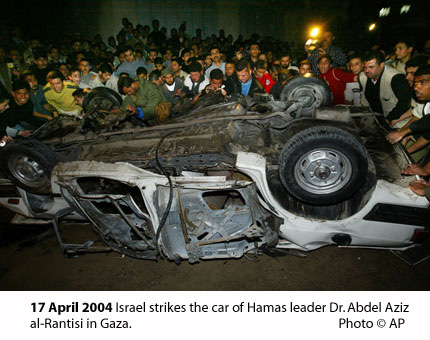
Yassin. He was replaced by Abd al-Aziz Rantisi, who in
turn was eliminated in an assassination on 17 April 2004
in Gaza City. Other senior figures have been killed or
wounded since summer 2003. Yassin was half blind and a
paraplegic, and his killing elicited vehement popular
and official protest from Europe and throughout the
Muslim world. Funeral marches in Gaza were a deliberate
and impressive show of force by Hamas. According to a
poll taken by the Palestinian Center for Research and
Cultural Dialogue after his death, 31% of Palestinians
in the West Bank and Gaza would vote for Hamas, compared
to only 27% for Fatah. In Israel's counter-terrorism
calculus, however, the operational benefits of
disrupting the terrorist apparatus at the strategic
planning level were judged to outweigh the political
cost of momentary Palestinian outrage.
That calculus appeared to embody four main
considerations. Firstly, while assassination of Hamas
leaders may be provocative in the short term, the
movement was already maximally radical and could not
become more so. Although Yassin had manifested sporadic
flexibility – for instance, theoretically accepting Jews
as a client population in an Islamic state comprising
mandatory Palestine – Rantisi consistently maintained
that peace could take hold only after Jews had left that
territory for their countries of origin, and he was
bullish on Hamas's strengthening links with Hizbullah
and Iran. Secondly, hitting mainly lower-level
operatives arguably encouraged the leaders to be bolder
by giving them less to fear. Thirdly, Rantisi was widely
considered to be the most formidable opponent of the PA
(which had imprisoned him for 21 months in the late
1990s). Eliminating him therefore stood to strengthen
the PA vis-à-vis Hamas, and eventually to improve scope
for the PA's constraining the group politically or by
force. Finally, and perhaps most importantly, given the
disarray in the PA, Hamas's characterisation of the
prospective Israeli withdrawal as a Hizbullah-style
military victory potentially opens the door for Hamas's
political primacy in Gaza, the disintegration of Fatah
there and, consequently, continuing instability. A tough
stance against Hamas prior to withdrawal is intended to
counter any impression among the Palestinians that
Israel is acting out of weakness, to cripple Hamas
operationally so that it cannot use Gaza as staging area
for attacks in Israel, and to ensure the potency of
Israel's military deterrent even after withdrawal.
More shaken than
stirred
On balance, the evidence suggests that the Israeli
assessment was generally correct. Terrorist attacks in
the West Bank diminished markedly after Yassin's death –
even though Bush's April 2004 statement that territorial
negotiations would have to account for 'major Israeli
population centers' there and support for the security
barrier might be expected to increase violence.
Rantisi's avowed revenge for Yassin's death never came
to pass. During his five-week tenure, Hamas carried out
only one suicide bombing, killing an Israeli policeman.
As of April, Israeli security forces were stopping
80–90% of Palestinian attacks, compared to 50% early in
the second intifada. At the same time, the liquidation
of the two Hamas leaders apparently shifted Hamas's
internal balance of power from the relatively pragmatic
Gaza-centred 'inside' leadership that heeded Yassin to
the more hard-line Damascus-based 'outside' leadership
(with which Rantisi sided) under Khaled Mashaal, head of
the Political Bureau. Yet Mashaal's behaviour indicates
that that the putative hard-liners themselves may feel
intimidated by Israel's tough counter-terrorism policy.
He resisted anointing Rantisi as Yassin's fully fledged
successor, confining his leadership status to Gaza. In
addition, he diffidently instructed Hamas-Gaza to keep
secret the name of Rantisi's successor, and the group
may even have settled for an interim collective
leadership, which hints at a relatively quiescent mood.
Hamas retracted an intemperate threat, implied after
Rantisi's death, to attack the US.
Yassin's death deprived Hamas of its most charismatic
leader. The assassination of Rantisi underscored
Israel's unwillingness to acquiesce to Hamas's
predominance in Gaza. Since then, the IDF has reinforced
the message with Operation Rainbow – the
bulldozing of Palestinian dwellings in the Rafah refugee
camp on the Egyptian border. The tactical aim of the
offensive is to preclude the smuggling of weapons from
Egypt into Gaza through underground tunnels that have
been dug from the Gaza neighbourhoods across the border
by denying terrorists access to them, as well as to
eliminate Hamas and other terrorist operatives. The
strategic aim is to preserve the Israeli deterrent. On
18 May, the first day of Operation Rainbow, 20
Palestinians were killed, many of them civilians, and
90,000 people lost electric power and water service.
While this would logically antagonise Hamas,
countervailing factors appeared more substantial.
Curtailing tunnel access reduced Hamas's operational
capacity. The Israelis expressly reserved control over
Gaza's borders and airspace pending the PA's control of
the territory and its effective counter-terrorism, both
of which appear to be distant eventualities. More
broadly, the Israeli withdrawal has increased Egypt's
incentive to extend security cooperation against Hamas
in Gaza, as President Hosni Mubarak's secular regime
would not welcome the political and operational
ascendancy of a radical Islamist organisation on its
eastern border. So far, however, Egypt has shown little
stomach for confronting terrorists in Gaza.
Still an
obstacle
The fact remains that Hamas is not Sinn Fein: it is
more a rigid religious militia than a pragmatic
political party, and it will conclusively relent only in
response to force. A more effective application of force
against Hamas is still essential to sustainable peace
between the Israelis and Palestinians. To regain the
popular support it needs to govern effectively, the PA –
not Israel or the US – must be the agent that tames
Hamas. Israeli efforts have rendered Hamas weaker than
it was before. This would make it easier – both
politically and operationally – for the PA to confront
and disarm Hamas. But PA President Yasser Arafat is a
terminally unacceptable interlocutor to Israel and the
US, and will favour continued instability to stave off
complete marginalisation. PA Prime Minister Ahmed Qurei
is not sufficiently independent of Arafat to unleash the
PA against Hamas without Arafat's backing.
While Hamas is probably still capable of a major
attack, it is fairly clear that it cannot function at
the tempo that it once did. The group is likely to
continue terrorist operations to intensify the
impression that Israel is withdrawing under fire – a
tactic Arafat has encouraged. Bush's April statement
commits the US to 'lead efforts' with Egypt, Jordan and
other outside actors to build the 'capacity and will' of
the PA to secure Gaza against Hamas and other terrorist
groups without involving Israel. To ensure that a Gaza
withdrawal facilitates the eventual resolution of the
conflict and the conclusive defanging of Hamas, it would
be best for Washington to begin these efforts soon. But
Washington is not likely to re-immerse itself in the
Middle East until after the inauguration of a newly
elected American president in January 2005. Meanwhile,
Israel is unlikely to see any alternative to continuing
robust counter-terrorist operations prior to withdrawing
from Gaza, and maintaining freedom of action for the IDF
even after it has left. |