Ariel Sharon’s push for unilateral Israeli withdrawal from
the Gaza Strip and four forlorn West Bank settlements in the spring
of 2004 came after a year of mounting criticism inside and outside
Israel that he had no long-term “solution” for the
Israeli-Palestinian conflict. As the prime minister conceded, his
scheme was designed to forestall solutions brokered by international
actors, as well as locally engineered initiatives, like the Geneva
Accord of November 2003, that would implement a two-state solution
based upon the last formulas discussed by Israeli and Palestinian
negotiators at Taba in January 2001. With disengagement, Sharon
seeks to exploit the perception that there is no Palestinian partner
for negotiations, and to impose Israel’s power on the weaker party.
The Sharon plan was rejected in a poorly attended Likud Party
referendum on May 2, 2004, but outside the settler right wing,
unilateral withdrawal enjoys wide support among the Israeli Jewish
public. This support is drawn from deeper springs than the
traditional split between the Likud right and the Labor Party center
over the concept of trading land for peace.
Talk of disengagement obscured the growingdebate, during 2003 and
2004, over alternatives to the two-state model—a discourse that
increasingly has tested the long-standing conventional wisdom that
the two-state solution is “the only game in town.”[1] Purveyors of conventional wisdom took note. In
October 2003, the editors of the New York Times described
arguments against the two-state solution as “insidious,” but
acknowledged that they were gaining ground. In the same month, the
state-controlled Israel Broadcast Authority’s prestigious
“Popolitika” program hosted a debate on the continuing viability of
the two-state solution. Research published by the liberal Israeli
daily Haaretz suggests that 67 percent of the Israeli public
“strongly or moderately fear” a scenario in which Israel finds
itself in a one-state reality.[2]
Two
alternatives to the two-state endgame are discussed. One is a
binational state, offering power-sharing to two separate peoples
with distinct collective identities within one polity. The
binational model encompasses federal, confederal and consociational
variants. The second alternative proposes a single democratic
polity, where there is no ethnic or national distinction between
citizens. Whereas the former alternative is premised on collective
entitlements, as developed in the Good Friday Agreement in Northern
Ireland, the latter is premised on individual rights, as in
post-apartheid South Africa. The two concepts are often used
interchangeably, and the word “binational” is understood by most
Israelis to denote the South African endgame. Some, like Meron
Benvenisti, suggest that the conflation of terminology is designed
to “prevent any debate about…attractive alternatives” to the
two-state solution.[3]
There are, of course, other alternatives to a two-state
outcome. These include an entity in which Jews rule over a
Palestinian majority, through various schemes of coercion. The
Israeli right has variously proposed canton schemes which will allow
a Jewish minority to rule over a Palestinian majority through
gerrymandering or a model in which Palestinians exercise their
political rights in Jordan and Egypt. Others fear that Sharon and
the Israeli right wish to create a set of disconnected cantons that
would bear the name of “Palestinian state.” Such a “bantustan” model
would maximize Israeli control of territory, while minimizing the
number of Palestinians living in the Israeli state. In this climate,
how did the first two alternatives to the two-state solution come to
return from their banishment to the margins?
International Doubters
In
the international community, by far the most forthright opposition
to the two-state solution comes from the intellectual left, with its
antipathy for nationalism and ethnic states. It is held that Zionism
is a discriminatory ideology and that Israel is an inherently
inequitable state.[4] Many Israelis view these arguments as
fundamentally anti-Semitic, because Israel is singled out for
condemnation as a nation-state, or because Israel is singled out for
condemnation as an occupying power, while China’s occupation of
Tibet and Russia’s anti-separatist war in Chechnya attract less
attention. The Oslo “peace process” of the 1990s dramatically
weakened the impact of anti-Zionist leftists on public discourse,
and some abandoned their opposition to Zionism in the hope that the
Oslo process—which tacitly envisioned two states—would work, and on
the assumption that both peoples desired such a deal. The collapse
of Oslo has encouraged the intellectual left to argue anew that a
binational state is not only likely, but desirable. Tony Judt
stirred a major uproar when he recently noted that, “The very idea
of a ‘Jewish state’—a state in which Jews and the Jewish religion
have exclusive privileges from which non-Jewish citizens are forever
excluded—is rooted in another time and place. Israel, in short, is
an anachronism.”[5] Judt’s submission elicited thousands of
letters to the editor, confirming Daniel Lazare’s assessment that a
“long-standing taboo has finally begun to fall.”[6] That taboo inhibits debate in the US over the
legitimacy of a Jewish state.
Over
the ensuing months, writers who believe that a two-state solution is
simply impracticable have joined the band of two-state doubters.
Veteran journalist Helena Cobban, who reversed her earlier
opposition to a one-state outcome, provides one example.[7] Even before the spate of articles in highbrow
publications, diplomats engaged in the Israeli-Palestinian conflict
also raised doubts over the viability of a two-state solution,
despite the fact that the international community invested vast
resources in the Oslo process and, now, the “road map.” For
instance, in 2002 the UN secretary-general’s special envoy to the
Middle East, Terje Roed-Larsen, asked whether the UN was “nearing
the death of the two-state solution, the bedrock for all our
peacemaking efforts?”[8] These misgivings stem from the political
impasse, not an ideological preference.
Intellectually, the renewed opposition to the notion of
ethnically exclusive states must be seen against the backdrop of the
bloody conflicts of post-Communist Eastern Europe, especially the
Balkans, deepening and widening European integration and opposition
to “clash of civilizations” theory. Israel’s violations of human
rights in the Occupied Territories have also eroded support for
Israel and its legitimacy, particularly in Europe. In a Europe-wide
survey conducted in November 2003, a whopping 59 percent of
respondents ranked Israel ahead of the US, Iraq, North Korea and
Iran as the greatest perceived threat to world stability. Though
many Israelis quickly dismissed these results as evidence of
anti-Semitism, Eliahu Salpeter notes that it was Israel and the Jews
who “determined that Israel should be a light unto the nations”[9]—hence they are judged by the moral standards
they claim. If Israel has so far won the war of images in the US,
one Jewish American leader, Brian Lurie, cautions that if the
intifada does not end soon, “Israel is liable to end its
preferential standing in American public opinion.”[10]
Israeli Doubts
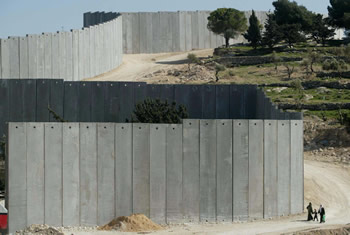
Wall art
in Israel. (Eddie Gerald)
Doubts over a two-state outcome are also, increasingly, being
articulated in Israeli discourse. One prominent supporter of the
two-state outcome who has raised his concerns is Yossi Alpher.
Alpher warns that the two-state solution should not “be taken for
granted.”[11] Daniel Gavron has gone one step further,
advocating that Israeli Jews embrace a binational state while they
still enjoy demographic ascendancy. Gavron, a Zionist, notes that
having concluded that partition is no longer possible, “we are left
with only one alternative: Israeli-Palestinian coexistence in one
nation.”[12] Gavron’s idea enjoys scant support among
Jewish Israelis; 78 percent of them oppose such an entity,[13] which they view as a recipe for a “Greater
Palestine.” But the binational idea is rooted in Zionist discourse.
In mandatory Palestine the likes of Henrietta Szold, Martin Buber,
Judah Magnes and the Hashomer Hatzair movement propagated it. Though
vilified in Zionist historiography for their views, they were not
alone. Prominent Zionist leaders like Chaim Weizmann and Chaim
Arlozoroff supported the idea. David Ben Gurion, the first prime
minister of Israel, toyed with binational ideas between 1924 and
1939, probably for tactical purposes. At a time when Jews were a
minority (less than 20 percent) in the territory of mandatory
Palestine, he surmised that the Zionists were too weak to take on
both the British and the Arabs. Moreover, the demand for parity in
political representation, implicit in the rally for binationalism,
clearly served the Zionist movement. On the one hand, it would have
ensured over-representation for Jews in the mandate’s political
institutions. On the other hand, it allowed the Zionist leadership
to maintain ambiguity about its real intention to create a Jewish
state. But the Peel Commission rejected the cantonization proposed
by the Zionist movement, and this development, coupled with the
plight of the Jews in Europe and Ben Gurion’s pessimism that an
accommodation with Arab leaders was possible, led him to abandon the
binational idea.[14]After independence, Israeli support for
binationalism declined.
On
the other end of the Israeli political spectrum, elements in the
ideological right and the settler movement actively pursue a single
state. In opposition to “disengagement,” some of Sharon’s right-wing
detractors have openly called for annexation of the West Bank and
Gaza Strip, while maintaining the Jewish nature of the state. The
implication is that the Jewish state would need to construct
institutions that formally discriminate in favor of Jews, or engage
in ethnic cleansing. As the Hebron settler leader Noam Arnon has
argued, “if there is a contradiction between this [Jewish] essence
and the character of the government [democracy], it is clear that
the essence takes precedence.”[15]
In
revealing newspaper interviews, Effi Eitam, leader of the National
Religious Party and a minister in the Sharon government, laid out
his vision for a Greater Israel. Eitam noted that the “only Jewish
state in the world requires a minimum of territory.” Regarding those
Palestinians who wish to remain in the West Bank and the Gaza Strip,
Eitam suggested that Israel offer them “enlightened residency,” as
opposed to citizenship. Those unwilling to accept this status would
have to relocate.[16] Some on the right propose leaving
Palestinian areas under Israeli security control, yet allowing
Palestinians municipal autonomy. Another version of the Greater
Israel concept proposes that the entire geographical area west of
the Jordan be divided into ten cantons, eight Israeli and two
Palestinian, with each canton given the same representation in the
Knesset, thereby guaranteeing a Jewish majority. Many Israeli
commentators hold that the settler movement and its supporters are
endangering Israel by rendering a binational state more likely.[17]
The Palestinians
Until 1988, advocacy for a “secular Palestine” was the
traditional position of the Palestine Liberation Organization (PLO),
though Israelis viewed support for this idea as tactical, rather
than ideological. After the Oslo accord of 1993, diaspora
intellectuals, most notably the late Edward W. Said,carried the
banner of opposition to separation. Many of these standpatters feel
vindicated by the current state of affairs. More importantly,
leaders inside the Palestinian territories have come to propose
alternatives to the two-state solution. The most important of these
voices has been Birzeit University’s Ali Jarbawi, who has long
argued that the Palestinians should serve Israel an ultimatum
demanding that it agree to a Palestinian state within six months,
after which the Palestinians would demand annexation.[18] The idea has gradually gained currency as
the stalemate continues. The first prominent Fatah leader to sound a
warning that time is running out for this accommodation was Marwan
Barghouti, general secretary of Fatah in the West Bank. Speaking at
the close of his trial on charges including murder and conspiracy,
he cautioned: “I hope the Israelis have learned that the Palestinian
people cannot be brought to yield with force. If an occupation does
not end unilaterally or through negotiations then there is only one
solution—one state for two peoples.”[19]
Thus
far, the Palestinian Authority (PA) leadership has largely refrained
from dabbling in this debate, underscoring the growing gap between
the street and the political elite. One poll suggests that almost a
third of ordinary Palestinians support a binational outcome.[20] A notable voice for alternatives to the
two-state solution has been the Negotiations Support Unit (NSU), a
team of lawyers drafting position papers and making maps for the PLO
in preparation for eventual final status talks. NSU staffers, many
of whom are diaspora Palestinians, have submitted that the
Palestinian cause would be better served by a struggle for civil
rights. The first prominent PA official to warn that time for a
two-state accommodation is running out was the PA Minister of
Finance, Salam Fayyad. In a memorandum submitted to the Bush
administration in October 2002, he warned that Israeli settlement
expansion was undermining a future two-state deal.[21] In December 2003, Prime Minister Ahmad Qurei
also sounded the warning after Sharon announced that he was going to
move ahead with his unilateral disengagement plan at the annual
Herzliya conference. Qurei noted, “This is an apartheid solution to
put the Palestinians in cantons. Who can accept this? We will go for
a one-state solution.… There’s no other solution. We will not
hesitate to defend the right of our people when we feel the very
serious intention [of Israel] to destroy these rights.”[22] Yasser Arafat soon followed suit in an
interview he granted to the Guardian.[23] These warnings were, however, largely
dismissed as tactical by Israelis. The PA can ill afford to abandon
the two-state outcome, and thereby forego the vast amounts of
international aid that sustain its large civil service.[24]
Facts on the Ground
But
the most important reasons for the challenge to the two-state
solution relate to developments on the ground, especially continued
settlement expansion and the construction of the “separation fence.”
According to Amira Hass, the pace of settlement expansion in the
Occupied Territories since 1993 has created the “geography of a
single state.”[25] Peace Now says that in 2003 the Israeli
government published an additional 1,627 tenders for new housing in
the West Bank, a fact that speaks volumes for Israel’s commitment to
a sustainable two-state outcome. The land grab, argues Meron
Benvenisti, nurtures a sense that the “connection between territory
and ethnic identity—which was applicable up to about 20 years
ago—cannot be implemented and any attempt to implement it will only
complicate the problem instead of solving it.”[26] Others simply doubt whether Israel is
willing or able to extricate itself from the territories. Such
doubts are not ungrounded. Eitam confidently dismisses settlement
removal: “Do you really think that anyone is capable of dismantling
Ariel, Kiryat Arba or Karnei Shomron?”[27] The former head of the army’s central
command, Yitzhak Eitan, fears that dismantling settlements will
trigger a civil war, making the evacuation near impossible.[28] The assassination of former Prime Minister
Yitzhak Rabin in November 1995 serves as a striking reminder that
many Israelis deny the right of a democratic government to surrender
land promised by God. The Likud Central Committee’s vote against the
creation of a Palestinian state in May 2002, and the rank and file’s
vote against withdrawal from Gaza in May 2004, are more evidence of
Israel’s possible inability to deliver the two-state deal.
The
second major fact on the ground that nurtures pessimism regarding
the two-state outcome is the “separation fence.” Israeli proponents
of the barrier that Israel is building in the West Bank argue that
it will create a de facto two-state solution, leading to the
inevitable evacuation of settlements lying to the east of its route.
They further believe that the route will “correct itself” over time.
Skeptics submit that far from enhancing the two-state solution, the
Sharon government has effectively hijacked “separation”—originally a
Labor Party idea—to serve its own political agenda, namely, a state
of bantustans on some 42 percent of the West Bank. Avraham Bendor, a former head of the General Security
Services, says that “instead of creating a reality of separation and
maintaining a window of opportunity for ‘two states for two
peoples’…this window of opportunity is gradually closing. The
Palestinians are arguing: you wanted two states, and instead you are
closing us up in an [apartheid-era] South African
reality. Therefore, the more we support the fence, they lose
their dream and hope for an independent Palestinian state.”[29]
From
a Likud perspective, imposition of such a state is justified on the
grounds that Israel will require strategic depth to defend itself,
in the form of “security zones” in the coastal regions, around
Jerusalem and an Israeli presence along the Jordan river. The senior
IDF command reportedly no longer believes that a two-state outcome
along the Geneva contours is sufficient to resolve the conflict. The
IDF brass hints that a future deal will need to be based on a
regional understanding, shorthand for a Jordanian-Palestinian
federation wherein Jordan absorbs the land from which Israel agrees
to withdraw and the vast population that inhabits that land.This, as
Uzi Benziman notes, is the same policy prescription of the extreme
right.[30]
But
it seems highly questionable that the Palestinians will agree to
anything less than the territorial parameters of the unfinished Taba
negotiations of January 2001, which spoke of dividing Jerusalem and
land ceded by Israel in exchange for any settlements retained. As
chief PA negotiator Saeb Erekat wrote, “It has
become clear to many Palestinians that what Mr. Sharon and many
other Israelis have in mind for the Palestinians is a ghetto ‘state’
surrounded by Israeli settlements, with no ability to defend itself,
deprived of water resources and arable land, with an insignificant
presence in Jerusalem and sovereign in name only. Palestinians will
never accept such a future. Nor should we.”[31] Likewise, it seems unlikely that Jordan will
sacrifice the Hashemite entity it has actively consolidated since
1988. It is also extremely unlikely that the international community
will indulge a redrawing of an internationally recognized border. As
Benziman says, these IDF assessments open up space for debate over
alternatives to the two-state outcome.[32]
Demography
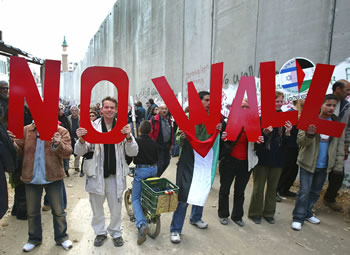
Joint
Palestinian/Israeli demonstration at the wall in Abu Dis.
(Yoav Lemmer/AFP)
Due
to Sharon’s refusal to pursue negotiations, many prominent
two-staters believe, time for a two-state solution is running out.
Sari Nusseibeh and Ami Ayalon, respectively a Palestinian and an
Israeli who seek popular endorsement of a set of basic principles
for a permanent status accommodation, voice this concern. Key
supporters of the Geneva Accord such as David Kimche harness the
worry to promote their own initiative, arguing that opponents of the
accord will lead Israel down the path to a binational state.[33] Inside the Israeli establishment, former
Prime Minister Ehud Barak, army chief of staff
Moshe Yaalon and four past heads of the security services echo the
fear that government indecision may see Israel slide into a
binational reality. Deputy Prime Minister Ehud Olmert, a Likud
member, surprised many observers when he
concurred:
We don’t have unlimited time. More and more Palestinians
are uninterested in a negotiated, two-state solution, because they
want to change the essence of the conflict from an Algerian
paradigm to a South African one. From a struggle against
“occupation,” in their parlance, to a struggle for one man, one
vote. That is, of course, a much cleaner struggle, a much more
popular struggle—and ultimately a much more powerful one. For us,
it would mean the end of the Jewish state.[34]
Olmert’s remarks hint at the extent to which demography,
rather than coexistence, has come to underpin the Zionist case for
disengagement. Haifa University’s Arnon Sofer argues that the
total population west of the Jordan will reach 15.5 million by 2020.
The 6.4 million Jews will constitute only 40 percent of the
population; the majority will be 8.8 million Palestinian Arabs.
Sofer contends that demographic parity between Jews and Arabs
already exists, if Israel’s non-Jewish, non-Arab residents are
excluded from the count.[35] Such calculations led Barak’s chief
negotiator, Gilead Sher, to call on Israelis to “define our borders
by ourselves and place an iron wall against the demographic threat”
posed to the Jewish majority between the Mediterranean and the
Jordan.[36] The West Bank barrier is widely supported as
such an iron wall.
The
right, including Sharon, has long pooh-poohed the “demographic
threat,” arguing that immigration (aliyah) will sustain the
Jewish demographic advantage. But these assumptions fly in the face
of the reality. Not only are there insufficient aliyah
reservoirs, as the head of the Jewish Agency, Sali Merridor
(himself a settler), recently confessed,[37] but some 210,000 Israeli Jews have
reportedly left the country since the fall of 2000.[38] Ehud Olmert’s comments confirm that the
right is mindful of the demographic threat. Olmert supports a
sweeping unilateral disengagement from 80 percent of the West Bank
and all of Gaza, in order to retain a Jewish democracy. Explaining
the sudden prominence of the demographic issue, one journalist
suggests that “the silent majority has by now grown familiar with
the term ‘demographic threat’ and learned what it means. Today most
Israelis can say: we’ve seen the future, and it doesn’t work.”[39] Fear of losing a Jewish majority and facing
a binational reality brings together a range of Israeli actors from
both the left and the right wings. In a dialectical fashion, the
ongoing diplomatic stalemate and the rise of the demographic
discourse could serve to heighten the Israeli sense that Israel must
swiftly and decisively move to extract itself from a quagmire. The
results of the Likud members’ poll may well indicate that it will
not be possible to do so under the current configuration of the
Knesset, whose term ends in 2007.
Demography and the Extremes
Though proponents of separation, either negotiated or
unilateral, may win the demographic argument, it is not evident that
the Israeli public will adopt their prognosis. The Israeli right,
which initially opposed the “separation barrier” in the West Bank,
embraced the idea as a result of public pressure, but altered the
route to maximize Israeli territorial control. The hazard of the
demographic argument, and indeed using binationalism as a scarecrow,
is that they may increase support for ethnic cleansing or
institutionalized discrimination against non-Jews. As David Landau,
editor of the daily Haaretz, puts it, “While the peace camp
hopes that the very real and frightening demographic scenario will
convince the settlers to finally sober up—lest the entire Zionist
enterprise find itself in mortal danger—the rightists hope that this
same demographic threat will convince the whole of Israel to join
their ranks.” [40] Veteran peace activist Uri Avnery warns
against using talk of inevitable binationalism to “frighten
Arab-hating Israelis. They see it only as another reason to put up
more settlements all over the West Bank.”[41] Settler leader Israel Harel, indeed, claims
that once the Arab minority inside Israel reaches 40 percent the
state will no longer be a Jewish state. Harel adds that once Israel
has “run away” from the Occupied Territories, the demographic
pressure will intensify as Palestinian refugees are resettled
there.[42] Though Harel refrains from proposing a
solution to his demographic problem, he hints that Zionism has not
relied on miracles, but has created them. What miracle he wants to
create is unclear, but it is not a two-state solution.
Demographic trends raise the temptation to refuse compromise
and consider radical measures. The demographic obsession also
threatens the precarious relations between the Jewish majority and
Palestinian citizens of Israel. Leading Labor party leaders support
moving the town of Umm al-Fahm, an Arab town in Israel, to the
future Palestinian state. Dani Mor, a left-wing supporter of moving
communities inhabited by Palestinian citizens of Israel to the
future Palestinian entity, notes that whoever supports equal rights
for all citizens must support measures to ensure that the majority
of the country’s citizens are Jews. According to Mor, equal rights
for non-Jews will only be assured when there is no threat to the
Jewish character of the state. Residents of Umm al-Fahm who wish to
stay in Israel could move elsewhere in the country.[43] Commenting on such ideas, Amnon
Raz-Krakotzkin notes, “The peace discourse of the Israeli left in
fact proposes getting rid of Arabs, and therefore it sounds exactly
like the talk of transfer.”[44] Support for less subtle forms of
transfer—forced expulsion or migration induced by material
incentives—peaked at 57 percent in a national survey conducted in
2003, while 46 percent of Israelis supported enforced "transfer" of
Palestinians residing in the Occupied Territories, and 33 percent
supported the transfer of Palestinians who hold Israeli
citizenship.[45]
Ironies of Stalemate
Talk
of one-state options has not yet overcome the powerful currents that
favor separation and the two-state solution. But the longer the
diplomatic stalemate and settlement expansion proceed unabated, the
more disillusioned Israelis and Palestinians will become with the
land-sharing formula.
The
two-state solution will certainly become increasingly discredited among Palestinians if there is no serious
diplomatic process. For some Palestinians, the failure of the
PA between 1994 and 2000 to develop credible and transparent
institutions contributed to a sense that the Oslo years “proved the
[Palestinian] nationalist goal unattainable.”[46] The two-state solution is also associated
with the Palestinian ruling class, viewed by many Palestinians as
corrupt and inept. The availability of vast sums of international
aid created a rentier state in which the dependent PA elites failed
to develop a rapport with their constituency. So far, the
Palestinian mainstream refrains from endorsing one-state ideas out
of consideration for the besieged Arafat and how much the PA
invested in a negotiated two-state solution. But even in the
mainstream, there are hints of a radical rethinking. Prominent Fatah
leader Qaddura Faris claims that he has been approached to form a
party promoting a one-state solution. Faris suggests that because
Palestinians “have been left without any hope…we are seeking any
path—even annexation to Israel—in other words to win [Palestinian
rights] by using the vehicle of democracy.”[47]
Ironically, the beginnings of eroded support for the
two-state solution among secular nationalist Palestinians may induce
Israel to look toward Hamas as its preferred partner. Though
Israelis view Hamas as a proponent of a single Islamic state and,
therefore, committed to Israel’s obliteration, others disagree,
citing numerous Hamas statements over the years accepting a
two-state solution in exchange for a long-term hudna
(ceasefire). A further irony is that, of all the Palestinian
factions, the Islamist movement has perhaps the most to lose in a
secular or binational state. Given both the declining standing of
the PA and the growing popularity of Hamas, Fatah entrepreneurs may
come to view demands for a binational or secular state as a marker
to distinguish their movement from other political players. Still
another irony is that the increasingly frequent use of the
demographic argument in internal Israeli discourse may, in fact,
encourage Palestinians to view the demand for a vote within a
unitary entity as increasingly attractive. The Israeli demographic
debate reinforces thinking about the conflict as a zero-sum game in
which Israel’s greatest “weakness” is the Palestinians’ greatest
advantage.
Steady Erosion
Writing in 1998, Azmi Bishara predicted, “When it becomes
fully apparent that an independent and democratic state occupying
every inch of the West Bank and Gaza Strip free of Israeli
settlements is not realizable, it will be time for Palestinians to
reexamine the entire strategy. We will then begin to discuss a
binational state solution.”[48] History and Israeli actions might well have
vindicated him. For almost two decades, Meron Benvenisti has also
warned that, at some point, Israeli expansion would pass the point
of no return, beyond which implementation of a two-state solution is
not possible. In reply to this hypothesis, the scholar Ian Lustick
suggested that the issue at stake was not “facts on the ground,” but
rather “facts in people’s minds.”[49] Borrowing from the prison writings of
Antonio Gramsci, Lustick argued that processes of state expansion
were reversible, especially if the territory in question is not
widely accepted as an integral part of the metropolis. He offered
the examples of French disengagement from Algeria and Irish
independence, granted by Britain, as evidence. But there is no sea
separating Israel and Palestine, and counter-claims on the territory
of the Israeli metropolis have not disappeared. Lustick also failed
to appreciate what impact the “facts on the ground” would have on
the calculations of the Palestinians in regard to supporting the
two-state outcome. These facts have, over time, undermined the very
notion of the two-state deal that Lustick deems desirable and
inevitable.
While the debate over the “final status” of the conflict
between Israel and the Palestinians is far from resolved, the
legitimacy, basis and support for separation between the two peoples
is steadily being eroded, primarily by unilateral Israeli actions.
Theoretically, this process can be reversed, but at present there
does not appear to be an Israeli, Palestinian or international
leader who can alter the trend. It is worth recalling that the
two-state idea itself is not deep-rooted, only becoming salient for
Palestinians and Israelis after 1988 and only becoming the
conventional wisdom in the 1990s. Could the two-state solution be
judged unattainable before another ten years pass?
One
thing is certain: the binational state will not emerge because Meron
Benvenisti or Qaddura Faris set up a party and campaigned for one.
Rather, it will come about because separation is discredited and
impossible. As Israeli journalistAluf Benn perceptively
notes, in the wake of the Likud referendum, “talk has shifted to the
left, the reality to the right, and the gap between them has only
grown wider.”[50] The two-state outcome is far from being the
inevitable solution to the conflict, and it may well plunge into
that crack between discourse and reality.
[1] Telling evidence of the debate can be viewed at
http://www.one-state.org.
[4] Kirkpatrick Sale, “An End to the Israeli
Experiment? Unmaking a Grievous Error,” Counterpunch, March
3, 2003.
[5] Tony Judt, “Israel: The Alternative,” The New
York Review of Books, October 23, 2003.
[6] Daniel Lazare, “The One-State Solution,” The
Nation, November 3, 2003.
[7] Helena Cobban, “Ends and Means: A Response to
‘The Case for Binationalism,’” Boston Review (December
2001-January 2002) and “A Binational Israel-Palestine,” Christian
Science Monitor, October 9, 2003.
[16]Haaretz, November 4, 2002 and
Maariv, November 21, 2003.
[17] Yoel Esteron, “Who’s in Favor of Annihilating
Israel?” Haaretz, November 28, 2003 and Ben Dror Yemini,
“Arafat’s Dancers,” Maariv, November 24,
2003.
[45] Asher Arian, Israeli Public Opinion on
National Security 2003, Memorandum 67 (Tel Aviv: Jaffee Center
for Strategic Studies, October 2003), p. 30.
[46]Lama Abu Odeh, “The Case for Binationalism,”
Boston Review (December 2001-January 2002).
[49] Ian Lustick, Unsettled States, Disputed
Lands: Britain and Ireland, France and Algeria, Israel and the West
Bank (Ithaca, NY: Cornell University Press,
1993).
In a
May 3 address to the Anti-Defamation League's
National Leadership Conference, presumptive
Democratic presidential nominee John Kerry
reiterated his steadfast support for Israel and
assured attendees that, if elected, he would never
force Israel to negotiate without a "credible
partner." Full
Story»
For
everyone except George W. Bush and his entourage,
the recent siege of Falluja and the standoff with
the militia of Shiite cleric Muqtada al-Sadr gave
occasion to rethink the conventional wisdom about
the US-led occupation of Iraq. Full
Story»
Two
days after a lethal car bomb exploded outside the
Mount Lebanon Hotel in downtown Baghdad last
month, I sat down for tea with an Iraqi poet near
the capital's famous open-air book market.
Full
Story»