A generation from now, historians may look back
to April 28, 2004, as the day the United States lost the war in
Iraq. On that date, “CBS News” broadcast the first ugly photographs
of abuses by American soldiers at Baghdad's Abu Ghraib prison. There
were images of a man standing hooded on a box with wires attached to
his hands; of guards leering as they forced naked men to simulate
sexual acts; of a man led around on a leash by a female soldier; of
a dead Iraqi detainee, packed in ice; and more. The pictures had
been taken the previous fall by U.S. Army military police soldiers
assigned to the prison, but had made it into the hands of Army
criminal investigators only months later, when a soldier named
Joseph Darby anonymously passed them a CD-ROM full of prison photos.
The images aroused worldwide indignation, and illustrated in graphic
detail both the lengths to which the United States would go to get
intelligence, and the extent to which those efforts had been
corrupted by the exigencies of the difficult war in Iraq.
Two days later, The New Yorker published a report on Abu
Ghraib by Seymour Hersh. Hersh won a Pulitzer Prize in 1970 for his
reporting on the U.S. Army's atrocities in Vietnam; now he had come
full circle, documenting the full extent of the abuses at Abu Ghraib
and the Army's initial efforts to investigate them. Hersh's
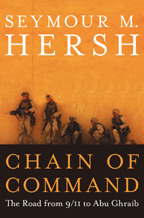
reporting—which forms the nucleus of his new book, Chain of
Command—helped launch nearly a dozen different criminal
investigations into what former vice president Al Gore dubbed “the
American Gulag,” the extraterritorial chain of prisons and
detainment centers, stretching from Guantanamo Bay to Afghanistan,
set up by the Bush administration to hold suspected terrorists. More
than 300 instances of abuse in those facilities, from November 2001
to as recently as March 2004, have been alleged since then. To date,
eight out of 11 investigations have been completed. They have
produced thousands of documents, witness interviews, military
orders, emails, and PowerPoint briefings, with each one telling a
small piece of the story of how America's vaunted all-volunteer
professional military lapsed into some of the most unprofessional
and despicable conduct of its history. Forty-five soldiers have been
recommended for courts-martial, and 23 others for summary discharge.
Nearly one year after the first sadistic acts took place, the extent
of the abuses remains unknown. But by all indications, the worst
revelations are yet to come. In closed-door presentations before
Congress, Pentagon officials revealed evidence of crimes ranging
from the rape of female detainees to the sexual abuse of minors held
at Abu Ghraib.
There is no doubt that the abuses at Abu Ghraib stand as an
indelible stain on the honor of the American military. What is less
clear is the degree to which the resulting scandal has damaged our
national security and undermined our efforts to bring peace to Iraq
and win the war against radical terrorism—a war that is as much a
fight for the political and moral high ground as it is a shooting
war that pits American soldiers against Islamist ones. America
suffered a huge defeat the moment those photographs became public.
Copies of them are now sold in souks from Marrakesh to Jakarta,
vivid illustrations of the worst suspicions of the Arab world: that
Americans are corrupt and power-mad, eager to humiliate Muslims and
mock their values. The acts they document have helped to energize
the insurgency in Iraq, undermining our rule there and magnifying
the risks faced by our soldiers each day. If Osama bin Laden had
hired a Madison Avenue public relations firm to rally Arabs hearts
and minds to his cause, it's hard to imagine that it could have
devised a better propaganda campaign.
The damage done by Abu Ghraib might at least have been minimized
had the administration pursued a strategy of publicly and sincerely
holding accountable those responsible for it. Instead, it has done
something close to the opposite. The Bush administration has
condemned the abuses as the work of a “few bad apples,” while
working diligently to get the story off the front pages and out of
the presidential campaign. In a meeting with Human Rights Watch
executive director Kenneth Roth shortly after the scandal broke,
reports Hersh, National Security Adviser Condoleezza Rice argued
that the abuses resulted not from the president's policies in the
war on terrorism, but from “implementation of policy” by the
military. The various committees and commissions investigating the
scandal have more or less abetted this line of defense. Discussing
the results of the independent investigation into Abu Ghraib he
chaired, former defense secretary James R. Schlesinger explained
that while “institutional and personal responsibility” for the
abuses went all the way to Washington, they were rooted in the
sadism and brutality of a few individuals—“Animal House on the night
shift,” as he put it. While the military's civilian leadership was
guilty of “indirect responsibility,” Schlesinger told reporters,
Donald Rumsfeld's resignation “would be a boon to all of America's
enemies.”
Go past the executive summaries and press releases, however, and
a careful reading of the reports reveals a different story. The
devastating scandal of Abu Ghraib wasn't a failure of
implementation, as Rice and other administration defenders have
admitted. It was a direct—and predictable—consequence of a policy,
hatched at the highest levels of the administration, by senior White
House officials and lawyers, in the weeks and months after 9/11. Yet
the administration has largely managed to escape responsibility for
those decisions; a month from election day, almost no one in the
press or the political class is talking about what is, without
question, the worst scandal to emerge from President Bush's nearly
four years in office.
Defenders of the administration have argued, of course, that
there is no “smoking gun”—no chain of orders leading directly from
Defense Secretary Donald Rumsfeld to Pfc. Lynndie England and her
co-conspirators. But that reasoning—now largely accepted within the
Beltway—betrays a deliberate indifference to how large organizations
such as the military actually work. In any war, civilian leaders set
strategic aims, and it falls to commanders and planners at
successively lower levels of command to refine that guidance into
executable orders which can be handed down to subordinates. That
process works whether the policy in question is a good one or a bad
one. President Bush didn't order the April 2003 “thunder run” into
Baghdad; he ordered Tommy Franks to win the war and the Third
Infantry Division's leaders figured out how to make it happen.
Likewise, no order was given to shove light sticks into the rectums
of Iraqi prisoners at Abu Ghraib. Nevertheless, the road to the
abuses began with flawed administration policies that exalted
expediency and necessity over the rule of law, eviscerated the
military's institutional constraints on the treatment of prisoners,
commenced combat with insufficient planning, preparation and troop
strength, and thereby set the conditions for the abuses that would
later take place.
But there's a reason why most of the investigations into Abu
Ghraib have punted on the essential question of executive
responsibility. To judge the administration's decisions to have been
wrong, after all, requires us to discern what the right decisions
would have been. And to do that, we must put ourselves in their
shoes. Given the particular conditions faced by the president and
his deputies after 9/11—a war against terrorists, in which the need
to extract intelligence via interrogations was intensely pressing,
but the limits placed by international law on interrogation
techniques were very constricting—did those leaders have better
alternatives than the one they chose? The answer is that they did.
And we will be living with the consequences of the choices they made
for years to come.
Breaking the law
War has always had its own codes and rules, but the modern laws
governing armed conflict were developed during the 20th century,
when industrialized nations fought large, mechanized, bloody wars of
attrition. World Wars I and II—featuring aerial combat, bombing
campaigns, chemical and trench warfare, and the slaughter of
soldiers and civilians on an unprecedented scale—spurred the four
Geneva Conventions of 1949, which laid out basic principles of
conduct for civilized nations. These treaties aimed to distinguish
between combatants and civilians, and to the extent possible, to
minimize the suffering inherent in war. But like their
predecessors—the prisoner-of-war treaty signed in Geneva in 1929,
the Union Army's Lieber Code of 1863, the 1864 Geneva Convention,
and the 1907 Hague Conventions, among others—the Geneva Conventions
of '49 were fundamentally backward-looking, reflecting the dominant
nature of warfare at the time: large air and land campaigns between
states employing relatively symmetrical forces. When the treaties
mentioned paramilitaries and non-state guerrillas, they were
typically treated as bandits who played only a tangential role in
the conduct of warfare. The conventions wholly failed to anticipate
the wave of unconventional warfare that would sweep the world after
World War II, from U.S. and British-sponsored guerillas in Greece to
Communist-backed insurgents in Vietnam to the asymmetric warfare
practiced by the terrorists of today. By the late 1990s, conflicts
in the Balkans and elsewhere made it clear that paramilitaries,
terrorists, and other irregular combatants—far from fighting on the
margins—had become the principal security threat to much of the
world, including the United States. Yet international law continued
to treat them as mere criminals, best dealt with through indictments
rather than artillery.
Such was the legal paradigm in place when al Qaeda attacked the
nation on September 11, 2001. By the conventional laws of war, al
Qaeda was neither a state nor a military; its operatives were
neither soldiers nor civilians. Within weeks of the 9/11 attacks,
the United States launched its armed response in Afghanistan—and,
almost immediately, legal questions emerged which showcased the
difficulty of pounding the round problem of al Qaeda into the square
hole of existing international law. Unlike a national army, al Qaeda
and the Taliban militia wore no conventional uniforms, and often did
not operate in conventional units that could be identified or
distinguished from the civilians among whom they hid. Most
importantly, al Qaeda rejected the very notion of the laws of war,
of protecting civilians when at all possible. Indeed, the
terrorists' apocalyptic doctrine expressly made civilians—in their
view, agents of Western cultural and economic imperialism—legitimate
targets.
The inherent nature of stateless terrorism presented the Bush
administration with another quandary, this one linked to the
desperate need, in the months after 9/11, for reliable intelligence
about the shadowy force that had just murdered more than 3,000
Americans. In a conflict between states, captured soldiers rarely
possess strategically useful information; they may know about their
own unit, or the plans for the next ground offensive, but rarely
much more than that. A German corporal, or even a colonel, was
unlikely to know much in 1944 about the big picture on the Western
Front, let alone plans for V-2 strikes on London. Thus nations at
war could, in the past, usually afford to treat prisoners relatively
well—because doing so did not require trading away significant
intelligence opportunities. The war on terror—an asymmetric war in
which small numbers of combatants could inflict catastrophic
damage—changed that equation. Unlike states, where the most
important intelligence might concern evidence of a nuclear
capability or the presence of tanks near the border, the most
valuable intelligence about al Qaeda concerned its plans and
intentions. Moreover, rank-and-file enemy operatives might well
possess such information; were U.S. authorities to capture someone
from a terror cell on the eve of its next attack, they couldn't
afford simply to store him in a jail cell until the war was over.
(Similar conditions obtained once the war in Iraq shifted from a
conventional war fought largely between designated combatants to an
insurgency fought between American soldiers on the one side, and a
hodgepodge of guerrillas and irregulars on the other.)
In military terms, the global war on terror shifted the calculus
of intelligence-gathering almost entirely towards human intelligence
(HUMINT) of the kind that can only be produced through clandestine
infiltration, interrogation, and other means. Satellites,
surveillance systems, giant listening devices, and
ground-penetrating radar won't alert the CIA and FBI to the next
terrorist attack, or tell the U.S. Army where the insurgents have
placed explosives on the highway between Fallujah and Baghdad. Yet
here, too, the Bush administration had a problem: Over the years,
the intelligence community's HUMINT capabilities had atrophied
considerably, in favor of “technical” intelligence collection
systems like satellites and electronic surveillance. Indeed, where
the Middle East was concerned, the CIA, FBI, and military had
virtually no HUMINT assets in place before or immediately after 9/11
to provide intelligence about the terror organization that had hit
the United States. “At the time of the attacks, it's possible that
there wasn't a single such [clandestine] officer operating today
inside Islamic fundamentalist circles,” Hersh writes in, based on
what he says are extensive interviews with current and former
officials in the U.S. intelligence community. Writing in the
Atlantic in the summer of 2001, former CIA officer Reuel Marc
Gerecht summed it up this way: “Operations that include diarrhea as
a way of life don't happen.” The only way to gather intelligence
about global terrorism would be to extract it from the terrorists
themselves.
Prisoner's dilemma
These problems converged with the first mass capture of prisoners
at Mazar-i-Sharif in Afghanistan in November 2001. Under the Geneva
Conventions, prisoners of war are accorded certain rights and
privileges—among them humane treatment, freedom from coercive
interrogation, and repatriation at the end of active hostilities.
But the Pentagon and CIA needed to gather HUMINT from these
detainees about al Qaeda and its global terror network. As the Bush
administration saw it, its choice was clear. Al Qaeda posed a clear
and present danger. The nation desperately needed to gather
intelligence about that threat. Either they could toss out the rule
book and operate by any means necessary, or America would be
attacked again.
Any president in that situation would have had to go beyond the
bounds of existing law. But in truth, there were choices beyond
either action or acquiescence. Well before Mazar-i-Sharif, legal
scholars and philosophers had grappled with the question of whether
a nation could ever justify the use of torture, assassination,
hostage-taking, mass internment, and other measures. One course
would have been to open up a series of narrow loopholes in the law,
with tight oversight, and require that top leaders approve every use
of extraordinary measures. This is more or less what former
president Bill Clinton did during the 1990s, when he secretly signed
an order essentially legalizing the assassination of Osama bin Laden
should the opportunity arise. According to the order, the president
had to personally sanction bin Laden's death—a measure framed
largely at the insistence of Agency officials who wanted to ensure
their agents would not be found culpable if anything went wrong. (In
the end, when the opportunity did present itself—a planned 1998 raid
by the CIA on the al Qaeda camp at Tarnak Farms near Kandahar—the
Clinton White House was talked out of it.)
The other option was to sanction a wholesale abandonment of the
law and delegate the responsibility for its violation down the chain
of command to front-line troops. And that's precisely what the Bush
administration did. They began with the plausible argument that the
Geneva Conventions were anachronistic in an age of asymmetrical,
non-state warfare. Al Qaeda didn't wear uniforms or fight according
to the laws of war, they reasoned, and so they were not necessarily
entitled to the conventions' protections. But the lawyers—including
White House counsel Alberto Gonzales, Defense Department general
counsel William Haynes II, Vice President Cheney's counsel David
Addington, and Jay Bybee of the Justice Department (who now sits on
the Ninth Circuit Court of Appeals)—went further. They advised the
president to sign a blanket statement of policy that the men
captured in Afghanistan would not be subject to the Geneva
Conventions, and that by executive fiat, they would all be declared
“unlawful enemy combatants,” a category that does not exist in
international law. White House, Justice Department and Pentagon
lawyers also pushed President Bush to sign a secret finding on Feb.
7, 2002, that would have far-reaching consequences for the nation
and the world. “I… determine that none of the provisions of Geneva
apply to our conflict with al Qaeda in Afghanistan or elsewhere
throughout the world,” this document determined, adding that the
White House also had “the authority under the Constitution to
suspend Geneva as between the United States and Afghanistan, but I
decline to exercise that authority at this time.” For all intents
and purposes, these memoranda gutted the Geneva Conventions.
Within months, those first legal memoranda were joined by more
focused opinions from the administration's top lawyers, each
authorizing specific tactics the Bush administration wanted to use
in the global war on terrorism. In 2002 and 2003, attorneys in the
departments of Justice and Defense drafted memoranda outlining what
international and domestic law would allow with respect to “coercive
interrogation” practices, eventually settling on a list of dozens of
tactics, among them sleep deprivation and the use of stressful and
painful physical positions. Such tactics, argued the lawyers, didn't
run afoul of the Geneva Conventions because the President had
already unilaterally declared those conventions null and void with
respect to al Qaeda and other terrorist detainees. This opinion also
rendered the U.S.'s own federal war-crimes statute impotent, because
that law defines a war crime as a violation of the existing
international laws of war, including the Geneva Conventions. To be
enforced, that law depends on the existence of a Geneva Convention
violation; similarly, the Uniform Code of Military Justice prohibits
war crimes, but without a Geneva Convention violation, there was no
war crime.
The Bush administration's memoranda also took an excruciatingly
narrow view of the federal torture statute, essentially defining it
out of existence for the purposes of interrogations in Afghanistan
and Guantanamo Bay: “A defendant is guilty of torture only if he
acts with the express purpose of inflicting severe pain or suffering
on a person within his custody or physical control.” In other words,
interrogation tactics which accidentally result in severe pain or
suffering were not enough to merit the label of torture. Only
tactics which were specifically intended to cause severe pain and
suffering—and performed by professional torturers with the knowledge
of how their tactics would affect the body—would fit the definition
under federal criminal law. Under this reasoning, amateur
interrogators (such as the reserve military police soldiers assigned
to Gitmo) could never be guilty because they lacked the skill and
experience to know the exact causal links between their tactics and
the pain and suffering those tactics would cause. The Justice
Department also took the view that only someone who specifically
intended to cause extreme pain and suffering, on the level of organ
failure and death, would be guilty. This interpretation set a bar so
high that virtually no prosecutor would ever be able to meet it in
court, and opened the door to any use of coercive interrogation
tactics that fell just shy of the “severe pain and suffering”
threshhold. Justice's interpretation ensured no U.S. defendants
would ever face torture charges and made the U.N. Convention Against
Torture a dead letter too.
The Bush administration also chose Guantanamo as the site to hold
detainees specifically because it was thought to be outside the
reach of U.S. courts—and it was, until the Supreme Court ruled in
June 2004 that detainees there had the right to ask a federal court
for a writ of habeas corpus. In addition, the federal anti-torture
statute excluded from jurisdiction military bases and diplomatic
missions, such as Guantanamo and Abu Ghraib, a loophole that would
remain open until October 2004 when Congress closed it. Thus, in
addition to stripping the detainees themselves of rights, the
administration picked a place where the law simply had no
force—Gitmo provided the perfect legal black hole in which to house
detainees and practice the dark arts of interrogation.
One of the problems cited by the Schlesinger report was the
disconnect between tactics authorized at Guantanamo, where “unlawful
enemy combatants” were held and the Geneva Conventions did not
apply, and the tactics authorized in Iraq where the president had
said the Geneva Conventions did apply. As guidance from the top
filtered down through several layers of command, it became unclear
which methods were appropriate for which location, an ambiguity
compounded by the movement of individual interrogators and guard
force personnel between the two physical locations. One fateful
decision was the one to “Gitmoize” the prison operation in Iraq in
August 2003, a response to the blooming insurgency there and the
failure of the U.S. military prisons in Iraq to produce intelligence
about the insurgency. The Pentagon brought Maj. Gen. Geoffrey
Miller, the head of the Guantanamo Bay facility, to Iraq to make
recommendations on how better to squeeze detainees for information.
His prescription: “Detention operations must act as an enabler for
interrogation… to provide a safe, secure and humane environment that
supports the expeditious collection of intelligence.” Miller
imported a number of the non-Geneva Convention techniques from Cuba
to Iraq to assist interrogators in gathering information, and by so
doing reportedly turned on a spigot of human intelligence, leading,
among other things, to the capture of Saddam Hussein. But in his own
investigation of the Abu Ghraib abuses, Maj. Gen. Antonio Taguba
reported that this extension of Gitmo tactics to Iraq had only
exacerbated confusion about what the Geneva Conventions did and did
not authorize, and where Geneva applied, to the point that
intelligence officers and military lawyers could not define any
recognizable lines between the two modes of interrogation. Under the
circumstances, it was almost inevitable that the techniques
authorized for Gitmo would migrate over to Abu Ghraib.
The investigation by Maj. Gen. George Fay and Lt. Gen. Anthony
Jones, which looked at the role of military intelligence units in
the abuse scandals, backed up Taguba's findings. According to Gen.
Paul Kern, who oversaw the Fay-Jones inquiry, “the people who were
conducting the interrogations clearly were feeling a lot of pressure
to produce intelligence, as they should have been. That's what the
purpose of the interrogation is.” But when they sought policy
guidance and legal advice about what they could do to produce
intelligence, they got directives back from headquarters “which were
never in our view completely clarified … in the end, [headquarters]
did not absolutely make it clear what the boundaries were.” An
after-action report on the “legal lessons learned” from the wars in
Afghanistan and Iraq, authored by the Army's Judge Advocate General
(“JAG”) school, found the same thing: “Detainees are a potential
source of valuable information, and the motivation to extract that
information through interrogation may sometimes create strong
temptation to test the limits of the [law of armed conflict].
Questions often concerned the legality of specific proposed
interrogation techniques.” Army officers tend to understate these
things, especially in after-action reports, so it's no surprise that
Gen. Kern and the JAG school phrase their findings so circumspectly.
But don't be fooled: This is the military equivalent of shouting
from the rooftops.
The memos had another practical effect, which was the
evisceration of any legal opposition from the ranks to the proposed
methods of interrogations. Military units of a certain size are
staffed with JAG officers, chaplains, and other professionals who
typically serve as a unit's legal and ethical conscience. In formal
and informal ways, they vet operational plans to ensure missions
comply with the laws of war. According to Army doctrine, operational
orders at the brigade level and above must contain an annex covering
the legal implications of the plan, procedures for dealing with
prisoners, and other issues. It's not clear to what extent the
actions at Abu Ghraib were subjected to this sort of scrutiny before
they were implemented. But even if a young JAG officer were to raise
objections in the field, it's unlikely they would have gone
anywhere. The memoranda from the White House—signed by the
commander-in-chief's top lawyer —stamped the interrogation tactics
with the imprimatur of legality, ensuring that any dissent from the
field would have been ignored.
Finally, the memos directly affected the junior soldiers, like
Pfc. England, who now stand accused of torturing Iraqi prisoners.
Every new soldier learns in basic training that he or she must
follow lawful orders when they are given. But they also learn they
must disobey orders—to kill innocent civilians, for example, or
torture detainees—that are unlawful, and they cannot invoke
“superior orders” as a defense when those orders are illegal. The
junior soldiers now charged with abuses at Abu Ghraib should have
objected to any orders to abuse prisoners, because they were
patently immoral and unlawful. But in reality, that's easier said
than done. After all, the orders to interrogate prisoners by
coercion had come from the very highest levels of the
administration.
They had been filtered through every level of the chain of
command without objection. Senior administration lawyers with Ivy
League credentials and decades of experience had approved these
procedures, including some that were startlingly close to those
depicted in the Abu Ghraib photographs, such as the use of stress
positions and hoods. It may be unrealistic to expect that a junior
enlisted soldier such as England, or even her immediate supervisor,
Staff Sgt. Ivan Frederick, would have the knowledge or the temerity
to contradict such orders when they were given. The effect of the
Bush administration's exhaustively creative research into breaking
the rules was virtually to ensure that every player in this tragedy
went along and followed orders.
Unintended consequences
Two other decisions by the Bush administration also proved
fateful, both of them made long before the Iraq war began. One was
the administration's attempt—directed by Secretary of Defense Donald
Rumsfeld—to run the Iraq war with fewer soldiers in place than
considered military opinion believed necessary. The resulting
shortage of troops set the conditions for abuse at the prison. The
after-action report by the Army's JAG school specifically blames
troop shortages for the chaotic and disorganized detainee operations
in Iraq, sharply criticizing the decision to delay the deployment of
the 800th Military Police Brigade—the unit responsible for Abu
Ghraib—until well after combat had begun. From the moment it touched
ground, the 800th was behind the eight ball, and it's not clear the
brigade ever got a handle on the detainee mission.
“There was chaos at Abu Ghraib… there was a very low ratio of
military police to the number of inmates, which ranged as high as
8,000,” Schlesinger noted in announcing his panels' findings last
summer. “At Guantanamo, which is something of a model, the ratio of
military police to detainees was one to one. At Abu Ghraib, the
ratio of military police was one to 75.” Add in the pressure from
the Bush administration to produce intelligence, and take away the
legal constraints of the Geneva Conventions, and you can appreciate
what a pressure cooker Abu Ghraib became. Even had there been no bad
apples in the 372nd MP Company, with which Pfc. England served,
abuses were almost inevitable.
The second fateful decision was to rush those troops that were
allocated to Operation Iraqi Freedom into battle too quickly. During
the first Gulf War, military planners set aside months to build a
war machine in the Arabian desert, allowing units to stabilize and
train together at length before the start of hostilities—time that
was especially valuable to the hundreds of thousands of reservists
called up for the war. (Indeed, it's worth noting that, although
American soldiers took as prisoners tens of thousands of Iraqis
soldiers during the first Gulf War, allegations of abuse were
sparse.) But the second Gulf War was launched in a hurry, even
before most of the forces assigned to it were in place. Many have
pointed out that, had the Bush administration not “rushed to war,”
U.N. inspectors might have been able to show that Iraq had no WMD
capability; at the very least, the White House would have had time
to line up more support from our allies. Less widely understood is
that a longer delay would have given military police and civil
affairs units—most of which come from the reserves—time to arrive,
acclimate, and train longer together, bringing them up to readiness
levels approaching those of active duty troops.
The situation in Iraq deteriorated rapidly after the United
States took Baghdad, with the result that reserve units had to be
called up and immediately thrown into the fight. The 372nd MP
Company hit the ground in Kuwait in May 2003, and was immediately
sent into Iraq to patrol the town of Al-Hillah with Marines and
Iraqi police units. Although its soldiers received pre-deployment
training in the states after their February 2003 call-up, they
received nothing like the pre-war training of their active-duty
brethren in the Third Infantry Division, some of whom spent a year
in the Kuwaiti desert before actually crossing into Iraq in March
2003. When the 372nd went into combat, it was not ready for war.
Perhaps more importantly, the 372nd MP Company's training records
indicates that it barely trained at all on handling prisoners of
war, let alone managing a maximum-security prison even though
“internment and resettlement” operations are a bread and butter MP
mission. The Taguba report found that this unit and its parent
headquarters—the 320th MP Battalion and 800th MP Brigade, both
reserve units—suffered from chronically poor training, resourcing,
and leadership. These problems within the MP units combined with
atrocious planning and resourcing decisions in Washington to create
a formula for disaster.
Creative tactics
The duty force at Abu Ghraib, then, had ambiguous policy guidance
from Washington, too few men, and too little training. What happened
next should hardly have been a surprise. Take, for example, the
guards' implementation of the interrogation practices authorized by
the Pentagon. Interrogation tactics like “sleep deprivation” sound
entirely too sterile when taken out of context—after all, who hasn't
been deprived of sleep, whether by a newborn baby or a last-minute
project at work? What's crucial to understand is how such methods
are translated into practice in the field. As Hersh writes:
In May 2004, I interviewed a company captain in a
military police unit in Baghdad who told me about an incident the
previous fall in which he was approached by a junior military
intelligence officer who requested that his M.P.s keep a group of
detainees awake around the clock until they began talking. “I
said, 'No, we will not do that,'” the captain said. “The M.I.
commander comes to me and says, 'What is the problem? We're
stressed, and all we are asking you to do is to keep them awake.'
I ask, 'How? You've received training on that, but my soldiers
don't know how to do it. And when you ask an eighteen-year-old kid
to keep someone awake, and he doesn't know how to do it, he's
going to get creative.'”
Chain of Command by Seymour Hersh Harper
Collins, $25.95
What, exactly, does “creative” mean? Consider the iconic image of
Abu Ghraib: a hooded Iraqi man standing on an Army rations box with
wires extending from his arms in a grotesque pose almost reminiscent
of a crucifixion. It turns out that this was among the tactics
employed by untrained prison guards and interrogators as a means
both of instilling fear and of keeping a detainee awake, in faithful
execution of the “sleep deprivation” tactic authorized by the
secretary of defense. Even though the wires were actually inert, the
detainee was likely told that he would be electrocuted if he moved
off the box, which he would do if he fell asleep. And thus, so
modestly-named a tactic as sleep deprivation was transformed into
something far more sinister. The same tactic could be used in
conjunction with the “stress position” technique approved by the
Pentagon, according to one former intelligence officer I talked to.
A hooded person forced to stand still on a box for hours will
quickly lose his sense of equilibrium and orientation. Lower back
pain will eventually develop from the strain of remaining upright
for such a long time; pain in the legs and feet will follow as blood
pools there. Held for several hours without movement, such a
position can induce excruciating pain, particularly for detainees
not in top physical condition. When the image first surfaced, these
officers said they were not surprised by the tactic. It was merely a
creative attempt by amateurs to achieve the results desired by their
leaders—an unfortunate twist on the old maxim of Gen. George S.
Patton: “Never tell people how to do things. Tell them what to do,
and they will surprise you with their ingenuity.”
Weighing torture
There are few slopes more slippery than the one from small war
crimes to large ones, as evidenced by the incremental movement of
U.S. interrogation tactics from “a little bit of smacky face,” as
one intelligence officer described the officially-sanctioned tactics
at Gitmo to The Wall Street Journal, to the abuses depicted
in the Abu Ghraib photographs. For decades, the laws of war have
stood as a braking point on this slippery slope, establishing
bright-line rules about what is forbidden even in the heat of
combat. Generally speaking, absolute rules are the only ones that
work well in wartime. Where only vague guidance exists, junior
military leaders may exploit ambiguity to employ tactics that fall
outside the boundaries of acceptable conduct. In war, there is
always some battlefield exigency or necessity which can be invoked
as a justification before or after the fact. It's one thing to argue
that there was a compelling need for these tactics, and that
therefore they were implicitly authorized in certain situations but
always tightly controlled; it's quite another to loosen the rules
altogether and let junior soldiers take the initiative to do what
they think must be done.
If our political leaders decide that Khalid Sheikh Mohammed needs
to be immersed in water so that he spills his guts about the next
terror plot, I can accept that—and I suspect the rest of the world
could, too. But those who take action should also take
responsibility for it. Our soldiers need a better legal framework to
deal with these situations, one that gives commanders the
flexibility to do what must be done while not stepping on our values
or hurting our strategic interests in the process.
First and foremost, the framework should maintain existing rules
about treating prisoners, because those should govern all but the
most extraordinary of cases. Second, when a departure is necessary,
we should require authorization from the White House and Pentagon
articulating both the scope of the authorization and the
justification for doing so. Such authorizations might mirror the
kind of court documents required of the Justice Department when it
applies for a secret warrant under the Foreign Intelligence
Surveillance Act. This will let our soldiers know why they are
breaking the rules, and minimize the cognitive dissonance that led
to so much confusion at Abu Ghraib about what was allowed and
forbidden. Third, the services should actively rely on their
lawyers, chaplains and career non-commissioned officers to serve as
the legal, moral and institutional checks respectively on this kind
of activity. All three of these systems failed at Abu Ghraib.
Fourth, to the extent practical, we must add some measure of
transparency to detention operations. The military can't publicize
exactly what it's doing to interrogate prisoners, because that would
destroy the value of these methods, but we should recognize the
value of good publicity and let the Red Cross see as much as
possible.
Finally, the nation's political leaders must constantly
reevaluate these departures from the law, to ensure we are getting
something in exchange for our calculated decision to break the law.
A measured approach to this problem will ensure that breaches of
international law, if they must occur, will take place in an orderly
and disciplined manner, allowing soldiers to resume their normal
treatment of prisoners immediately afterwards. What's wrong is to
loosen the restrictions across the board or abandon them altogether;
once discipline is lost, it is nearly impossible to restore.
There's a reason why career military officers are among those who
have expressed the greatest revulsion over the Bush administration's
cavalier treatment of the laws of war. These officers aren't
soft-minded idealists who believe in the rule of law for its own
sake. Quite the contrary; three generations of military officers
have grown up respecting the Geneva Conventions for extremely
practical reasons. When the administration publicly declared in
February 2002 that those conventions would not apply to the
detainees at Guantanamo Bay, many of America's soldiers worried that
this policy would be reciprocated by our nation's enemies, should
Americans themselves ever be captured in a future conflict. It is
worth noting that Secretary of State Colin Powell, who saw combat in
Vietnam and helped run the first Gulf War, strongly opposed this
move, as did his chief legal adviser, William Howard Taft IV. The
principle of reciprocity has long served as one of the chief
mechanisms for compliance with the laws of war. The Bush
administration's approach has put future generations of U.S.
military personnel in grave risk of mistreatment.
But our overriding of international law has also had much broader
implications for U.S. interests. Although America's record in
establishing and complying with the laws of war has stood the test
of time, the rhetoric of realism and national interest reigned
supreme during most of the Cold War; international law was relegated
to the back burner. Something changed around the time of the first
Gulf War. In his arguments for that war against Iraq, then-President
George H.W. Bush invoked the language of international justice. The
case for the first Gulf War hinged on international law and the need
to maintain the rule of law among nations. Bill Clinton made similar
arguments to justify American interventions in Haiti, Bosnia, and,
most spectacularly, Kosovo, where principles of international
justice were used to trump the principle of national sovereignty in
order to justify the NATO air war against Serbia. Because we
convinced the world that our interest was to apply international
standards of conduct, the United States was able to make the case
that the sovereignty of a country could be breached in the service
of a larger moral and security goal—a major and salutary watershed
in international affairs. Our embrace of those ideals magnified our
power and increased the chances that we would succeed, as we did in
Kosovo.
The Bush administration, however, has altered course. Few
students of international law would have challenged America's
near-instant retaliation against al Qaeda's Taliban hosts. But then
came the decisions to cast aside the Geneva Conventions and then to
invade Iraq without the sanction of the U.N. Security Council. These
moves occurred at roughly the same time as the Bush administration's
unilateral decision to scrap the Kyoto Protocol, withdraw from the
International Criminal Court's Rome Treaty, and obstruct its
implementation by negotiating deals to keep U.S. citizens out of its
jurisdiction, and abandon the Anti-Ballistic Missile treaty in order
to pursue a missile-defense system. All of a sudden, the world's
leader in international principles had become, in some sense, the
world's scofflaw. To a world accustomed to watching American
invocation and support of the rule of law and the import of
international institutions like the United Nations, WTO, and NATO,
the reversal was startling.
It's true that the administration has garnered some human
intelligence through its use of torture. Arguably, some intelligence
gathered this way helped lead to the capture of Saddam Hussein in
December 2003. But it's unlikely that torture would be a useful tool
day-to-day; a vast body of literature on the subject indicates that,
on the contrary, coercive interrogations tend to elicit unreliable
intelligence more than they do useful information. And whatever
gains have come from our use of torture have come at enormous
cost—to the historic commitment of this nation to liberal ideals and
the rule of law, to the safety of American soldiers, and to the
ultimate national security of the nation. In warfare, the United
States cannot succeed strategically simply by vanquishing its foes
on the battlefield; it must secure the peace as well, which requires
the winning of hearts and minds.
Regardless of America's past reputation, it cannot hope to ever
win the popular support of a country unless it acts both with just
cause and just means. As political theorist Michael Walzer has
written, when a nation must prevail in the political and moral
dimensions of conflict as well as the strategic and tactical
theaters, the pursuit of justice becomes virtually a military
necessity. No one can dispute that the United States won a stunning
tactical victory over the Iraqi army in April 2003. But the
perceived injustices committed by the United States during our
subsequent occupation of Iraq may well deliver us a strategic
defeat. Al Qaeda confederates, such as the Ansar al-Islam terror
network operating inside Iraq, have incorporated the pictures from
Abu Ghraib into their recruiting literature. Abu Musab al-Zarqawi's
Tawhid and Jihad movement has also benefitted from the Abu Ghraib
scandal, citing abuses of Iraqi women there as the justification for
the kidnapping and beheading of several Western hostages. It is
clear that Abu Ghraib has given Iraqi insurgents—and, potentially,
terrorists around the world—a new raison d'etre.
Being seen as the good guys—and more importantly, actually being
the good guys—helps to win battles on the ground, too. Those tens of
thousands of Iraqis who surrendered during the two Gulf Wars did so
because they believed they would be treated better as prisoners by
the United States than as soldiers by the Hussein government. But in
the wake of Abu Ghraib, more future battles fought by America will
have to be fought to the death. Similarly, civilians in the places
where we fight can no longer be expected to greet us as liberators.
For as long as the memories of Abu Ghraib linger, our soldiers will
be greeted with suspicion wherever they go.
The world will forgive—and indeed, secretly applaud—those
occasions, such as Kosovo, where we ignore the letter of the law or
sidestep international institutions in the service of an obviously
greater good. What it will neither understand nor condone is the
wholesale abandonment of the law. The Bush administration has cast
the debate over the laws of war in all-or-nothing terms—either you
can throw out the old laws of war, or do nothing to secure the
nation against a terrorist attack. In many ways, this position
resembles much of the administration's rhetoric in the war on terror
and its bid for reelection: You're either with us or against us, for
good or for evil, a supporter of American policy or a supporter of
terrorism. But the world is far more complex than that. There was a
third path between living with the anachronistic laws of war and
rejecting them in favor of expediency. The Bush administration
rejected that path, and now, every day, U.S. soldiers and Iraqi
citizens are paying the ultimate price for its mistake.


 A generation from now, historians may look back
to April 28, 2004, as the day the United States lost the war in
Iraq. On that date, “CBS News” broadcast the first ugly photographs
of abuses by American soldiers at Baghdad's Abu Ghraib prison. There
were images of a man standing hooded on a box with wires attached to
his hands; of guards leering as they forced naked men to simulate
sexual acts; of a man led around on a leash by a female soldier; of
a dead Iraqi detainee, packed in ice; and more. The pictures had
been taken the previous fall by U.S. Army military police soldiers
assigned to the prison, but had made it into the hands of Army
criminal investigators only months later, when a soldier named
Joseph Darby anonymously passed them a CD-ROM full of prison photos.
The images aroused worldwide indignation, and illustrated in graphic
detail both the lengths to which the United States would go to get
intelligence, and the extent to which those efforts had been
corrupted by the exigencies of the difficult war in Iraq.
A generation from now, historians may look back
to April 28, 2004, as the day the United States lost the war in
Iraq. On that date, “CBS News” broadcast the first ugly photographs
of abuses by American soldiers at Baghdad's Abu Ghraib prison. There
were images of a man standing hooded on a box with wires attached to
his hands; of guards leering as they forced naked men to simulate
sexual acts; of a man led around on a leash by a female soldier; of
a dead Iraqi detainee, packed in ice; and more. The pictures had
been taken the previous fall by U.S. Army military police soldiers
assigned to the prison, but had made it into the hands of Army
criminal investigators only months later, when a soldier named
Joseph Darby anonymously passed them a CD-ROM full of prison photos.
The images aroused worldwide indignation, and illustrated in graphic
detail both the lengths to which the United States would go to get
intelligence, and the extent to which those efforts had been
corrupted by the exigencies of the difficult war in Iraq.