|
“My Islam” on the
Internet
|
|
|
In
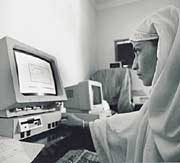
2002, the total number of Internet users in the Arab world was
7.5 million
|
I went to the lecture, maybe not even with the
intention of reviewing it, and here I am. What I came out
with—despite my observation that most of the audience did not
understand the lecture for what it was, or appreciate the genuine
sense of subtlety and profound research talent—was an intellectual
“itch.” Despite the distance that could be sensed between the
subject matter—“Islam and the Internet”—and the distance that the
paradigmatic subtext of the work had traveled along in its inherent
chain of thought, the work proved to be well constructed; as its
intellectual foundations were solid enough to take the argument to a
high dialectical edifice.
The lecture, which took place on October 10 at
the Goethe Institute, the German Cultural Center in Cairo , as a part of the German
Festival filled the lecture hall completely.
How could a topic like “Islam and the Internet”
knock with a subtle hand on the high doors of pressing debates such
as “modernism and traditionalism,” “personal judgment,”
“individualism and personal interpretation of text,” “virtual
Ummah,” “the referential position of scripture, text, and
individuals,” “role and qualification of a scholar,” and many more?
Although the research did not go outside the Muslim electronic
existence on the World Wide Web, the reflections of all such ideas
on the realm of the work was noticed. Is the Internet an actual
reflection of the Muslim reality? Or, is reality reflecting itself
on the Muslim Internet? Is the “online” a direct indication of the
“offline”? Or is “online” contributing to things going “offline” (as
the Internet comes with inherited values, generated from its modern,
Western designation)?
Dr. Albrecht Hofheinz, a subtle and sober voice,
who I had the pleasure of meeting after the lecture to discuss his
work, revealed interesting findings. His lecture brushed away many
general assumptions about the issue at hand; mostly relating to the
sensationalist—to say the least—“terrorist” Web sites. What was even
more interesting was his introductory remark that only the Internet,
unlike the introduction of other technological advancements, such as
the television, was not received with jurisprudential debate
concerning its validity: Its scope, impact, and lawfulness has not
been debated amongst Moslem scholars, unlike its technological
sisters that, throughout history, were received by a thorough debate
on their bearing and their impact on the quality of the Muslim
individual in relation to his God, which ultimately determines their
position.
In spite of the lack of scholarly attention, the
cultural and moral dimensions of the Internet have been the subject
of heated debate in many circles. Hofheinz mainly focuses on “The
Internet and the Change of Moral Values in Arab Societies.” Because
the economic benefits of the Internet, in his view, were never seen
as problematic, his main interest in the Arab use of the Internet
focuses more on the sociological. Against the falsehood of equating
the Arab and Muslim use and development of the Internet as
“e-jihad,” he tries to unearth the actual, true effect of the
Internet on Arabs, especially in relation to Islamic interests, and
how this is affecting moral values.
Amongst the top 150 most popular Arab Web sites,
there are 50 religious ones. Arabs seem to have a vivid interest in
religion. This number is not matched by any other country or region
in the world, including the US, where religion plays an important
role in many aspects of society.
Statistically speaking, as Hofheinz’s research
shows, in 2002, the total number of Internet users in the Arab world
was 7.5 million, which is 3 percent of the Arab population. By the
end of 2005, the number is expected to reach 25 million, still only
8 percent of the Arab population. In particular, Egypt and Saudi
Arabia will be mainly responsible for this growth. However, economic
factors will hinder further increase of this percentage; according
to Hofheinz, a maximum of 15 percent is the highest that could be
achieved, considering the socio-economic reality.
As he asserts, the Internet, in essence, is a
medium for the younger generation. And, of course, as youth
constitutes a phase of moral and intellectual formation and
development, the cyber-impact could be intensified, especially when
dealing with a topic as sensitive as religion. The work deals with
how the inherent values of the Internet are reflected on the Muslim
cyber-existence. The main users of the Internet are middle-aged
professionals, but now include many other social groups. For them
all, the Web seems to be a particularly suitable space for the
process of “socialization”—the main reason for the change of values
in the Arab world. The findings that more women are using the
Internet than men, that more and more people with a low educational
background go online, and that most users belong to the urbanized
population, surely contribute to this change in values.
Still, the Arab Internet is a not a mass medium
for private use. However, for a special part of society who are
intensively using the Net, namely students and graduates of higher
education, journalists, civil servants, politicians, parties,
activists, big companies, its effect is becoming more instrumental.
The use of the Internet started for the purpose of communicating
with relatives abroad. Now, it is these same people who rely on it
for a long term experience for two purposes: gathering information
and communication. A third use, which seems exceptionally popular
amongst Arabs, is the discussion forums. The three main (“golden”)
taboos here are religion, politics, and male-female relations.
Islamists and nationalists seem to conquer the floor of the debates,
creating an “Islamist nationalist debate,” which is not a new
discursive product, but one that reinforces itself from the offline
mass media. Also, information gathering from non-local and critical
sources (like Al-Jazeera and the BBC) is a popular motivation for
going online.
As for the general picture of the majority of
Islamic sites, they are moderate and reformist. They predominantly
consist of non-political Salafie neo-fundamentalist voices and
opinions that call for moral reformation. This Islam seems to
flourish on the Net because of the funding coming from the
“oil-money Islam,” generated by the wealthy Gulf. Hofheinz
emphasizes that the much less popular “militant” message is mainly
related to the occupied territories, such as Palestine and Iraq.
Even for Arab activists, Cyberspace is still no more than a source
for research, not for mobilization of common interests. We are
reminded that the majority of Arab Web surfers are in fact not
politically minded at all.
It is no wonder that the Internet is very
popular amongst the youth. The possibility of transformation through
the use of the Internet will depend on how the content and means of
communication will acquire greater meaning in the socialization of
the youth and the formation of their opinions. Especially in the
formation of opinion, Egypt, Saudi Arabia, and UAE take the lead
(the last two especially for financial reasons). This is proven by
the fact that most of the Arab Web sites, religious or otherwise,
originate in or are funded by resources from the Gulf. Reality shows
that although, theoretically speaking, the Internet is a medium in
which people with little knowledge can publish their opinions, in
practice, economic force is stronger in determining who has a voice
and an audience.
One can conclude that the essence of Muslim
cyber-presence seems to conform to axioms and the conditions that
created electronic space; modernity’s commitment to mass
communication. As a state abstracted by values such as
individualism, religious freedom, and freedom of expression, among
many others, its products necessarily inherit such values. The
products of modernity, for better or worse, are not value
free. The values of modernity slip, intentionally or
unintentionally, into the intellectual and technological products
under the modern condition. These products represent the conditions
they were created in. To be aware of that, to see the effects of
that, to deal with that—in one way or another—is the heart of the
matter. Let us now have a closer look at the biggest Islamic Web
sites in the context of this thought.
It is not a coincidence that the biggest Islamic
Web sites are subscribers to modernist Islam. The neat looking and
high-tech Web site of popular numero uno preacher Amr Khaled
(amrkhaled.net) comes to the forefront. It is second to IslamOnline
(IOL). After Amr Khaled has been the star of many shows on numerous
satellite channels, the cable network seems not to be enough. Amr
Khaled’s Web site, too, tops all. The Web site, a byproduct of mass
education, fragmented knowledge, reverence for the printed word, and
an avant garde setting, enjoys incredible and ascending
popularity. With its positivist and dynamic message and socially
conscious discourse as its essence, it easily won the top
position.
Our Web site, IOL, conquered the top of Muslim
online positions. The original message of IOL is to offer a portal
for modernist and activist Islamic discourse. In theory, this
discourse, reformist in nature, tries to find a middle ground
between modernity, with all its axioms, and Islam, with both its
principles and various understandings of those principles. IOL now
offers many streams of thought within modernist Islam, more diverse
than that of Amr Khaled’s and other Web sites. In a meeting with Dr.
Hofheinz, Hisham Ja`far, the editor-in-chief of the Arabic section
of IOL, explained to the researcher that IslamOnline has managed not
to be merely a Web site associated with the thoughts of Sheikh Yusuf
Al-Qaradawi, the chairman of the board. It has become a “reference
for discourse,” a modernist, liberal, and reformist one. With
activism being at the heart of the Web site, IslamOnline tries to
reach out to the “sociological” backdoor of the Internet, bringing
together many voices and efforts.
Of course the Internet has provided an excellent
opportunity to “reform” Muslim thought; to try to marry the
untrusting couple, Islam and modernity. Modern Islam has found a new
medium for itself. On the other hand, traditional Islam, with its
comprehensive and interconnected system of knowledge, uninterrupted
chains of transmission of teaching (silsilah), reverence for
qualified and authorized scholars and teachers, detachment from the
worldly dimension and emphasis on the spiritual dimension, seems to
be drawn to the backstage of Cyberspace. The silsilah has
always been an institution and a major criterion for legitimization
in all traditional Islamic sciences such as jurisprudence, Hadith,
tafseer (exegesis), Qur'anic recitation and
tasawwuf.
As a medium, the Internet, with its setting and
structure, seems to favor modernist Islam. For the Internet, with
its basic notion of unlimited access to all, provides equal footing
for the qualified and the commoner alike. There is now the boundless
and self-perpetuating electronic space where everyone is free to
publish their interpretation and judgment. The Qur’an and the Sunnah
are being discussed on popular forums, unlike the in the 7th
century, for example, when the discussion of such topics was
confined to “qualified” and specialized scholars. Oversimplification
and then absolutization seem to be the order of the day. This has
led to what Hofheinz has termed “My Islam”: a lingo spread on
discussion forums and personal web sites wherein generalizations and
statements like “the Islam I know”… “Islam as everyone knows is” are
familiar; hence, “My Islam”.
|
|
|
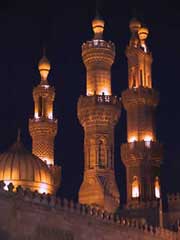
On
the Net, both al-Azhar and a marginal heretical group could
appear to share equal status and
credibility
|
The Internet, as it gives equal access to all
e-publishers, might create a virtual but unrealistic account of both
the publisher/author and readership. Having an interactive
cyber-existence for each party or person could make them look on a
par with each other. For example, both al-Azhar, the oldest
functioning university in the world and vanguard of Islamic
scholarship, and a marginal heretical group could appear to share
equal status and credibility, by the grace of having one Web site
each. For someone who does not know much about the Islamic and
Muslim makeup, both could look equally influential. Moreover, any
Web page, as it comes in a technological wrapping, could bear the
fake seal of “qualification”—especially since there is no actual
contact with the author. In this, the Internet seems to further
deepen the gulf between authorship and authority.
The values that the Internet carries are
suitable and befitting to a certain Islam. The significant point
here is that, as the Internet helps create a “virtual sense” of
contact with the outside world and a sense of independence from
one’s local surroundings, it undoubtedly contributes to the
weakening of the traditional as well as the social understanding of
oneself. Surely, this will be mirrored in one’s
religiosity.
Nonetheless, Hofheinz sees that the religion of
the Internet is just one offering amongst many. That feeling of
autonomy with regard to reading a text and understanding it is what
the young are trying to achieve through keeping themselves away from
the established religious authority; the same axiom of modernist
Islam. In that, an Islam based on few references (vis-à-vis that of
traditional Islam which is based on qualified and established works
of successive religious scholarly authority) is given precedence.
All popular Salafie-inclined portals e-publish such reductionist
sources.
Despite the unlimited access the Web offers, the
reduction, coupled with fragmentation, of Islam and its
“re-prioritization” continues. The result, as Hofheinz brilliantly
diagnoses, is the “canonization of information” by the popular
electronic outlets. Cyber-individuality may seem to be confined to
its domain; that of the individual’s right to access and to debate.
However, the generation which is now dealing with the Internet will
grow and claim their role in affecting public life in the Arab
social and religious space. Whether Arabs realize how the Internet
works as a virus that imports its integral values into their
religious thought is a question that I, for one, believe will take
more space in the future; whether in the offsite realm, or the
onsite one is an altogether different question. The Internet seems
to prove itself as another ground for the individualistic and
modernist “My Islam” to stand against the authentic “traditional
Islam”.
Tarek A. Ghanem is the editor of the
Contemporary Issues Page
|