|
By Humphrey Davies, TBS Managing
Editor
Dubai changes fast.
On the day I arrived, a local newspaper noted the demolition of the
Clock Tower to make way for new development after a reign of a full
40 years as the city's best known monument (it must only be us
visitors who accord that title to the Deira City Center shopping
mall); the same writer also mourned the disappearance of other
landmarks dating all the way back to…1991. The place is clearly,
even explicitly, managed like a business: what doesn't pay goes, and
the customer is right.
This bracing outlook
is to be found in the media field as much as in the post-modern
architecture and ever-proliferating highway system. Dubai TV, the
emirate's state television service, had been drifting for a while,
guided by no particular strategy, the shortcomings of its main
channel cruelly exposed by the burgeoning of the independent Arab
satellites, its Business Channel no longer worthy of that name (see
TBS
12: The Gulf Media Mood: As Good As Ever), and its
English-language channel an outdated effort at providing home
comforts to expatriates. All that has now changed, or is about to,
with Dubai TV's main channel re-launched in the summer and much more
to come (Dubai
TV's New Look).
Re-launching isn't a
state monopoly either: CNBC Arabia, with just over a year of
operation behind it, is initiating a major expansion in terms of
both time on-air and programming (CNBC
Arabia Re-launches), while CEO Zafar Siddiqi also has his eyes
on the conquest of new territory (CNBC Pakistan to
Launch May 2005).
So it goes in
Dubai--the national motto might be "Watch This
Space!"
Dubai TV's New Look
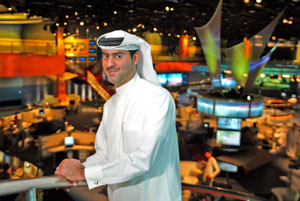
| Hussein Lootah,
CEO Dubai Media
Inc. | |
Readers of the Arab
press over the summer will have noticed a series of advertisements
in which a family, carefully composed of representatives of all
generations on the couch--youngest kiddies in Dad's lap,
grandparents accorded their own armchairs, Mum standing and leaning
fondly over the back of the couch before returning to the
kitchen--is joyfully transfixed by what is happening on their
favorite channel, Dubai TV. That Dubai TV could be anybody's
favorite channel must have surprised a number of readers: in the
days when it was formally known as Emirates Dubai Television (EDTV)
it had been, in the words of CEO Hussain Lootah, "a channel without
a character." Worse, it was "doing very badly in terms of revenue
and expenditure." It was failing to attract advertising and was, in
general, "simply failing to keep up with Dubai itself."
The change started in
July 2003, when Sheikh Muhammad bin Rashid Al Maktoum, Dubai's crown
prince and the generally acknowledged driving force behind the
emirate's rapid development, stepped in to create and chair Dubai
Media Incorporated, a holding company for all the government's media
assets. These consist of four TV channels (EDTV, Dubai Business
Channel, a sports channel, and Channel 33, the English-language
channel), four radio stations, and a newspaper (Al-Bayan).
The idea, says Lootah, was to create something that represents "the
spirit of Dubai."
So far, the revamp
extends only to the main station, now known as Dubai Television,
which re-launched June 1, 2004, after DMI had built a
state-of-the-art News Center in Dubai Media City from scratch. The
new approach is, however, all-embracing. According to Lootah, the
new channel is "a general family, entertainment, social, and
educational channel with a very good dose of news" and it is now on
air 24/7. Implicitly distancing the new channel from any attempt at
competition with all-news Al Jazeera and Al Arabiya channels, Lootah
stresses that he hopes the Dubai TV viewer will "feel good every
time he watches television. People don't like to watch things that
will make them upset. They want to get some relief by watching a
station that caters to their tastes. It's a feel-good
station."
These values are on
display in the numerous new shows of which the channel boasts.
Though the channel provides the most recent perch for Hamdi
Kandeel's mordant press analysis show Ra'is al-Tahrir
(Editor-in-Chief), formerly aired on Egypt TV's Channel 1 and
then on Dream TV [see TBS 12 Rude
Awakening-Dream Drops Top Talkers] and for aggressive Saudi
interviewer Dawoud Al-Shiryani, few in the remaining line-up are
likely to spoil the mood of the viewer in search of feel-good
entertainment. Moataz Demerdash, for example, hosts Al-Layla Ma'a
Mu'tazz (Tonight with Moataz), a David Letterman-style talk
show, Dina Azar a women/fashion show, Marianne Khlat and Nour Abid
quiz shows. That the station is anxious to avoid over-taxing the
capacities of its viewers may be deduced from a question posed on a
recent episode of Abid's Sabah al-Nur (Good Morning).
Grinning with delighted anticipation at the prospect of seeing a
caller win a cash prize, presenter Abid asked the caller, "Were the
original inhabitants of America (a) the Yellow Indians (b) the Red
Indians or (c) the Green Indians?" Well, it was Ramadan.
News bulletins are
similarly soft-focus with plenty of camera movement and a double
anchor format that allows for a good deal of chit-chat between
presenters. Samer Hamzeh, the channel's News consultant, notes that
this allows editors to introduce political analysis in a way that's
"not stiff, and not like a military statement. It's a chat between
two people, me and you, and we're just sitting in a café and
analyzing politics." In the same spirit, Hamzeh emphasizes that "we
religiously write to pictures, and talk to pictures. It's TV
language. The news package is really a small movie, it's a one
minute and a half movie: it's entertainment in news and news in
entertainment."
With this and other
shows coming in a visual package of graphics and colors as rich as
the smell of oud and enlivened with animations as perky as those of
any computer game (on the news, booby-trapped toy cars explode over
the map of Iraq while stick men with guns advance and retreat),
Dubai TV is not, as Hamzeh points out, about being "the First to
Know." It may, however, be the wave of the future: Hamzeh claims
that in the four months since they've been on air, the techniques
employed in the News Center have "traveled" to other Arabic
channels--"and I'm not just talking abut small channels."

| Najla Al-Awadhi, deputy general
manager, Channel 33
| |
Channel 33, Dubai's
English-language channel, is next in-line for a make-over. Najla
Al-Awadhi, the channel's deputy general manager, sounds a familiar
note when she states that "we don't really consider Channel 33 to be
a commercial channel." According to Al-Awadhi, Channel 33 "was
directed towards the expat community and the programming was never
really logical. However, we do feel there's a lot of commercial
potential for the channel." To realize that potential, the channel
will take a radical new direction, becoming a 24/7 channel for
"Arabic-speaking audiences who enjoy Western entertainment." Movies
will be sub-titled in Arabic and voice-overs and advertising will be
in Arabic. Identifying MBC2 as the new channel's only rival in terms
of offering quality Western entertainment for free, Al-Awadhi
believes that "we can provide the same, but better" by pursuing an
acquisition strategy that will bring in "the best that Hollywood and
Europe has." "Seeing that the Emirates and Dubai are moving towards
becoming the media hub of the Middle East, we feel that this is the
perfect place to launch this type of channel," says Al-Awadhi. She
promises too that, while "there is always some level of censorship
applied in the Middle East," the new channel will be "more open than
its Arabic equivalent" and geared towards "an audience that enjoys a
certain amount of official freedom." Al-Awadhi is cagey about both
the precise date set for the re-launch and the new name that the
channel will carry but she says, "Look out for us before the end of
the year. We intend to launch hard and with a very interesting media
campaign. People will hear about us. There will be a buzz in the
market."
With the new Arabic and
English channels on their way, there remain the Business Channel,
which will be re-worked to become a promotional channel for Dubai
and the UAE in general (promotion starts next month), and the Sports
Channel, which will also be re-packaged.
According to Lootah,
the effort expended on remaking Dubai TV is already bearing fruit.
The channel is receiving increased advertising revenue as it makes
new headway in the regional market. Lootah says that despite
re-launching in the summer--a bad time for change according to
conventional wisdom--"by September we were competing with the
biggies." He places Dubai TV at number five in the immediate region
"if you take out the news stations," coming after MBC, MBC2, Saudi
TV, and LBC, and claims that it has increased its viewership by 41
percent. The ambition is larger than this however. Partly by
pursuing a policy of employing presenters from all over the Arab
World, Lootah hopes that Dubai will soon be making its mark
throughout the larger region as well.
So--Watch This
Space!
CNBC Arabia Re-launches

| Mohammed Moumenine of CNBC
Arabia
| |
It is just over a year
since CNBC Arabia (or CNBC Arabiya - both forms seem to be used)
first went on air from its studios in Dubai Media City, and to some
it may seem that the initial promise of the world's first all-Arabic
dedicated business channel (see TBS
12 Business Unusual) has not yet been realized. Live
programming has not exceeded five or six hours a day and has tended
to be meat-and-potatoes financial news rather than the in-depth
examination of the region's and the world's economies that was
foretold. There is no clear indication that the channel is reaching
its prime target audience (but then "How many CEOs answer surveys?"
queries CEO Zafar Siddiqi) and there are rumors that staff morale
has fallen and departures have been numerous. Siddiqi stresses that
the first priority in this period was to get the product on air and
that this has been achieved, with bureaus established around the
region and live feeds set up also in Tokyo, Singapore, London, New
York, Milan, Paris, and Frankfort (a feather in CNBC's cap at this
level has been to become the first non-Saudi channel to be permitted
a live up-link from inside the kingdom). Nevertheless, the channel
has seemed recently to be lacking a certain je ne sais
quoi.
All that is set to
change. CNBC Arabia re-launches on November 23, 2004 with a
projected eighteen hours a day of "relevant live programming," to
quote Siddiqi, that will include a range of new magazine programs.
Leading this new thrust
is Mohammed Moumenine, recently appointed vice president for
programming and news, who comes to CNBC Arabia with an MBA in
economics from the United Kingdom and twelve years of experience as
head of MBC's and Al-Arabiya's business programming department.
Moumenine explains that the new program grid, parts of which are
already in place, will continue to provide a mixture of stock market
reports and analysis along with financial news during the day,
following the sun across the region and the globe as markets
successively open. Then, in the evenings, as the weary businessman
relaxes with his family, CNBC Arabia will provide a dash of
political news (mainly backgrounders, with the economic angle always
to the fore). It is the late evening ten o'clock spot, however, that
will receive the major thrust of CNBC Arabia's new programming, with
a new magazine show for each day of the week. As Moumenine puts it,
"In the past we used to bombard people with numbers, numbers,
numbers. If you do that you will reach only a small proportion of
the viewership. What I want to do is to increase the base of my
viewership."
Programs that are
already up and running (adding about two and half hours of live
broadcasting) include a program on Money and Islam (Al-Mal
wal-Islam), where viewers can call in and ask an expert in
Islamic jurisprudence about knotty problems relating to the
religious aspects of commerce and finance; a program on real estate
(Moumenine points out that, post-9/11, there has been increased
liquidity in the Arab market and hence increased investment in this
area); a program on personal investing (Bidun Wasit - Without a
Broker) that aims to unravel for the general business audience
the intricacies of the stock market; and a sports show, focusing, of
course, on the business aspects of the sporting world. Among those
still to come are a talk show (Al-Bu'd Al-Akhar - The Other
Dimension) that will look at critical and sensitive Arab-world
issues such as child labor, education, unemployment, the drug trade,
and the Greater Middle East Project from a primarily economic rather
than political perspective; a show based on interviews with CEOs in
the region (Qurb al-Qimma - Near the Top); one on Arab
businesswomen; one on entertainment and fashion; and even a stand-up
comic called "Joe Briefcase" (in reality a Lebanese stock market
analyst who wears bowties, suspenders, and flashy jackets) who will
"try to make finance very simple for the ordinary viewer." These,
plus a daily half-hour show on political and economic events in the
USA, a series of documentaries, brighter colors, new sets and some
investment in new technology (for more on which see ITP Business
- Digital
Studio, 28 October 2004, make up the cutting-edge of CNBC
Arabia's new approach.
Will it be enough to
pull CNBC Arabia out of the doldrums? "Within 12 to 16 months, I
think we will have achieved our objective," says Siddiqi. And that
is? "To be the premier source of business information in the
region."
Again--Watch This
Space!
|