Popular
Social Movements and the Future of Egyptian
Politics
Joel
Beinin
March 10,
2005
(Joel
Beinin is a professor of Middle East history at Stanford University
and an editor of Middle East Report. He
contributed this article from Cairo.)
President Husni
Mubarak’s unexpected announcement that Article 76 of the Egyptian
constitution will be amended to permit a direct and competitive vote
in the September presidential election has captured the attention of
the international and local media and political classes. The
substance of the proposed constitutional amendment, announced on
February 26, remains undetermined. While the president will not run
unopposed in a single-party referendum, as he has done on four
previous occasions, a multi-party contest might not end his 24-year
rule. Past multi-party elections for the parliament have been
plagued by voter intimidation, fraud and other dirty tricks intended
to pad the ruling National Democratic Party’s majority.
It is far from
clear that Mubarak’s decision heralds the birth of genuine electoral
democracy on the Nile. Moreover, focusing on top-level political
maneuvering misses the pressure from below that has played a
significant role in forcing this concession from the
regime.
|
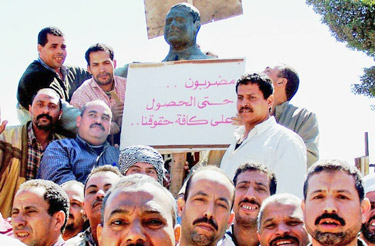
Workers at the Qalyub Spinning
Company. |
For the last
several months, a disparate collection of burgeoning movements among
several sectors of Egyptian society has converged upon one message:
opposition to the status quo. Since December 11, 2004, the Kifaya
(Enough) movement has organized three demonstrations demanding that
Mubarak step down and that he refrain from handing off the
presidency to his son, as happened in Syria and in the “democratic”
US-allied monarchies of Jordan and Morocco. Kifaya activists have
collected well over 1,000 signatures of public figures on a petition
calling for a direct and contested presidential election. Members
and supporters of the Ghad (Tomorrow) Party have loudly protested
the incarceration of their leader Ayman Nur. Human rights activists
have continued to criticize the regime’s arbitrary roundups of
Islamists in response to the October 7, 2004 terrorist bombings in
the Sinai resort of Taba. Workers have engaged in long strikes
protesting the business-friendly policies favored by Mubarak -- and,
even more so, his son Gamal. In covering these developments, the
non-governmental media have gone well beyond previous limits on
freedom of the press.
Since 1952, no
Egyptian head of state has been targeted directly in this manner. A
taboo has been broken, and there is no telling where these popular
movements may lead.
A STRIKE
AGAINST PRIVATIZATION
Some 12 miles
north of Cairo, 400 textile workers at the Qalyub Spinning Company,
a branch of the ESCO conglomerate, have been conducting a sit-in
strike since February 13. They are protesting the government’s sale
of their mill to a private investor because they believe
private-sector management will not maintain the levels of wages and
benefits they have achieved since ESCO, like most other significant
Egyptian manufacturing firms, was nationalized in the early 1960s.
The strike began because the government and company management
failed to deliver on promises to provide an adequate early
retirement package in response to a shorter ten-day strike in
October 2004.
|
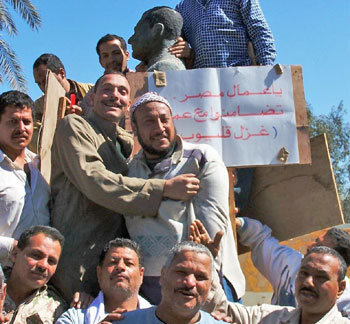
Workers at the Qalyub Spinning
Company. |
Privatization
of the public sector has long been strongly supported by Washington,
as well as Egypt’s creditors at the International Monetary Fund and
the World Bank. Fearing social unrest, the Mubarak regime delayed
the recommended privatization measures for years before moving with
relative vigor to sell off state-owned enterprises in 1993. Despite
several bitter wildcat strikes and indications that privatization
was contributing to a greatly widened gap between rich and poor,
that state passed over 100 factories into private hands between 1993
and 1999. In May of 1999, the International Monetary Fund declared
itself satisfied that Egypt was finally heeding its advice. But the
selloffs stalled as the economy stagnated. The sale of the Qalyub
Spinning Company is part of a renewed wave of privatization.
Textiles, one of the largest and perhaps the most storied of
Egyptian industries, have been targeted because the sector has been
in crisis since the 1970s due to competition from east and southeast
Asia.
The first step
in preparing firms for privatization is reduction of the labor
force. The six ESCO mills employed some 24,000 workers in 1980; they
have been reduced to 3,500 by a combination of attrition, a hiring
freeze since 1987 and five waves of early retirement packages, the
last in 2000. At ESCO’s Bahtim facility, the administrative offices,
garage and spinning mill were all sold to a private investor without
any obligation on his part to employ the workers who previously
worked there. The striking ESCO workers believe that the long years
they have worked in the mill -- many have 20 to 30 years seniority
-- entitle them to continue working there rather than being replaced
by new workers who will undoubtedly receive lower wages and
benefits. Basic monthly wages now range from 250 Egyptian pounds
($43) to 600 pounds ($103) a month -- below the poverty line at the
lower end of the scale.
The Qalyub
Spinning Company workers believe the state is divesting itself of
valuable assets without due process -- and at bargain-basement
prices. Gamal Shaaban, a skilled worker with 23 years seniority,
asked, “With what right was the sale [of this mill] conducted?” The
workers own 10 percent of the firm, but they were not consulted
about the sale. “Muhsin Abd al-Wahhab al-Gilani [the CEO of the
public-sector holding company that owns the mill] agreed to the
sale. Was the company his property or the property of the people?”
Muhammad Gabr
Abdallah, a night supervisor with 28 years seniority at ESCO and a
spokesperson for the workers, led a tour of the mill and explained
that in 1999 the company was valued at 60 million pounds. In 2003
the government invested 7 million pounds in capital improvements,
including computerized spindles. It then concluded a three-year
lease agreement for 2.5 million pounds a year with a businessman
named Hashim al-Daghri, expecting that he would buy the mill. Before
the lease expired, the mill was sold to al-Daghri at the steeply
discounted price of 4 million pounds.
The ESCO
workers are highly conscious that their strike questions the
fundamental direction of Egypt’s economic strategy. Not only are
Gamal Mubarak and his entourage of US-educated economists and
business tycoons intent on introducing more free-market policies,
but in December Egypt also concluded a trade agreement with the US
creating seven Qualifying Industrial Zones where foreign and
domestic factory owners will be free to pay structurally lower
wages. Rashid Muhammad Rashid, the new minister of industry who is
associated with the younger Mubarak, attempted to parry nationalist
criticisms of the agreement by claiming that the zones would
revitalize the struggling textile sector. Indeed, the Qalyub
facility is not the only mill on the auction block. Gilani announced
on February 25 that the Delta Spinning and Weaving Company is up for
sale.
“ASK THE
GOVERNMENT”
Because of the
political importance of the Qalyub strike, activists from the Center
for Trade Union and Workers’ Services in Helwan have supported the
workers. Journalists from al-Ahali, the weekly of the legal
left National Progressive Union Party, and the open-minded
English-language al-Ahram Weekly have written sympathetic
accounts. The new English-language weekly, Cairo, published
an equivocating report that nonetheless contained more information
than is commonly available in Arabic.
In contrast,
Ibrahim Nafie, chief editor of al-Ahram, made it known that
he was not enthusiastic about covering the strike in the
quasi-official, Arabic-language daily. The workers have received no
support from the state-sponsored Federation of Spinning and Weaving
Unions. Federation spokesman Ali Muhammad Mansour agrees, however,
that ESCO cannot pay the workers an adequate retirement package.
Early retirement packages have been an integral but controversial
component of Egypt’s privatization schemes. The downsized workers
first receive a lump sum, which the state encourages them to invest
in a small business, and then a monthly stipend that is often much
less than the pension they would have received had their factory
remained state-owned. Workers have long complained that the stipends
are too low to meet the rising costs of living. In the severe
downturn that has afflicted Egypt’s economy since 1999, the limited
appeal of the lump sum payment has also diminished. The ESCO trade
union representative resigned because he did not want to bear any
responsibility for the packages on offer to the Qalyub Spinning
Company employees.
ESCO’s
management is equally aware of the import of the strike. Sitting at
his desk below a poster of the shrine of the Kaaba in Mecca, the
manager of the mill, Sayyid Abd al-Fattah, an ostentatiously pious
Muslim with a large prayer scar on his forehead, evaded direct
answers to questions put to him by a group of journalists. He
complained that the workers were “pressuring” him and the private
investors to accede to their demands. To buttress his claim that the
current strike and the one in October 2004, for which three days’
wages were deducted from workers’ pay checks, were illegal, he
pulled the text of the New Labor Law (Number 12 of 2003) out of his
desk drawer and quoted the appropriate sections. It is almost
impossible to conduct a legal strike in Egypt, as this requires the
approval of the government-controlled trade union
federation.
The striking
workers have proposed three options to the ESCO management and the
government. They want their mill to remain in the public sector. If
that is impossible (as is likely since the contract of sale has
already been signed), they want the workers to be permitted to
transfer to other mills of the Egyptian Holding Company for Spinning
and Weaving, which manages all textiles firms in the public sector.
If they cannot be transferred, they want to receive “reasonable”
early retirement packages. The third option is the sticking point,
because while 10 percent of workers’ monthly wages are deducted for
retirement benefits, the company has not paid its matching 20
percent share into the retirement fund since 1992. Consequently, the
retirement fund is not able to pay out an adequate retirement
package. Abd al-Fattah was asked if the company’s failure to prime
the fund was not as illegal as he asserts the strike to be. He
responded, “Ask the government.”
POLITICAL
ISLAMISTS
The 287 workers
at the Egyptian-Spanish Asbestos Products Company (Ora Misr) in
Tenth of Ramadan City, one of six satellite communities built by the
state to ease population pressure in greater Cairo, have been on
strike since November 20, 2004. The owner of the factory, Ahmad Abd
al-Azim Luqma, is known as a member of the Muslim Brothers -- an
illegal but semi-tolerated Islamist party widely considered the
largest and most organized opposition force in Egypt. The workers
assert that he arbitrarily fired 52 workers after the Ministry of
Labor Power closed the factory because of health code violations.
Luqma has also refused to pay the workers’ wages since September.
They claim he intends to sell the plant’s stock of raw materials and
to evade paying the fine the government has imposed on him and the
compensation due workers for health damages.
The Muslim
Brothers have a long history of breaking strikes and opposing
militant trade union activity going back to the 1940s, when they
clashed with communists in the textile center of Shubra al-Khayma,
north of Cairo. The Brothers continued to oppose the left during the
1980s and 1990s. But in this period the Brothers-Labor Party
alliance adopted a more pro-labor stance, though this did not
necessarily lead to pro-labor practices. Since the 2001 death of
Adil Husayn, a former communist who became an Islamist and a leader
of the Labor Party, the Brothers have returned to their
traditionally pro-business stance.
At Ora Misr,
the workers’ factory-level trade union committee is supporting their
strike, although their trade union federation is not. The
government, although it is no friend of the factory owner, has not
acted decisively to break the impasse.
Some suspect
that the government is highly strategic about when it chooses to
confront the Muslim Brothers. The regime knows the extent of the
Brothers’ popular support, and, for that reason, its leaders are
periodically arrested. But an all-out assault on the Brothers
carries many political risks in an already unstable political
situation.
Muhammad Mahdi
Akif, who assumed the mantle of general guide of the Society of
Muslim Brothers just over a year ago, has announced that the
Brothers will support a fifth term for Husni Mubarak on the grounds
that the Qur’an says that Muslims should obey their leader. This is
a political maneuver designed to persuade the government to legalize
the society -- a long-sought goal. Liberal-minded leaders of the
Muslim Brothers -- those now in their fifties who joined during the
Islamic upsurge of the 1970s -- objected vociferously and publicly
to Akif’s statement. The organization is deeply split, and it is
unclear if it can maintain its historically tight
discipline.
A different
face of Islamism was evident at the February 22 press conference
called by Human Rights Watch to publicize its report on the mass
arrests and torture of at least 800 residents of the northern Sinai
town of al-Arish following the Taba terrorist bombings. Eight women
from al-Arish -- wives, mothers and sisters of those incarcerated --
attended the event. They call themselves salafis -- a
reference to the era of the Prophet Muhammad and the first four
caliphs. Salafis believe that Islamic faith and legal practice
should be derived solely from the example of this first period in
Islamic history. One woman, speaking in a polished Cairene accent,
announced her name and related the tales of several of her
imprisoned male relatives. She said that her brother, who has been
in jail for 18 years, urged her to speak out strongly against the
regime. Otherwise her husband, who was arrested without a warrant or
a judicial order after the Taba bombings, and is being held without
charge, would remain in jail for 18 years as well. She then sharply
and directly attacked Husni Mubarak using language rarely heard in
public.
According to
Human Rights Watch, Egyptian authorities are holding as many as
2,400 people without charge following the sweep in the coastal town,
despite having identified only nine people as having a hand in the
Taba attacks. On March 4, some 50 women in al-Arish demonstrated
against the continuing detention of their male relatives and shouted
anti-government slogans. Police intervened and closed off the area.
AMERICAN-STYLE
OPPOSITION
Members of the
Ghad Party, which embraces pro-US, pro-free market policies, have
shouted slogans and hung banners out the windows of their
headquarters in Talaat Harb Square, a major Cairo intersection, on
numerous occasions since their leader was arrested on January 29.
Nur, a wealthy, aristocratic lawyer, was arrested on the rather
ridiculous charge that he forged signatures on the petition to found
the party. Some believe Nur was jailed because he published a draft
of a new constitution with far more substantial changes than Mubarak
and his acolytes are now discussing.
The Ghad Party
proposed abolition of the emergency laws in force since 1981, limits
on the nearly dictatorial powers of the president, and a limit on
the number of presidential terms in office. These demands echo those
of other parties and influential individuals. In other words, in
contrast to the largely formalistic “national political dialogue”
that convened at the end of January, Nur and the Ghad Party put some
of the substantive political issues facing Egypt on the public
agenda. Although still incarcerated, Nur has announced he will run
for the presidency. He is the most credible candidate who can be put
forward by the legal parties. One of the apparent devils in the
details of Mubarak’s “bombshell” is that parties the regime does not
recognize -- like the Muslim Brothers -- will not be allowed to
field a candidate.
There is little
doubt that Husni Mubarak will win even a relatively free election,
assuming that he runs, because the political, media and educational
infrastructure for a viable democratic political system does not
exist and cannot be installed by September. A similar scenario would
likely apply if the father contrived magnanimously to withdraw his
name from the race in favor of the son. Consequently, the future of
Egyptian politics will not be determined by the amendment of the
constitution.
Rather, it will
depend on whether these popular political initiatives are capable of
building a social movement for change. While such a movement has not
yet coalesced, challenges to the regime by human rights activists,
workers and other marginalized strata show no sign of abating and
are becoming increasingly sharp. Ahmad Sayf al-Islam, the director
of the Hisham Mubarak Law Center, assisted Human Rights Watch in its
investigation of the al-Arish detentions. At the HRW press
conference he accused the government of breaking into his home and
stealing his laptop computer for a second time two days earlier.
Sayf al-Islam’s exceptionally bold public statement addressed itself
to “tyrants, pharaohs of Egypt” and concluded, “the fish starts
rotting from the head. Don’t you smell the rot of our fish?”