
April 2005



THE EGYPTIAN STANCE ON THE MACHAKOS FRAMEWORK
Hani Raslan
|
|
Egypt is aware that any structural changes in Sudan would affect its own national security. Sudan is not only linked to Egypt by the waters of the Nile, it is also its main gateway to an active African role. Should Sudan disintegrate, Egypt, without a doubt, would lose the opportunity it has to redraft its vision for this important role.
Current developments in Sudan raise many questions related to Egypt’s policy towards its southern neighbour, both now and during the interim period. The most important of these questions concern the specific definition of Egypt’s interests in Sudan and what can be done to protect them. Is a unified Sudan a strategic necessity for Egypt or could it deal with the south if it separates? Would the separation of the south lead to the creation of a coalition against Egypt among Nile source countries? Would this new state be uncooperative or could it be used as a tool for exerting pressure on Egypt? What would be the form of the international relations and coalitions of this new entity? Would it fall under the influence of other countries, such as Israel, that aim to reduce the role of Egypt?
Other questions include: What is the nature of the relations between the north and south of Sudan? Would separation lead to stability or to another round of violence and civil war? Is it possible to envision confederal unity between the north of Sudan and Egypt? Could Egypt proceed with such a project in light of the current international and regional situation?
A preliminary answer to these questions is that the protection of Egypt’s vital interests demands its strong support and the development of cooperation between the two countries in a manner that ensures the balance of interests, not only between Egypt and Sudan, but also among the various groups within Sudan.
Egypt had sought to contribute to the settlement of the Sudanese crisis through a joint initiative with Libya, though this attempt was not successful (for reasons outside the scope of this paper). The circumstances that preceded the signing of the Machakos protocol and the surprising announcement of its content raised many reservations in Egypt on the official level and came as somewhat of a shock for the public, intellectuals and the media. Egyptian journalists equated the issue of self-determination with separation, assigning blame to the Sudanese government. Many observers in Egypt believe that self-determination will lead to separation regardless of the incentives for unity as throughout history it is hard to find a population that has turned down the opportunity to create an independent state.
Lt General Lazaro Sumbeiywo, the Intergovernmental Authority on Development (Igad) special envoy for the Sudan peace process, had visited Egypt three times in order to achieve some sort of coordination with the Egyptian-Libyan initiative. During these visits, Egypt presented a vision centred around exerting efforts to protect the unity of Sudan through a just solution for the south and argued that any solution not based on a framework of unity would be unacceptable. Sumbeiywo seemed to accept these principles and left for Nairobi announcing that he would call for a meeting between the two conflicting parties in order to bring their points of view closer. He then sent Egypt an invitation to attend negotiations based on the Igad initiative ignoring all the points raised during his visits to Cairo. Egypt declined the invitation, perceiving it was being called on to lend its support to developments it does not regard as in the best interests of Sudan or Egypt. It subsequently appeared that Egypt had not been kept informed by any of the parties to the agreement or its mediators as to its progress.
Egypt’s official and unofficial reservations to the Machakos protocol were met with a degree of indifference in Sudan. The Sudanese media asserted that it was up to Sudan alone to find the best solution to its problems, criticising Egypt for its inadequate support of the Sudanese government.
After the initial shock wore off, Egyptian diplomacy moved in the direction of dealing with the status quo calmly on the basis that although the agreement had been signed there would still be a long process of negotiations and accompanying sets of problems. Egypt maintained its position that the secession of the south would not be in Sudan’s best interests, but felt its involvement could help prevent the further weakening of the Sudanese government.
In this context, Egypt announced it would support the Sudanese government’s efforts to make unity an attractive solution. Sudanese-Egyptian relations continued to improve as Egypt sought to protect its interests in Sudan by supporting unity and as the Sudanese government found in Egyptian support the regional backbone that it lacked. At the same time, Sudanese opposition forces endeavoured to strengthen their relations with Egypt, aware that it would have an influential role during the interim period. The SPLM also sought to improve its relations with Cairo, no doubt seeking to dispel concern over the issue of separation.
Egypt gradually lost its reservations over the negotiation process resulting from Machakos, even if it continued to refrain from direct or indirect involvement in the negotiations. Its aim was to support unity through continuous dialogue with the Sudanese government and all other Sudanese political factions. In this context, there followed two important developments in relations between Cairo and Khartoum:
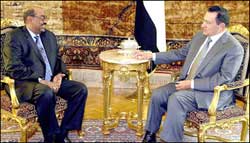
- A visit by Egyptian president Hosni Mubarak to Khartoum on 1 May 2003, his first trip to Sudan in more than 13 years, signalled an improvement in relations between the two countries. Many commentators described the trip as a fast and interesting response to the US invasion of Iraq and the removal of Saddam Hussein, with Egypt looking southwards as the US threat in the Middle East was growing. Others saw that Egypt had merely decided to follow up on developments that had taken place in Kenya under the umbrella of Igad – as a sign of its continued desire to promote unity and an expression of its flexibility. During the visit, Mubarak and his counterpart in Khartoum, Omar Al-Bashir, agreed to activate a number of institutions to promote integration between the two countries.
- On 18 January 2004, Al-Bashir was in Cairo. The visit saw the announcement of the Four Freedoms agreement, which would allow freedom of ownership, movement, residence and employment for Egyptians and Sudanese in both countries. Al-Bashir’s visit also led to the establishment of a general secretariat for integration and a fund to implement related projects.
Despite the apparent improvement in relations between Cairo and Khartoum, the two need to focus on establishing new rules and bases for their relations based on honesty and transparency in order that they can progress beyond their previous frameworks and traditional sensitivities. Developments in the region no longer allow for the presence of differences between the two neighbours, or their traditional approach of signing agreements without working to initiate positive interaction between the two peoples.
Go to topAAAAAAAAAA