 |
|
| |
|
Editor Gary C. Gambill Executive Director David Epperly Send questions or comments to info@mideastmonitor.org |
The Lion in Winter: Bashar Assad's Self-Destruction by Gary C. Gambill
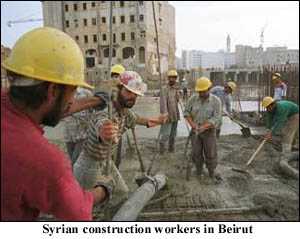
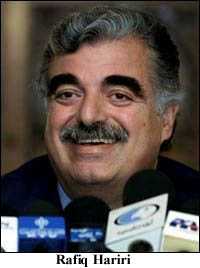
Today, following the most acute diplomatic reversal of fortune in modern history, these same governments are spearheading an international murder investigation likely to drive the 40-year-old dictator from power. Other tyrants who have run this far afoul of international consensus (e.g. Saddam Hussein and Moammar Qaddafi) were invariably viewed as disreputable (if strategically palatable) by the civilized world long before they became pariahs. No "respectable" head of state has ever fallen so far so fast from international grace. The underlying dynamics of Assad's descent into the diplomatic netherworld are not widely recognized. He was locked into an escalating confrontation with the international community long before the February 14 car bombing in Beirut that killed former Lebanese Prime Minister Rafiq Hariri and 22 others. The Valentines Day massacre was a desperate attempt by Assad's inner circle to combat growing American, French, and Saudi subversion of Syrian hegemony in Lebanon - it was not the genesis of this tripartite overseas alignment. Two critical questions arise from the killing: Why was Assad so desperate to stop Lebanon from slipping away? And why, given the enormous groundswell of foreign support he enjoyed after taking office, was he unable to cut a deal before it came to that? Time and time again, Assad has rejected opportunities to cut his losses and accommodate the international and regional powers that his policies have antagonized. This pattern of obstinacy is not intelligible in Western media accounts, which almost invariably understate the roles of key players in this drama, confuse official pretexts with underlying motivations, and - most importantly - ignore the Syrian regime's staggering financial dependence on revenue from Lebanon. Assad's Geopolitical Inheritance
The occupation of Lebanon also became the regime's Achilles heel, however, because it was not sustainable without de facto international recognition. Keenly aware that no government in the world (apart from Israel, intermittently) was willing to openly criticize (or even explicitly acknowledge) the Syrian occupation - and intimately familiar with the kind of horrors that can take place under cover of international silence - the vast majority of Lebanese refrained from overtly resisting Syrian domination in the 1990s. The late Hafez Assad's de facto colonial mandate over Lebanon evolved from an understanding reached between Washington and Damascus in the late 1980s. In return for the release of American hostages in Beirut and vague Syrian commitments to stabilize Lebanon, Washington helped politically isolate Michel Aoun's interim military government - the last remnant of Lebanon's First Republic still resisting Syrian hegemony. Assistant Secretary of State Lawrence Eagleburger openly derided the Lebanese general's March 1989 declaration of war against Syria, telling the Senate Foreign Relations Committee that "things would be worse rather than better" if Syrian troops exited the country - a remark that made headlines in Beirut.[4] Washington's flat disavowal of Aoun (even after his appeals elicited the largest mass demonstrations in Lebanese history) was critical to Syria's success in subduing Lebanon's militia elite and most of its political class. After Iraq's invasion of Kuwait the following year, the quid pro quo deepened - Syria agreed to participate in the US-led coalition against Baghdad in return for an American green light to attack and decimate Aoun's beleaguered forces.[5] American "constructive engagement" with Damascus contrasted sharply with European policies at the time. France reacted to the onset of Aoun's war against Syrian forces by successfully lobbying the European Community (EC) to call for the withdrawal of all foreign forces from Lebanon. After Aoun's defeat, however, the French daily Liberation correctly predicted that Paris would henceforth "avoid chastising, even in whispers, for reasons of geopolitics, the Syrian presence in Lebanon.''[6] Once Assad acquired American sanction for his dominion, France had little leverage over Damascus and therefore nothing to gain by antagonizing the Syrian dictator. With most European governments deferring to the French on matters concerning Lebanon, appeasement of Syria quickly became the order of the day. Similarly, Arab governments did not endorse Syrian hegemony in Lebanon until Washington paved the way. During the peak of Aoun's "war of liberation," officials in the Arab Gulf states frequently complained about Syria off the record,[7] while the Arab League tripartite committee on Lebanon issued a report calling for a timetable for the Syrian redeployment of military forces from Lebanon.[8] Once it became clear that Washington was committed to an understanding with Syria, however, the Saudis threw in their lot by brokering the 1989 Taif Accord that legitimized Syria's military presence - many Lebanese parliamentary deputies signed it only after receiving Saudi assurances that Syria was committed to withdrawing once the militias were disarmed. If the Syrians made such a promise to Riyadh, it clearly became null and void after the Iraqi invasion of Kuwait. The Saudis needed Syria's token participation in the 1991 Gulf War even more than the Americans and were happy to pay the price - over $2 billion in economic aid and recognition of Syrian hegemony over Lebanon. Once the Saudis effectively endorsed the occupation, other Arab governments had little to gain by offending Damascus. The late Hafez Assad understood that universal diplomatic acceptance of the Syrian occupation was not sustainable without an underlying arrangement with the Americans. An open renunciation of Syrian hegemony by Washington would sooner or later set off a chain reaction in which the Saudis and French reassert their own interests in Lebanon, opening the floodgates to internal dissension by their Lebanese allies and broader Arab and European involvement. The problem for Assad was that US support for Syrian hegemony in Lebanon wasn't sustainable in the long run without progress (or at least American expectations of progress) in the Syrian-Israeli peace process. Although Assad negotiated on and off with the Israelis in the 1990s, he remained unwilling to accept peace terms agreeable to them, even after being assured that Syrian control of Lebanon would not be challenged following the conclusion of a peace treaty.[9] The conventional wisdom that uncontested control of Lebanon would facilitate Syrian moderation toward Israel turned out to be dead wrong. On the contrary, the occupation reduced Syria's need for the "economic dividends of peace" (much as it alleviated the need for economic reforms that might have weakened Assad's grip on power) and its perceived legitimacy rested in part on the indefinite continuation of the conflict with Israel. Once the failed Clinton-Assad summit in March 2000 dashed hopes of a breakthrough in Syrian-Israeli negotiations, American officials began sharply criticizing Damascus. French officials were quick to follow. Prime Minister Lionel Jospin used the word "terrorism" to describe Hezbollah violence against Israel for the first time, while Defense Minister Alain Richard went so far as to accuse Syria of abandoning the peace process with Israel to preserve its "domination over Lebanon."[10] Although both governments quickly aborted their diplomatic offensives following Assad's death in June, the French reaction to the summit revealed an eagerness to challenge Syrian control of Lebanon in the absence of geopolitical constraints.
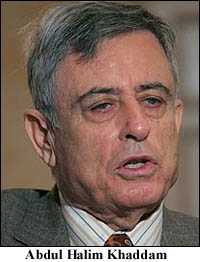
While this arrangement helped ensure continuing Saudi support for the occupation, it had potentially dangerous political implications for the Syrian regime. Money flowing into the regime from Lebanon was concentrated in the hands of officials in charge of the occupation, most notably Vice-president Abdul Halim Khaddam, Army Chief-of-Staff Hikmat Shihabi, and Maj. Gen. Ghazi Kanaan, the head of Syrian military intelligence in Lebanon. There was also a clear sectarian bias in the division of spoils. Khaddam and Shihabi happened to be the two most influential Sunnis in a regime dominated by the country's heterodox Alawite minority. Lebanon may have been in Syria's pocket, but factions of the Syrian regime were clearly in Hariri's pocket and indirectly beholden to the Saudis. Consequentially, the late Assad saw the Harirists and their allies in Damascus as a threat to his son's ascension and worked to sideline them during the last two years of his reign. In 1998, he forced Shihabi to retire and passed direct management of the "Lebanon file" from Khaddam to Bashar, who then engineered the ouster of Hariri and the election of his arch-rival, Gen. Emile Lahoud, as president of Lebanon. In the following months, the heads of Lebanon's military and security establishment were replaced with officers close to the Assad family.[11] This core military-security elite aligned itself with traditional Sunni politicians sidelined by Hariri's rise, ex-warlords, and pro-Syrian ideologues. The one common denominator of this motley counter-elite (dubbed the "Lahoudists" by some) was that they lacked power bases independent of the institutional prerogatives of their offices. Having no political future in a post-occupation Lebanon (unlike the Harirists, who could always buy their way into office), their loyalty to Bashar was absolute. The Saudis were not happy with this state of affairs. The Teflon Dictator
Within hours of Rifaat's bombshell, however, US Secretary of State Madeleine Albright convened a press conference and declared that "it's important for Dr. Bashar Assad to take on the mantle and for the transition process to be . . . peaceful."[14] Her stunning breach of diplomatic protocol was remarkably contagious - one after the other, Arab and Western governments followed suit.[15] Even UN Secretary-General Kofi Annan's spokesman referred to Assad as the "future leader of Syria" - nearly three weeks before his election.[16] If anyone was entertaining thoughts about obstructing a hereditary succession in Damascus, this tidal wave of outside endorsements quickly put them to rest (even Rifaat had a change of heart and publicly praised his nephew when he took office in July).[17] Whether external intervention was a decisive influence on Assad's smooth ascension is debatable,[18] but it underscored a strong conviction among American and European officials that a father-to-son transition in Syria was favorable to their interests. Assad's most well-known domestic political slogan, "change through continuity," might just as well have been coined to drum up foreign support. Western and Arab governments alike were concerned first and foremost that he maintain political stability at home and honor his late father's strategic commitments. Beyond that, everyone saw in Assad what they most wanted to see. The Americans imagined that he would deescalate Syria's conflict with Israel (and eventually make peace with it). The French expected him to introduce sweeping economic reforms (which they would be well poised to exploit), modest political liberalization, and a gentler approach to ruling Lebanon. The Saudis assumed he could be bought. Assad's greatest political weakness - lack of deep institutional ties within the regime - was seen as a virtue by outsiders, who presumed that he would need their backing to survive politically. His temperament and the exigencies of his office were assumed to be perfectly reinforcing. Assad did not live up to his billing. Instead of accelerating the modest political liberalization drive begun by his father, he brought it to a halt as his brother-in-law, deputy military intelligence chief Assef Shawkat, methodically purged the security establishment. Economic reform fell by the wayside, and high-level corruption became more rampant than ever. Rather than moderating Syria's stance toward Israel, Assad and Shawkat dramatically upgraded its sponsorship of militant anti-Israeli terrorist organizations. Fearful of undermining his authority at home, he resisted Saudi enticements to relax the Lahoudist grip on power in Lebanon. In spite of these failings, Assad's benevolent underdog image proved to be remarkably resilient, as most Western observers assumed that a cabal of aging hardliners within the regime was obstructing his authority.[19] The so-called "old guard" theory was flatly contradicted by the readily observable monopolization of political and economic power within Assad's inner circle during the past five years, but it dovetailed neatly with his habitual claims to be unaware of or powerless to prevent wrongdoing that draws Western criticism. For a time, misperceptions permitted all manners of sin for Syria's young ruler. For all of the red carpets that graced his feet, the stability of Assad's regime still depended on controlling Lebanon. Economic stagnation at home had left the regime heavily reliant financially on the occupation, while the power struggle between Hariri and Lahoud directly impacted the strength of his adversaries at home. Assad reinstated Hariri in the fall of 2000 after his allies triumphed in parliamentary elections, but sharply curtailed his authority to set economic policy and excluded him entirely from security policy. However, Hariri's strong backing from France and Saudi Arabia, where he was very well known and genuinely liked by senior government officials, strengthened his leverage. Hariri's collusion with Riyadh and Paris was subtle, but effective. Crown Prince Abdullah and Chirac spearheaded a major bailout of the Lebanese economy (the November 2002 Paris II conference netted $4.4 billion in aid and soft loans), but only on the condition that Lebanon pledge to implement economic reforms, particularly the privatization of inefficient state industries. Since privatization would shift power within the governing elite from those who rely primarily on administrative patronage for political support (i.e. the Lahoudists and Amal) to those who have capital (i.e. the Harirists), the loan conditions might just as well have been dictated by the prime minister himself. Although the Syrians raised no objections when Lebanon accepted the conditions, they were later obliged to veto Hariri's privatization plans, preventing Lebanon from meeting its Paris II obligations and unwittingly casting Damascus as the paramount obstacle to its economic recovery. In the midst of tensions with the Saudis over Lebanon, Assad inscrutably provoked Riyadh on other issues. His efforts to sabotage Abdullah's February 2002 peace initiative needlessly offended the Saudis (his proposals were hardly threatening to jumpstart the peace process).[20] The Syrians also irritated Abdullah by supporting a campaign by the half-Lebanese Saudi Prince Al-Walid bin Talal to replace Hariri as prime minister.[21] Meanwhile, Assad's relations with the French were strained by the increasingly overt opposition to Syrian hegemony expressed by mainstream Maronite Christian political and religious leaders following the death of his father and the Israeli withdrawal from south Lebanon in 2000. Chirac was finding it more difficult to reconcile his country's longstanding ties to the largely francophone Maronite community with continued appeasement of Damascus. Fortunately for Assad, Syria's relationship with Washington soared to new heights after 9/11. Intelligence cooperation between the two countries deepened, with the CIA establishing an office in Damascus to liaison with the Syrian mukhabarat, and there was much talk in both capitals of a new strategic partnership against the common threat of Sunni fundamentalism. Although Congress was agitating for sanctions to punish Syria for its increased sponsorship of Palestinian terrorist groups, the White House and State Department remained more committed than ever to constructive engagement. As long as Assad remained in good standing in Washington, he could rest assured that the Saudis and French would toe the line in Lebanon. Misstep in Iraq Assad's decision to confront the Bush administration in Iraq remains enigmatic to this day. While the US-led campaign to install a democratic political system on the ruins of Iraq's Baathist dictatorship clearly did not bode well for Syria's Baathist dictatorship, there was little Assad could do to obstruct it short of providing material support to forces combating the Americans - a very risky provocation. Most observers expected him to barter some measure of Syrian neutrality toward the American intervention (or perhaps even token support for it) in exchange for the best possible concessions he could achieve diplomatically (at the very least, a continuation of cut-rate petroleum imports and preferential trade relations with the new Iraq). It's not entirely clear why Assad failed to cut such a deal, but presumably he (or Shawkat) feared that exchanging a probably irreversible strategic concession (accepting Iraq's transition to democracy) for economic payoffs that could be easily withdrawn in the future would increase American leverage over his regime. Syria's decision to begin illegally transshipping arms from eastern Europe to Iraq in early 2002 probably originated as an initiative to persuade Washington that it must pay a higher price for Syrian cooperation with its impending plans for Iraq. Although American officials quietly pressed Assad to end the illicit weapons shipments for over a year, the Syrian leader steadfastly denied all knowledge of the transfers - either they didn't say the magic words or too many in the Syrian regime were profiting from the trade for Assad to intervene. As private American-Syrian diplomatic exchanges grew acerbic in the weeks leading up to the war, Syria went on the diplomatic offensive, engineering a February 16 Arab League summit communiqué urging member states to refrain from aiding or facilitating any military operation against Iraq. After Syria scuttled plans by an Arab League ministerial committee to persuade Saddam Hussein to go into exile two weeks before the war, Secretary of State Colin Powell used the term "occupation" to describe the Syrian military presence in Lebanon (a word that had been absent from American public statements on this issue for over a decade).[22] Barely noted in the American media but splashed across headlines in Beirut (much like Eagleburger's remark fourteen years earlier), Powell's statement carried an unmistakable warning - Washington was prepared to hit Syria where it hurts to get its way in Iraq. Once the war started and it became clear that Syrian-supplied weapons were costing American lives, the Bush administration issued a succession of bellicose warnings, but generally stopped short of accusing Assad of knowingly permitting arms to flow across its border - career diplomats still took Assad's claims of ignorance at face value, cautioning the White House that getting tough with him would weaken his authority over the "old guard." In fact, Iraqi documents captured after the fall of Baghdad suggest that Assad's close relatives, not regime malcontents, were responsible for the illicit arms trade.[23] His blatant duplicity served only to discredit his staunchest defenders in Washington. After the fall of Baghdad, Syrian support for terrorist infiltration into Iraq quickly became the main bone of contention. Once again Assad feigned ignorance and once again his Western sympathizers took him at his word. Although the scale of infiltration suggested high level Syrian government complicity, there was no smoking gun clearly indicating that Assad himself was responsible for facilitating it.[24] In October 2003, however, coalition officials learned that Assad was secretly urging the supreme leader of Iraqi Shiites, Grand Ayatollah Ali al-Sistani, to declare a holy war against American forces.[25] More than anything else, this blunder turned the administration against Assad. Weeks later, after resisting strong congressional pressure for sanctions for over a year, the White House signed legislation imposing a mandatory (if largely symbolic) regime of sanctions on Damascus.[26] Bush waited six months to issue an executive order putting the sanctions into effect, hoping for breakthrough in talks with the Syrians. None came. Khaddam later revealed that Assad was convinced by members of his inner circle that the Americans would pay a high price for his cooperation in Iraq if he held out long enough.[27] Assad failed to recognize that Iraq's descent into violence was not detrimental only to Anglo-American interests. The vocal objections of many European governments to Operation Iraqi Freedom didn't mean they wanted to see its transition to democracy collapse - indeed, fear of a botched Iraqi transition was partly what fueled their objections to the war in the first place. Other Arab regimes certainly shared Syria's misgivings about the American project in Iraq, but they had even greater misgivings about Syria's efforts to foment a radical Islamist holy war in the heart of the Arab world. Saudi Arabia and Jordan experienced resurgences of terrorist violence on their own soil as a direct result of the war in Iraq. More importantly, Assad failed to recognize that his break with Washington was creating powerful geopolitical incentives for the French and Saudis to reassert their own interests vis-a-vis Damascus. Diplomatic Dominoes As in the spring of 2000, it did not take long for Paris to capitalize on Syria's rift with the Bush administration. In April 2003, French Foreign Minister Dominique De Villepin publicly called for a Syrian withdrawal from Lebanon (much more explicitly than Powell had the previous month).[28] After the White House signed the Syria Accountability Act, Syria's association agreement with the EU (which was all but signed) abruptly hit a snag as France joined Britain, Germany, and the Netherlands in demanding the inclusion of a weapons of mass destruction (WMD) non-proliferation clause.[29] Assad retaliated by backtracking on a promise to award France's Total-Elf a bid for exploring oil and gas in central Syria, angering Chirac even further.[30] Although unwilling to publicly call for a Syrian withdrawal, the Saudis also saw the escalation of American pressure on Syria as an opportunity to reassert their influence in Beirut. With the expiration of Lahoud's term in the fall of 2004, Assad faced an unsettling dilemma in choosing a successor - no candidate with a shred of credibility in the Maronite community (for whom the presidency is reserved under the constitution) could be counted on to remain loyal to Damascus in the event that Hariri revolted against Syrian authority. Speculation mounted that Syria would extend Lahoud's tenure, a move that required a special amendment to the constitution (which disallows two consecutive terms) approved by a two-thirds majority of parliament. Although Hariri's parliamentary bloc could easily defeat such a measure by voting alongside the Christian and Druze opposition, the prime minister was unwilling to defy explicit Syrian instructions to the contrary. At the secret urging of Hariri (and probably also the Saudis), American and European officials began openly calling for Assad to publicly forswear Syrian intervention in the Lebanese parliament's selection of a new president.[31] Assad initially gave such a pledge, but apparently expected to receive Western concessions in return for honoring it. When none came, he strong-armed Hariri into approving a three-year extension of Lahoud's term. On the eve of the parliamentary vote in early September, the UN Security Council passed Resolution 1559, calling for the withdrawal of all foreign forces from Lebanon and a constitutional presidential succession, but Syria's fiat was dutifully promulgated. Assad took far too much heart in the fact that Resolution 1559 didn't specifically mention Syria by name and was approved by only three fifths of the council (with 6 abstentions). Once the Security Council broke its long-standing silence on the Syrian occupation, the genie was out of the bottle - the United States and France would have much less difficulty mobilizing support for subsequent resolutions. After the passage of 1559, Hariri spent weeks shuttling to and from Damascus, trying to cut a deal that would let him name two-thirds of the cabinet. Assad was faced with a Catch-22. Granting Hariri a veto-proof majority of the cabinet might alleviate outside pressure for a time, but it would eliminate internal checks on the prime minister's power - Syria would have to directly intervene each and every time it wanted to stymie him. The October 2 car bombing that severely injured Marwan Hamadeh, a cabinet minister who resigned in protest after Lahoud's term extension, failed to intimidate Hariri. After leaving office in late October, he quietly entered into talks with Druze and Christian opposition figures over the formation of a tripartite electoral alliance capable of winning a commanding parliamentary majority in the Spring 2005 elections. In light of the clear threat posed by Hariri to Syrian hegemony in Lebanon, the decision to eliminate the ex-prime minister was not the inscrutably stupendous blunder it is often made out to be. Syria's Alawite-dominated regime has always been paranoid of dissent among Lebanese Sunni leaders, fearing that they might join forces with the Maronites (as happened with the election of Bashir Gemayel as president in 1982) or incite Syrian Sunnis to rebel. A long line of distinguished Lebanese Sunni political and religious leaders have been assassinated after openly defying Syria.[32] The assassination of Hariri was a last ditch effort to intimidate Lebanese Sunnis into submission.
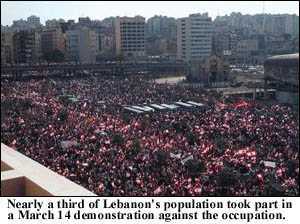
Endgame Occurring at a time when Damascus was already facing intense international scrutiny of its occupation of Lebanon, the assassination of Hariri left no one fence sitting on the question of whether Syria must immediately withdraw from the country (and only Iran opposed to it). Even in the Arab world, most governments were openly (if very diplomatically) calling on Syria to abide by Resolution 1559 within a month of the assassination. A unanimous Security Council resolution explicitly threatening sanctions would have been inevitable had Syrian forces not pulled out of Lebanon in April. Above and beyond their efforts to negate Syrian influence in Lebanon, however, the American, French, and Saudi governments each pressed Syria on other scores. Saudi Crown Prince (now King) Abdullah and Chirac were intent on identifying and prosecuting Hariri's killers, while Washington prioritized forcing Syria's complete disengagement from the Iraqi and Israeli-Palestinian conflicts. What made the combination explosive for Assad is that the Franco-Saudi push for an investigation and the American pursuit of strategic concessions began to cross-fertilize over time and override concerns about Syrian political stability. In the first few months after the assassination, Assad probably could have won assurances that his inner circle would not be targeted if he had been willing to fully appease American demands and turn over lower-ranking intelligence officials (as Libyan leader Moammar Qaddafi did to beat the rap for the 1988 PanAm bombing), but he hesitated for too long. For Assad, the biggest problem with such a deal was that the key quid pro quos (e.g. no indictments of his inner circle, extradition of low ranking officials, expulsion of terrorists from Syria) would be too highly visible for him credibly disguise having scapegoated Syrian nationals and abandoned pan-Arab causes merely to save his own skin. The window of opportunity for Assad to cut such a deal began to close in April, when the Security Council passed Resolution 1595, establishing an International Independent Investigation Commission to investigate the killing. It closed still further with the May 13 appointment of renowned German anti-terrorism prosecutor Detlev Mehlis to head the commission. The landslide victory of the Harirists (now led by the late prime minister's son, Saad) in the May-June parliamentary elections produced a new Lebanese government committed to bringing Hariri's assassins to justice. Unwilling to accommodate this growing chorus of demands, Damascus apparently sought to win a reprieve by destabilizing Lebanon with a series of bombings and assassinations.[33] Rather than convincing the Saudis and French that Assad alone can guarantee peace for Lebanon, the violence convinced them that only the indictment and prosecution of those directly responsible for planning and executing the Hariri hit (if not Assad himself) could nail the coffin shut on Syrian influence in Lebanon. Syria's test launch of three Scud missiles in late May (its first in several years) similarly backfired - the aggressive posturing was both poorly timed and remarkably inept (one of the missiles landed by mistake in Turkey).[34] Exasperated by Assad's reckless provocations, American, French, and Saudi officials began meeting with exiled Syrian dissidents, most notably Khaddam and Shihabi, who joined Saad Hariri in Paris during the summer to plot against Damascus.[35] By September, Assad began to see the writing on the wall and offered to make at least some of the strategic concessions demanded by Washington and hand over low level military intelligence officers in return for immunity from prosecution for his inner circle, but his offers were rebuffed.[36] Assad's long history of giving personal assurances that he was later unwilling or unable to honor (in sharp contrast to his late father, who promised little but generally delivered what he promised) was catching up with him. Following the Mehlis commission's release of an interim report implicating Shawkat and other key figures in Assad's inner circle[37], prospects for an immunity deal evaporated entirely. On November 1, the Security Council unanimously passed Resolution 1636, requiring Damascus to detain any Syrian nationals implicated in the investigation and make them available for questioning at a location of the commission's choosing or face "further action." Since then, Assad has offered piecemeal cooperation with the probe, but he has refused to turn over Shawkat for questioning outside of Syria (possibly because he lacks the power to do so) or allow himself to be questioned anywhere. The Security Council has yet not declared Syria to be in violation of 1636, as there is no firm consensus yet as to what the consequences of Assad's stonewalling should be. Whether and for how long it will stay that way depends on how the investigation proceeds. If it stalls (and if Assad avoids further provocations), concerns about Syrian political instability could forestall further action by the Security Council indefinitely. The investigation will not go away, however, until senior Syrian officials are indicted for the murder. Assad's best-case scenario - no further action by the Security Council and no indictments - still leaves his regime forever under suspicion in the eyes of the world. Wholly unaccustomed to this kind of international isolation, Syrians will not easily resign themselves to life in a pariah state. In light of Syria's declining oil production[38] and loss of revenue from Lebanon, the economic toll will steadily mount even if the country escapes UN sanctions. Whatever the outcome of the current crisis, Assad will face enormous internal challenges as the socio-economic impact of Syria's isolation deepens. Notes |