|
“Model
Employees”: Sri Lankan Domestics in Lebanon
Monica
Smith
(Monica
Smith is completing her M.A. in geography at the University of
Colorado in Boulder. Her thesis is on domestic labor migration, with
a focus on Southeast Asia and the Middle East.)
|
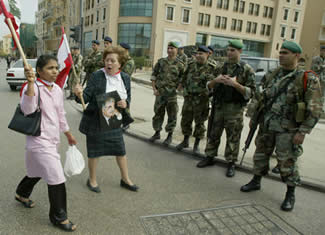
Lebanese
woman with her Sri lankan maid at an anti-Syrian rally in
Beirut, March 7, 2005. Patrick Baz/AFP)
|
Twenty-two year
old Leela made a promise to her family in Sri Lanka: she would earn
enough money working abroad as a maid or a nanny to build a new
house back home. Living thousands of miles from her husband and
young son would be difficult, but Leela thought she would be able to
send them money while she was gone. Her absence from Sri Lanka, in
any case, would be short. She could not have been more
wrong.
Upon arriving
in Beirut, Lebanon, Leela was taken to a household to work as a
maid. There her employer took away her passport, locked her inside
the house, forced her to work 20-hour days and provided her with
inadequate food and living conditions. When Leela complained, she
was beaten. Three months passed, during which time her wages were
withheld to recoup the cost to her employer of her trip from Sri
Lanka to Lebanon. Six months into her contract, she still had not
received any compensation for her work.
When Leela left
her native country, she was assured by the hiring agency that
assisted her in finding work and the Sri Lanka Foreign Bureau of
Employment that they would protect her. But, after she arrived in
Lebanon, no such assistance was forthcoming. Leela managed to place
a secret telephone call to her parents to inform them of her dire
circumstances, and she was eventually able to leave.
No aspect of
Leela’s story is uncommon. Each year, over 10,000 female Sri
Lankans arrive in Lebanon with the intention of working hard to make
better lives for themselves and their families.[1] Most of them go to work cleaning, cooking and
caring for children—jobs that Lebanese are generally not willing to
take though the services are in high demand. Along with Filipinas,
Bangladeshis and other Asian and African women, Sri Lankans have
become an integral part of the Lebanese home and the Lebanese
economy in the post-war era.[2] In most cases, these women earn more than they
could in their home country, but it is estimated by the Migrant
Services Center, one of the largest NGOs in Sri Lanka serving
domestic migrants, that 40 percent of them return to Sri Lanka
no better off than they were when they left. Some are struggling to
repay large loans taken out for migration expenses and the families
of others mismanaged their remittances, but many simply had their
wages withheld. It is estimated that 20 percent of the
80,000 Sri Lankan migrant workers living in Lebanon experience
some form of maltreatment, ranging from non-payment of wages to
verbal, physical and sexual abuse.[3]
Stigma
While the
reasons for the abuse are multiple and complex, one critical
explanation is the lack of legal protections, in the form of local
labor laws and bilateral agreements, to ensure worker safety and
adequate wages. Even where such legal mechanisms do exist, in the
form of memoranda of understanding, contracts, civil and criminal
laws, and international compacts, they are often not enforced.
Because maids
and nannies work inside people’s homes, the state is hesitant to
intervene to regulate conditions or resolve disputes. Although
domestic migrant workers are technically protected under criminal
law and there are Lebanese lawyers willing to assist them, there
have been very few cases where Lebanese hiring agents or employers
were prosecuted for abuse.[4] In the end, most victims just want the abuse
to stop. They have little faith in the Lebanese legal system and
simply hold out hope that their wages will eventually be paid.
According to Sriyani Perrera, who worked as a maid in Lebanon for 12
years, “Sri Lankans would be afraid to go to the police with a
complaint because they know that the employer would just say that
they stole money or something like that. The courts would always
believe the Lebanese employer’s word over ours. Sri Lankans would
just be afraid they would end up in prison.”
Lack of
enforcement is also due to the low status of female migrant workers
in Lebanon. Because they are poor and often uneducated, they are
viewed as undeserving of legal protection. As Ray Jureidini writes
in his study of the subject, “Both during and since the war, such
positions have come to be seen by Arab women as degrading and
unacceptable. Since the influx of foreign women from Africa and Asia
particularly, the position of domestic maid has become one that
carries with it a particularly low status. This is not only because
of the servile nature of the tasks, the conditions of work and
relatively low wages, but also because there is now a racial and
discriminatory stigma attached to domestic employment.”[5] As these problems are slowly brought into the
light, there has been something of a racist backlash as well. A
columnist for Beirut’s English-language newspaper, The
Daily Star, offended by a Bangladeshi lawyer’s critical
comments about the treatment of domestics in Lebanon, pined for the
“time when our helpers were also Lebanese…. They did not leave
behind foreign letters in the closet accusing us of beating them and
starving them and molesting them. Nor did they spit in our soup or
demand more leisure time or flee in anger to some embassy.”[6]
The
Complicit Sri Lankan State
Responsibility
for the maltreatment and lack of protection for domestic migrant
workers does not lie solely with prejudice and poor law enforcement
in receiving countries. The countries that send workers abroad are
deeply complicit as well. Labor-exporting states intervene only
meekly on their citizens’ behalf when specific abuses are reported,
and have done little to ameliorate the systemic problems. There are
several memoranda of understanding between Sri Lanka and Lebanon’s
respective Ministries of Labor regarding the plight of domestic
migrant laborers, but these documents skirt the workers’ most
pressing complaints. A two-page memorandum concluded in the summer
of 2005, for example, established requirements that the migrant
undergo a physical examination and that the employer cover travel
expenses and pay wages in convertible currency. Yet it contained no
demand for improved wages or better treatment for the domestic
migrant workers already living in Lebanon.
The reason is
clear: for labor-exporting countries, migrant workers are a growing
source of badly needed hard currency. The World Bank estimated in
2004 that 3 percent of the world’s population is made up of
migrants, who collectively contribute $110 billion in
remittances to their home countries, 52 percent more than they sent
home in 2001. According to P. G. Jayasinge, director of planning,
research and development at the Labor Secretariat of Sri Lanka,
abuse of domestics is never mentioned directly in meetings or
written correspondence with counterparts in labor-importing
countries. “If we demand better working conditions and greater
salaries,” he explains, “the receiving countries, like Lebanon, will
look to other sending countries for their labor.”
In part to
maximize remittances, more and more labor-exporting states
have created special branches of the government—like the Sri Lanka
Foreign Bureau of Employment (SLFBE)—to oversee migration affairs
and engage in such activities as pre-departure training sessions for
prospective migrants. (The Philippines also provides training for
its nationals headed to Lebanon.) Nominally, the training is
intended to equip the women with basic language skills they will
need to cope in the host country, but the training is insufficient,
even though migrant workers have become Sri Lanka’s largest and most
consistent earners of foreign exchange. Those migrating to East Asia
or Europe are required to complete a 21-day pre-departure course,
whereas domestic workers headed for the Arab world study for only 12
days. Migrants moving to the Middle East are required to have no
education beyond the fifth grade, no English and only limited
literacy skills in their native tongue. The Arabic they learn is not
taught by native speakers and not dialect-specific. According to
David Soysa of the Migrant Services Center, hiring agencies direct
the least skilled and least educated women to Lebanon, because that
destination is perceived to have the highest rates of worker abuse.
SFBLE statistics do show slightly higher rates of reported
maltreatment in Lebanon than elsewhere.
“Always
Please the Madame”
In early 2000,
a famous Sri Lankan actor, Ranjan Ramanayka, drew great media
attention when he visited Lebanon and reported finding intense abuse
of domestic workers in homes and prisons.[7] Though the problems with abuse of domestics in
Middle Eastern countries are widely known in Sri Lanka, the
government continues to encourage women to work in the region. In
fact, the government capitalizes on the fact that Sri Lankan females
are viewed as hard-working, docile and affordable. Little is done
through the mandatory pre-departure sessions to prepare women to
face maltreatment. Rather, the SFBLE program encourages prospective
migrants to be “model employees” who are forever diligent,
respectful and soft-spoken, regardless of what problems arise. Says
Sureika, a domestic who recently left for the Middle East, “We
learned in the classes that we should work hard to always please the
madame.… This is the best way to ensure that we will be treated and
paid well.” The training sessions imbue the migrants with little
knowledge of their rights or awareness of the value their labor
brings.
In the end, the
behaviors pushed by the SLFBE derive from the patriarchal value
system that persists in Sri Lanka despite the fact that a majority
of women inside and outside the country are the sole breadwinners
for their families. K. O. D. D. Fernando, deputy general manager of
the SLFBE, puts it bluntly: “We know that some countries prefer our
women because they will work hard and make few demands, and this is
beneficial for us and something that the Bureau needs to continue to
market.”
Barring
effective bilateral agreements, migrant worker advocates like Sister
Angela, a Good Shepherd nun who worked for over 12 years assisting
domestics in Lebanon, see change in the training of domestics as the
primary imperative. “In my experience, Sri Lankans are treated more
poorly than any other migrants working in Lebanon, in part because
they are too passive and accept the ill treatment. The SLFBE should
be teaching them that simply because they are economically
disempowered does not mean they are any less human. They provide an
important job for Lebanon and they should demand and maintain their
dignity and pride.” A 1996 study done by the Marga Institute, a
research NGO in Sri Lanka, found that those domestic migrant workers
who went abroad with clear ideas about how they wanted to be
treated, and asserted these ideas while overseas, were more
financially and socially successful in the Middle East.[8]
Back in
Lebanon, several Lebanese organizations that assist domestic workers
have also laid great stress on effecting change in how the domestics
are perceived. The Beirut-based Afro-Asian Migrant Center started a
working group of attorneys and journalists in 2005 to concentrate on
how migrants are viewed in the law and in the media. In addition, in
2004 CARITAS Liban-Migrant Services Center, launched a research
project to investigate Lebanese opinions of domestic migrant workers
and to assess what needs to be done to instill positive change.
Subsequently, in 2005, they helped to fund a documentary, Maid in
Lebanon, which captures on film the true lives of Sri
Lankan domestic migrant workers in Lebanon and exposes some of the
abuse they endure. The film has been shown widely in Lebanon.
Director Carol Mansour says it is making a difference: “Audiences
see that the women in the film are people with a rich culture and
history…. I think it makes it harder to take advantage of someone
when you have an understanding of who they are.”
Endnotes
[1] Sri Lanka Bureau of Foreign Employment,
Statistical Handbook on Migration (Colombo, 2003).
[2] See Michael Young, Migrant Workers in
Lebanon (Beirut: Lebanese NGO Forum,
September 2000).
[3] Mertyl Perera, Sri Lankan Migrant Workers in
the Gulf, unpublished World Bank-funded study,
1996.
[4] Young, op cit.
[5] Ray Jureidini, Women Domestic Migrant Workers
in Lebanon (Geneva: International Labor Organization, 2002), p.
2.
[6] Nahla Atiyah, “The Discreet Charms of the
Domestic Worker,” Daily Star, November 14,
2005.
[7] He also reported on a prostitution ring run from
inside the Sri Lankan embassy in Beirut, wherein migrants coming to
the diplomatic mission for assistance were forced into providing sex
for wages.
[8] Perera, op cit.

|