SPIEGEL ONLINE -
May 1, 2006, 02:14 PM
URL: http://www.spiegel.de/international/0,1518,413423,00.html
International Media
The Global News War
By Marcel Rosenbach
For over a decade, BBC World and CNN have dominated the global market in
TV news. But now there's a challenge to the Anglo-American imperium. Al-Jazeera
will enter the international market with an English channel later this year and
the French are also set to start broadcasts of their "CNN à la
francaise."
|
|
|
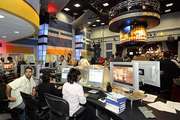
Al-Jazeera's broadcasting center in Doha, Qatar. The company plans
to launch an English-language international service later this year. |
It must
have been one of the greatest moments in Dominique de Villepin's
political life. In February 2003, as France's then-foreign minister, Villepin
delivered a strident speech to the United Nations Security Council in New
York opposing the American plan to invade Iraq. In a rousing speech he
demanded further arms inspections instead of a war. The applause was like
wildfire.
That evening, in his
hotel room, came the anticlimax -- the major American news networks
marginalized his speech and cut the scenes of applause from their newscasts.
Diplomatic sources hint
that de Villepin's wounded vanity led him afterwards to push a project that had
languished for years in France, namely the founding of a "CNN à la
francaise." In November 2005 -- as prime minister -- he signed a
contract with the heads of the public France Télévision and the private channel
TF1 to establish the "Chaine francaise d'information internationale,"
or CFII for short.
Leading the new
institution will be Alain de Pouzilhac. Until recently the leader of
French advertising giant Havas, Pouzilhac knows the business of
international image-making. Whenever he traveled abroad, he says, it bothered
him that France had no voice of its own in international news -- unlike
Germany, which funds and disseminates broadcaster Deutsche Welle around
the world.
Now he's the leading
French ambassador for TV news, overseeing €30 million in startup financing from
the state and a yearly budget of €65 million. After a number of initial
hiccups, he hopes to start broadcasting at the end of 2006, "between
November 10 and December 10."
No less than Jacques
Chirac has said -- a little belligerently -- that de Pouzilhac's mission was
eventually to "fight on the front lines of the worldwide image war."
His aggressive tone isn't
hard to understand. Recently CNN aired a report on the street protests in Paris
with commentary saying the scene at the Place de la République sort of brought
back "memories of Tiananmen Square." Of course, no one was
killed in the French student riots this year. In Beijing, however, Chinese
soldiers opened fire on pro-democracy demonstrators in Tiananmen Square in 1989
and massacred hundreds of people.
Battling
Anglo-American dominance
|
|
|
AP CNN Center in Atlanta |
De Pouzilhac wants to
counter the Anglo-American dominance of world news with two channels aimed at
opinion leaders in Europe, sub-Saharan Africa and the Maghreb. One station
would broadcast only in French; the other would air 75 percent of its content
in English. Despite the fact that only 2 percent of the world's population
speaks the language of Voltaire, the idea of broadcasting exclusively in
English landed with a thud at Elysee Palace. Quel Affront!
The French aren't alone
in their apprehension of BBC World and CNN. The world is starting to see a
real groundswell of new, transnational news networks, including:
- In the coming months, Al-Jazeera
International, an English-language spinoff of the leading Arab
network, is set to begin broadcasting. The Arab-language service has
grown to include sports news and channels for kids.
- As a "counter-attack" (according the
Britain's Guardian newspaper), the BBC World Service is
planning to launch its own Arabic program.
- For six months now, the
English-language Russia Today, 50 percent financed by the
Kremlin, has been broadcasting.
- The first state-run TV station in Latin
America, Television del Sur (or Telesur) has been broadcasting
since July 2005 -- subsidized by countries including Venezuela (51
percent) and Cuba (14 percent).
- There have been early talks in Nairobi
for a similar continent-spanning channel in Africa.
"We are finding
ourselves in a kind of media arms race," says Christopher Lanz, managing
director of Deutsche Welle TV (DW-TV), who last month met with colleagues from
other major news networks at a conference in Kazakhstan. Last year, Lanz's
German channel, which is funded by taxpayers and the German Foreign Ministry,
began broadcasting three hours of daily programming in Arabic. There are
internal plans to increase to 12 hours a day by September.
With its early start, DW
beat both the BBC and Russia Today into the Arab-speaking market. The
Russians want to broadcast 12 hours of Arabic-language programming a day
starting next January, and the French intend to compete by autumn 2007.
The battle for hearts
and minds
"Arms race,"
"battle," "counter-attack," "image-war" -- the
language of media globalization is no more accidental than the interest in
Arabic markets. This information war has less to do with commercial interests
than politics. Every network operates at a loss, except for CNN, and in global
debates over issues like the Iraq war, Iran's nuclear program or the
Danish cartoon riots, there's a struggle for the privilege of interpreting
facts and promoting a view of the world. Or, as Ulysse Gosset, CFII's general
director puts it: "A media presence in other countries has become as
important as traditional diplomacy."
Cameras now compete with
guns in the new cross-cultural war. The Netherlands recently blocked the
Lebanese satellite channel al-Manar and Iran's Sahar TV1 because they were
allegedly broadcasting anti-Western and anti-Semitic propaganda that openly
promoted hate. France banned al-Manar in 2004.
Sometimes, all it takes
is a single word to show the chasm between cultures. When a suicide bomber
blows himself up anywhere in the world, he's referred to as a
"terrorist," "martyr," or "freedom fighter"
depending on the seat of the media service.
More than anything else,
though, it was the unprecedented wave of patriotism on the major American
news networks after the Sept. 11, 2001 terrorist attacks
that prompted defensive responses in the rest of the world. The idea was
that if the US can push through its policies as a unilateral superpower, it
shouldn't also have a monopoly on the news.
The rise of Al-Jazeera
|
|
|
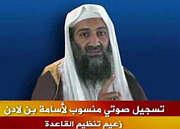
AFP Al Jazeera: al Qaida's outlet of choice |
Al-Jazeera,
founded ten years ago in the small sheikhdom of Qatar, grew out of this niche
during America's "War against Terrorism," which proved as vital for
the Arabic channel as the 1991 Gulf War was for CNN. "How Arab TV
Challenges America," was the subtitle of Middle East expert Hugh Miles'
book last year on Al-Jazeera -- though the channel is just now starting to
mount a challenge.
About a year ago, the
company put up a new building next to its main broadcast center in Doha, Qatar.
The building will house Al-Jazeera International. The studios are finished,
plasma screens hang on the walls and phone and Internet cables have
just been laid. So far it's the most expensive and ambitious assault ever
staged on the Western "world news" establishment. The 24-hour English
channel won't have much in common with the Arabic service -- or so, at any
rate, is how it will seem.
The emir of Qatar is an
enlightened despot who doesn't allow dissent but introduces one
liberal reform after another in his tiny Persian Gulf state. He's financed the
new English channel himself and wants to beat any Western competitors at their
own game -- and, in some cases, with their own ex-employees. The head of
the service will be Nigel Parsons, a British journalist who has spent a large
part of his 30-year career at BBC radio. Lindsey Oliver, from CNBC Europe, will
run the marketing side. The channel has even poached news anchors from the
competition. BBC veteran Sir David Frost and CNN personality Riz Khan, among
others, are under contract.
"Free of any
national agenda"
The English service will
broadcast from four main centers around the world -- Kuala Lumpur, Doha, London
and Washington. The launch date keeps changing, but according to Parsons,
"by the end of May the technical infrastructure should be ready."
Then there will be a test phase. "We'll start as soon as we're done with
that," he says, "-- in any case it will be in 2006."
|

Viewers
in Germany can watch the new channel by satellite or cable. But there have been
problems -- as expected -- finding distribution for the channel in the United
States, the world's largest English-speaking market.
Al-Jazeera will hire
around 100 employees to work in its Washington bureau on K
Street, says Parsons. He admits that in America there has been "more
skepticism and mistrust than anywhere else." The major cable networks are
openly afraid of mass cancellations if they offer "the mouthpiece of
al-Qaeda" as part of their programming packages. But the channel will
still be available to many Americans -- either via the Internet or satellite
television.
As for content, says
Parsons, the channel doesn't want to "follow the agenda of politicians,
like all the other networks, or broadcast the same pictures from G-8
summits." Instead, the service will use a diverse network of
correspondents who hail from many regions of the world in an effort to appeal
to people "who might be tired of seeing themselves only through Western
eyes."
When asked if the former
BBC man and his prominent colleagues are putting their careers on the line by
making themselves dependent on the whims of a hard-to-read emir in the Middle
East who could yank funding at anytime, Parsons counters aggressively. "On
the contrary," he says, "we work free of commercial pressures and
free of any national agenda."
But who will tune in? Is
there even a demand for so much cross-cultural TV? Dependable numbers are hard
to come by, but surveys can be disillusioning. An analysis by the University of
Maryland showed that only about 1 percent of viewers chose al-Hurra -- a
US-funded, Arabic-language service based in Virginia -- as their favorite TV
channel. This apparent ratings disaster has led to an expansion of the
station's programming from 16 to 24 hours a day. Washington has also realized
that al-Hurra might be a significant new way to spread radio and TV programming
in Farsi. The target audience? Iran.
|
||||||||||||||||||||||||||||||||||||||||