|
PEER REVIEWED ARTICLE:
The Appeal of Sami Yusuf and the Search for Islamic
Authenticity
By Christian Pond
 A quick glance at the top 40
most requested songs on the Web site for the popular Arabic music
video channel Melody Hits TV reveals the latest and
greatest from stars such as Lebanon’s Nancy Ajram—infamous for her
sexually suggestive videos—as well as others like America’s rapper
Eminem and Egypt’s crooner Tamer Hosny. Next to each song’s title
and number is also displayed a picture of the artist. At number 32,
next to her hit Megamix, is a picture of Britney Spears
staring at the viewer with the fingers of her right hand resting
suggestively on her bottom lip. At number 35, popular rapper 50 Cent
is shown in front of an expensive sports car wearing a fur coat,
diamond-studded chain and black bandana. Wedged between the two at
number 34 is the British Muslim singing phenomenon Sami Yusuf with
his latest hit Hasbi Rabbi.(1) A quick glance at the top 40
most requested songs on the Web site for the popular Arabic music
video channel Melody Hits TV reveals the latest and
greatest from stars such as Lebanon’s Nancy Ajram—infamous for her
sexually suggestive videos—as well as others like America’s rapper
Eminem and Egypt’s crooner Tamer Hosny. Next to each song’s title
and number is also displayed a picture of the artist. At number 32,
next to her hit Megamix, is a picture of Britney Spears
staring at the viewer with the fingers of her right hand resting
suggestively on her bottom lip. At number 35, popular rapper 50 Cent
is shown in front of an expensive sports car wearing a fur coat,
diamond-studded chain and black bandana. Wedged between the two at
number 34 is the British Muslim singing phenomenon Sami Yusuf with
his latest hit Hasbi Rabbi.(1)
Well-dressed, sporting
a fashionably cut, close-cropped beard and preferring tailored black
suits to traditional dress, he is famous for his glitzy religious
CDs and music videos. Born in 1980 to Azerbaijani parents, Sami
Yusuf grew up in London and first studied music under his father, a
composer. From a young age he learned to play various instruments
and at the age of 18 was granted a scholarship to study at the Royal
Academy of Music in London.(2) In 2003, Yusuf released his first
album entitled Al Mu’allim (The Teacher). Along with the
Al Mu’allim also came the release of the first “Islamic
music video” for the album’s title track by the same name. Both the
video and the album were immensely popular throughout the Muslim
world, where even in conservative Saudi Arabia album sales topped
100,000 copies.(3)
Yusuf’s message is one
of tolerance and integration. In Yusuf’s music, talk of infidels and
jihad are replaced with appeals to God’s love and the beauty of
religion. “Islam teaches us to be balanced, to be in the middle,”
Yusuf says, adding that “Islam is not a religion of extremism, and
my message is balance.”(4) Yusuf believes that the majority of
Muslims hold Islam to be a religion of peace and tolerance(5) and so
Muslim youth, especially in the West, should be proud of their
religion. “My message (to the youth) is … to be proud of your
religion, be proud of who you are whether you’re from Pakistan or
from Saudi Arabia or from Algeria or from Morocco or anywhere in the
Muslim world … just be proud of who you are.”(6)
Looking at his photo on
the Melody Entertainment Web page, those unacquainted with Yusuf’s
work would probably be hard-pressed to tell the difference between
him and other contemporary music stars in the Middle East and
Europe. Dressed in a stylish collared shirt with slicked-back hair
and close-cropped stubble, Yusuf does not appear much different from
other popular singers such as Egypt’s Amr Diab or French-Algerian
Cheb Khaled. This outward similarity has often led to Yusuf being
confused with other “non-Islamic” popular music stars, as recently
happened on a trip to Egypt. “I am not a pop singer,” said Yusuf in
an interview with Turkey’s Zaman newspaper. “I reminded
people of this many times in Egypt. You know that some youngsters
requested my phone number there. You know such things always happen.
I told them that I am not a pop singer and don’t want to be a pop
singer.”(7) Despite the cool, pop star-like image, however, Yusuf
remains—at least in his own eyes—a religious singer, and it is
primarily in this capacity that he has been able to achieve such
popularity.(8)
As a Muslim singer with
a specifically religious message, Sami Yusuf must, like all social
actors and entertainers for whom religion is a primary identity, be
able to legitimate his own interpretation of “what Islam is.” He
frequently condemns religious radicals, saying in one interview:
“Although they are not as widespread among normal Muslims, the
extremists have a very loud voice in spreading their
narrow-mindedness and ignorance, bringing confusion to the minds of
many Muslims.”(9) But like the messages of those radicals he
deplores, Yusuf’s message must be perceived as authentically Islamic
in order to be accepted. In short, Yusuf’s legitimacy as a preferred
religious artist for young Muslims is not just tied to his ability
to deliver his songs through an entertaining medium
(although this no doubt plays a part), but also is based on the
content of his message. For unlike most other video artists
whose sole aim is simply fame or money, Sami Yusuf’s self-identified
aim has always been to “do something for Islam”(10) and to create,
in TBS contributor Patricia Kubala’s words, “Al Fann Al
Hadif (art with a purpose).”(11)
Islamic
Authenticity, Popular Culture, and the West: A Theoretical
Context
In his book Islam:
The View from the Edge, historian Richad Bulliet argues, “The
impetus for change in Islam has more often come from the bottom than
from the top, from the edge than from the center.”(12) Lacking a
centralized religious hierarchy, Bulliet contends that the evolution
of Islam often has taken place on the geographical and ideological
margins of the Muslim Ummah when new communities of
believers seek ways of melding their newfound religion with the
native culture and environment.
In a modern era that is
characterized by transnational flows of people, ideas and
information, the new edge of Islam lies less in the historical
Dar al-Islam, and more in the West. Now home to large
communities of Muslim immigrants, their progeny, as well as an
increasing population of native converts, the Islamic West is
becoming an increasingly important location of religious
re-interpretation as Muslim diasporas and new converts seek to
reconcile Islam with Western culture and the contemporary Western
lifestyle.
Much of the new
thinking about Islam in the West is not taking place as much within
the traditional realms of religious authority, however, but within
popular culture. Faced with the realities of secular society and
aided by the development of new media such as the Internet, the
battle over “who speaks for Islam” in the West (and more and more in
the East, for that matter) increasingly is being played out in the
modern public sphere and outside the traditional realms of Islamic
authority.
Concurrent with this
expansion of Islam and Muslim religious interpretation into the
realms of popular culture is an escalation of concerns over
religious authenticity. With new interpretations of Islam
proliferating throughout the realms of Western popular culture
accompanied by the rise of a “new breed of religious leader, often
only half educated in conventional Islamic teachings, but determined
to interpret the faith in ways that make sense to people with modern
educations,”(13) debates abound over “what Islam is, as well as
“what Islam is not.”
This growing debate
over Islamic authenticity as manifested through the medium of
popular culture, moreover, should be of keen interest to scholars of
the Middle East and Islam. Mass media in particular, as a vehicle of
expression for popular culture, is of great significance “in the
contemporary process of constructing the boundaries of social
identity.”(14) When we examine the role played by tele-Islamists,
Muslim TV talk show hosts, and religious pop singers like Sami Yusuf
in the contested locus where the struggle to define Islamic
authenticity is taking place, popular culture and its expression
though mass media can tell us a great deal about the evolution of
Islam in the modern age.
An Awakening:
Finding a 'Way of Life' in the Modern World
For Yusuf, the desire
to act out for his faith came, as it most likely has for other young
“born-again” believers and converts,(15) with an “awakening” at an
early age. “Sometimes people’s faith seems to fade away,” he says,
“but then they go through an awakening. They find that their faith
is back in line, stronger than before. And this is what gives them
the desire to do something. This is what happened to me,”(16) For
Yusuf, this awakening occurred during his teenage years, and was a
result of finding the hidayet, or true path, to God. “I am
the kind of person who always researches, thinks and tries to learn
the truth. This awakening occurred as a result of many things.
Elhamduillah, the turning point came when I was about 16 or 17 and I
really wanted to do something for Islam.”(17)
In re-discovering the
“true path to God,” Yusuf is not alone. Recent research indicates a
rise in the number of young Muslims who are eschewing traditional
interpretations of religion and choosing for themselves as
individuals what being Muslim means.(18) The contemporary search for
Muslim religious meaning in the West, however, is occurring in a
social environment where the collective memory—the means by which
traditional religion is sustained over time—has by and large now
ceased to exist.(19) In the traditionally defined Christian West,
where dramatic social changes associated with the historical process
of secularization having been occurring for some time now, we have
already seen the religious “quest for certainty” manifested through
the fragmentation of traditional religions, the subsequent spread of
religious pluralism as a response to secularization, and the rise of
alternative religious expression such as the New Age Movement,
itself a response to the decline of traditional
religion.(20)
The general spiritual
confusion that characterizes post-modern, Western society is also
further exacerbated by new means of communication and social
organization which “means that everyday life is being shaped, for a
growing number of people, as much by events taking place in distant
places as by those in the local community. Hence people become
exposed to a variety of sources and types of information that they
realize are important but cannot always grasp and control.”(21) For
religiously minded young people growing up in the secularized West,
religion can act as a form of guidance that allows one to navigate
the confusing post-modern social environment. For young Muslims,
Islam is especially appealing for its perceived ability to offer a
“complete way of life” in which modernity is conveniently filtered
through the regulations and spiritual guidelines encompassed by the
Qur’an, Shari’a, Hadith, Sunna of the Prophet, and various other
sources of religious authority. This is seen in Jacobson’s 1998
study of young British Muslims, whose responses indicate that Islam
is able to inform all decisions related to navigating daily life.
One young man says, for example, “I’d say religion plays the
greatest part in my life. I certainly wouldn’t do anything at all
that would conflict with what my religion says … It’s a way of
life (italics mine) for me. I eat, breathe and everything the
way the religion tells me.”(22) Another respondent echoes similar
sentiments about Islam’s all-encompassing power saying, “It’s not
religion, is it—it’s a way of life (italics mine). It’s
interweaved with what you do every day. Like you can’t define it in
its own existence—that’s how it is for us. Like if you eat pork,
that’s not religious; if you don’t ear pork, that’s religious.”(23)
And still a third informant adds, “It’s not religious—it’s a way of
life (italics mine)—the way you should be. Do certain things.
Religion’s not just praying and wearing a certain dress – it’s the
way you act, the way you act towards people. It’s just – being
human, basically.”(24)
The belief that Islam
is a “way of life,” as it is understood by Sami Yusuf and other
young Muslims, necessitates the creation an alternative social
sphere in which vulgar products and aspects of modernity are
re-constituted and re-shaped into acceptable Islamized forms. Thus
we see Sami Yusuf making claims, for example, about creating music
and music videos in accordance with the Shari’a, or Islamic
Holy Law. “I do think it (music) can be used as a means for
integration (in Europe), but it must be done according to the
Shari’ah,” Yusuf has said. “For example, there should not be any
indecent or immoral connotations, basic things that go against our
fundamental understanding of Islam.”(25) For Yusuf, accordance with
the Shari’a does not imply, however, that Islam is incompatible with
modernity because Yusuf also believes that Islam and modernity are
not only reconcilable, but complimentary. “The youths are very
open-minded now. They are mostly proud of their religion. Although
there are some elements of modernity they like, they have realized
that staying aloof from religion and shying away from religion is
wrong. Religion goes hand in hand with modernity.”(26)
Islamizing
Modernity
Before proceding, a note should be made
about the concept of modernity itself. As Giddens and many others
have noted, modernity is neither uniform nor clearly defined.
Modernity is in fact an ambiguous project, and varies greatly
depending on time and place. Similarly, the same degree of ambiguity
surrounds the concept of secularism. Talal Asad points out, for
example, that one’s definition of what defines secular space often
depends on the type of religious symbols involved. Referring to
France, he notes, “What is it that makes the wearing of the veil a
violation of secular rules of politics and not the yarmulke? My
point is not that there is unfair discrimination here, but that even
in a secular society there are differences in the way secular people
evaluate the political significance of "religious symbols" in public
space.”(27) Thus, we must keep in mind that secularism, along with
modernity, are hardly uniform concepts. As we will see below, even
in the strain of Islamism that some may describe as “liberal,”
definitions of modernity and secularism can and do vary
greatly.
In
the contemporary age, attempts to define exactly what constitutes
“Islamic art” have proven equally elusive. As Ernst rightly
suggests, part of this is due to the “absence of a single,
monolithic, Islamic culture.”(28) Taking a step back, however, it is
possible to place the debate over “Islamic Art” within a wider
debate presently taking place in the West. On the Internet and in
Western publics, where religious authority is not controlled by the
state, there is now a debate taking place not only over what
constitutes “Islamic art” or the “Islamic artist,” but over Islam
itself. As Eickelman and Anderson note:
A
new sense of public is emerging throughout
Muslim-majority states and Muslim communities elsewhere. It is
shaped by increasingly open contest over the authoritative use of
the symbolic language of Islam. New and increasingly accessible
modes of communication have made these contests increasingly
global…These increasingly open and accessible forms of communication
play a significant role in fragmenting and contesting political and
religious authority.(29)
The contemporary wave of
Western Islamization—involving fundamentalists and liberal reformers
alike—is in part driven by the search for religious autonomy in an
already established secular society.(30) Sami Yusuf’s creation of
“Islamic” versions of a secular forms such as the music video can
thus be seen as part of a larger effort—utilizing everything from
television (www.islamchannel.tv) to Western stand-up comedy
(www.allahmademefunny.com)—to Islamisize “non-Islamic,”
secular spaces. In regards to Islamists and modernity, Göle
argues:
In the
case of Islam in the public sphere, there is a double movement that
causes uneasiness: Islamists seek to enter into spaces of modernity,
yet they display their distinctiveness. There is a problem of
recognition to the extent that Islamist start sharing the same
spaces of modernity, such as the Parliament, university classes,
television programs, beaches, opera halls, and coffeehouses, and
yet they fashion a counter-Islamic self (italics mine). In
contrast with being a Muslim, being an Islamist entails a reflexive
performance; it involves collectively constructing, assembling, and
restaging the symbolic materials to signify difference. The symbols
of Muslim habitus are reworked, selectively processed, and staged in
public.(31)
In a way similar to
Göle’s Islamist archetype, Yusuf also appropriates traditional
symbols and spaces of secular Western modernity—i.e. music videos
and television—while adding an Islamic tinge. The video for Al
Mu’alim acts as a “counter-Islamic self” for secular videos
that often glorify non-Islamic themes like casual sex and violence.
“There is art, and non-art, and nothing else in between” Yusuf has
stated. “So as for in the West there is excellent art, and another
that is deviant.”(32)
Like political
Islamism, the socio-cultural Islamism espoused by Yusuf and others
is similarly focused on the creation of an “Islamic society,”
however that may be defined. “Political Islam” as expounded by
Khomeini, Maududi and others saw this objective best accomplished
through the formation of an Islamic state and government, but
contemporary socio-cultural Islamism in Europe, faced with the
realities of secularization that prohibit Islam’s ascendancy into
the realm of popular governance, realizes its objective instead
through the gradual Islamization of individuals and individually
owned commodities. This type of socio-cultural Islamism corresponds
to what Göle terms the ’second wave’ of (post-revolutionary)
Islamism” where “actors of Islam blend into modern urban spaces, use
global communication networks, engage in public debates, follow
consumption patterns, learn market rules, enter into secular tim,
get acquainted with values of individuation, professionalism, and
consumerism, and reflect upon their new practices.”(33) Whereas
older fundamentalist arguments called for the avoidance of
Westernized modernity and its decadence, socio-cultural Islamism is
a realization that for Muslims living in Europe today, this ideology
is neither practical nor possible. While younger religious Muslims
such as Sami Yusuf may sometimes display a level of ambivalence
towards the West and “mainstream” Western culture—alternating
between criticism and praise as Yusuf often does—they are, by
geography alone, nevertheless participants in the formation of
modern British culture and consumers of modernity like everyone
else.
Part of the appeal of
Sami Yusuf, therefore, is that he provides an “Islamic” alternative
to a common Western commodity (the music video) and commodity
experience (listening to popular music) already enjoyed by young
people, regardless of faith. If there must be popular music and
videos, so the socio-cultural Islamist argument goes, then there
must be Islamic popular music and Islamic videos.
Sami Yusuf’s fame is therefore not only related to his considerable
talent as a musician, but also to the fact that he is one the first
significant European artist to produce popular Islamized adaptations
to Western models of musical experience already accepted and enjoyed
by young people, both Muslim and non. The fact that this is so is
evidenced by Yusuf ‘s own assertions that he has exerted great pains
to replicate in form, if not in content, the most appealing aspects
of this Western model. Take, for example, the mission statement
listed in the album cover notes to his first work, Al
Mu’allim:
Awakening and Sami Yusuf were greatly motivated to
produce this project from the outset, and this motivation stemmed
from a shared deep conviction that we have a duty to provide an
Islamic alternative for the Muslim youth that is vibrant and
enjoyable to listen to and is produced to the highest standards of
composition, singing, sound production and engineering, being in
all these aspects a match for any albums produced by the Western
music industry [italics mine], and yet containing the beautiful
teachings of Prophet Muhammad (saw). To this end, Sami Yusuf’s many
talents, the best studios, sound engineers and equipment were
brought together, no costs were spared and no shortcuts were taken,
always keeping as our motto the hadith of the Prophet
(saw): “Verily Allah loves that if one of you does an action that he
perfects it.” So, perfection in every aspect was our aim; thus Sami
Yusuf spent many long hours in the studio programming, singing,
playing the instruments and singing the main tracks as well as the
harmonies and some of the backing vocals, and Barron, one of the
best and most experienced sound engineers spent hundreds of hours
recording, mixing, editing and mastering, using the best studios and
equipment to produce an album that is equal if not better in
sound quality than albums produced by the Western music
industry [italics mine] .(34)
What the above
indicates is that Yusuf is competing with, rather
than opposing, Western popular music. Moreover, he is not
only competing against the “Western music industry,” but he is using
the same means of production and marketing in order to disseminate
his message. His claim that his music is superior the “Western music
industry” by its own norms and standards, therefore, is at
least as important to marketing his music and image as is the
contention that it provides an “Islamic alternative.” It is also in
keeping with demands of many young Muslims in the West, who seek
products that “that will also give them pride to be Westernized
Muslims in an Islamic and non-polemical way.”(35)
The desire for products
that are at once genuinely Islamic yet socially accessible—such as
Yusuf’s music videos—is an essential reason for Yusuf’s popularity.
Today, young British and European Muslims find themselves in what
Andrew Shryock describes as a “double remoteness.” In his study of
cultural production in Detroit, Shryock argues that Arab Americans
are not only remote from the Arab world, but also to the American
social mainstream.(36) This “double remoteness” that Arab Americans
find themselves is manifested in the creation of two distinct
self-identities identities: the first, which Shryock terms “identity
1,” is often associated with multiculturalism, stresses similarities
between Arab-Americans and the social mainstream, and is that which
is presented to “outsiders.” The second, which he terms “identity
2,” is the identity usually expressed inside the Arab American
community itself, and is not usually presented to most
“outsiders.”(37) Similar to Arab-Americans in Detroit, British and
European Muslims also experience a sort of “double remoteness.” On
the one hand, they are physically and, for the younger generation,
culturally separated from their countries of origin. Their ethnicity
ties them to the old country, but their upbringing in Europe forces
them to be located somewhere between being British and being, for
example, Pakistani, Bangladeshi or Egyptian. The increasing movement
of young European Muslims towards identification with a global
ummah—as suggested by Olivier Roy and evident in the work of Sami
Yusuf—is itself the result of this “double remoteness.” Believing
that the social mainstream does not accept them, young Muslims in
Britain and elsewhere feel a shared sense of suffering with their
co-religionists in Palestine, Iraq, Chechnya and other Muslim
countries, whom they believe are, like them, victims of Western
governments that are as hostile towards Islam and Muslims. This
imagining of and identification with the global ummah is in
a large part a reflection of the inability of European nations to
integrate their own Muslim communities.
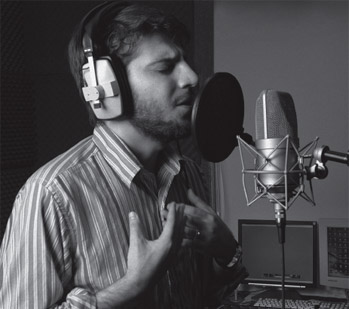 Although they may be “cool” and “Islamic,” Sami Yusuf’s
videos are in many ways no different from any other video produced
by Britney Spears or other “Western” artists. The Videos for Al
Mu’allim and My Ummah have been created using the same
means of production, are marketed (even juxtaposed) in many of the
same public spaces, use some of the same instruments, and are
essentially commodities to be purchased just like Spears’ Baby
One More Time (1999) or the 2000 follow-up Oops!…I Did It
Again. Take for example one of Vodafone’s newest television
advertisements in Egypt featuring clips from Yusuf’s latest video,
Hasbi Rabbi. The commercial opens with a caption of a young
Egyptian man surrounded in darkness and staring into his lighted
Vodaphone mobile while the beginning Arabic chorus—Ya rabbal
‘alamin /Allahu Allah (O Lord of the world /
Allahu Allah)—of Yusuf’s latest hit, Hasbi Rabbi,
plays in the background. The scene then cuts to a group of young men
playing soccer. As the chorus continues—Salli ‘ala Tahal amin /
Allahu Allah (Send peace and blessings on Taha the
trustworthy / Allahu Allah—the camera focuses on the face of
one of the young men as he looks out in another direction, and then
cuts to a scene of a few people running across a bridge. Now the
chorus is in the third refrain—Fi kulli waqtin wa hin / Allahu
Allah (In every time and at every instant / Allahu Allah)—and
as the music continues to play, a group of four young women
approach. Two are dressed in hijab and two without, but all
are fashionably dressed and flashing big smiles move towards the
camera. As the chorus continues in the final refrain—Imla’ qalbi
bil yaqin / Allahu Allah / Thabbitni ‘ala hadhad din / Allahu Allah
(Fill my heart with conviction / Allahu Allah / Make me steadfast on
this Religion / Allahu Allah—everyone, young people, old
people, women and children, are all shown crowding into a circle to
take a look at something. This something is revealed as the camera
shows the original young man from the first frame voicing the final
Allahu Allah as he stares into his mobile phone. But what is on his
phone that is brings everyone from near and far to come and look?
Why it’s none other than Sami Yusuf’s latest video, now available
for downloading on your very own Vodafone mobile. As the camera
shows clips from Yusuf’s video for Hasbi Rabbi on the young man’s
phone, a voice announces, “Faqat mca ‘Vodafone Live’ likulihum
cumla’ il-khat wi-lkart, istamticu, sharik, ‘ahdis album li Sami
Yusuf...Vodafone…mish bas kalam (Only with ‘Vodafone Live’ for all
clients with either line or card service, enjoy, participate, the
latest album of Sami Yusuf…Vodafone…not just talk.”(38) Although they may be “cool” and “Islamic,” Sami Yusuf’s
videos are in many ways no different from any other video produced
by Britney Spears or other “Western” artists. The Videos for Al
Mu’allim and My Ummah have been created using the same
means of production, are marketed (even juxtaposed) in many of the
same public spaces, use some of the same instruments, and are
essentially commodities to be purchased just like Spears’ Baby
One More Time (1999) or the 2000 follow-up Oops!…I Did It
Again. Take for example one of Vodafone’s newest television
advertisements in Egypt featuring clips from Yusuf’s latest video,
Hasbi Rabbi. The commercial opens with a caption of a young
Egyptian man surrounded in darkness and staring into his lighted
Vodaphone mobile while the beginning Arabic chorus—Ya rabbal
‘alamin /Allahu Allah (O Lord of the world /
Allahu Allah)—of Yusuf’s latest hit, Hasbi Rabbi,
plays in the background. The scene then cuts to a group of young men
playing soccer. As the chorus continues—Salli ‘ala Tahal amin /
Allahu Allah (Send peace and blessings on Taha the
trustworthy / Allahu Allah—the camera focuses on the face of
one of the young men as he looks out in another direction, and then
cuts to a scene of a few people running across a bridge. Now the
chorus is in the third refrain—Fi kulli waqtin wa hin / Allahu
Allah (In every time and at every instant / Allahu Allah)—and
as the music continues to play, a group of four young women
approach. Two are dressed in hijab and two without, but all
are fashionably dressed and flashing big smiles move towards the
camera. As the chorus continues in the final refrain—Imla’ qalbi
bil yaqin / Allahu Allah / Thabbitni ‘ala hadhad din / Allahu Allah
(Fill my heart with conviction / Allahu Allah / Make me steadfast on
this Religion / Allahu Allah—everyone, young people, old
people, women and children, are all shown crowding into a circle to
take a look at something. This something is revealed as the camera
shows the original young man from the first frame voicing the final
Allahu Allah as he stares into his mobile phone. But what is on his
phone that is brings everyone from near and far to come and look?
Why it’s none other than Sami Yusuf’s latest video, now available
for downloading on your very own Vodafone mobile. As the camera
shows clips from Yusuf’s video for Hasbi Rabbi on the young man’s
phone, a voice announces, “Faqat mca ‘Vodafone Live’ likulihum
cumla’ il-khat wi-lkart, istamticu, sharik, ‘ahdis album li Sami
Yusuf...Vodafone…mish bas kalam (Only with ‘Vodafone Live’ for all
clients with either line or card service, enjoy, participate, the
latest album of Sami Yusuf…Vodafone…not just talk.”(38)
Sami Yusuf’s Vodafone
commercial indicates the while his music may be an “Islamic
alternative,” it is also, like Western pop music, an extremely
useful tool for marketing and selling products. And like Britney
Spears, Sami Yusuf’s image is an essential part of the
marketing appeal. Yet while Sami Yusuf, his music, videos, and the
Islamist ideology he espouses are themselves a part of Westernized
modernity, what is interesting, is that Yusuf has repeatedly made an
effort to draw dichotomies between his music and his company
(Awakening) on the one hand, and “Western” music and the “Western
music industry” on the other. While doing this may, in light of the
previous discussion, appear somewhat contradictory, it is
nevertheless a vital element of Sami Yusuf’s appeal. Part of Yusuf’s
drawing power is his ability to bring a product to the market that
is perceived as “authentic,” but at the same time, modern. By
maintaining a distance between himself and his “Islamic” art, on the
one hand, and Western artists and their “non-Islamic” art on the
other, Yusuf is able to offer a religious product that is
“authentically Islamic” even if, like the “Western” products it
competes with, it is thoroughly modern in form and
expression.
Locating
Authenticity
For young Muslims today
who see Islam as not merely a set of rituals but as a complete
life-system, the reconciliation of religion and modernity often
requires a bit of innovative thinking. In Europe and elsewhere,
young Muslims today are faced with questions relating to certain
aspects of modern life for which the traditional sources of Islamic
authority do not have direct answers. A quick search of the “Fatwa
Bank” of Sheikh Yusuf al-Qaradawi’s popular IslamOnline.net
website will reveal young Muslims asking all sorts of
modernity-inspired questions such as the permissibility of watching
television,(39) whether one should remove nail polish before
prayer,(40) or whether nail polish is permissible at all.(41) Asking
these sorts of questions is necessary, however, if one is to create
a “way of life” that is still “authentically Islamic” in
capitalistic, secularized societies where the religious individual
is faced with public displays of questionable morality and an
exponentially increasing array of consumer and lifestyle
choices
Young Western Muslims’
search for “Islamic authenticity” is also reflected in many of the
case interviews undertaken by Jacobson in her 1998 study of British
Muslim youth. In talking to young Muslims in northern Britain, she
found that for many respondents their attachment to Islam was a
manifestation of a personal “quest for certainty.” For these young
Muslims, convinced that in Islam are all the answers on how to lead
a successful life, questioning religion was not so much an
expression of doubt as it was a means to establish correct
belief.(42) In the words of one young man, “You question (teachings)
not because you think they’re wrong, but to reaffirm your own
belief. You work through the issues where the religion says
so-and-so—you take the issue and you say, oh, let’s break this issue
down into what does it actually mean (italics mine)…”(43)
For this young man and other young Muslims like him who are
searching for spiritual certainty through Islam, the “quest for
certainty” or for Islamic authenticity is in essence a way to
“escape the dilemmas of subjectivism, relativism, and
meaninglessness that are often linked to postmodern vistas on human
affairs.”(44)
The search for
authenticity is, however, “a peculiar longing, at once modern and
anti-modern. It is oriented toward the recovery of an essence whose
loss has been realized only through modernity, and whose recovery is
feasible only through the methods and sentiments created in
modernity.”(45) In other words, since the very notion of
authenticity is a modern construct, creating something that is
authentic can only take place in the framework of modernity. This is
similar to the development of what Abu-Lughod terms the “’culturing’
process,” in which one’s notion of culture is not shaped by its
actual progenitors (i.e. the “indigenous people”), but by how it is
defined in modern constructs and processes such as nationalism and
globalization.(46) Like culture when it enters the “culturing
process,” authenticity is not established by actual history, but
only by the way it is shaped within realms of the systematic
framework in which modern communicative expression takes place, such
as in music videos.
Moreover, when Sami
Yusuf and other young Muslims look towards Islamic history in their
quest for authenticity, many are doing so in a completely modern
way: as individuals. This is not to imply that the desire for
individual religious experience is only a modern phenomenon—Sufism
and other forms of mysticism, for example, have a long history. But
even in traditional Sufism that emphasizes the individual experience
of the divine, there is still a fundamental and well-established
relationship between the student and master involving the
time-honored tradition of passing Islamic knowledge through a set of
chain of authority, or isnad. In the modern West, however,
where authenticity feeds our desire for “unmediated
genuineness,”(47) what is considered genuine for the
religiously-minded individual is often completely open to individual
interpretation. When, for example, the widely popular Dr. Jamal
Badawi—a professor of management at St. Mary’s University in Canada
and a prolific commentator and writer on “what Islam is”—pens an
“authentic exposition of the teachings of Islam regarding
women,”(48) should this be regarded as an “authentic”
interpretation? Does it matter that he has no formal religious
certification? Who should decide? If it is completely subjective,
then how can it really be authentic?
For advocates of
authenticity, be it Sami Yusuf, Jamal Badawi, or even a television
therapist such as Dr. Phil, establishing authenticity requires
walking a difficult, ideological tightrope. For in order to avoid
the dreaded subjectivism and relativism that authenticity seeks to
eliminate, the truth that all of these advocates seek “must be
recognizable not just as “my own” (for then it might as well be
subjectivist) but as something that ties me to other human beings
and gives us some ground upon which to build a life together that is
anchored in legitimate institutions. To do that we must have some
basis for common knowledge.”(49) For socio-cultural Islamists such
as Sami Yusuf, becoming popular thus involves the establishment of
foundation of authenticity that is both widely recognized and
recognizable.
One of the ways in
which Yusuf establishes authenticity is though a kind of process
that might best be described as “othering”. In her work on African
art, primitivism and authenticity, anthropologist Shelley Errington
makes reference to a similar phenomenon when discussing past
attempts to define “authentic,” “primitive” African tribal art.
Quoting William Rubin, former director of the Museum of Modern Art
in the mid 1980s, she writes: “An authentic object is one created by
an artist for his own people and used for traditional purposes.
Thus, works made by African or Oceanic artists for sale to outsiders
such as sailors, colonials or ethnologists would be defined as
inauthentic.”(50) As Errington points out, this type of view is
predicated on the belief that an authentic object is one untouched
by “outsiders” to the “traditional culture.”(51) In other words, for
colonialists, sailors, ethnologists and other non-African “cultural
outsiders,” authentic African art is only that which is made by and
for the “locals.”
In the case of Sami
Yusuf, his “otherness” derives from the fact that his immediate
heritage lies outside of Europe, in Azerbaijan from where his
parents came. Can we imagine that he would be half as popular if he
were “just another white guy”? Unlike other mainstream singers, Sami
Yusuf is in regards to ethnicity and heritage still very much an
“outsider” to the mainstream, Anglo-Saxon, English socio-cultural
milieu. Thus we see frequent references in interviews to his ethnic
heritage, and to his father’s educating him in “traditional” (i.e.
non-European) music and musical theory. As we have seen, Sami Yusuf
frequently makes reference to the present need to construct a new
model of Islam. “We are facing difficulties collectively as
Muslims,” he says, “but the modern youth are educated, open-minded
and they will go back to study their ancestors, their lineage,
to know who they really are and I am confident that they
will renew the message of Islam (all italics mine).”(52)
As one of the leaders
of the current “Islamic reformation,” another part of Yusuf’s
authenticity, which allows him to be seen as a legitimate
figurehead, lies in his ability to connect himself to an idealized
past. As one of the new interpreters of Islam, he is able, so it is
implied, to connect with this past in an authentic way. It is only
him and like-minded Muslims that are able to access the “true”
meaning of scripture, and the “true” beliefs and actions of the
Prophet. An acknowledgement that authenticity lies in the connection
with an idealized past, however, is also at the same time a
recognition that modernity is now cut off from that past. However,
Yusuf’s alternative vision directly challenges those who assert that
to be modern, one must necessarily make a clean break from the past.
On the contrary, for Yusuf it is only through the connection to the
past that an authentic Islamic present can be established. The
re-connection with the past is therefore a means of re-establishing
the collective religious memory that has largely broken down in
Western and Westernized societies where notions of modernity are
often predicated on a break from tradition. The idealized past, like
the idea of “pristine culture,” is thus a well-spring of
authenticity. By connecting themselves with the “real” version of
this idealized past, the SamiYusufs of the world become
authentic.
Authentic
Spirituality
One of the primary ways
in which Sami Yusuf appeals to young Western Muslims is by
emphasizing spirituality, a characteristic that, along with
religious authenticity, accompanies the individualization of
religion.(53) In Yusuf’s view, spiritualized music such as his is in
great need in the present age. "Spirituality is missing in the vast
majority of most songs," Yusuf said in a recent interview. "The art
world has been hijacked by the commercial environment. That's why we
have a vacuum in producing positive art with positive messages,
promoting good values."(54) For many young British and European
Muslims, Islam is increasingly becoming individualized as each
believer enters into the process of deciding for him or herself what
Islam means. For the young Muslim man or woman looking towards
social integration in Europe, and who is more concerned with ethics
and values than with rules and regulations, spiritualized
commodities such as Sami Yusuf’s videos, with their emphasis on
values, meanings and ethics, readily appeal to the individual who is
searching for the “spirit,” rather than the “letter,” of religion.
By catering to the believer’s need to access more esoteric religious
meanings associated with the “inner self,” spiritualized commodities
such as Yusuf’s also maintain a certain mass appeal; in that they
stress values and ethics over rules and regulations, spiritualized
commodities such as Yusuf’s generally present a unifying group of
non-threatening principles that are easily accessible to a large
section of the public, regardless of confession.
Conveniently for
producers of value-oriented products such as Yusuf’s, “authentic”
spirituality is highly marketable. “Consuming spirituality” by
purchasing the countless array of “products for the soul”—offered by
everyone from right-wing televangelists to New-Age gurus—has become
an obsession for many in the West,(55) regardless of religious
inclination. In the work of Sami Yusuf, we often see this sort of
spiritualism manifested in his emphasis on qualities of love and
beauty. Take for example the opening lines to Yusuf’s latest hit,
Hasbi Rabbi: O Allah the Almighty / Protect me and guide me
/ To your love and mercy / Ya Allah don’t deprive me / From
beholding your beauty / O my Lord accept this plea.(56) These dual
themes are continued in digital form through the video for the same
song. In the Hasbi Rabi video, Yusuf’s emphasis on love is often
represented through frequent depictions of happy children and
families. In the video’s second episode,(57) Yusuf is shown walking
through a public park in Istanbul. As he passes by a young boy
sitting with his father on a bench, Yusuf stops to lovingly pat the
boy’s head. As he continues on his way, the camera cuts to a close
up of the boy, who looks in Yusuf’s direction, smiling. In the next
sequence, filmed at the Taj Mahal, Yusuf plays the part of a Quranic
teacher (faqih in Arabic) to a group of young Indian boys.
Far from the traditional stern-looking, disciplinarian type of
religious teacher, however, Yusuf appears more in the mode of
someone from a Western-style afternoon talk show. At one point in
the sequence of singing and smiling, Yusuf bends down to put his
right hand on the face of one of the smiling pupils while crooning
in Hindi, “Uskey sab nishan hai (Whatever you see in this world is
His sign).”(58)
The Taj Mahal in
Yusuf’s video is an idealized version, beautified and gleaming
white. Similarly, in the last segment filmed in Cairo, the city’s
urban spaces are portrayed unrealistically. The first part of the
sequence, filmed downtown, shows a Midan Tahrir that is striking
firstly for the lack of people present, and secondly for its
conspicuous cleanliness. For anyone who has actually seen the bustle
of Cairo’s busiest downtown square, it is readily apparent that this
is a completely idealized depiction. Midan Tahrir is chaotic and
teeming with people and cars. This is especially true during the
day, as steady streams of government employees and citizens move
into and out of the central government administration building, or
Mogamma, located on the square’s south side. Also
conspicuously absent in Yusuf’s video are the noise and air
pollution from honking horns and vehicle exhaust that characterize
Tahrir and other urban spaces in modern day Cairo.
In the second half of
the Cairo sequence, in which Yusuf takes a ride on a public bus to
the old quarter of the city, the urban landscape depicted in the
video bears little resemblance to the hustle, grit and grime that
characterize the overpopulated quarter known as Islamic Cairo. Yusuf
walks through a virtually empty, polished old city. Nowhere to be
seen are the open sewer lines, large numbers of poor women selling
packets of tissues, or the frenetic and ubiquitous mélange of voices
and street sounds that greet real-life visitors. This is an urban
space that has been beautified. Poverty and other unfortunate
aspects of modern urban life may be realities, but they’re not very
entertaining or aesthetic, certainly not beautiful, and probably
don’t sell CDs very well. Beauty makes people feel good, and the
most beautiful spiritualized commodity, the one that makes us feel
the best, is the one we will choose when buying products that we
feel express a part of “who we are.”
Islamic
Authenticity & the Mainstream
Sami Yusuf, like most
musical artists, is constantly evolving. Looking at the progression
of Yusuf’s career to date, one notices a clear move away from the
classical nashid model to a more contemporary Western
musical style. Unlike the videos for Al-Mu’allim, which
contained only minimal instrumentation and the focused more on the
artist’s voice, with his latest album, My Ummah, we see
something different. In addition to using a more diverse range of
instruments, Yusuf is also starting to incorporate popular Western
musical genres, such as rap. In addition, there is also a noticeable
change in content between the two albums. Whereas the first album’s
tracks focused on two primary themes, namely praise of God and His
Prophet, My Ummah’s tracks branch out into treatments of
political issues (Try Not to Cry, about the Palestine
conflict), social issues (Free, about veiled Muslim women
facing discrimination in the West), generalized spiritual/religious
values (Mother, about being good to one’s mother) and the
current state of Islam (My Ummah, about the current
“Islamic reformation”). So what does this apparent transition in his
music mean?
In an interview conducted
last May while on tour in the Arabian Gulf, Yusuf declared, “My five
year plan is to be able to play my music in mainstream channels … as
many channels as possible. To become a mainstream singer in ideas as
well, to keep my ideologies and beliefs. What’s the point of telling
people something they already know?”(59) As these words suggest, the
transition within Yusuf’s music appears to be linked to his desire
to become a mainstream artist accessing mainstream markets. Formerly
loathe to associate himself with the celebrity status attached to
mainstream artists, it now appears that Yusuf is finally starting to
accept it, to even celebrate it. “In the West, we don't have enough
Islamic celebrities who would make minority Muslims proud," he said,
in a recent interview conducted while on his February 2006 tour of
Egypt.(60) What exactly constitutes the “mainstream,” however is
still rather unclear, and surely depends on location. For example,
the mainstream in the Middle East (if we can even posit that such a
thing exists) is surely different from what constitutes, say, the
mainstream in Western Europe or the United States. However, the very
fact that Yusuf is attempting to reach a wider audience with his
second album demonstrates that, at the very least, he maintains a
vision of a targeted, mainstream audience and is desirous of
accessing it.
This new attitude
towards fame and the desire to access mainstream markets (however
those may be defined) demonstrates that Yusuf clearly realizes the
power of mass culture and media to impact social definitions. As
Garofalo indicates, popular mass culture is, “One arena where
ideological struggle—the struggle over the power to define—takes
place. While there is no question that in this arena the forces
arrayed in support of the existing hegemony are formidable, there
are also numerous instances where mass culture—and in particular
popular music—issues serious challenges to hegemonic power.”(61) If
one’s goal is social, rather than political Islamization, as it is
for Sami Yusuf, Tariq Ramadan and other socio-cultural Islamists,
then it is absolutely necessary to enter into the mainstream spaces
of the public sphere. This is the place where, as Garofalo notes,
the power of social definition takes place. But will Yusuf be able
to make this transition to the mainstream? And, if he is able to,
how might this affect his status as an “authentically Islamic” role
model?
As
discussed above, part of Sami Yusuf’s drawing power as an
“authentic” Muslim artist derives from his being a Muslim “other” to
the social mainstream. For Muslims, on the other hand, his
attraction is precisely because he is just that, an “other”, i.e.
“one of us,” a Muslim living in a globalized, Westernized world. He
shares a similar ethnic background located in the historical Dar
al-Islam, and he is constantly calling for young Muslims to be proud
of their religion. If Yusuf is to move into the mainstream as he has
indicated, he will face great challenges from those who do not agree
with his definition of Islamic art and the role of the Islamic
artist in the public sphere. If he goes completely mainstream, his
drawing power as an “authentic other” (“one of us”) will most
certainly decrease. If, however, he is to avoid becoming just
another “ethnic” world-beat artist, he will surely need to
compromise, to a certain degree, his focus on religion (Will most
young people in the mainstream want to buy his music if he continues
to sing about the Prophet?). The future of Sami Yusuf, whether he is
able to go from margin to mainstream, will thus depend in part upon
how his transformation is received by audiences located in both the
margins (his current mainstream) and by the social mainstream (his
current margins).
Today, Sami Yusuf is only
one of a number of important social actors involved in the
production of Islam for consumption by the Western general public.
In the near future, it can be expected that he will face intense
competition, even from among other like-minded “progressive”
Islamists. With the Danish cartoon controversy, for example, one
could see how the competition to represent Islam in public created
cleavages, even between figures that are associated with
socio-cultural or “progressive” Islamism. There were reports of
popular Muslim televangelist Amr Khaled and media über Shaikh Yusuf
Al Qaradawi, both highly esteemed by Sami Yusuf, publicly feuding
over how the Muslim world should form a response to the controversy.
Naturally both assume they represent popular Muslim opinion. “The
deep-rooted solution of this problem is through dialogue to reach an
understanding and coexistence between the nations,” said Khaled,
adding that, “We have to lay a future base to build our own
renaissance.”(62) “Dialogue about what?” Al Qaradawi responded on Al
Jazeera. “You have to have a common ground to have a dialogue with
your enemy. But after insulting what is sacred to me, they should
apologize.”(63) Like his colleagues, Sami Yusuf as an actor and
producer of public Islam will also most likely attract controversy
for those that do not agree with his message and interpretations.
In the West, the fight
over who represents Islam and how it should be represented in the
public sphere is just beginning. Even within Western socio-cultural
Islamism, there is a large amount of disagreement over exactly what
Islam is as well as what it isn’t. Both Sami and American Shaikh
Hamza Yusuf, for example, while admittedly involved in different
forms of communicative expression (Sami being a singer and Hamza a
preacher), both acknowledge the necessity of creating an “authentic”
Islamic community. However, the two Yusufs have markedly different
interpretations of what Islamic authenticity actually entails. For
Sami Yusuf, merely Islamizing the content of something that is
Western in form, such as the music video, is enough to produce an
authentically Islamic object. There is no criticism of modernity’s
intrinsic value or the Western model as such. Rather, there is only
a criticism of its content. If we disregard the content of
Yusuf’s music, however, then it is difficult to see how his means of
production, distribution and musical commoditization differ from any
other non-religious Western artist. For Hamza Yusuf, on the other
hand, it is the intrinsic nature of Western modernity—a modernity
based on technology that “dehumanizes by its nature because it is
based on massification”(64)—that is at issue. For Hamza Yusuf, an
authentic Islamic existence cannot be found until modern Western
society itself is reformed.
For the two Yusufs,
constructing an authentic Islamic existence in the modern world is
thus achieved through two related, but very different, methods. For
Sami Yusuf, creating an authentic Islamic existence simply involves
a process of Islamizing modernity. For Yusuf and other
proponents of this method, modern Western forms and commodities can
easily be appropriated and, once their content are acceptably
Islamized, be refashioned as authentically Islamic objects like
“Islamic music videos.” In contrast, Hamza Yusuf believes the means
of attaining an authentic Islamic existence are not found in the
process of Islamizing modernity, but in modernizing
Islam. Yusuf’s Zaytuna Institute is the perfect example. Itself
a result of Yusuf’s deep dislike for the modern Western education
model,(65) the Zaytuna Institute offers a mode of learning whose
uniqueness lies in the very fact that it offers a model of
education—one based on “reviving time-tested methods of
educating”(66) —that is thoroughly different from the Western
standard. Hamza Yusuf’s view of how to create an authentic Islamic
existence thus differs from Sami Yusuf’s in that it contains an
implicit critique of Western modernity. For Hamza, finding an
authentic Islamic identity is based on modernizing Islam,
rather than Islamizing modernity.
In regards to Muslim
integration into the Western social mainstream, Hamza’s model of
modernizing Islam appears more problematic Sami’s. For if Muslims in
the West are to follow the lead of Sami Yusuf and his initiative to
Islamize modernity, comparatively fewer ideological or moral
roadblocks are encountered because the models and forms needed for
establishing Islamic authenticity are already present. They only
need to be accepted. Music videos and other mass-produced
commodities are already encountered by Western Muslims on a daily
basis. If one agrees with Sami Yusuf’s interpretation of
authenticity, all that is required for its establishment are for
everyday commodities to be Islamized in content. But if, on the
other hand, one is to follow Hamza Yusuf’s understanding of Islamic
authenticity, what is required is not merely an Islamization of the
commodity, but a fundamental reworking of the form itself. For Hamza
Yusuf, education or any other Western form to be truly Islamic
requires a reworking from the ground up.
Producing Islam
for the Public
Sami Yusuf’s notion of
an authentic Islamic existence, based on the concept of
Islamizing modernity, is more easily accessible to a mass
audience than Hamza Yusuf’s, which requires a fundamental re-working
of modernity from the ground up. To fundamentally restructure the
framework of Western modernity into an authentically Islamic form,
as Hamza Yusuf seeks to do, requires a much higher degree of
engagement and participation on the part of a potential audience
than does the simple act of watching a music video. In order to
access the field of Hamza Yusuf’s restricted production,
one is first required to be learned in religion. It requires
knowledge of classical Arabic, as well as traditional Islamic
sciences and as Islamic history. To engage with the work of Sami
Yusuf, on the other hand requires comparatively little effort. All
one must do is turn the television to the right channel and watch.
In other words, all that is required to enjoy an authentic Islamic
musical experience provided by Sami Yusuf is the money to buy a TV
or a CD.
These different
interpretations of Islamic authenticity also have an effect on how
their respective proponents market and sell their religious goods.
As Askew notes, Bourdieu identified two modes of cultural
production. In the first, identified as the field of restricted
production, cultural producers create products for other cultural
producers. In the second, identified as the field of large-scale
production, cultural producers create products not only for
other producers, but for the general public.(67) For Sami Yusuf,
moving into the mainstream necessitates a movement away from the
field of restricted production and into the field of large-scale
production. For Hamza Yusuf, whose feet are firmly planted in the
field of restricted production (i.e. his products are primarily
intended for a Muslim audience), any move into the mainstream would
necessitate a fundamental shift in the general public’s
understanding of what constitutes the mainstream. If Hamza is to
appeal to non-Muslims in the capacity of a restricted producer, the
general non-Muslim public must agree with Hamza Yusuf’s alternative
Islamic vision of Western modernity. But for Sami Yusuf, who has
located himself within the field of large-scale production,
succeeding as an authentic Islamic artist in the mainstream merely
requires Muslims accepting an “Islamic” version of an already
popular Western form. There is no need to try and fundamentally
rework conceptions of Western forms and/or modernity itself.
Yusuf’s latest video
for the song Hasbi Rabbi is an interesting example of the
new direction that Yusuf appears to be taking towards producing
material of large-scale production for mainstream audiences. Filmed
in four locations (London, Istanbul, Agra, India and Cairo) and sung
in four languages (English, Turkish, Hindi and Arabic), Hasbi
Rabbi is in its scale alone a far more ambitious project than
any of Yusuf’s previous videos. The high degree of cinematic quality
and professional production indicate that Yusuf (in keeping with his
ethic of Islamizing modernity) is not only aiming to
compete with the secular pop music industry, but is looking to do
one better. Hasbi Rabbi also is significant for the fact
that it includes for the first time significant numbers of
non-Muslims as subject matter. This is in sharp contrast to previous
videos such as Al-Muallim, Supplication and
Mother, which lack depictions of non-Muslims entirely. This
inclusion is most likely deliberate, and in keeping with the
artist’s desire of entering into large-scale production.
After three successive
screen shots—first of the Pyramids, then the Taj Mahal and thirdly
Istanbul’s Blue Mosque—the video for Hasbi Rabbi opens with
a scene in which Yusuf is shown walking through London on his way to
work. In keeping with his desire to appeal to a Westernized
audience, Yusuf is not dressed in any kind of exotic Middle Eastern
garb but rather in black pinstripes and a fashionable pink tie. As
he continues to move along, the camera cuts to show Yusuf helping a
lost tourist. The tourist, a middle-aged white man in a sweater,
leans toward Yusuf while fumbling with his map. As they walk
together, Yusuf reassuringly puts his hand on the man’s shoulder as
he looks to help the lost stranger. In this role reversal it is thus
Sami Yusuf, rather than the white tourist, who is the social
“insider.” The fact that the tourist, who could have asked for help
from any of the many non-ethnic-looking white Brits walking around,
instead asks Yusuf, who might still be considered an
“outsider” by some Europeans, confirms his insider status. The
message here seems to be clear: Being modern and British while
retaining a genuine Islamic identity is not only possible, but
desirable.
In the second half of
the London sequence after his encounter with the tourist, Yusuf
makes his way onto a red double-decker bus. As he sits chatting with
a Caucasian (and presumably non-Muslim) gentleman, an older woman
(also Caucasian and presumably non-Muslim) enters the bus. As the
seats are all full, Yusuf stands up and allows the woman to take his
seat. She smiles in obvious gratification and Sami smiles along with
her. The camera then cuts to a scene of a modern workplace and Yusuf
is shown entering through the glass front door as a secretary looks
on. After Yusuf makes his way to the back of the office, the camera
cuts to a show a conference taking place in the boardroom. Seated
around the table are Yusuf, several Caucasian women and men (the
women are not wearing hijab), as well as a Muslim woman
wearing full hijab. As Yusuf smiles and presents financial diagrams
on a poster board, the other members take notes and nod in
agreement. Again, as with the scene with the tourist, there appears
to be a similar message that there is no contradiction between being
a modern British citizen and a Muslim. Islam and Muslims are a part
of British “mainstream” society.
The above two London
sequences serve to reinforce the message of social integration that
Yusuf so often invokes. As demonstrated by the recent controversy
over the Danish cartoons depicting Mohammad, there still exists a
gap in understanding between a certain portion of the Muslim
community and the non-Muslim European public. Many Muslims and
non-Muslims alike remain apprehensive about the Muslim community’s
ability to integrate into Europe. By portraying Muslims and
non-Muslims involved in the normal interactions of daily European
life, however, Yusuf presents an appealing picture of what many
consider the multi-cultural ideal. For non-Muslim Europeans, it
counters many of the stereotypical images of Muslims as anti-modern,
anti-Western and/or extremist. By placing himself (Sami Yusuf the
authentic Muslim artist) in the narrative of this video, moreover,
he appeals to his Muslim fan base by personally demonstrating that
social integration does not come at the price of losing one’s
religious authenticity. In bringing this issue into his video, Yusuf
also accomplishes his goal of appealing to the mainstream. By
presenting a subject that is of wide interest to the European public
at large, the video for Hasbi Rabbi will most likely reach
many new non-Muslim viewers who find the heavier religious imagery
and content of his past videos less accessible.
Yusuf’s decision to
sing in a wide array of languages also is interesting in light of
his self-identified goal of accessing the mainstream. In keeping
with the demands of large-scale production, Yusuf’s use of Arabic,
Hindi and Turkish does not prohibit English-speaking listeners from
enjoying his product. By the simple act of listening, one can still
enjoy Hasbi Rabbi in the much the same way as, say,
listening to Romanian folk ensembles or other groups associated with
the genre commonly called “world music.” Unlike products of
restricted production that might require a high degree of engagement
or foreknowledge, one is not required to have any previous cultural
understanding or know any exotic languages in order to enjoy its
pop-like sound. In contrast to the Qur’an, the meaning of
the Arabic words in the music video context is not what is
important. In order to sell records in the non-Arabic-speaking
Western mainstream, the sound of the song, feel of its rhythm, and
the attractiveness of the video’s images are at least, if not more
import, than the meaning of the words. This is not to imply,
however, that the content of his newest videos actually are really
appealing to a more mainstream and non-Muslim audience. I have yet
to see any actual hard evidence, such as audience research, that
confirms his appeal to these populations. However, the point that
this paper has endeavored to make is that by affirming his goal of
reaching the mainstream through interviews and videos, Sami Yusuf
has demonstrated his desire to reach a wider audience that includes
non-Muslims.
Following the
projection of Sami Yusuf and his push to enter the mainstream is key
not only for understanding how Sami Yusuf as an Islamic artist is
able to negotiate a place in the Western mainstream public sphere,
but also because it will serve as a useful index for understanding
how Muslims in general envision themselves as participants in
Western modernity. Will they, as encouraged by Sami Yusuf, choose
the path of Islamizing modernity? Will they choose the more
complicated path of modernizing Islam, as suggested by Hamza Yusuf?
Or will they choose something different? Whatever the case may be,
those who continue to question whether Islam is compatible with
modernity are, in effect, missing more important questions. The
experience of Islam as an objectified religion in the West is a
highly individualized and personal one. To experience Islam in
Europe today is to experience and recognize secularization. Whether
the religion’s new European interpreters are seeking to Islamize
modernity or, alternatively, to create an alternative ”Islamic”
version of it, the very fact that the battle for religious
definition is taking place not in the realms of popular governance,
but rather in the public sphere, is recognition of the fact that
European Muslims, like their Christian and Jewish counterparts, are
today experiencing religion as an individual, rather than social,
phenomenon. Thus, Islam in Europe is, as far as modernity goes, as
“modern” as any other “modern” Western religion. When someone like
Sami Yusuf proclaims that “Religion goes hand-in-hand with
modernity,”(68) the question does not become whether Islam is
amenable to modernity, but rather, whose modernity do we
mean?
Christian
Pond recently graduated from the University of Michigan
with a master's degree in Modern Middle Eastern and North African
Studies. Working with Professor Andrew Shryock of the anthropology
department, his thesis examined new forms of Islamic religious
modernity in the West. After spending the next year in the Middle
East, he will return to Ann Arbor in 2007 to begin the doctoral
program in anthropology.
NOTES
1.
Melody Entertainment, Top 40 Requested on Melody Hits TV, accessed
January 24 at
http://www.melodyhits.tv/docs/topmelody.asp?view=melodytv
2. Dina
Rasheed, “For the Love of God,” Al-Ahram Weekly Online, November
4-10, 2004, http://weekly.ahram.org.eg/2004/715/feature.htm
3.
Nahad ‘Andijani, “Al-‘anashid al-islamiyya tuhajir ila qanuat
al-fidiu klib” (Islamic Nashids Move to the Video Clip Channels),
Al-Sharq Al-Awsat, April 9, 2005,
http://www.asharqalawsat.com/details.asp?
section=37&issue=9629&article=292497&search=????%20????&state=true
4.
Blessing Johnson, “Islam is not a Religion of Extremism.,” The
Khaleej Times Online, May 17, 2005, retrieved October 18, 2005 from
Lexis-Nexis Database.
5. Sami Yusuf, “Assalamu alaykum peace be
with you (album cover notes),” My Ummah, Awakening Records, 2005,
CD.
6. Omair Ali, “BBC Religion and Ethics Featured Interview
with Sami Yusuf,” n.d.,
http://www.bbc.co.uk/religion/religions/islam/features/sami_yusuf/
7.
Elif Kuru and Gulizar Baki, “Religion Goes Hand in Hand with
Modernity,” Zaman Online, March 9, 2005,
http://www.zaman.com/?bl=turkuaz&alt=&trh=20050903&hn=23644.
8.
According to Wise, the demand for more artists in the mold of Sami
Yusuf has given way to plans for an American-Idol type reality show
featuring Islamic singers on the new Islamic TV channel Al Resalah.
See Lindsay Wise, “Whose Reality is Real? Ethical Reality TV Trend
Offers ‘Culturally Authentic’ Alternative to Western Formats,”
Transnational Broadcasting Journal 15, Spring
(2006).http://www.tbsjournal.com/Wise.html
9. Soha Elsaman, “Sami
Yusuf: Breaking the Shackles of Bigotry Through Inshad,”
IslamOnline.net, March 16, 2004,
http://www.islamonline.net/English/ArtCulture/
2004/03/article07.shtml
10. Mazzika TV, “Interview with Sami
Yusuf,” Videos, Samiyusuf.cjb.net Forum Index,
http://officialfanclub.8.forumer.com/viewtopic.php?t=892&sid=2749c2ee3cd9cb72ed11178a69ca133d
11.
Patricia Kubala, “The Other Face of the Video Clip: Sami Yusuf and
the Call for al-Fann al-Hadif,” Transnational Broadcasting Journal
14, Spring (2005): par. 12, http://www.tbsjournal.com/Archives
/Spring05/kubala.html
12. Richard Bulliet, Islam: The View from
the Edge (New York: Columbia University Press, 1994), 195.
13.
Bulliet, Islam: The View from the Edge, 205.
14. Walter Armbrust,
“Introduction: Anxieties of Scale,” in Mass Mediations: New
Approaches to Popular Culture in the Middle East and Beyond, edited
by Walter Armbrust (Berkeley: University of California Press, 2000),
I.
15. Take for example the case of the popular American Sheikh
Hamza Yusuf who, after a near fatal car accident, was “awakened”
upon discovering the Qur’an and converted to Islam at age 17. See
Jack O’Sullivan, “If you hate the West, emigrate to a Muslim
country,” The Guardian, October 8, 2001,
http://www.guardian.co.uk/g2/story/0,3604,564960,00.html
16.
Rasheed, For the Love of God
17. Kuru and Baki, Religion Goes
Hand in Hand with Modernity
18. Jessica Jacobson, Islam in
Transition: Religion and Identity Among British Pakistani Youth (New
York: Routledge, 1998), 32..
19. Danièle Hervieu-Léger, Religion
as a Chain of Memory, translated by Simon Lee (New Jersey: Rutgers
University Press, 2000), 127-129.
20. Michael York, “New Age
Commodification and Appropriation of Spirituality,” Journal of
Contemporary Religion 16, no. 3 (2001): 361.
21. A. Giddens,
Modernity and Self-Identity: Self and Society in the Late Modern Age
(Stanford, CA: Stanford University Press, 1991), 4, quoted in Mia
Lövheim, “Young People, Religious Identity, and the Internet,” in
Religion Online: Finding Faith on the Internet, edited by Lorne L.
Dawson and Douglas E. Cowan (New York: Routledge, 2004), 61.
22.
Jacobson, Islam in Transition, 105.
23. Jacobson, Islam in
Transition, 105.
24. Jacobson, Islam in Transition, 105.
25.
Elsaman, Sami Yusuf: Breaking the Shackles
26. Kuru and Baki,
Religion Goes Hand in Hand with Modernity
27. Talal Asad,
interview with Nermeen Shaikh, Q&A AsiaSource Interview,
AsiaSource, December 16, 2002,
http://www.asiasource.org/news/special_reports/asad.cfm
28.
Judith Ernst, “The Problem of Islamic Art,” in Muslim Networks: From
Hajj to Hip Hop, edited by Miriam Cooke and Bruce B. Lawrence
(Chapel Hill, NC: University of North Carolina Press, 2005),
128.
29. Dale F. Eickelman and Jon W. Anderson, “Redefining
Muslim Publics,” in New Media in the Muslim World, 2nd ed., edited
by Dale F. Eickelman and Jon W. Anderson (Bloomington, IN: Indiana
University Press, 2003), 1.
30. Olivier Roy, Globalized Islam:
The Search for a New Ummah (New York: Columbia University Press,
2004), 4.
31. Nilüfer Göle, “Islam in Public: New Visibilities
and New Imaginaries,” Public Culture, 14(1): 186.
32. Salah Hasan
Rashid, “Listu daciyya…Lakinuni ‘uhamil risalat tauwsil samaha
al-‘islam lilakhir
(I am not a missionary…But I carry a message
communicating the tolerance of Islam for the
Other),”
Hamasna.com, retrieved October 18, 2005 from
http://www.hamasna.com/samy1.htm
33. Göle, Islam in Public,
174.
34. Sami Yusuf, “Al-Mu’allim: The Project (album cover
notes),” Al-Mu’allim, Awakening Records, 2003, CD.
35. Amel
Boubekeur, “Cool and Competitive: Muslim Culture in the West,” ISIM
Review 16 (Autumn 2005), 16,
http://www.isim.nl/files/Review_16.pdf
36. Andrew Shryock, “In
the Double Remoteness of Arab Detroit: Reflections on Ethnography,
Culture Work, and the Intimate Disciplines of Americanization,” in
Off Stage On Display: Intimacy and Ethnography in the Age of Public
Culture, edited by Andrew Shryock (Stanford, CA: Stanford University
Press, 2004), 291-92.
37. Shryock, In the Double Remoteness,
296-301.
38. Vodafone-Egypt, “Sami Yusuf Egyptian Vodafone
Advertisement,” Videos, Samiyusuf.cjb.net Forum Index,
http://officialfanclub.8.forumer.com/viewtopic.php?t=1105&sid=
2749c2ee3cd9cb72ed11178a69ca133d
39. Masoud, posting to
IslamOnline.net Fatwa Bank, January 14, 2004,
http://www.islamonline.net
/servlet/Satellite?pagename=IslamOnline-English-Ask_Scholar/FatwaE/FatwaE&cid=1119503543096
40.
Rose, posting to IslamOnline.net Fatwa Bank, November 8, 2004,
http://www.islamonline.net
/servlet/Satellite?pagename=IslamOnline-English-
Ask_Scholar/FatwaE/FatwaE&cid=1119503549208
41. Nesreen,
posting to IslamOnline.net Fatwa Bank, August 20, 2003,
http://www.islamonline.net
/servlet/Satellite?pagename=IslamOnline-English-Ask_Scholar/FatwaE/FatwaE&cid=1119503545876
42.
Jacobson, Islam in Transition, 109-110.
43. Jacobson, Islam in
Transition, 110.
44. Robert D. Lee, “Overcoming Tradition and
Modernity: The Search for Islamic Authenticity (Boulder, CO:
Westview Press, 1997), 3.
45. Regina Bendix, In Search of
Authenticity: The Formation of Folklore Studies (Madison, WI: The
University of Wisconsin Press, 1997), 8.
46. Lila Abu-Lughod,
Dramas of Nationhood: The Politics of Television in Egypt (Chicago:
University of Chicago Press, 2005), 45.
47. Bendix, In Search of
Authenticity, 8.
48. Jamal Badawi, “The Status of Women in
Islam,” Articles, CT Muslims – Connecticut’s Islamic Portal Website,
http://www.ctmuslims.com/media/articles/womeninislam.pdf
49. Lee,
Overcoming Tradition and Modernity, 14.
50. William Rubin,
“Modernist Primitivism: An Introduction,” In Primitivism in 20th
Century Art, edited by William Rubin (New York and Boston: Museum of
Modern Art & Little, Brown, 1984), 76, no. 41, quoted in Shelley
Errington, The Death of Authentic Primitive Art and other Tales of
Progress (Berkeley: University of California Press, 1998),
72.
51. Errington, The Death of Authentic Primitive Art,
72.
52. Johnson, Islam is not a Religion of Extremism.
53.
Roy, Globalized Islam, 191.
54. Reuters, “Sami Yusuf seeks to
spiritualize pop,” February 21, 2006,
http://english.aljazeera.net/NR/exeres/3CAFFBE3-33F2-4212-96B9-236D6B0E9929.htm
55.
Dr. David Lewis and Darren Bridger, The Soul of the New Consumer:
Authenticity – What We Buy and Why in the New Economy (Naperville,
IL: Nicholas Brealey Publishing, 2000), 12-13.
56. Sami Yusuf,
“Hasbi Rabbi”, My Ummah, Awakening Records, 2005,
CD.
57. The video for Hasbi Rabbi was filmed in 4
countries and features four successive sequences (in order of
appearance) from London, Istanbul, Agra, India and Cairo.
58.
Sami Yusuf, “Hasbi Rabbi”, My Ummah, Awakening Records,
2005, CD.
59. Johnson, Islam is not a Religion of
Extremism
60. Reuters, Sami Yusuf seeks to spiritualize
pop
61. R. Garofalo, Rockin’ the Boat: Mass Music and Mass
Movements (Boston: South End Press, 1992), 2, quoted in Andy
Bennett, Popular Music and Youth Culture (New York: St. Martin’s
Press, 2000), 40.
62. Nadia Abou El-Magd, “Egyptian Clerics Clash
over Islam’s Approach to West,” Globe and Mail, March 9, 2006,
http://www.theglobeandmail.com/servlet/story/RTGAM.20060308.wprophet0308/
BNStory/International
63. Abou El-Magd, Egyptian Clerics
Clash
64. Randa Hammadieh, “Hamza Yusuf on TV, Truth and
Technomania,” The Message International, n.d.,
http://www.messageonline.org/interviews/hamza.htm
65. See
Hammadieh
66. Zaytuna Institute, “About Zaytuna Institute,”
http://www.zaytuna.org/about.asp
67. Pierre Bourdieu, The Field
of Cultural Production (New York: Columbia University Press, 1993),
115, quoted in Kelly M. Askew, “Striking Samburu and a Mad Cow:
Adventures in Anthropollywood,” in Off Stage On Display: Intimacy
and Ethnography in the Age of Public Culture, edited by Andrew
Shryock (Stanford, CA: Stanford University Press, 2004), 49.
68.
Kuru and Baki, Religion Goes Hand in Hand with
Modernity
[printer friendly
version] |